Introduction
Kellogg's acceptance rate hovers around 20%—and many of the applicants who don't make the cut have strong GPAs, impressive titles, and polished resumes. What separates them from admitted students is rarely credentials. It's that their essays read like professional summaries instead of the intentional, values-driven narratives the admissions committee is actually looking for. The prompts cover leadership, values, and career goals, but the real test is whether you can articulate who you are, not just what you've done.
This guide breaks down the 2025-2026 Kellogg essay prompts, explains what each question is actually testing, and shows you how to respond strategically without losing your authentic voice. Kellogg's stated purpose is to "educate, equip and inspire brave leaders who create lasting value" — every essay you write should speak directly to that standard.
Key Takeaways
- Kellogg requires two 450-word essays: one on career goals and school fit, one on leadership and values
- Video essays (3 questions, ~1 minute each) are due 96 hours after the application deadline to reveal personality
- The defining theme is intentionality—past decisions, future goals, and your Kellogg choice must feel deliberate
- Citing specific clubs, programs, or alumni conversations is what makes a "Why Kellogg" essay land — generic school praise won't
- Re-applicant and optional essays serve distinct functions — using them interchangeably is a common and costly mistake
What Kellogg Really Looks For in MBA Applicants
Kellogg's identity centers on collaborative, community-first leadership. The school evaluates candidates not just by individual achievement but by how they elevate the people around them. According to Kellogg's official admissions priorities, the school seeks:
- High IQ, high EQ: Approaching business challenges with technical skills and emotional intelligence
- The power of teams: Relying on "compassionate collaboration" to strengthen work and perspectives
- Willingness to grow and adapt: Staying curious as the business world shifts
- A different perspective: Valuing diversity in thought and lived experience
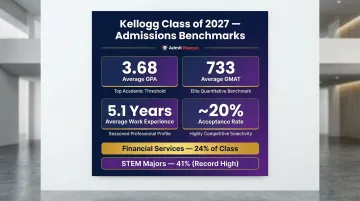
Kellogg uses holistic review—academic readiness, professional trajectory, community contributions, and cultural fit all matter. The Class of 2027 profile shows competitive benchmarks: average GPA of 3.68, average GMAT of 733, and 5.1 years of work experience. Financial Services backgrounds jumped to 24% and STEM majors hit a record 41%, intensifying competition among these applicant pools.
Kellogg specifically evaluates "fit"—whether you would thrive in its student-led, team-oriented culture and contribute meaningfully to it. Fit is genuinely hard to fake, which is why conversations with current students and alumni matter: they reveal the specific clubs, class formats, and cultural norms that shape your "why Kellogg" story. Admit Beacon's live webinars connect applicants directly with students from top programs, including Kellogg, to gather exactly that kind of first-hand detail.
Kellogg MBA Essay 1: Career Goals and Why Kellogg (450 words)
The Prompt
"Intentionality is a key aspect of what makes our graduates successful Kellogg leaders. Help us understand your journey by articulating your motivations for pursuing an MBA, the specific goals you aim to achieve, and why you believe now is the right moment. Moreover, share why you feel Kellogg is best suited to serve as a catalyst for your career aspirations and what you will contribute to our community of lifelong learners during your time here."
What This Essay Really Tests
This essay evaluates the logical chain connecting past experience → identified skill gap → MBA timing → Kellogg as the specific solution.
The essay rewards candidates who explain why this moment in their career is the right inflection point for an MBA. "Now" matters because it shows you've thought strategically about when an MBA delivers maximum value.
Practical Structure for 450 Words
Paragraph 1 (100-120 words): Career trajectory and gap
- Briefly trace your professional path
- Identify the specific skill gap or limitation you've encountered
- Show how this gap emerged from real experience, not abstract ambition
Paragraph 2 (100-120 words): Short- and long-term goals
- State your immediate post-MBA goal (specific role, industry, function)
- Articulate your long-term vision (5-10 years out)
- Connect these goals logically to your identified gap
Paragraph 3 (120-140 words): Why Kellogg specifically
- Name specific courses, clinics, experiential programs, clubs, and events
- Explain how each connects to your goals
- Demonstrate you've done genuine research beyond the website
Paragraph 4 (80-100 words): What you will contribute
- Frame contribution as a natural extension of your background
- Show how your experience creates value for peers
- Make it reciprocal, not just about what you'll receive
Making "Why Kellogg" Hyper-Specific
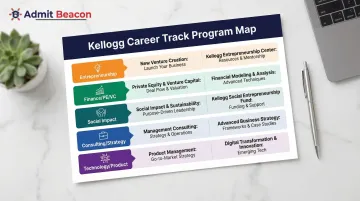
Generic references to "collaborative culture" or "diverse cohort" could describe any top-10 MBA program. Instead, ground your essay in the specific programs, courses, and communities that connect directly to your goals:
| Career Interest | Specific Kellogg Programs |
|---|---|
| Entrepreneurship | Kellogg Innovation & Entrepreneurship Initiative (KIEI), Zell Fellows Program, New Venture Discovery (ENTR 462) |
| Finance / PE / VC | Heizer Center for Private Equity & Venture Capital, Asset Management Practicum (FINC 456-458), Venture Lab (FINC 615) |
| Social Impact | Golub Capital Board Fellows Program, Social Innovation: Designing for Change (SSIM 452) |
| Consulting / Strategy | Growth Strategy Practicum (STRT 615), Analytical Consulting Lab (MECN 615) |
| Technology / Product | NUvention courses, Center for Research in Technology & Innovation (CRTI) |
Name specific student clubs:
- Consulting Club (Kellogg's largest student-run club)
- Kellogg Tech Club (KTech)
- Private Equity Club
- Social Impact Club at Kellogg (SICK)
- Healthcare Club
The most effective way to gather authentic, specific details is speaking with current Kellogg students or alumni. Admit Beacon's live webinars connect applicants directly with current students and alumni — a practical way to build this school-specific layer before you write.
Framing Your Contribution
Don't just list clubs you plan to join. The strongest contributions follow a clear logic: what you've done professionally shapes what you bring into the classroom, which in turn creates specific value for your peers.
Example: "Having led product launches in emerging markets, I would bring firsthand insights into scaling strategies in resource-constrained environments—perspectives that would enrich discussions in Growth Strategy Practicum and support classmates pursuing international expansion."
Kellogg MBA Essay 2: Leadership, Difficult Decisions, and Values (450 words)
The Prompt
"Kellogg leaders are primed to tackle challenges everywhere, from the boardroom to their neighborhoods. Describe a specific professional experience where you had to make a difficult decision. Reflecting on this experience, identify the values that guided your decision-making process and how it impacted your leadership style."
What This Essay Really Tests
The admissions committee wants to see:
- Moral clarity and self-awareness
- Values and reasoning behind decisions (not just outcomes)
- A leadership philosophy that evolved from real experience
The "difficult" element is essential. If the decision had an obvious answer, it doesn't satisfy the prompt. Kellogg's admissions team emphasizes that "today's changing business landscape demands leaders who possess a blend of analytical, creative and social intelligence and who can uplift teams to their full potential."
Choosing the Right Story
Your experience must:
- Be professional (not personal)
- Involve genuine tension or competing priorities
- Allow for honest reflection on how values shaped the choice
Warning: Don't choose examples where you:
- Simply executed a directive from leadership
- Faced a logistical challenge rather than an ethical or interpersonal one
- Had an obvious "right" answer
Recommended Structure
Use STAR (Situation, Task, Action, Result) as a framework, but emphasize reflection:
| Section | Word Budget | What to Cover |
|---|---|---|
| Situation | 60–80 words | Context and competing priorities |
| Task | 40–60 words | The decision you faced and why it was genuinely hard |
| Action | 120–140 words | Values that guided your choice and how you navigated the tension |
| Result | 80–100 words | Outcome with emphasis on leadership impact |
| Reflection | 100–120 words | How this experience shapes how you lead today |
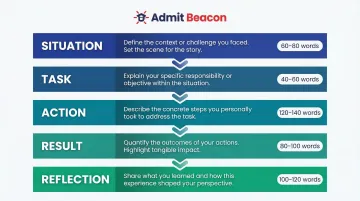
The structure matters less than what the final third delivers. The closing reflection should not simply restate the outcome—it should show how this experience changed you as a leader. Kellogg values leaders shaped by difficulty, not just those who cleared it.
Name Your Values Explicitly
That reflective depth connects directly to how you name your values. Don't leave them implied—the admissions committee should finish the essay knowing exactly what you stand for and why. That specificity is what separates a good leadership story from a genuinely memorable one.
Weak: "I had to balance team morale with business objectives." Strong: "I prioritized transparency and collective ownership over short-term efficiency, believing that sustainable performance requires teams who understand the 'why' behind difficult decisions."
Kellogg Video Essays: Showing the Person Behind the Application
The Format
Three questions, approximately one minute per response, completed within 96 hours of submitting the written application. You have 20 seconds to prepare and 60 seconds to speak for each question, with zero opportunity for re-dos on official questions (though practice questions are available).
The questions are designed to reveal personality, communication style, and authenticity—elements that written essays cannot fully convey. According to Kellogg's official guidance, video essays "bring to life the person we have learned about on paper."
Preparation Strategy
Do:
- Use practice questions extensively to get comfortable with timing
- Speak naturally and conversationally while staying clear and focused
- Show genuine personality—the adcom wants to see someone classmates would want to work with
Don't:
- Over-rehearse to the point of sounding scripted
- Try to deliver a polished performance instead of authentic responses
- Treat video essays as separate from your overall application narrative
Strategic Role in Your Application
How you prepare directly shapes what the admissions committee sees. Video essays give the adcom a chance to assess how you carry yourself, how you communicate under mild pressure, and whether you're someone peers would want in the room. The applicants who perform well treat them as a natural continuation of their written narrative—same story, different medium.
Other Application Components to Know
Re-applicant Essay (250 words)
Prompt: "How have you grown or changed personally and professionally since you previously applied and what steps have you taken to become the strongest candidate you can be?"
This is not the place to restate your original application. Focus on concrete, demonstrable changes made since the last application cycle:
- New responsibilities or promotions
- Retaking the GMAT or GRE
- Expanded community involvement
- Skill development through courses or certifications
Use a direct, non-defensive tone: acknowledge what you've changed, briefly contextualize it, and move on.
Additional Information / Optional Essay (280 words)
Kellogg's additional information section is intended for explaining application weaknesses, not for adding a third essay or more accomplishments. Use it only if there is something genuinely unclear or concerning:
- GPA dip due to extenuating circumstances
- Employment gap
- Non-traditional recommender choice
- Academic inconsistency
Keep it factual and brief — one to three sentences per issue is enough. Adcoms are looking for context, not justification.
Kellogg's Generative AI Policy
This policy applies across all essays above, so it's worth knowing before you start drafting.
Per ClearAdmit's essay analysis and Kellogg's Academic Policies Manual, the school's GenAI rules are specific:
- AI tools are permitted as a "supplementary" resource
- Any AI use must be disclosed at the end of the essay (tool name and URL)
- Failure to disclose is a violation of academic honesty policies
AI can help with structure and editing. Heavy reliance on it, though, tends to produce essays that read like everyone else's — which defeats the purpose of a prompt designed to surface who you actually are.
Common Mistakes to Avoid in Kellogg Essays
Mistake 1: Writing a Career Narrative That Reads Like a Resume
Kellogg's essays are not looking for a chronological recap of your accomplishments. They want reasoning, reflection, and evidence of intentionality. Every story should answer "why" at least as much as it answers "what."
Weak: "I joined Company X as an analyst, was promoted to associate, then senior associate, managing teams of 5-10 people." Strong: "After two years executing others' strategies, I recognized I lacked the frameworks to diagnose which problems were worth solving—a gap that became clear when my team spent six months building a product no customer wanted."
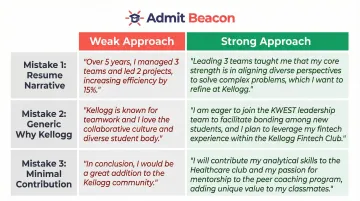
Mistake 2: Using Generic "Why Kellogg" Language
Phrases like "collaborative culture," "diverse cohort," or "strong alumni network" could describe any top-10 MBA program. Writers who rely on these phrases signal they haven't done genuine school research.
Specificity—named programs, professors, clubs, events, or conversations with current students—is what makes this section land. A single reference to a professor whose research aligns with your goals, or a club that directly addresses a gap in your background, will do more than three paragraphs of general praise.
Mistake 3: Treating the Contribution Component as an Afterthought
Many applicants spend the bulk of Essay 1 on goals and add two sentences at the end about clubs they'd join. Kellogg's community identity means the admissions committee takes the contribution section seriously—it should feel as thought-through as the goals themselves.
Show how your specific background creates value for peers. The difference between weak and strong looks like this:
Weak: "I'll join the Consulting Club and the Entrepreneurship Club." Strong: "Having navigated regulatory challenges in three emerging markets, I'd bring firsthand insights on government relations to classmates pursuing international consulting or policy careers."
The first tells the committee nothing. The second gives them a reason to want you in the room.
Frequently Asked Questions
What does Kellogg look for in MBA applicants?
Kellogg uses holistic review to evaluate academic readiness, leadership, community involvement, and a collaborative mindset suited to its student-led culture. The admissions committee prioritizes "high IQ, high EQ" candidates who demonstrate emotional intelligence alongside analytical rigor.
How do you write a Kellogg essay?
Lead with intentionality—show a logical connection between past experience, the need for an MBA now, specific Kellogg fit, and what you will contribute to the community. Use concrete examples, name specific programs and clubs, and demonstrate you've done genuine school research beyond the website.
How important are Kellogg video essays?
Video essays let the admissions committee assess personality, communication style, and cultural fit beyond what written essays convey. They show how you handle mild pressure and whether you're someone classmates would genuinely want to work with.
Does Kellogg still have video essays?
Yes, Kellogg continues to use video essays as of the 2025-2026 cycle. They are due 96 hours after the application deadline and consist of three questions with 20 seconds to prepare and up to 60 seconds to respond per question.
Is it hard to get into Kellogg's MBA?
Yes. Kellogg's acceptance rate is 28.6%, making it highly selective. Strong candidates bring not just impressive credentials but a clear articulation of fit and contribution to the school's community-focused culture.
What is the average GPA for Kellogg MBA?
The average undergraduate GPA for the Class of 2027 is 3.68. Kellogg evaluates GPA alongside work experience, leadership trajectory, and community contributions — a strong overall profile can offset a lower GPA.