Introduction
Every year, thousands of qualified applicants — strong GPAs, solid test scores, real professional accomplishments — receive rejections from top MBA programs. Most misread the problem: they optimize for metrics when committees are evaluating something harder to quantify.
The M7 schools collectively received 48,545 applications for the Class of 2026, pushing acceptance rates to 18.7% overall — Stanford's dropped to 6.8%. Strong numbers get you read. What separates admits from rejections is how clearly and compellingly an applicant constructs their narrative.
This guide breaks down exactly how the MBA application review process works: the criteria committees weigh, the stages your application moves through, and the strategic implications for how you build and present your candidacy.
Key Takeaways
- MBA review is multi-stage and holistic—not a checklist of scores
- AdComs evaluate professional trajectory, leadership, intellectual ability, and cultural fit
- Each review stage (screening, profile assessment, narrative review, interview) focuses on different signals
- Weakness in one dimension can be offset by exceptional strength in another, provided your application is built with that intent
- Understanding the review process gives you a strategic positioning edge
What Is MBA Application Review—And Why It Matters
MBA application review is the structured process by which admissions committees assess candidates across multiple dimensions to build a diverse, high-potential cohort—not simply select the highest scorers. This distinction matters because most applicants focus exclusively on hitting score thresholds without understanding the holistic judgment layer that determines most outcomes, especially at M7 and top-15 programs.
The process is neither purely objective nor entirely subjective. Reviewers use scoring rubrics but also exercise qualitative judgment—which is why identical credentials can produce different outcomes at different schools or in different rounds.
Both schools are explicit about this. Stanford GSB states that "no single component—whether your academic performance, essays, test scores, letters of recommendation, work experience, or interview—determines your admission decision." Chicago Booth similarly evaluates candidates through "a holistic process that incorporates every component of the application."
That has real implications for how you apply:
- Maxing out one metric won't compensate for gaps elsewhere
- A well-positioned application story can move a borderline profile to an admit
The Core Criteria: What Admissions Committees Evaluate in Every Application
While each school has its own rubric, virtually all top programs assess candidates across four overlapping dimensions. Strong applications don't excel in just one — they build a coherent case across all four.
Professional Trajectory and Goals
AdComs look for evidence of consistent upward progression, quantifiable impact, and a clear, believable logic connecting past experience to the MBA and to post-MBA goals. Vague goals or an implausible career pivot are common reasons for rejection even among strong candidates.
What matters more than employer brand:
- Ownership and initiative in your role
- Specific, quantified outcomes you drove
- Depth of responsibility relative to your experience level
- Logical progression toward your stated goals
Kellogg's admissions team explicitly warns against telling the committee what you think they want to hear: "When the goal you give us doesn't really fit with where you've been or where you want to go, it can make it hard to understand your path and how the MBA will help you."
Applicants in flat organizations or non-traditional roles can compete by articulating ownership and specific outcomes. Quality of growth matters more than employer brand.
Leadership and Influence
Leadership does not require a management title. AdComs are evaluating moments where you mobilized others, drove outcomes, or elevated a team—including through informal roles, community initiatives, or cross-functional influence.
The key distinction AdComs make:
- Management = task coordination, getting the team to execute
- Leadership = behavior change and inspiration in others, creating non-incremental impact
Harvard Business School professors define management as "getting the confused, misguided, unmotivated, and misdirected to accomplish a common purpose," whereas leadership is "the creation of positive, non-incremental change... and the empowerment of people to make the vision happen."
Example contrast:
- Management: "Coordinated a team of five analysts to complete quarterly financial reports on time"
- Leadership: "Recognized team morale was declining due to repetitive tasks; redesigned the workflow to automate data entry, freeing analysts to focus on strategic analysis—resulting in 40% faster report completion and three team members receiving promotions within six months"
Stanford GSB emphasizes that "you do not need to hold a specific role nor reach a certain level or title to show leadership. We look for examples of when you have taken initiative, persisted through challenges, engaged others in your efforts, and supported those around you."
Intellectual Aptitude and Academic Readiness
Top programs evaluate intellectual aptitude through GMAT/GRE scores, undergraduate GPA, and course rigor. Quantitative performance carries disproportionate weight, reflecting the analytical demands of the core curriculum.
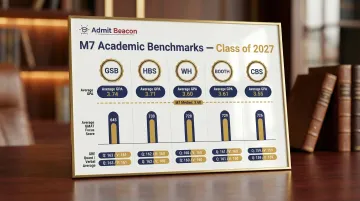
M7 Class of 2027 Academic Benchmarks:
| School | Average GPA | GMAT Focus (Avg) | GRE Quant/Verbal (Avg) |
|---|---|---|---|
| Stanford GSB | 3.76 | 689 | 164/164 |
| Harvard | 3.76 | 685 (median) | 164/164 (median) |
| Wharton | 3.70 | 676 | 163/162 |
| Chicago Booth | 3.60 | 670 | 163/161 |
| Columbia | 3.60 | 690 | 163/163 |
Applicants with below-average scores or GPAs can address this directly:
- Supplemental quant coursework: Wharton advises that "calculus and/or statistics are good foundation courses" to demonstrate quantitative readiness
- Alternative transcripts: HBS Online CORe is widely recognized as proof of business fundamentals capability
- Optional essay: Use it to provide objective context for academic inconsistencies
AdComs respond positively to demonstrated initiative. A well-chosen supplemental course paired with a candid optional essay does more to close the gap than a stronger GMAT retake alone.
Interpersonal Skills and School Fit
The "fit" dimension has become increasingly formalized through video essays, group interviews, and team-based discussions. AdComs are evaluating whether you'll add to the cohort — contributing to discussions, supporting peers, and engaging the community rather than simply performing well individually.
Fit is school-specific:
- HBS: Bold, case-cracking leadership at scale
- Stanford GSB: Authentic self-reflection and transformative ambition
- MIT Sloan: Innovation mindset and analytical problem-solving
- Kellogg: High-impact, low-ego collaboration
Applicants who apply the same narrative to every school often fail this dimension. Wharton's 35-minute Team-Based Discussion and Kellogg's 96-hour Kira video essays test interpersonal skills in real-time, unscripted formats that reveal authentic communication style and emotional intelligence.
How the MBA Application Review Works—Stage by Stage
Understanding what happens after you hit "submit" allows you to anticipate what scrutiny each component will face and construct your application accordingly.
Stage 1—Initial Screening: The Quantitative Filter
Most programs run an initial pass that checks for threshold eligibility: GMAT/GRE scores, GPA, and work experience minimums. Applications that fall well below program averages may be deprioritized before reaching full review.
What this means practically:
- Being at or above median on quantitative metrics earns a "full read"
- It does not guarantee a favorable outcome—it's only the entry ticket
- Falling significantly below median (e.g., 3.0 GPA, 650 GMAT) increases the burden on your narrative to prove academic readiness
The GRE is no longer stigmatized—44% of admits at both Harvard and Stanford submitted GRE scores. Take whichever test yields your highest relative percentile.
Stage 2—Holistic Profile Review: Career Story and Leadership Evidence
Once you clear the quantitative filter, your full application moves to a primary reader—typically an admissions officer—who evaluates your resume, work history, and career arc. They're building a mental picture of who you are professionally and whether your trajectory is credible.
Common failure at this stage:
Strong titles but generic descriptions of responsibilities, rather than specific, quantified achievements that reveal judgment and impact.
What reviewers look for:
- Clear upward progression in responsibility and complexity
- Evidence of initiative beyond your job description
- Quantified outcomes that show what changed because of your work
- Logical connection between your career path and MBA goals
Wharton evaluates work experience "not in terms of years, but the depth and breadth of an individual's position, his or her contributions to the work environment, and level of responsibility." The average across M7 programs is 5 years, but quality matters more than quantity.
Stage 3—Narrative Review: Essays, Recommendations, and Storytelling Coherence
For candidates who clear the profile review, this is the most differentiating stage. The AdCom is assessing whether your essays, recommendations, and optional materials tell a single, consistent story—one where your past explains your present and your present makes your goals inevitable.
Red flags reviewers identify:
- Inconsistencies between resume and essays
- Vague future goals that don't connect logically to past experience
- Recommender letters that sound templated or misaligned with your self-narrative
- Essays that describe what happened rather than what was learned
What strong narrative review looks like:
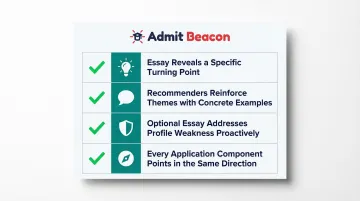
- Essays reveal a specific turning point that shaped your leadership approach—not a list of accomplishments
- Recommenders reinforce the same themes with their own concrete examples, unprompted
- Your optional essay proactively addresses the one weak spot in your profile, with context and a credible response
- Every component points in the same direction
Stage 4—Interview and Final Committee Decision
The interview functions as a verification and deepening stage—not just a personality check. Reviewers test whether you can substantiate your written narrative in real-time conversation and demonstrate genuine self-awareness.
MIT Sloan requires candidates to submit a data visualization slide 24 hours before the interview to test analytical communication. HBS interviews are conducted by AdCom members who have already reviewed your application—they're testing for authenticity and depth.
Final committee decision:
Post-interview, the committee convenes. At Wharton, a committee of seven makes final decisions, often advocating for or questioning specific candidates. A strong interview can rescue a mediocre application; a weak one can sink a strong one.
Typical Round 1 timeline:
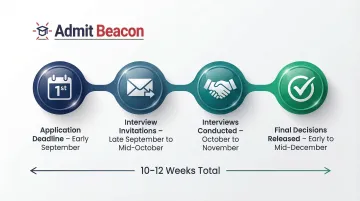
- Application deadline: Early September
- Interview invitations: Late September to mid-October
- Final decisions: Early to mid-December
The process takes roughly 10-12 weeks from submission to decision.
MBA Application Review in Action: A Sample Candidate Walkthrough
Let's examine how the review process plays out for a composite candidate:
Profile:
- Mid-level healthcare consultant at a Big 4 firm
- 3.4 GPA from a state university, Biology major
- 720 GMAT (Legacy format)
- 5 years of work experience
- Goal: Healthcare consulting focused on digital transformation
- Leadership examples: Led client workshops, mentored junior analysts, organized firm-wide volunteer initiative
Stage 1: Initial Screening
Strengths: GMAT of 720 clears the threshold (above the 25th percentile at most M7 programs). Five years of experience aligns with M7 averages.
Potential concerns: 3.4 GPA sits below the M7 median of ~3.68. Biology major provides some quantitative foundation, but AdCom will look for evidence of business/analytical coursework or professional quantitative work.
Outcome: Application advances to full review. The GMAT score provides enough academic signal to earn a complete read.
Stage 2: Holistic Profile Review
Strengths on resume:
- Clear progression from analyst to senior consultant
- Quantifiable client impact: "Led digital transformation project for regional health system, resulting in 30% reduction in patient wait times and $2M annual cost savings"
- Cross-functional leadership: "Coordinated 12-person team across IT, operations, and clinical staff"
Potential weaknesses:
- Leadership examples are functional but not inspirational—they describe coordination more than influence
- No evidence of leadership outside of work
- Career progression is solid but predictable for a Big 4 consultant
What the reviewer notes: Strong professional foundation with clear impact. Leadership is competent but lacks a distinctive angle. Will need to see depth and self-awareness in essays to differentiate.
Stage 3: Narrative Review
Scenario A—Generic Application:
Essays describe the healthcare projects worked on and list skills gained. Goals essay states: "I want to pursue an MBA to develop strategic and leadership skills to advance in healthcare consulting and eventually become a partner." Recommenders provide templated praise about being "hardworking" and "detail-oriented" without specific behavioral examples.
AdCom assessment: Capable consultant, but narrative lacks depth. Goals are vague and don't require an MBA specifically. No clear differentiation from dozens of other healthcare consultants in the pool. Leadership examples are managerial, not transformational.
Likely outcome: Waitlist or rejection. The profile is solid but not compelling.
Scenario B—Strategic Application:
Essays connect a specific personal turning point—caring for a grandmother navigating a fragmented healthcare system—to both past leadership behavior (why the candidate advocates for patient-centered solutions in client work) and future goals (building technology solutions that improve patient experience at scale).
The optional essay proactively addresses the 3.4 GPA: working 20 hours/week to fund education affected study time, and quantitative readiness is demonstrated through two completed online statistics courses (with grades) and strong performance on quantitative client deliverables.
Recommenders provide specific behavioral examples: "When our client team was divided on implementation approach, [candidate] didn't just coordinate—she facilitated a session where she helped clinical staff articulate their concerns in business terms that IT could address, ultimately building consensus that led to successful rollout."
AdCom assessment: Authentic, specific narrative that connects personal motivation to professional trajectory. Clear evidence of leadership through influence, not just coordination. Proactive mitigation of GPA concern demonstrates self-awareness and initiative. Goals are specific and believable given background.
Likely outcome: Interview invitation. The narrative transforms a solid profile into a compelling candidacy.
The Difference
Both scenarios start from the same credentials. The difference is narrative construction—how deliberately the candidate connects their personal history, professional behavior, and future direction into a coherent arc. AdComs reading hundreds of applications aren't just evaluating what you've done; they're evaluating whether you understand why it matters and where it leads. Generic descriptions bury that signal. A well-constructed narrative surfaces it.
Stage 1: Initial Screening
Stage 2: Holistic Profile Review
Stage 3: Narrative Review
How Admit Beacon Can Help You Navigate the Review Process
Admit Beacon operates as a strategic application partner—not a document editor—helping applicants understand how AdComs will read their specific profile, identify gaps and narrative opportunities in their candidacy, and build each application component with the evaluation criteria in mind.
The limited client intake model means each applicant works directly with lead consultant Niketa on resume positioning, school selection, career narrative, essay storyboarding, and one mock interview. Niketa dedicates approximately 40% of total application effort through direct offline review and feedback, providing the depth that high-volume consulting firms cannot match.
School-Specific Insight Across the Top 25 Programs
Admit Beacon's memberships in AIGAC, AIIEC, and TOC—combined with a network of current students and alumni across HBS, Stanford GSB, Wharton, MIT Sloan, and other top programs—means clients learn how different schools actually evaluate the same credentials.
The firm's knowledge base covers the top 25 MBA programs, with detailed guidance on each school's evaluation priorities and cultural fit criteria. You get school-specific strategy, not recycled advice.
Building a Narrative, Not Just Editing Essays
Rather than editing essays, Admit Beacon helps you discover and construct the coherent narrative that connects your past experiences, current role, and future goals. The essay storyboarding process typically requires at least four iterations before your application reaches the clarity and specificity AdComs respond to.
Niketa delivers feedback through Google Docs comments, recorded videos, voice notes, and Zoom calls—enabling deeper strategic conversations about narrative choices, not just grammatical corrections.
Applying Directly to How You'll Be Evaluated
Admit Beacon's process is structured around the criteria AdComs actually use to evaluate candidates. That means:
- Reframing professional responsibilities into quantified achievements and leadership evidence
- Proactively addressing academic gaps before reviewers flag them
- Aligning your narrative authentically with each school's culture and values
- Positioning your career goals as credible, not aspirational

Most Admit Beacon clients don't have a perfect profile—no 780 GMAT, no brand-name undergrad, no linear career path. The firm specializes in helping engineers, entrepreneurs, nonprofit leaders, and first-generation applicants turn those unconventional backgrounds into a genuine competitive edge.
Frequently Asked Questions
Is 3.3 a good GPA for MBA?
A 3.3 GPA is below the median at most M7 programs (which average ~3.68) but is not disqualifying. AdComs look at GPA alongside course rigor, major, and institution reputation. A strong GMAT/GRE score and proactive supplemental coursework can offset a lower GPA—schools respond positively to demonstrated initiative in closing the academic gap.
What do MBA admissions committees look for most?
While criteria vary by school, AdComs prioritize a compelling career trajectory with clear goals, genuine leadership evidence, and authentic program fit. Raw test scores open the door, but qualitative dimensions determine the outcome. Thousands of applicants at or above median statistics are rejected every cycle because these elements fall short.
How long does the MBA application review process take?
Review timelines vary by round and school, but most programs release decisions 6-8 weeks after a round deadline. Interview invitations typically come 3-4 weeks after submission. For Round 1 applications submitted in early September, expect interview invitations in late September to mid-October and final decisions in early to mid-December.
Can strong work experience make up for a low GMAT score?
Work experience is a qualitative factor; GMAT serves as a quantitative signal of academic readiness. Strong experience enriches your profile but cannot substitute for a score significantly below a program's threshold. Programs need proof you can handle rigorous quant coursework, so pair a low GMAT with strong undergraduate quant grades or an alternative transcript.
How important are essays compared to test scores in the MBA review?
Test scores function as a threshold filter; essays are often the most differentiating element among equally-credentialed candidates. For applicants who clear the quantitative bar, essay quality and narrative coherence determine outcomes. With M7 acceptance rates ranging from 6.8% to 28.7%, a generic narrative rarely survives the cut.
Do all top MBA programs evaluate applications the same way?
All top programs use holistic review, but weight criteria differently based on school culture. HBS emphasizes leadership at scale, Stanford GSB places premium on authentic personal reflection, MIT Sloan prioritizes innovation and analytical thinking, and Kellogg values high-impact, low-ego collaboration. Applying the same narrative to every school often fails the fit dimension—tailor your story to each program's unique values.