Introduction
Structuring a business management essay trips up even capable writers — undergrads, working professionals, and MBA applicants alike. Knowing an essay needs an introduction, body, and conclusion is easy. Building one where the argument holds, the evidence lands, and each section earns its place is harder.
This guide walks through the complete structure: what each section should accomplish, how to prepare before you write a single sentence, and where most essays lose points — so yours doesn't.
Key Takeaways
- A strong business management essay needs a clear thesis, evidence-backed body paragraphs, and a conclusion that ties the argument together
- Start with a position — essays written without one tend to describe rather than analyze
- Introduction, body, and conclusion each serve a distinct role; treat them as interdependent, not interchangeable
- Weak essays over-describe; strong essays prioritize critical thinking over fact-listing
- Good structure isn't enough on its own — tone, source quality, and logical flow matter just as much
What Is a Business Management Essay?
A business management essay is a formal piece of academic or professional writing that argues a position on a management topic — leadership, organizational behavior, strategy, or ethics — using evidence and reasoned analysis. The goal is to test your ability to think critically and build a persuasive case, not simply summarize what others have said.
Essays vs. Reports: Know the Difference
One of the most common mistakes students make is confusing essays with business reports. If your assignment asks for an essay but you submit something that looks like a report, you risk losing marks. Here's the key distinction:
| Feature | Business Management Essay | Business Report |
|---|---|---|
| Purpose | Argumentative and idea-based; analyzes concepts and theories | Informative and fact-based; examines real-world issues |
| Structure | Continuous prose without section headings or table of contents | Formally structured with numbered headings and table of contents |
| Visual Elements | Rarely includes tables, charts, or diagrams | Frequently uses bullet points, graphs, and data visualizations |
| Conclusion | Offers reasoned conclusions about a thesis | Ends with actionable recommendations or solutions |
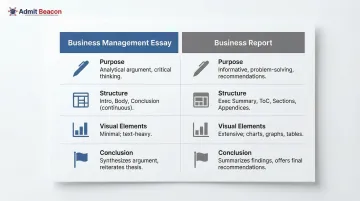
Essays are argument-driven and analytical rather than descriptive or prescriptive. This distinction matters because students often write essays that read more like reports — listing facts and summarizing theories without taking a critical stance.
Understanding what makes an essay distinct from a report also helps you recognize where each format belongs.
Where These Essays Appear
Business management essays show up in three main contexts:
- Undergraduate and postgraduate coursework — Assess how well you apply management theories and engage critically with the literature
- MBA admissions applications — Give admissions committees a window into your character, values, and leadership potential beyond what a resume shows
- Professional development programs — Demonstrate mastery of management concepts in executive education settings
Each context carries different expectations for tone, depth, and structure.
The Standard Structure of a Business Management Essay
Most business management essays follow the same three-part structure: introduction, body, and conclusion. What separates a good grade from a great one is how well you execute each part. University writing centers recommend the 10/80/10 rule: allocate approximately 10% of your word count to the introduction, 80% to the body, and 10% to the conclusion.
Introduction
The introduction should open with brief context on the topic, clearly state the essay's thesis or argument, and outline how the essay will be structured. The thesis should be specific and defensible, not a broad statement of fact.
Length guidelines:
- In a 2,000-word essay: 150–200 words
- In a 3,000-word essay: 250–300 words
Common mistakes to avoid:
- Introductions that are too long or give away the conclusion prematurely
- Starting with dictionary definitions or overly broad generalizations
- Failing to present a clear, arguable thesis
Pro tip: Many expert sources recommend writing the introduction last, after the body is complete, to ensure it accurately reflects your final argument.
Body Paragraphs
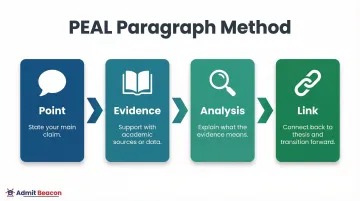
Body paragraphs should each carry one main argument or point, opened with a clear topic sentence. Strong paragraphs follow the Point–Evidence–Analysis structure:
- Point — State your main claim in your own words
- Evidence — Provide supporting evidence (academic literature, data, case examples)
- Analysis — Explain what the evidence means in the context of your argument
- Link — Connect back to your thesis and transition to the next point
The Description vs. Analysis Balance
Essays that score lower tend to summarize theories and examples without pushing further. Higher-scoring work uses description sparingly and devotes the bulk of the word count to critical analysis. According to the University of Reading, descriptive writing merely states the "who," "what," and "where," while analytical writing evaluates the "why," "how," and "so what."
Self-check questions:
- Am I just summarizing what others have said, or am I critically engaging with the material?
- Have I explained why this evidence matters to my argument?
- Does each paragraph advance my thesis, or am I just listing facts?
Signposting for Flow
Strong signposting keeps readers oriented as your argument builds. Practical techniques include:
- Opening each paragraph with a topic sentence that signals what's coming
- Using pivot phrases ("This suggests," "In contrast," "Building on this") to link ideas
- Closing paragraphs with a sentence that connects back to your thesis
Harvard College Writing Center recommends starting sentences with "old information" before introducing "new information" to help readers see connections.
Conclusion
The conclusion should synthesize the essay's key arguments (not merely repeat them), state your final position in response to the question, and note limitations or avenues for further inquiry.
What not to do:
- Introduce new evidence or arguments
- Simply restate your introduction word-for-word
- End with vague statements like "This shows why leadership is important"
The best conclusions leave the reader with something to carry forward — a specific implication, an unresolved tension in the research, or a practical consequence of your argument.
Before You Begin: Planning and Research
Deciding on argument structure and paragraph budget before you write prevents structural drift and keeps you within word count — two of the most common causes of lost marks in business management essays.
Calculate Your Paragraph Budget
Work backward from your total word count. For example, in a 3,000-word essay:
- Introduction: 300 words
- Conclusion: 300 words
- Body: 2,400 words
If you write paragraphs of approximately 300 words each, you can fit 8 body paragraphs. This means you need to identify 8 distinct arguments or points that support your thesis. The University of Newcastle recommends using a "box plan" to divide your body allocation by the number of arguments you want to make.
Paragraph length guidelines:
- Minimum 150 words to ensure sufficient analytical depth
- Maximum 400 words to prevent burying your key point in excessive detail
Research and Source Selection
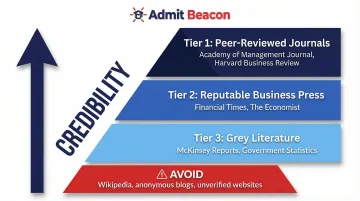
Strong essays rely on high-quality evidence. Here's the source hierarchy:
Tier 1: Peer-Reviewed Academic Journals
- Highest credibility for academic arguments — vetted by independent field experts
- Vetted by field experts for accuracy and objectivity
- Examples: Academy of Management Journal, Harvard Business Review (academic articles), Journal of Management Studies
Tier 2: Reputable Business Press
- Excellent for current market trends and real-world context
- Must be evaluated for bias and corroborated with academic sources
- Examples: Financial Times, The Economist, Wall Street Journal
Tier 3: Grey Literature
- Government reports, think tank publications, industry white papers
- Useful for data and policy context
- Examples: McKinsey reports, World Bank publications, government statistics
Avoid:
- Generic web sources without clear authorship or institutional backing
- AI-generated content that may contain fabrications or "hallucinations"
- Over-reliance on news articles as your primary evidence
Forming an Argument Before Writing
Arrive at a clear position or thesis before drafting. The research phase exists to map the full landscape of arguments before you commit to a specific line of reasoning — not to confirm a position you've already decided on.
Research process:
- Read broadly to understand different perspectives
- Identify patterns, contradictions, and gaps in the literature
- Form a preliminary position
- Test it against the evidence
- Refine your thesis before you start writing
Skipping this sequence typically produces descriptive essays that catalogue research rather than argue a position — and those essays rarely score well.
Key Elements That Elevate a Business Management Essay
Two essays can follow the same structure but produce very different results. The difference lies in execution across several key dimensions.
A Strong, Specific Thesis
The thesis statement is the central claim of your essay and serves as a roadmap for the reader. According to Harvard College Writing Center, a strong thesis must be arguable (a thoughtful reader could disagree), focused (narrow enough to be proven), and analytical (interpreting facts rather than just stating them).
Contrasting examples:
Weak (Descriptive): "Leadership is important in organizational success."
- This is a statement of fact that no one would dispute
- It's too broad to be proven in a single essay
- It doesn't signal an analytical position
Strong (Analytical): "While transformational leadership drives innovation in stable markets, transactional leadership proves more effective during organizational crises when employees require clear direction and immediate accountability."
- This is arguable — someone could disagree and provide counter-evidence
- It's specific enough to be proven within an essay's scope
- It takes an analytical stance that requires evidence to support
Source Quality and Citation Rigor
Graders and admissions readers assess not just what you argue but what evidence you use to support it. Strong essays use a mix of foundational academic works and current research.
Integration tips:
- Cite sources naturally within your argument flow
- Don't let citations disrupt readability
- Use a variety of sources (not just one or two repeatedly)
- Ensure every major claim is backed by credible evidence
Tone and Academic Register
For Academic Coursework: Business management essays require formal, precise language. Avoid casual phrasing, unsupported opinions, and overly technical jargon that obscures meaning. The focus is entirely on evidence-first analysis.
For MBA Admissions Essays: The tone shifts dramatically. Top programs like Harvard, Wharton, and Stanford look for authentic narratives that reflect strategic self-awareness and leadership potential — not generic statements.
Stanford GSB explicitly states: "In each essay, we want to hear your genuine voice... There is no 'right answer' to these questions — the best answer is the one that is truest for you."
For applicants working on MBA admissions essays, balancing authenticity with strategic positioning is the central challenge. Admit Beacon works with applicants to build narratives that are personalized, school-specific, and strategically positioned rather than formulaic.
Admit Beacon helps applicants connect their thinking to what admissions committees actually want to see by:
- Linking past experiences directly to MBA goals and post-MBA direction
- Building authentic stories grounded in specific moments, not broad claims
- Tailoring each narrative to align with each school's ethos
- Surfacing overlooked experiences that carry real strategic value

Common Mistakes to Avoid
Writing a Descriptive Essay Instead of an Analytical One
Descriptive writing is the most common structural failure in business management essays. Summarizing what theorists said is not analysis — connecting their ideas to your argument is.
How to fix it:
- For every piece of evidence, ask "So what?" and "Why does this matter?"
- Spend more words on analysis than on description
- Use frameworks like PEEL to ensure every paragraph includes critical evaluation
Poor Paragraph Discipline
Two extremes to avoid:
- Paragraphs so short they fragment the argument — reading more like a bulleted report than coherent reasoning
- Paragraphs so long the main point gets buried before the reader finds it
Rule of thumb: Body paragraphs should be 150–400 words, with most falling in the 200–300 word range.
Misaligning Content with the Question
Going off-topic — or treating a broad question as permission to discuss anything loosely related — will cost you marks. Every paragraph needs to earn its place.
Prevention strategy:
- Before submitting, check every paragraph against the essay question
- Ask: "Does this paragraph directly answer what was asked?"
- Cut any content that doesn't serve your specific thesis
Frequently Asked Questions
What is a business essay?
A business essay is a formal, argument-driven piece of writing that explores a specific management, strategy, or organizational topic using evidence and critical analysis — distinct from a business report in that it centers on defending a position rather than describing facts or making recommendations.
What are the 5 main types of essay?
The five main essay types used in business management contexts are argumentative, analytical, expository, descriptive, and persuasive — with argumentative and analytical most frequently assigned in business school, since both require evaluating theories and applying them to real organizational situations.
What are the 7 principles of business writing?
The seven principles are clarity, conciseness, correctness, completeness, coherence, consideration (audience awareness), and concreteness. These apply equally to academic essays and professional writing.
How long should a business management essay be?
Length varies by assignment. Undergraduate essays typically run 1,500–3,000 words, postgraduate essays 2,500–5,000 words, and MBA admissions essays 500–1,000 words. Universities enforce word limits closely — exceeding them can result in grade penalties.
What makes a good business management essay introduction?
A strong introduction provides brief context, presents a specific and arguable thesis, and signals the essay's structure — while remaining concise (typically 8–10% of the total word count). Avoid broad generalizations, dictionary definitions, or giving away your conclusion prematurely.
How do you write a strong thesis statement for a business essay?
A strong thesis makes a specific, arguable claim in response to the essay question, avoids vague language, and signals your analytical position. For example, argue that a particular management approach is effective under specific conditions rather than simply stating that leadership is important.