Introduction
Your MBA resume is the first document an admissions officer reads—before your essays, before your recommendations. It anchors everything that follows.
Unlike a job application resume, an MBA resume is an admissions document. It's designed to show leadership, impact, and trajectory—not just responsibilities. Most applicants already have a polished professional resume, but the gap between a solid career document and a compelling MBA resume is larger than it looks.
This guide covers:
- How an MBA resume differs from a standard professional resume
- Which sections to include and how to structure them
- How to write bullets that impress admissions committees
- What expert reviewers actually look for
- The most common mistakes that hurt otherwise strong candidates
Key Takeaways
- An MBA resume targets admissions officers, not recruiters—it must show leadership, impact, and trajectory
- One page is standard; aim for approximately 600 words using clean, conventional formatting
- Every bullet should demonstrate results or accomplishments, not duties
- Use numbers when you have them; when you don't, describe the qualitative win specifically
- Avoid industry jargon—write for a smart generalist
Why Your MBA Resume Is Different from a Job Application Resume
Admissions officers aren't evaluating you as a hire—they're assessing your potential as a classmate, future alumni, and campus contributor. This fundamentally changes what the document must do. Harvard Business School received 9,409 applications for the Class of 2027, and your resume is the first filter in that massive pool.
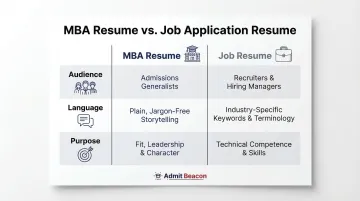
Unlike a job resume laser-focused on technical skills and deliverables, an MBA resume must present the whole person — professional experience, leadership, extracurricular involvement, and personal character — all within one page. The differences go beyond scope:
- Audience: Admissions committees read applications from consultants, engineers, military officers, and nonprofit leaders simultaneously, so your resume must be clear to a general reader
- Language: Industry jargon creates friction; Chicago Booth explicitly advises applicants to "avoid jargon and acronyms that people outside of your industry would not be aware of"
- Purpose: The resume signals fit with a school's community, not just competence in a role
That last point carries real weight at schools like Dartmouth Tuck, where the admissions team notes that "your resume is the only document your Tuck interviewer will see prior to interviewing you." In other words, your resume doesn't just filter you in — it sets the entire frame for your interview.
What to Include: The Essential Sections of a Strong MBA Resume
Contact Information
Your header should include your full name, professional email, phone number, LinkedIn URL, and city/state — condensed to one or two lines. Leave out objective statements, full street addresses, and "References available upon request."
Education
List degrees in reverse chronological order. For each, include the institution, degree, and graduation year. Beyond the basics, add:
- Academic honors (Dean's List, scholarships, awards)
- Extracurricular involvement (athletics, club leadership, academic competitions)
Admissions committees use this section to understand who you were before your career — and to predict how you'll contribute on campus. Drop high school information entirely.
Professional Experience
This is the largest section. Organize roles in reverse chronological order, beginning each bullet with a strong action verb. Focus on results, not duties—what changed because of your work, not just what you were responsible for.
Highlight:
- Promotions and expanded responsibilities
- Larger team sizes or budgets managed
- Cross-functional scope showing strategic thinking
- Months and years for all roles so the timeline is transparent
Extracurricular Activities and Leadership
Your professional record tells one story. This section tells another — how you show up beyond your job title. Feature community leadership, board positions, volunteer roles, and nonprofit work. Admissions committees weight this section heavily because it signals how you'll contribute outside the classroom. If your extracurricular record is thin, keep this section brief rather than padding it with passive memberships.
Personal or Interests Section
This small section should be used strategically. Generic activities like running marathons or watching sports aren't differentiating. Instead, include unusual hobbies, unique experiences, or personal passions that make for genuine conversation starters in interviews—competitive chess, documentary filmmaking, or restoring vintage motorcycles work better than "traveling and reading."
How to Write Bullets That Impress Admissions Committees
Lead with Strong Action Verbs
Upgrade weak verbs to specific ones. "Wrote report" is far less compelling than "developed 50-page competitive analysis presented to the C-suite."
Weak bullet: "Responsible for managing a team and improving processes"
Strong bullet: "Led cross-functional team of eight to redesign product fulfillment process, reducing delivery time by 35% and saving $120,000 annually"
Structure for Results
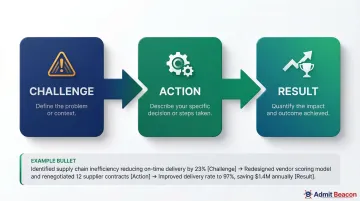
Each bullet should move from context to action to outcome — not just what you did, but the specific decision you made and what changed as a result. A bullet that reads "managed budget cuts" tells the admissions committee nothing; "renegotiated vendor contracts during a 20% budget reduction, maintaining full project scope and delivering on schedule" tells a story.
Use frameworks like CAR (Challenge-Action-Result) or STAR (Situation-Task-Action-Result) to organize your thinking. Yale SOM recommends the SAR framework, explicitly connecting past achievements to skills required for target roles.
Quantify Achievements
Include revenue figures, percentage improvements, cost savings, team sizes, customer impact, or rankings. Wharton instructs applicants to "quantify the outcomes or impacts of key projects with metrics: team size, increased revenue, costs saved, valuations, project timelines and budgets, returns on investments, deals closed."
When exact numbers are confidential:
- Use ranges ("$500,000–$1,000,000")
- Express as percentages ("increased revenue by 40%")
- Reference scale indirectly ("managed budget equivalent to mid-sized department")
Demonstrate Non-Quantifiable Results
For roles where quantifiable results don't exist—support roles, early-career positions, nonprofit work—demonstrate impact through:
- Leadership recognition or selective awards
- Qualitative feedback from supervisors or stakeholders
- Process changes adopted organization-wide
- Selection for high-visibility projects or stretch assignments
Test for Clarity
Ask: "Would someone outside my industry understand this and find it impressive?" Eliminate jargon, internal acronyms, and company-specific terminology that outside readers won't recognize. A study of 125,000 resumes found that only 26% included five or more measurable metrics — a persistent missed opportunity.
A quick clarity check before you finalize:
- Can someone outside your company follow every bullet without Googling?
- Does each bullet answer "so what?" within the line itself?
- Have you replaced internal project names with plain descriptions of the work?
Key Factors That Separate Good MBA Resumes from Great Ones
Leadership Narrative Across All Phases
Admissions committees want evidence that leadership is a pattern, not a one-time event. Your resume should show leadership in college, in the workplace, and in the community. Informal moments count too:
- Mentoring a new hire through onboarding
- Leading a volunteer project in your community
- Organizing a cross-functional team initiative
Tuck evaluates resumes for transferable skills, looking for how you approached a task or problem to prove that strong performance can be replicated in the MBA program. Wharton looks for "growth, progression of responsibilities, accomplishments, and proof of analytical skills, communication skills, teamwork, collaboration, leadership, and impact."
Career Trajectory and Upward Momentum
Great resumes show a clear arc of increasing responsibility. For career switchers or non-traditional profiles (entrepreneurs, military veterans, government professionals, family business operators), frame horizontal moves as strategic growth and translate impact into business terms.
If you're from a boutique firm or less-known organization, Wharton and Yale SOM explicitly instruct applicants to provide a brief one- to two-sentence company description so admissions officers can contextualize your achievements.
Alignment with Your Overall Narrative
The MBA resume should preview the stories that will appear in essays and interviews. Think of it as a table of contents: every bullet should connect to a theme you'll develop in your essays and interviews.
This is where structure matters most. Admit Beacon's approach centers on aligning the resume with your career narrative, school selection, and essay storyboarding — so every part of the application tells the same story.
School-Specific Tailoring
While the format stays consistent, the emphasis within the resume can be adjusted to reflect program values. A school that prizes innovation and global perspective should see those themes surface in the resume's bullets and sections. Programs have distinct culturesKnowing these nuances lets you position your experience where it will land hardest.
Common MBA Resume Mistakes That Can Hurt Your Application
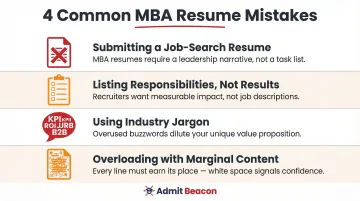
Submitting a Lightly Edited Job-Search Resume
This is the most common and most damaging mistake. A resume that works for a recruiter often fails with an admissions committee because the audience and objectives are fundamentally different. Recruiters scan for technical keywords; admissions officers evaluate leadership potential and transferable skills.
Listing Responsibilities Instead of Results
Bullet points that describe daily duties give admissions committees no evidence of effectiveness. The reader is left asking "but did it work?" One results-driven bullet — with a number or outcome attached — beats five responsibility-driven ones.
Using Industry Jargon
Dense technical language wastes the reader's limited attention and signals poor communication skills. Columbia Business School notes that heavy reliance on acronyms or internal terminology obscures your impact — and raises doubts about whether you're ready for the MBA classroom.
Overloading with Marginal Content
Including marginal content dilutes your strongest accomplishments. Common offenders include:
- Irrelevant certifications or routine software skills
- Minor awards with no context or impact
- Outdated roles listed in full when a single line would suffice
A B+ achievement placed beside an A+ one weakens the overall impression. Every line should earn its place.
Frequently Asked Questions
How long should my MBA resume be?
One page is the standard. MIT Sloan, Wharton, and Tuck all enforce strict one-page limits, and roughly 600 words is a useful gauge. Two pages are only justifiable for candidates with 10+ years of highly varied experience at schools that permit it, such as Yale SOM.
What does a good MBA resume look like?
A clean, one-page document in a conventional format with clearly labeled sections: contact info, education, professional experience, and extracurriculars. Use consistent formatting and bullet points that lead with action verbs and demonstrate measurable impact. Avoid graphics, colors, or creative layouts.
What makes a strong MBA candidate on a resume?
Strong candidates show a clear trajectory of increasing responsibility, demonstrate leadership across multiple contexts (professional, academic, community), and quantify their impact. Admissions committees look for evidence of someone who drives results and contributes to their environment.
Are paid MBA resume reviews worth it?
The most valuable reviews go beyond grammar and formatting to address strategic narrative — whether your resume aligns with your overall application story and reads clearly to committees at your target schools. The AIGAC 2019 Applicant Survey found that skilled advisors increase applicant self-awareness and sharpen communication, both of which show up directly on the page.
Should I include extracurricular activities on my MBA resume?
Yes. Extracurriculars are essential because admissions committees use them to gauge campus involvement and community contribution. Prioritize leadership roles and sustained commitments over a long list of passive memberships. If your post-college community involvement is limited, focus on quality over quantity.
How is an MBA resume different from a regular resume?
An MBA resume targets admissions officers rather than recruiters, covers the whole person rather than just technical skills, and is written for a generalist audience that may not know your industry. The goal is to connect professional impact with leadership potential and personal character — something a standard job application never needs to do.