Introduction
MBA applicants often spend weeks perfecting bullet points and formatting, yet the most common feedback from top admissions committees is that the resume "doesn't tell us who you are." This disconnect has a simple explanation: most resumes list experience rather than communicate a story.
Resume storytelling carries extra weight in MBA admissions because committees evaluate career trajectory, leadership potential, and fit — not just job titles. Harvard Business School reads applications holistically, considering all elements together to understand the candidate.
When your resume lacks narrative coherence, even impressive credentials look scattered.
This article explains why narrative matters in MBA resumes and how to build a story-driven resume that works for programs like HBS, Stanford GSB, and Wharton.
Key Takeaways
- Resume storytelling frames your career as a coherent arc with direction, not just a list of roles
- MBA adcoms spend 6 to 7.4 seconds on initial resume scans—narrative creates instant clarity
- Strong resume stories transform non-linear career paths from liabilities into evidence of strategic thinking
- Resume narrative anchors your essays, recommendations, and interview answers into one cohesive case
- Without clear narrative, even impressive credentials fail to convince admissions readers
What Is Resume Storytelling?
Resume storytelling is the intentional structuring of your career experience—roles, accomplishments, transitions—so they collectively communicate a clear professional identity, direction, and purpose.
In the MBA context, storytelling applies to the overall arc visible across your entire resume, from your earliest role to your most recent, and implicitly toward the MBA and beyond. Every role, pivot, and promotion should contribute to a coherent through-line—not just stand alone as a polished data point.
The goal is to make it immediately clear to an adcom reader why you've made the choices you have, what you've built, and where you're headed. According to GMAC's application guidance, admissions reviewers often turn to the resume first—and what they're assessing is whether the candidate has a clear sense of direction. That clarity doesn't come from bullet points alone. It comes from how the whole arc holds together.
Key Advantages of Resume Storytelling in MBA Admissions
MBA admissions isn't a hiring process. Adcoms evaluate leadership potential, future impact, and school fit—not just credentials to fill a role. The advantages below tie directly to those evaluative criteria.
Advantage 1: Converts a List of Jobs into a Legible Career Arc
Most MBA applicants have strong credentials, but credentials alone don't answer the question adcoms ask first: "Does this person know where they're going?" A narrative resume connects roles into a progression, making intent and growth visible.
How this works in practice:
Each role is framed not just by what you did, but by what problem you solved, what you learned, and how it prepared you for the next step. This creates a thread the reader can follow forward.
Why this matters:
- Adcoms review hundreds of applications from similarly credentialed candidates. A clear career arc makes a resume memorable and immediately distinguishes it from a credentials-dump
- Recruiters spend just 7.4 seconds on initial resume screens, making a readable arc essential for fast comprehension
- A candidate whose career arc clearly points toward needing an MBA—and then toward a specific post-MBA goal—is more compelling than one whose resume raises the question "why now?"
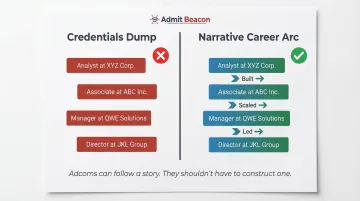
Candidates with diverse roles across industries or functions, or those making significant pivots, benefit most. The narrative thread makes diversity look purposeful rather than unfocused.
Advantage 2: Reframes Non-Linear or Unconventional Paths as Strategic
A significant portion of MBA applicants—entrepreneurs, career changers, professionals from non-traditional industries, or those who've moved across geographies—have resumes that look "scattered" without a narrative frame.
How storytelling reframes this:
Rather than presenting three different industries as inconsistency, a narrative lens finds the common thread (e.g., building in ambiguity, scaling teams, customer obsession) and makes diversity read as breadth of experience rather than indecision.
Why this matters:
- Adcoms actively seek candidates with unique perspectives and non-traditional paths—but only if those paths are legible. Stanford GSB explicitly values diverse professional backgrounds and is "more interested in the impact you have had in your workplace than in the name or stature of the organization"
- Narrative reduces perceived risk for the adcom: a candidate who can clearly articulate how past choices connect demonstrates self-awareness—a quality MBA programs expect
- 65% of Stanford GSB graduates changed work function post-MBA, indicating that admissions committees welcome candidates using the MBA for strategic pivots
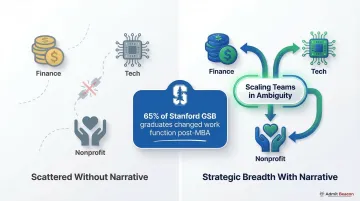
This advantage is most impactful for candidates with industry or function transitions, entrepreneurial stints, international career moves, or gaps that need explaining.
Advantage 3: Sets the Foundation for Your Entire MBA Application Narrative
In MBA applications, the resume doesn't stand alone. It's read alongside essays, recommendations, and interview performance. The career narrative your resume establishes is the throughline everything else must align with.
How this works:
When your resume communicates a clear story about leadership style and trajectory, essays can deepen it rather than repeat it—and recommenders can reinforce what you've already established. Misalignment across these elements is one of the most common reasons strong candidates get rejected.
Why this matters:
- A narrative-coherent application is significantly easier for the adcom to advocate for in committee—the reader who loved your resume can articulate your story clearly to colleagues who haven't seen it
- Former INSEAD Director of Admissions Caroline Diarte Edwards warns, "If your application doesn't hang together or contribute to the same story, that will raise a red flag"
- Schools like Stanford GSB look for "what matters to you and why"—a resume story that answers that question before the essays even begin gives you a structural advantage
This is critical for all applicants, but especially those applying to schools with holistic evaluation processes (HBS, Stanford, Wharton) where adcoms explicitly discuss how well the application "hangs together."
What Happens When Your MBA Resume Lacks a Narrative
The most common consequence: a technically strong resume reads as a job description document rather than a candidacy. Adcoms see a list of accomplishments but cannot answer essential questions—why this person, why now, why MBA, why this school.
The absence of narrative forces the adcom to do work that should have been yours. Under time pressure—with approximately 9.98 applications per seat at HBS and 16.73 applications per seat at Stanford GSB—adcoms often conclude you lack self-awareness or clarity of purpose. In a pool that competitive, that conclusion ends your candidacy.
The downstream effect compounds across your entire application:
- Essays become harder to write without a clear through-line to anchor them
- Recommender alignment weakens when even you haven't defined your story
- Interview performance suffers because you can't confidently own what you haven't articulated
How to Build Your Resume Story for MBA Applications
Start before writing a single bullet: map your career decisions. Why did you take each role? What were you trying to learn or build? What were the outcomes? The story lives in the space between roles — the decisions, pivots, and throughlines that connect them.
Structure that works for MBA resume bullets:
Lead with the outcome or scale, include the context (what problem existed), and make the action specific enough to signal how you think. This follows the Crisis → Action → Outcome framework used by professional resume writers, adapted for adcom readers evaluating leadership and impact.
Wharton explicitly expects resumes to demonstrate "growth, progression of responsibilities, accomplishments, and proof of analytical skills, communication skills, teamwork, collaboration, leadership, and impact." Your bullets must quantify outcomes: team size, increased revenue, costs saved, project timelines, returns on investments.
Use proven frameworks:
- STAR (Situation, Task, Action, Result): Best for complex bullets where context matters — sets the scene before showing what you did and what changed
- CAR (Context, Action, Result): Tighter than STAR; works well when the situation is self-evident and you want to move faster to impact
- PAR (Problem, Action, Result): Recommended by HBS Alumni Career Services — leads with the problem, which forces you to frame your role as a solution rather than a task list
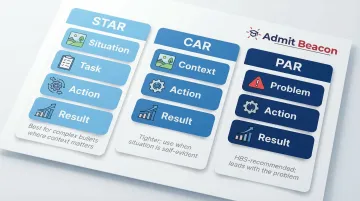
These frameworks are easy to understand and genuinely hard to apply to your own experience. Most candidates are too close to their own stories to see what's missing — or what's been undersold. A structured review with someone who understands school-specific expectations can surface the narratives you've stopped noticing.
At Admit Beacon, Niketa works with each candidate on resume and career narrative as a single integrated process — not as separate deliverables. Roughly 40% of total application effort goes into resume, school selection, career narrative, and essay storyboarding together, so the story that emerges reflects both who you are and what each school is actually looking for.
Conclusion
In MBA admissions, credentials are the floor—narrative is what gets you above it. A resume that tells a coherent, purposeful story about your career gives adcoms the language to understand and advocate for your candidacy.
The advantages of resume storytelling compound across the application: a strong narrative resume makes better essays, stronger interview answers, and more cohesive recommendations possible. With competition at nearly 10 applications per seat at HBS and nearly 17 per seat at Stanford GSB, differentiation through narrative clarity isn't optional.
Those numbers make one thing clear: narrative isn't a finishing touch you apply at the end. It's the strategic thread you build from the start — through honest reflection on your trajectory, deliberate framing of your choices, and a genuine understanding of where you're headed and why that direction matters to the schools you're targeting.
Frequently Asked Questions
What frameworks (e.g., the 5 C's, 5 P's, 3 C's) can I use to create a storytelling resume?
The most practical frameworks for MBA resumes are STAR (Situation, Task, Action, Result), CAR (Context, Action, Result), and PAR (Problem, Action, Result) — each designed to ensure every bullet captures what problem existed, what you specifically did, and what measurably changed as a result.
What is an example of a narrative for a resume?
A candidate moving from engineering to product management to a startup can frame their career as "building and scaling products in ambiguous environments." This through-line turns apparent randomness into strategic intent, showing consistent focus on creating customer value despite changing contexts and industries.
What are the 4 types of resumes?
The four main resume formats are chronological (reverse-order work history), functional (skills-focused), combination/hybrid (chronological with skill groupings), and targeted (customized for specific roles). For MBA applications, a targeted chronological format that supports a clear career arc is most effective for adcom readers.
What are the top resume mistakes to avoid?
Wharton warns that bullet points "should not read like a basic job description." The most damaging mistakes are listing responsibilities instead of impact, using buzzwords without evidence, and presenting a career history that contradicts your essay narrative.
What is a red flag on a resume?
Key red flags adcoms notice include unexplained gaps, a pattern of very short tenures without context, accomplishments that are vague or unverifiable, and a career history showing no clear progression in responsibility or impact. All signal a lack of the self-awareness MBA programs expect.