Introduction
MBA admissions at top-tier programs has reached unprecedented levels of competition. Stanford GSB admits just 6.8% of applicants, Harvard Business School sits at 11.2%, and Wharton accepts 20.5%. While the M7 schools saw a 22% application surge for the Class of 2026, the difference between admitted and rejected applicants is rarely credentials alone—it's strategy.
Admissions committees at schools like HBS and Stanford GSB explicitly state there is no typical student profile they're seeking. What separates successful applicants is how they build a differentiated narrative, research schools with genuine depth, and apply with focus rather than volume.
The three tips below break down exactly how to do that.
Key Takeaways
- Build a cohesive narrative connecting your past experiences, motivations, and goals
- Research specific professors, clubs, and cultural nuances at each school to prove genuine fit
- Apply to 6–8 strategically chosen programs with tailored, school-specific applications
- Demonstrate what you'll contribute to the MBA community, not just what you'll gain
Tip 1: Build a Career Narrative That Stands Out
What a Career Narrative Actually Means
In MBA admissions, your career narrative is the cohesive thread linking your past professional experiences, current motivations, and post-MBA goals. Admissions committees read thousands of stellar resumes every cycle—what differentiates candidates is the story behind the credentials, not the credentials themselves. As the Association of International Graduate Admissions Consultants notes, applicants with a clearly defined sense of purpose stand out, and the strongest candidates aren't necessarily those with the highest test scores.
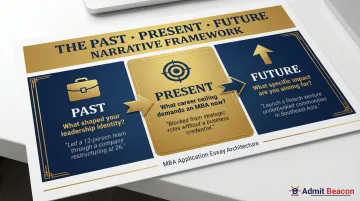
The Past-Present-Future Framework
Structure your narrative around three dimensions:
- Past: What experiences shaped your leadership skills and professional identity?
- Present: What problem or career ceiling are you hitting that demands an MBA now?
- Future: What specific impact or role are you aiming for post-MBA?
Weak example: "I want to transition from engineering to product management because I've always been interested in business."
Strong example: "After leading three product launches as a senior engineer, I realized the technical solutions I built had limited impact because they weren't aligned with customer needs or market strategy. An MBA will give me the frameworks to bridge technical execution with strategic positioning, enabling me to lead product teams at the intersection of technology and business."
The stronger version works because it's specific, shows cause and effect, and makes a clear case for why the MBA is necessary at this point in the career.
Two Fatal Narrative Mistakes
Generic goals like "I want to become a better leader" or "I want to make an impact" tell admissions committees nothing. Every applicant wants to lead. What specific leadership challenge are you solving? What kind of impact, in what industry, for which stakeholders?
The second mistake is reciting accomplishments without connecting them to a larger trajectory. That makes your application read like a resume, not a story. Admissions officers want to understand the why behind your choices, not just the what.
Consistency Across All Components
Avoiding these mistakes is only half the work — the narrative also has to hold together across every component. Admissions committees cross-reference your resume, essays, recommendations, and interview responses. A narrative that shifts between components—or contradicts itself—raises red flags. If your essays emphasize a passion for social impact but your recommenders describe you as purely profit-driven, the inconsistency undermines your credibility.
Every piece of your application should reinforce the same core story. That means aligning your resume framing, essay themes, and recommender talking points before you write a single draft.
What You'll Contribute, Not Just Gain
MBA programs are communities, and admissions committees evaluate whether your presence will enrich them. Your narrative should demonstrate:
- What perspectives or experiences you'll bring to classroom discussions
- How you'll contribute to clubs, student-led initiatives, or peer learning
- What unique value you add beyond your professional function
Schools like HBS explicitly seek candidates who will contribute to building a class of 900+ students with diverse experiences and perspectives. Your narrative must show you understand this reciprocal relationship.
Tip 2: Research Schools at a Level That Shows Genuine Fit
Beyond Generic Praise
There's a massive difference between surface-level research and deep institutional knowledge. Saying "HBS uses the case method" or "Wharton has a strong finance program" is generic and forgettable. Admissions readers can instantly spot when applicants recycle vague praise found on school websites.
Generic research: "Wharton's collaborative culture and analytical rigor will help me develop strategic skills."
Deep research: "I'm drawn to Wharton's Mack Institute for Innovation Management, particularly Professor Kartik Hosanagar's research on AI-driven consumer behavior. His course on Digital Marketing and E-Commerce aligns directly with my goal to lead product strategy in fintech, and I plan to contribute to the Wharton Fintech Club's annual conference by bringing my experience building payment infrastructure at scale."
That second example works because it names a professor, references his research area, identifies a relevant course, and connects it to a concrete club contribution — all in service of a specific career goal.
How to Research Effectively
Go beyond the admissions website:
- Attend virtual or in-person campus events to experience the culture firsthand
- Connect with current students and alumni on LinkedIn or through informational interviews
- Listen to school-specific podcasts or read student-run publications to understand program culture
- Review course catalogs and professor research to identify specific academic offerings that serve your goals
Many business schools track demonstrated interest through CRM software, monitoring email opens, website visits, and event attendance. While highly selective programs like HBS and Stanford GSB don't factor this into decisions due to naturally high yield rates, for mid-tier programs, demonstrated engagement can tip borderline decisions.
Doing this research well takes time — which is why Admit Beacon's Knowledge Base covers the top 25 MBA programs, and our live webinars connect clients directly with current students and alumni who share what the admissions website won't tell you.
Translating Research Into Essays
Your "Why this school?" essays should demonstrate that your choice is deliberate and informed, not prestige-driven. Admissions committees want to see:
- How specific programs, courses, or professors align with your unique goals
- Why this school's approach to business education fits your learning style
- What you'll contribute to the community based on your research
Avoid name-dropping programs without explaining why they matter to you. Instead, show you understand how those resources accelerate your specific trajectory.
Interview Performance
The same research that sharpens your essays will carry you through interviews. Candidates who've spoken with current students and alumni walk in with concrete, specific answers that stand out from applicants relying solely on marketing materials.
When an interviewer asks "Why Kellogg?" you can reference real conversations with students, specific club initiatives you'd join, and professors whose work connects directly to your goals.
Tip 3: Apply Strategically — Prioritize Quality Over School Volume
The Counterintuitive Truth
Applying to 10–12 schools with generic, lightly adapted applications typically yields worse results than applying to 6–8 schools with deeply tailored, program-specific ones. Admissions consultants generally recommend applying to four to eight MBA programs — enough to build a balanced portfolio without spreading yourself too thin.
Strong applications require serious time investment. Preparing four to eight applications typically takes 40–60 hours, and one fully prepared applicant applying to just three schools logged an estimated 154 hours across introspection, career goals, school research, and essays. Quality can't survive volume.
Building a Strategic School List
A balanced list includes:
- Reach (2–3 schools): Your profile sits below the median, but you have a compelling narrative that differentiates you
- Target (3–4 schools): Your credentials align closely with the median admitted profile
- Likely (1–2 schools): You exceed the typical admitted stats — your safety net
Evaluate fit using:
- Class profile data (GMAT/GRE, GPA, work experience)
- Post-MBA employment outcomes by sector and geography
- Alumni network strength in your target industry
- Program culture and teaching methodology

Don't choose schools purely by ranking. A top-10 program with weak alumni presence in your target industry may serve you less effectively than a top-20 program with concentrated placement in your field.
Round Timing Strategy
Each round carries different tradeoffs:
- Round 1 offers the most seat and scholarship availability — MIT Sloan confirms more open spots early in the cycle. That said, a rushed R1 application beats a polished R2 application by nothing.
- Round 2 works well if you need time to improve your GMAT, earn a promotion, or do deeper school research. Most applicants apply here, and acceptance rates stay competitive.
- Round 3 is highly restrictive. Wharton notes that space becomes more limited by R3. Only apply this round if your profile has genuinely strengthened since R2.
Time Investment Reality
Strong applications demand significant effort per school:
- Resume refinement: 5–8 hours
- School research: 10–15 hours
- Essay drafting and editing: 20–30 hours
- Recommender briefings: 3–5 hours
- Interview preparation: 10–15 hours
Eight schools means 384–584 hours of total work. Start building your timeline early — late starters almost always cut corners on the essays that matter most.
At Admit Beacon, each essay goes through at least four rounds of editing as part of a structured, iterative process. That level of revision takes time, which is exactly why we work with a limited number of clients per cycle.
What MBA Admissions Committees Actually Look For
Core Evaluation Dimensions
Admissions committees evaluate candidates across five core dimensions:
- Academic ability: GMAT/GRE and GPA demonstrate you can handle rigorous coursework
- Professional impact and trajectory: Evidence of increasing responsibility, measurable results, and leadership growth
- Leadership potential: Capacity to influence, motivate, and drive change
- Community contribution: What you'll add to classroom discussions, clubs, and peer learning
- Clarity of purpose: A coherent rationale for why you need an MBA now and how it serves your goals
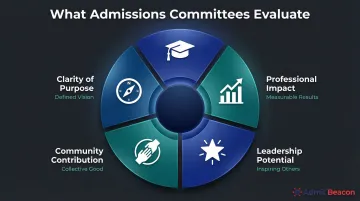
These dimensions aren't equally weighted at every school. Stanford GSB evaluates how you think, how you lead, and how you see the world. Wharton frames it as classroom, community, and career contributions — a notably different lens than HBS, which emphasizes business-mindedness, leadership focus, and capacity for growth.
Research each program's stated priorities and tailor your application accordingly.
The Role of Recommenders
Tailoring your story extends to who tells it on your behalf. Two strong, specific recommendations carry significant weight. Many top schools use the GMAC Common Letter of Recommendation, which includes a leadership assessment grid rating applicants across 12 traits and requires peer comparison ("top 5% of professionals I've worked with").
Choose recommenders who:
- Have directly supervised your work for at least 6-12 months
- Can provide concrete, quantified examples of your impact
- Understand your MBA goals and can connect your past performance to future potential
Brief them thoroughly on your narrative. Providing recommenders with a detailed briefing document — covering your goals, key stories, and the traits you want highlighted — ensures their letter reinforces rather than contradicts your application narrative. This is one of the most overlooked steps in the process.
Building a Class, Not Seeking Perfection
Admissions committees aren't looking for the "perfect candidate" — they're building a diverse class. HBS promises to create a class of 900+ students who bring as many different experiences and perspectives as possible. Stanford GSB emphasizes that rich diversity of backgrounds and perspectives enables students to tackle society's most pressing challenges.
In practice, this means the following all factor into decisions:
- Industry and functional background
- Geography and cultural perspective
- Career trajectory and post-MBA goals
- Life experiences outside of work
Understanding this helps you lean into what makes you genuinely different, rather than trying to mimic the "average HBS admit."
Frequently Asked Questions
What are the 3 C's for a job application?
In MBA applications, the three C's are Clarity (of purpose and goals), Coherence (a consistent narrative across all materials), and Connection (demonstrated fit with the school's culture and community).
What are the 5 C's of hiring?
The 5 C's — Competency, Character, Communication, Culture fit, and Commitment — come from corporate hiring, but MBA admissions committees apply the same lens. Expect committees to probe your leadership evidence, values alignment, and commitment to your stated goals.
Why is Gen Z struggling to find jobs?
Youth unemployment hit 10.8% in Summer 2025, driven by market saturation, credential inflation, and AI taking over junior analytical roles. An MBA from a top program helps accelerate career transitions and build the kind of professional network that opens doors otherwise closed.
How many MBA programs should I apply to?
Most admissions consultants recommend a list of 6-8 schools, balanced across reach, target, and likely programs. Quality and tailoring of applications matters far more than volume.
What is the single most important part of an MBA application?
While all components matter, most admissions committees emphasize essays as the most influential element because they reveal your narrative, self-awareness, and fit in ways that a resume and GMAT score cannot.