Introduction
For most top MBA programs, the personal statement is the only place in the application where admissions committees hear your voice directly. GMAT scores, transcripts, and recommendation letters tell them what you've accomplished—but they don't reveal who you are, how you think, or why you belong in their cohort.
Harvard Business School received 9,409 applications for the Class of 2027, and admissions officers routinely read 30-40 essays daily. A compelling opening and authentic voice are your best assets for earning the full read.
That competitive reality creates a clear problem: you've done impressive things professionally, but translating that into a narrative that's compelling and authentic—without just rehashing your resume—is harder than it looks.
It's a challenge that trips up even strong candidates. Many talented professionals assume top programs are reserved for perfect test scores or conventional career paths, and they quietly self-select out before applying.
What follows breaks down exactly how to write one that works — the structure, the writing principles, school-specific tailoring, and a real annotated sample essay you can learn from directly.
Key Takeaways
- An MBA personal statement covers where you've been, where you're going, and why this school—typically in 400-600 words
- Voice matters more than polish: admissions readers want to meet a real person, not read a marketing brochure
- Generic "Why School X" sections are the most common reason strong essays fall flat
- Three non-negotiables: your professional background, your post-MBA goals, and your fit with the specific program
- A strong opening line earns the rest of the read
Why MBA Programs Require a Personal Statement
Yield Protection and Genuine Fit
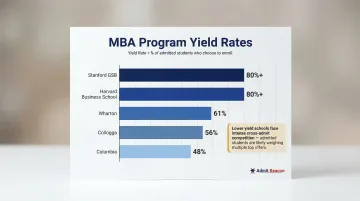
MBA admissions is about more than selecting strong candidates — schools are building a cohort that will actually enroll. They track yield rates closely, and the gaps are wide: Stanford GSB and Harvard Business School exceed 80%, while Wharton (61%), Kellogg (56%), and Columbia (48%) face intense cross-admit competition.
The personal statement is their primary tool for gauging genuine commitment and fit.
Programs with lower yield rates scrutinize "Why this school" sections more intensely. Generic essays signal low enrollment intent — and that alone can mean rejection for otherwise qualified applicants. The personal statement is where committees determine whether you've genuinely researched their program or just applied to fill out a list.
What the Personal Statement Is NOT
The personal statement is not:
- A second resume or chronological career summary
- A cover letter listing your qualifications
- An opportunity to explain away weaknesses (save that for optional essays)
Instead, it's a forward-looking narrative that frames your past and connects it to a credible future. Stanford GSB explicitly states that essays help them "learn about who you are rather than solely what you have done"—they want to understand how you think, how you lead, and how you see the world.
The Three-Part Framework Every MBA Personal Statement Needs
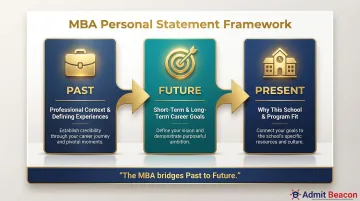
Nearly every successful MBA personal statement follows a Past-Present-Future framework, regardless of the specific prompt wording. This structure gives admissions readers the context (past), the destination (future), and the bridge — the MBA itself.
The Past: Establishing Professional Context
The "past" section doesn't need to be a career chronology. Instead, highlight 1-2 defining professional experiences that created the gap the MBA will fill. The goal is to establish credibility and identity, not list everything on your resume.
Be specific about:
- What you did and what you found meaningful or limiting about it
- A particular challenge, decision, or learning moment that shaped your thinking
- Why your current path, while valuable, isn't sufficient for your future goals
This is where your authentic voice begins to show. Instead of "I worked as a consultant for three years," try "Leading a cost-reduction project for a struggling manufacturer, I realized that financial analysis alone couldn't solve their core problem—they needed to fundamentally rethink their supply chain strategy."
The Future: Writing Credible Career Goals
Most top programs expect both short-term and long-term goals:
- Short-term goals demonstrate clarity and planning
- Long-term goals demonstrate ambition and vision
Wharton explicitly advises applicants to "be specific and direct" for immediate post-MBA goals but focus on "context" rather than "precision" for 3-5 year goals. The key test is plausibility — the path from where you are to where you want to be must be easy to follow.
What makes goals credible:
- Name specific industries, roles, or firm types where appropriate
- Connect goals authentically to your background and experiences
- Show how the MBA fills a genuine gap in your capabilities
Admissions committees have no preference for any particular industry or career path. Incoming classes represent diverse professional backgrounds: consulting (19-31%), finance (20-26%), technology (7-15%), and non-profit/government (4-10%) across top programs. What they evaluate is whether your goals are well-thought-out, specific, and genuinely connected to your background.
The Present: Connecting the MBA to Your Goals
This is where most applicants under-invest effort. The "why this school" component should be specific enough that swapping the school's name would break the paragraph entirely.
Vague praise like "great faculty" or "diverse cohort" signals you haven't done your homework.
Strong "why this school" sections reference:
- Specific courses by name and how they address your knowledge gaps
- Particular clubs, experiential programs, or learning models unique to that school
- Faculty research areas that align with your interests
- Student community elements you've discovered through genuine research
For example, instead of "I'm impressed by the collaborative culture," try "I'm drawn to Wharton's Learning Teams structure, where I can leverage my analytics background to support teammates while developing my own strategic communication skills through peer feedback."
Writing Tips That Make Your Personal Statement Stand Out
Voice: The Single Most Important Factor
Many admissions consultants consider "voice"—the quality that makes an essay feel like a real person wrote it—the single most important factor in personal statement success. Good voice is likable, authentic, reflective, and humble without being self-deprecating.
How to develop authentic voice:
- Write like you speak (then edit for clarity)
- Use first person actively: "I led" not "I was responsible for leading"
- Include moments of uncertainty or vulnerability—not as apologies, but as evidence of self-awareness
- Avoid business jargon and buzzwords that create distance
The Authenticity Principle
Voice and authenticity are two sides of the same coin. Writing what you think the committee wants to hear actively weakens essays — and admissions officers notice.
Successful essays often include a moment of failure, uncertainty, or vulnerability. Kellogg warns that "when the goal you give us doesn't really fit with where you've been or where you want to go, it can make it hard to understand your path". That doesn't mean oversharing or cataloging weaknesses. It means being honest about your journey, including the parts where you figured things out along the way.
Show, Don't Tell
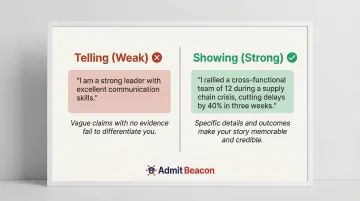
Instead of stating "I am a strong leader," describe the moment you led a cross-functional team through a difficult decision and what the outcome revealed about your leadership style.
Before (telling): "I am passionate about sustainability and have strong analytical skills."
After (showing): "When our manufacturing client resisted implementing the sustainability recommendations I'd spent three months developing, I realized that data alone doesn't drive change—people do. I spent the next two weeks on the factory floor, listening to line supervisors' concerns and redesigning our proposal to address their operational realities. The revised plan achieved 85% adoption within six months."
Quantify impact where possible: team size, revenue impact, timeline, percentage improvements.
The Opening Paragraph
The first sentence must earn the rest of the read. With admissions officers reviewing thousands of applications, a compelling lead is critical.
What makes a strong opening:
- A vivid scene that drops the reader into a specific moment
- An unexpected contrast or decision point
- A specific detail that establishes your professional identity
Avoid opening with:
- "I have always been passionate about business"
- "From a young age, I knew I wanted to be a leader"
- Generic statements that could apply to any applicant
Word Count Reality
Most programs set limits of 400–600 words for personal statements. Word limits vary by school and must be respected. A few practical rules:
- Write until your narrative feels complete, then trim until every sentence earns its place
- Never pad to hit a word count — tighter is almost always stronger
- Never exceed the stated limit. Going over tells the committee you can't prioritize — which is the opposite of the leadership story you're trying to tell.
How to Research and Tailor Your Essay to Each School
School-specific research is what separates a "good" personal statement from an accepted one. Generic essays are easily spotted, and submitting an essay with the wrong school name is a common and fatal mistake.
Actionable Research Methods
Before you write, invest time in:
- Attending school-hosted webinars and information sessions
- Sitting in on classes during campus visits
- Connecting with alumni or current students on LinkedIn
- Following school social media and reading student blogs
- Reviewing faculty research areas and course catalogs
School-specific language—course names, club names, faculty research areas, learning models—is the evidence the committee needs that you've genuinely engaged with their program.
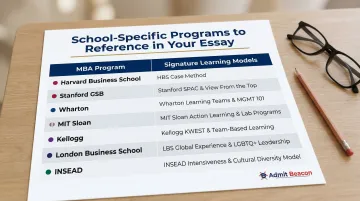
Program-Specific Resources to Reference
| School | Signature Programs & Learning Models |
|---|---|
| Harvard Business School | The Case Method (active debate) and FIELD Global Capstone |
| Stanford GSB | Global Management Immersion Experience (GMIX), Leadership Laboratory |
| Wharton | Learning Teams, Leadership Ventures, Executive Coaching Program |
| MIT Sloan | Action Learning Labs (applying "mens et manus" to real challenges) |
| Kellogg | Pathways curriculum, Venture Lab, Global Initiatives in Management |
| London Business School | Global Experience, Business Project, flexible program lengths |
| INSEAD | Personal Leadership Development Programme (PLDP), multi-campus exchange |
The Before/After Difference
Generic paragraph: "I was impressed by the warmth of the faculty and the collaborative student culture at Wharton. The school's strong reputation in finance and global reach make it the perfect place for me to achieve my career goals."
Specific paragraph: "Wharton's Learning Teams structure directly addresses a gap in my profile: while I've developed strong quantitative skills as a data scientist, I've had limited exposure to strategic decision-making under ambiguity. Working through case analyses with a diverse team of five peers will push me to articulate recommendations without perfect information—exactly the skill I'll need as a product manager. Additionally, Professor Kartik Hosanagar's research on algorithmic bias aligns perfectly with my interest in building ethical AI products, and I'm eager to explore these questions in his Digital Marketing and Analytics course."
That's the depth every "why us" paragraph needs: a named program feature, a clear personal reason it matters, and a direct link to your career goals.
If your own research hits a wall, Admit Beacon's network of current students and alumni across HBS, Stanford GSB, Wharton, MIT Sloan, Kellogg, LBS, and INSEAD can fill the gaps — the kind of candid, on-the-ground detail that's hard to find in any course catalog.
Sample MBA Personal Statement with Analysis
Note: The following is an illustrative personal statement for a technology professional (software engineer background) applying to a top MBA program. This sample demonstrates the framework and principles discussed above—not a template to copy. Each applicant's story must be their own.
Sample Essay (485 words):
Three years into building recommendation algorithms at a fintech startup, I realized I was optimizing for the wrong metric. Our model successfully increased user engagement by 23%, but customer satisfaction scores barely moved. The disconnect forced me to step back and ask a bigger question: what does "success" actually mean for our users, and how should we measure it?
That moment crystallized a pattern I'd noticed throughout my career as a software engineer. I'm drawn to the intersection of technical execution and strategic impact—not just building features, but understanding which problems are worth solving and why. At my current role at DataFlow, I led the development of a machine learning pipeline that reduced fraud detection latency from 48 hours to under 2 minutes, directly enabling $12M in previously blocked legitimate transactions. But the technical achievement mattered less to me than the strategic insight that preceded it: recognizing that our batch-processing architecture was fundamentally misaligned with our customers' need for real-time decisioning.
These experiences revealed a gap in my toolkit. I can build sophisticated systems, but I lack formal training in business strategy, financial analysis, and cross-functional leadership. I want to transition from engineering individual solutions to shaping product strategy and eventually leading a business unit at a technology company focused on financial inclusion.
*My immediate post-MBA goal is to join a product management team at a fintech company like Stripe or Square, where I can apply my technical background while developing skills in market analysis, customer discovery, and go-to-market strategy. Within 5-7 years, I aim to lead product strategy for a business unit.
My long-term aspiration is to launch a company addressing financial access gaps in emerging markets—a problem I witnessed firsthand growing up in rural India, where my family's small business struggled with limited banking infrastructure.*
Wharton's curriculum directly addresses my development needs. The core finance and accounting courses will give me the business fundamentals I currently lack, while Analytics and the Digital Economy will help me bridge my technical background with strategic business applications. I'm particularly drawn to Professor Kartik Hosanagar's research on algorithmic bias and platform design—questions that sit at the heart of building ethical, inclusive fintech products.
Beyond coursework, Wharton's Learning Teams structure will push me outside my comfort zone. As someone who's spent most of my career in engineering-heavy environments, I need practice navigating decisions where there's no data model to validate the answer. Working through cases with teammates from consulting, finance, and non-profit backgrounds will develop the cross-functional collaboration skills essential for product leadership.
I'm also eager to contribute to the Wharton Fintech Club and the Product Management Club, where I can share technical insights with classmates while learning from their go-to-market and customer development expertise. The Venture Initiation Program offers a structured way to test my long-term entrepreneurial aspirations with mentorship and resources I couldn't access on my own.
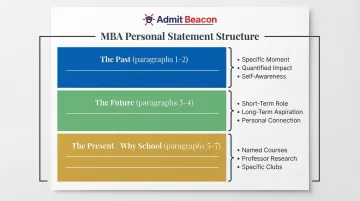
The three analyses below examine each section of the essay in turn — what the writer got right and the core principle it demonstrates.
Analysis: The Past Section
What this sample does well:
- Opens with a specific moment and concrete metric (23% engagement increase, flat satisfaction scores)
- Establishes professional identity (software engineer) and credibility (technical achievements with quantified impact: $12M in transactions, 48 hours to 2 minutes)
- Identifies a meaningful insight ("optimizing for the wrong metric") rather than just listing accomplishments
- Creates logical setup for why the MBA is needed: "revealed a gap in my toolkit"
The past section doesn't summarize the resume. It highlights defining experiences that created the need for an MBA — establishing technical credibility while showing self-awareness about limitations.
Analysis: The Future Section
What this sample does well:
- Balances clarity and ambition: short-term role (product management at Stripe/Square) is specific and plausible given the engineering background
- Long-term aspiration (business unit leadership, eventual entrepreneurship) is ambitious but traceable from the short-term path
- Connects goals authentically to personal background (growing up in rural India, family business experience)
- Names specific companies and roles, demonstrating research and clarity
Goals feel credible because they're grounded in the applicant's actual experiences and show logical progression. The personal connection to financial inclusion adds authenticity — this isn't a goal chosen because it sounds impressive.
Analysis: The Present Section
What this sample does well:
- Names specific courses (Analytics and the Digital Economy, core finance/accounting)
- References a professor's research area by name (Professor Kartik Hosanagar, algorithmic bias)
- Explains why Learning Teams matter for this specific applicant's development (limited cross-functional exposure)
- Mentions specific clubs and programs (Fintech Club, Product Management Club, Venture Initiation Program)
- Connects each program element back to the applicant's goals and gaps
This level of specificity makes the "why Wharton" argument credible and personal. You couldn't swap "Wharton" for another school name without breaking the paragraph — which is exactly the point.
Frequently Asked Questions
How long should an MBA personal statement be?
Most top programs set word limits between 400–600 words, though this varies by school. Harvard Business School now uses three 250–300 word prompts, while Stanford GSB allows 650 words for its primary essay. Respect the stated limit—exceeding it signals poor judgment and inability to prioritize.
Is a personal statement the same as an MBA essay?
Admissions offices often use the terms interchangeably, but "personal statement" typically refers to the goals/fit essay, while schools like HBS use distinct essay prompts that serve similar but slightly different functions.
Can I use the same personal statement for multiple MBA programs?
Your core narrative—the past and future sections—can remain consistent across applications, but the "why this school" section must be completely rewritten for each program. Submitting a generic "present" section is one of the most common and costly mistakes applicants make—admissions committees spot swapped school names immediately.
What should I avoid in my MBA personal statement?
The top pitfalls include repeating resume content without adding insight, using generic school praise, leading with cliché opening lines, over-explaining weaknesses, and writing in passive voice. Relying on generic phrases like "accelerate my career" and failing to answer all parts of a prompt are top reasons for essay rejection.
How do I start an MBA personal statement?
Start with a specific moment, scene, or decision rather than a broad statement of passion. Your opening line should create enough intrigue or tension that the reader is pulled into the rest of the essay. Avoid "I have always been passionate about business" or similar generic statements that could apply to any applicant.
Do MBA admissions committees prefer specific types of career goals?
Top programs have no preference for industry or function. Incoming classes represent diverse professional backgrounds across consulting, finance, technology, and non-profit sectors. What admissions committees evaluate is whether your goals are logical, ambitious, genuinely connected to your background, and whether the MBA is a credible bridge to get there. A goal that is specific and well-reasoned will always outperform one that simply sounds impressive.