Introduction
The MBA application process rewards careful preparation, genuine self-awareness, and school-specific storytelling far more than a strong GMAT score alone.
Most professionals targeting top programs struggle with the same questions: when to apply, how to stand out from thousands of equally accomplished candidates, and which components actually move the admissions needle.
This guide is built for professionals—consultants, engineers, entrepreneurs, investors, and tech leaders—targeting top MBA programs. It covers application rounds, timelines, what makes a competitive application, and the mistakes that derail strong candidates. Whether you're 18 months out or finalizing your Round 2 strategy, you'll leave with a concrete plan.
Key Takeaways
- Top MBA programs divide admissions into three rounds (R1 in fall, R2 in winter, R3 in spring) with progressively fewer seats
- Full preparation spans 12–18 months, covering test prep, school research, essays, and interviews
- R1 is safer for overrepresented profiles (consulting, tech), but a strong R2 beats a rushed R1
- Essays and interviews carry outsized weight—MBA admissions is holistically evaluated, not score-driven
- School-specificity in every component separates admitted candidates from the rest
What Is the MBA Application Process?
The MBA application process is a multi-stage, holistic evaluation through which business schools assess your academic background, professional track record, leadership impact, and cultural fit. Unlike law or medical school admissions, which rely heavily on standardized test scores, MBA admissions places significant weight on professional narrative, essays, and interview performance.
The goal is to curate a cohort with complementary skills, geographies, industries, and perspectives — the cohort itself is considered part of the MBA product. Top programs like Stanford GSB evaluate candidates on "how you think, how you lead, and how you see the world", not just credentials.
Strategic positioning and authentic storytelling matter as much as your GMAT score or work experience.
That's why the process demands more than strong numbers. For most applicants, it spans 12–18 months and involves:
- Test preparation and score planning
- School research and program fit analysis
- Career narrative and essay development
- Recommender coordination
- Interview preparation
Each component must work together to tell a cohesive story about who you are and why you belong at each specific program.
Understanding MBA Application Rounds
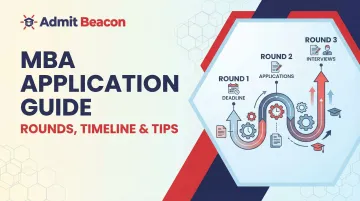
Most MBA programs divide their application cycle into three timed rounds, each with its own deadline and review cycle. Admissions committees evaluate applicants within each round and make acceptance, waitlist, or denial decisions before the next round opens. Exact deadlines vary by school and must be verified individually.
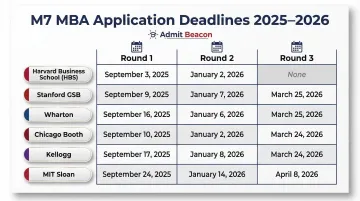
Here are the 2025-2026 deadlines for representative top programs:
| Business School | Round 1 | Round 2 | Round 3 |
|---|---|---|---|
| Harvard Business School | Sept 3, 2025 | Jan 5, 2026 | None |
| Stanford GSB | Sept 9, 2025 | Jan 7, 2026 | Apr 7, 2026 |
| Wharton | Sept 3, 2025 | Jan 6, 2026 | Apr 1, 2026 |
| Chicago Booth | Sept 16, 2025 | Jan 6, 2026 | Apr 2, 2026 |
| Northwestern Kellogg | Sept 10, 2025 | Jan 7, 2026 | Apr 1, 2026 |
| MIT Sloan | Sept 29, 2025 | Jan 13, 2026 | Apr 6, 2026 |
Round 1
R1 typically runs from September to October for US schools and offers the strongest strategic advantage. Why does it matter? Three concrete reasons:
- All seats are open — no cohort constraints by background or region yet
- Scholarship budgets are untouched — a meaningful advantage for funding your MBA
- Profile competition is lowest — especially relevant for applicants from consulting, finance, or tech
If you're coming from an overrepresented background, R1 gives you the best odds before the cohort fills with similar profiles. That said, this advantage only holds if your application is genuinely ready.
Round 2
R2 deadlines typically fall in January or February. If a stronger GMAT/GRE score, a recent promotion, or a meaningfully better application is achievable before the R2 deadline, waiting is almost always the right call. A polished R2 application will consistently outperform a rushed R1 submission.
Round 2 remains highly competitive and accounts for the largest portion of admits at most schools. The key is ensuring every component—essays, recommendations, resume—is as strong as it can be. Don't let deadline pressure push an underprepared application.
Round 3
By R3, available seats are limited and the cohort is largely formed. Wharton explicitly warns that "space in the class becomes more limited for Round 3 applicants, resulting in a more competitive round". R3 is best suited for candidates with genuinely differentiated profiles—non-traditional career paths, underrepresented geographies, or a unique angle that adds to the cohort in a way earlier rounds could not fill.
Ask yourself: how do I add value to an already-formed cohort? If the answer isn't clear and compelling, R3 is a risky choice.
Alternative Structures
Not every program follows the standard three-round model. Some offer alternative formats worth knowing:
- Early Decision (like Duke Fuqua) offers an early round in exchange for a binding commitment upon acceptance
- Rolling admissions (like Columbia's J-Term) review applications continuously, but seats still fill early—the advice to apply as early as you're ready holds regardless of format
Building Your MBA Application Timeline
The full preparation arc spans 12–18 months for most applicants targeting top programs. Starting early gives each component—test prep, school research, narrative development—the time and attention it actually needs.
Phase 1: 12–18 Months Out — Research and Test Preparation
Prioritize two parallel tracks:
Top scorers report studying for over 90 hours on GMAT Focus Edition or GRE prep, typically over two to three months. Your score calibrates school fit, offsets GPA weaknesses, and should be resolved early so your energy shifts to narrative-driven work.
Current median GMAT Focus scores at M7 schools:
- Stanford GSB: 689 (average)
- Harvard Business School: 685 (median)
- Northwestern Kellogg: 687 (average)
- Columbia Business School: 690 (average)
- Chicago Booth: 675 (median)
- MIT Sloan: 675 (median)
Alongside test prep, go deep on school research — not just rankings. Cohort culture, faculty access, career placement outcomes, alumni network strength, and program-specific specializations all shape fit. Resources like Admit Beacon's Knowledge Base (covering the top 25 MBA programs) and live webinars with current students and alumni can accelerate this phase considerably.
Phase 2: 6–12 Months Out — Career Narrative, Resume, and Recommenders
With test scores in hand, shift focus to the work that distinguishes candidates: your story. Develop a clear "why MBA, why now, why this school" narrative before writing a single essay. Vague career goals are the most common reason strong candidates are rejected.
Key deliverables in this phase:
- MBA-specific resume: One page, impact-driven, with quantifiable achievements — not a list of responsibilities
- Recommender identification and briefing: Give recommenders minimum 8–10 weeks lead time and a focused memo of themes to reinforce
- Career narrative framework: Connect past experiences, current role, and future goals so the MBA becomes a logical, necessary next step
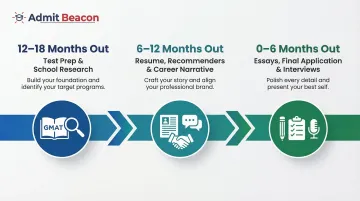
Phase 3: 0–6 Months Out — Essays, Final Application, and Interview Prep
Draft, iterate, and refine essays with one rule: every response must be school-specific. Generic essays that could apply to any program are easy for admissions committees to spot — and penalize. This is where working with a consultant like Admit Beacon, who limits client intake to focus on depth and authentic storytelling, can make a material difference.
Allow time for multiple revision rounds. Once submitted, prepare for interviews immediately — invitation timelines vary by school, and the gap between submission and invite can be shorter than most applicants expect.
Key Components of a Strong MBA Application
GMAT/GRE Score
Research your target programs' median and 80th percentile score ranges to set a realistic target. A strong quant score carries particular weight at most programs as a signal of academic readiness. The GMAT Focus Edition has reset benchmarks, with M7 medians clustering between 675 and 690.
Test waivers are rare at top programs. Harvard, Stanford, Wharton, Kellogg, MIT Sloan, and Columbia do not offer them. Chicago Booth limits waivers to University of Chicago alumni with 3.4+ GPA. Dartmouth Tuck offers waivers upon request for exceptional quantitative backgrounds.
MBA Essays
Essays are often the most differentiating component of a competitive application. Admissions committees evaluate not just what you've done, but how you think, what you value, and whether you're genuinely self-aware.
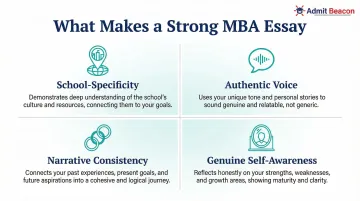
Strong essays share four qualities:
- Reference specific courses, professors, clubs, and career pathways at each school
- Tell your story in your voice — not a polished, committee-approved version
- Align with the rest of your application (narrative consistency matters)
- Reflect genuine self-awareness, not just accomplishment summaries
Letters of Recommendation
Recommendations provide third-party validation of your professional impact and character. The best letters are example-driven, specific, and reinforcing of your narrative — not generic praise.
Most schools prefer a direct manager as the primary recommender. Deviating from this requires explanation. Recommenders should understand your goals and the themes you want emphasized. Brief them thoroughly with at least 8–10 weeks of lead time.
Resume
One page for applicants with fewer than 10 years of experience. MBA resumes differ meaningfully from job-search resumes — rebuild rather than recycle. Every bullet should show value created, not responsibilities held.
Key elements to include:
- Quantifiable results tied to your leadership or decisions
- Career progression that shows increasing scope or responsibility
- Extracurricular contributions with concrete outcomes
- Impact metrics, not job descriptions
Interview
Invitation-only at most top schools, meaning a strong application is the prerequisite. Research each school's interview format (blind vs. application-based; behavioral vs. conversational).
The interview assesses the person behind the application—authenticity, clarity of purpose, and genuine knowledge of the program matter more than polished answers. Mock interviews with an informed reviewer are essential preparation.
Tips to Strengthen Your MBA Application
Build a Balanced School List
A list of 5–7 schools should include stretch targets, in-range programs, and at least one or two where you are a genuinely strong fit. Over-indexing on reach schools creates unnecessary pressure and often weakens the depth of application effort per school.
Never Let Round Anxiety Push a Weak Application
Admissions committees evaluate application quality within the context of the round. A hastily assembled R1 application does not benefit from early timing. The marginal advantage of R1 is outweighed by the disadvantage of a poorly crafted submission.
Tailor Every Single Application to the Specific School
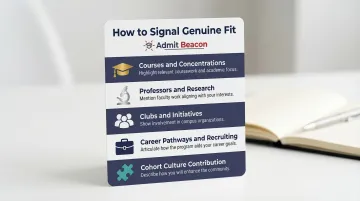
Signaling genuine research and fit means going specific — not just name-dropping a school's ranking. References that actually move the needle include:
- Courses or concentrations that align with your career goals
- Professors whose research or teaching connects to your interests
- Clubs, centers, or initiatives you'd actively contribute to
- Career pathways and recruiting relationships specific to that school
- Cohort culture and what you bring to that particular community
Top programs expect this level of specificity and penalize applications that feel generic or interchangeable across schools. Before writing a single essay, spend time on the school's website, talk to current students, and identify two or three things that genuinely distinguish it — then build your narrative around those.
Frequently Asked Questions
Frequently Asked Questions
What is required to apply for an MBA?
A standard MBA application requires a completed online application, GMAT or GRE scores (or a waiver at select schools), undergraduate transcripts, a professional resume, two to three letters of recommendation, and one or more essays. Some schools also require video essays.
What is the MBA application process?
The MBA application process moves through test prep, school research, essay writing, recommender coordination, and interviews at most top programs. Admissions committees evaluate academic capability, professional experience, leadership impact, and cultural fit across every stage.
How do MBA admission rounds work?
Most MBA programs divide their admissions cycle into three rounds with distinct deadlines. All seats are available in Round 1, while Round 2 and Round 3 see progressively fewer open spots and tighter cohort constraints. Admissions committees release decisions within each round before the next opens.
When should I start applying for an MBA?
Start 12–18 months before your target application deadline. This allows adequate time for test preparation, school research, narrative development, and essay drafting without rushing.
How hard is it to get into an MBA program?
Acceptance rates at top programs range from Stanford's 6.8% to Chicago Booth's 28.7%. Admission is highly competitive and holistic, with essays, recommendations, and interviews carrying significant weight alongside scores and GPA. Strong scores and GPA get you considered — your story is what gets you in.
What is the typical MBA salary?
Median base salaries at top programs range from $175,000 to $185,000. Harvard Business School reports $184,500, Stanford GSB and Wharton report $185,000, while Chicago Booth, Kellogg, MIT Sloan, Columbia, Tuck, and Yale report $175,000. Compensation varies by school, industry, and geography — consulting leads on base salary, while private equity delivers the largest performance bonuses.