Introduction
MBA applications demand serious resources. The typical applicant invests over $5,335 and 154+ hours across test prep, application fees, and campus visits—yet many start by targeting the wrong schools. Some reach exclusively for M7 programs without assessing competitive fit. Others undersell themselves by applying only to "safe" options, missing programs that could accelerate their careers.
Building the right MBA target school list means finding programs that align with your career trajectory, profile, and personal priorities—not just chasing the most recognizable name.
With Stanford's 6.8% acceptance rate and HBS at 11.2%, and a 7% global surge in MBA applications in 2025, a strategic approach separates strong applicants from well-qualified ones who get rejected everywhere.
This guide covers how to assess your profile, define selection criteria, and build a balanced list that gives you the best shot at admission to programs where you'll actually thrive.
Key Takeaways
- MBA target schools are the programs you strategically choose to apply to—distinct from employer "target lists" like McKinsey's or Goldman's
- Build a balanced list of 6-8 schools: 2 reach, 3-4 match, 1-2 safety programs spread across application rounds
- Choose schools based on career fit, program specialization, geographic recruiting reach, and culture—not rankings alone
- Applying only to M7 schools, ignoring placement data, or overlooking fit are the most common shortlist mistakes
- Start school research at least 12 months out—late shortlisting is one of the top reasons strong candidates get waitlisted
What Are MBA Target Schools?
From an applicant's perspective, MBA target schools are the curated list of programs you actively pursue as part of a deliberate application strategy. This is distinct from the "target school lists" that employers like McKinsey, BCG, or JP Morgan maintain for on-campus recruiting.
The Dual Meaning
While employer-side target lists influence where recruiting pipelines flow, your personal target list is a separate exercise driven by individual goals, not just prestige. For context:
- McKinsey's "Early Access" program historically limited eligibility to just 17 business schools
- BCG's "Unlock" program expanded to 37 elite schools globally, including European powerhouses and select U.S. programs
These employer lists matter for understanding recruiting access, but your application strategy must be broader and more personalized. Building that personal list starts with one practical structure: reach, match, and safety.
The Reach, Match, and Safety Framework
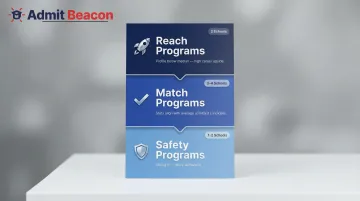
Your list should include three tiers:
- Reach programs: Your profile sits slightly below the median, but the career upside justifies the application
- Match programs: Your stats and experience align with the average admitted candidate
- Safety programs: Highly regarded programs where you're a strong fit and likely to be admitted
This isn't about "settling" with safety schools—it's about strategic optionality. With M7 collective admit rates falling to 18.7%, even perfect-stat candidates face rejection risks. Most applicants target 6–8 schools total—roughly two in each tier—to maintain real options without diluting the quality of each application.
Key Factors to Consider When Choosing MBA Target Schools
The "best" MBA program is the one that best serves your specific career goals, profile, and priorities. Rankings tell part of the story—these factors tell the rest.
Post-MBA Career Goals and Industry Alignment
The single most important filter is whether a school has established pipelines to your target industry and function. Companies recruit heavily from programs with proven placement records in their sector.
Industry-Specific Placement Leaders:
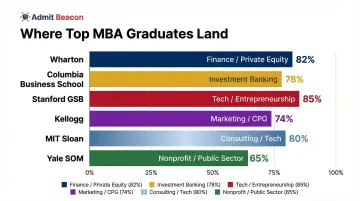
| School | Industry Strength | Key Placement Data |
|---|---|---|
| Wharton | Finance/Private Equity | 36.6% Finance, 15.2% Investment Banking, 10.0% PE |
| Columbia | Investment Banking | 35.9% Financial Services, 17.4% Investment Banking |
| Stanford GSB | Tech/Entrepreneurship | 35% Technology, 16% Starting New Business, 16% PE |
| Kellogg | Marketing/CPG | 19% Marketing/Sales, 9% Consumer Packaged Goods |
| MIT Sloan | Consulting/Tech/Ops | 32.1% Consulting, 19.0% Technology, 9.0% Operations |
| Yale SOM | Nonprofit/Public Sector | 5.2% Nonprofit, 3.1% Government |
If you're pursuing investment banking, Wharton and Columbia's East Coast finance networks are unmatched. For tech product management, Stanford and MIT Sloan offer direct access to Silicon Valley and enterprise tech employers. Your target role is the lens through which every other factor on this list should be evaluated.
Program Specialization and Curriculum Fit
Beyond brand name, evaluate whether the program's academic structure supports your intended specialization. Not all top programs teach all functions equally well.
Consider:
- Available concentrations in your target area
- Elective depth beyond core curriculum
- Experiential learning opportunities (consulting labs, field studies)
- Dual-degree options if you're pursuing interdisciplinary goals
- Specialized centers (entrepreneurship hubs, social impact institutes)
These distinctions matter when two schools have similar rankings but vastly different academic offerings in your focus area.
Geographic Location and Recruiting Network
Geography directly shapes recruiting outcomes. Employers concentrate hiring at nearby schools, and distance from your target city creates real networking friction that's hard to close remotely.
Regional Placement Concentration:
- Rice Jones: 85% of graduates stay in the Southwest
- UT McCombs: 66% stay in the Southwest, 98% of those in Texas
- Dartmouth Tuck: 55% place in the Northeast
If you're pursuing Latin American banking in Miami, applying to a Pacific Northwest program creates unnecessary friction. If your goal is Boston consulting or New York finance, Tuck and Columbia provide direct pipelines. Align your school's location with your target post-MBA city whenever possible.
Admissions Profile Fit
Each program publishes median GMAT/GRE scores, average GPA, and typical work experience profiles. Assess where you sit relative to these benchmarks—not to self-select out, but to build a list with the right balance of ambition and realism.
M7 Class Profile Baseline:
| School | Avg/Median GMAT | Avg GPA | Avg Work Experience |
|---|---|---|---|
| Stanford GSB | 738 | 3.80 | 5 years |
| Harvard (HBS) | 730 median | 3.76 | 4.9 years |
| Wharton | 732 | 3.68 | 5 years |
| Columbia | 734 | 3.6 | 5 years |
| Kellogg | 733 | 3.68 | 5.1 years |
Scores are just one dimension. Certain schools actively recruit applicants from underrepresented industries — military, nonprofit, family business — or from specific geographies, which can noticeably improve your odds beyond what raw numbers suggest.
Culture, Community, and Learning Environment
MBA programs differ significantly in culture and learning style:
- Collaborative vs. competitive cohorts
- Case-method vs. lecture-based pedagogy
- Tight-knit residential vs. larger urban programs
These factors shape your daily experience and the alumni relationships you build for decades — none of which shows up in a rankings table.
Before finalizing your list:
- Attend information sessions and virtual events
- Connect with current students through LinkedIn or school clubs
- Visit campus if possible to experience the environment firsthand
Admit Beacon hosts live webinars with current MBA students and alumni from top 25 programs — a practical way to get honest, school-specific perspective before committing to your list.
How to Build a Balanced MBA Target School List
Most applicants should target 6 to 8 schools—enough to create meaningful options, but not so many that application quality suffers from spreading effort too thin.
Recommended Structure
- 2 reach programs: Admission is possible but below median profile
- 3-4 match programs: You're a strong fit based on stats and experience
- 1-2 safety programs: Well-regarded schools where you're likely to be admitted
Spread applications across Round 1 and Round 2 to reduce risk. Round 1 typically offers slightly better odds — though Round 2 remains highly competitive at top programs and shouldn't be treated as a fallback.
Conduct Genuine School Research
The structure above is only as useful as the research behind it. Before locking in your list:
- Review employment reports to verify placement in your target industry
- Reach out to current students or alumni to understand culture and recruiting realities
- Attend live webinars or info sessions to assess whether the program's mission aligns with your goals
- Read each school's stated values to evaluate cultural fit
Admit Beacon's live webinars connect applicants directly with current students and alumni — making this kind of first-hand research accessible before you finalize your list.
Rankings Are One Input, Not the Primary Driver
Once you've done that research, rankings come back into focus — but in proper proportion. A school ranked 12th that matches your career goals can be a stronger choice than a top-5 program where you're unlikely to get in. Acceptance rates vary dramatically:
- Ultra-Reach (Sub-15%): Stanford (6.8%), HBS (11.2%), MIT Sloan (14.1%)
- Reach/Target (15%-25%): Wharton (20.5%), Columbia (20.9%)
- Target/Match (25%-35%): Kellogg (28.6%), Booth (28.7%), Tuck (31.2%), Darden (33.9%)
- Safety/Regional Dominance (35%+): McCombs (37.9%), Georgetown McDonough (60.3%)
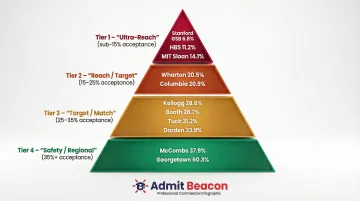
Use these data points to refine your list, not to eliminate schools prematurely.
Common Mistakes When Choosing MBA Target Schools
The Prestige Trap
Many applicants build lists exclusively of M7 schools without assessing whether their profile is genuinely competitive. With M7 admit rates at 18.7% and falling, this strategy leads to waitlists or rejections everywhere with no viable options left.
Applying to even one or two strong match programs outside the M7 protects against this outcome.
Underselling Your Profile
Applicants with competitive profiles sometimes cap their lists at "safe" schools, assuming rejection at top programs is inevitable. That instinct costs real opportunities — programs that could meaningfully accelerate a career.
Admissions committees evaluate the full narrative of your application, not just GMAT scores or GPA. A strong story, clear goals, and well-chosen programs can open doors that seem closed on paper.
Ignoring Industry-Specific Placement
Choosing schools based solely on overall ranking without evaluating placement in your specific industry or function is a costly mistake. A school ranked lower overall can outperform a higher-ranked program for a given career path.
Before finalizing any school on your list, check its employment report for your target function and geography. A few things worth verifying:
- Which companies recruit on campus (and whether your target employers are on that list)
- What percentage of graduates enter your target industry
- Whether the school has regional hiring strength that matches your goals
A regional energy company may hire heavily from UT McCombs over a nationally ranked program with no Texas presence — ranking alone won't tell you that.
How Admit Beacon Can Help You Choose the Right Programs
Admit Beacon is a personalized MBA admissions consulting firm that limits client intake to deliver depth, strategy, and real impact on every application. School selection is a deliberate, individualized exercise — not a checklist activity.
Strategic School Selection Process
Admit Beacon's approach draws on:
- Knowledge Base covering the top 25 MBA programs with detailed insights into curriculum, culture, and placement
- Live webinars with current students and alumni to access first-hand perspectives before finalizing your list
- Lead consultant Niketa's structured methodology for building career narratives that align authentically with each school's ethos
Every program on your list has a deliberate, well-reasoned purpose behind it.
Key Benefits
- Draws on an extensive alumni and student network for school-specific, on-the-ground insights
- Builds a realistic yet ambitious target list through a personalized candidacy assessment
- Positions your story differently across programs while keeping your narrative authentic

Niketa dedicates approximately 40% of her total consulting effort to Resume, School Selection, Career Narrative, and Essay Storyboarding — so the work that shapes your list gets the same rigor as the work that shapes your essays.
Frequently Asked Questions
What are Target MBA schools?
From an applicant's perspective, target schools are the programs you strategically choose to apply to. From an employer's perspective (McKinsey, Goldman Sachs), they are schools where the firm actively recruits—generally the M7 programs plus select other top programs.
What are the big 7 MBA programs?
The M7 programs are Harvard Business School, Stanford GSB, Wharton, MIT Sloan, Chicago Booth, Kellogg, and Columbia. They carry this designation due to historically strong recruiting outcomes and consistent placement at elite employers. That said, many programs outside the M7 deliver equally strong results for specific industries or roles—the M7 label matters most in finance and consulting.
What is the easiest school to get an MBA?
Rather than looking for the "easiest" program, seek programs where your profile is a strong match. Admissions selectivity depends on class size and applicant pool composition, so a smaller school with a 15% acceptance rate can be harder to get into than a larger, higher-ranked one admitting 20%.
Is getting an MBA at 32 worth it?
Most MBA programs welcome candidates aged 28–33, as their experience enriches classroom discussion. The average age across M7 programs is around 27–28, per GMAC data. ROI depends heavily on career goals, program fit, and post-MBA trajectory rather than age alone.
How many schools should I target for my MBA application?
Apply to 6 to 8 schools, structured across reach, match, and safety tiers. Applying to fewer than 5 programs significantly increases the risk of having no viable options, while applying to more than 8 typically dilutes application quality.
Does the MBA program's location matter for my career after graduation?
Yes. Geographic location directly affects recruiting access—companies recruit heavily from nearby schools. Align your school's location with your intended post-MBA city or industry cluster whenever possible to maximize your networking and recruiting reach.