Introduction
You have an entrepreneurial vision, but you're asking whether taking two years out for an MBA is the right move — or a costly detour. Many aspiring founders wrestle with this tension: the opportunity cost of steep tuition and two years away from building feels real, yet the prospect of structured frameworks, a strong network, and investor credibility is hard to ignore.
This guide covers what an entrepreneurship MBA genuinely offers beyond the classroom, which programs lead the world in producing founders, whether the ROI makes sense, and how to tell a founder's story in your application.
You'll find data-backed insights on survival rates, funding outcomes, and career pathways — so you can decide whether the MBA is your next strategic move or a detour you can skip.
Key Takeaways
- An MBA in entrepreneurship delivers frameworks, networks, and credibility that accelerate real ventures
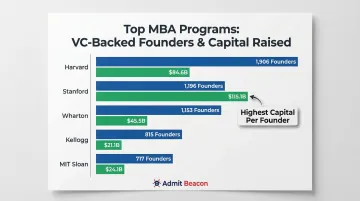
- Harvard produces the highest volume of founders (1,906), while Stanford alumni raise the most capital ($115.1B)
- ROI depends on your career stage, venture ambitions, and ability to tap into the school's ecosystem
- Entrepreneurship applicants need a strategy that demonstrates vision, risk-tolerance, and school-specific fit
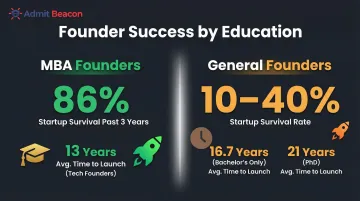
- MBA-founded startups survive past three years at 86% — far above the 10–40% general startup average
What Does an MBA in Entrepreneurship Actually Offer?
An entrepreneurship MBA combines broad business fundamentals — finance, marketing, operations, strategy — with specialized coursework in venture creation and growth. For founders, that combination matters: you need financial fluency to structure cap tables and strategic frameworks to scale under uncertainty.
Neither skillset alone is enough. The MBA builds both simultaneously.
Core Curriculum Components
Most top programs share foundational courses that build entrepreneurial competence:
- Foundations of Entrepreneurship - Hypothesis-driven testing, customer discovery, and lean startup methodologies
- Entrepreneurial Finance - Venture capital mechanics, angel investing, crowdfunding, and cap table management
- New Product Development - Design thinking, prototyping, and go-to-market strategy
- Corporate Entrepreneurship - Intrapreneurship frameworks for driving innovation within large organizations
The best programs allow significant elective customization. You can specialize in social entrepreneurship, family business succession, or deep tech commercialization depending on your venture ambitions.
Four Assets Beyond Curriculum
The MBA uniquely provides entrepreneurs with resources that extend far beyond coursework:
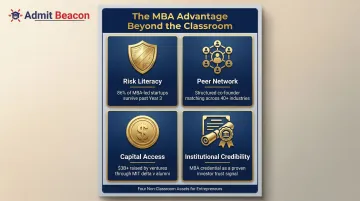
Risk literacy before you have a venture to risk. Research shows MBA-founded startups survive at an 86% rate past three years, far outperforming the 10-40% general startup survival average.
A peer network that becomes your founding team. At Harvard Business School, 46% of founders in the Class of 2024 found their co-founder directly through HBS — not LinkedIn, not a warm intro.
Direct proximity to capital. Alumni investors, on-campus VCs, and pitch competitions create real funding pathways. MIT's delta v accelerator alone has helped alumni raise over $3 billion.
Institutional credibility. The MBA signals competence to investors and potential hires — particularly valuable for career changers or first-time founders entering capital-intensive sectors.
MBA vs. Master's in Entrepreneurship
An MBA teaches broad business principles applied to venture contexts, while a standalone Master's in Entrepreneurship is narrower and more startup-specific. Choose an MBA if you want versatility — the ability to pivot into consulting, VC, or corporate innovation if your venture doesn't launch immediately. Choose a Master's in Entrepreneurship if you have a clear venture idea and want deep, specialized training without the broader business curriculum.
Experiential Learning Dimension
Top schools embed live venture-building into the program through incubators, accelerators, pitch competitions with prize funding, and consulting projects with startups. MIT Sloan's Martin Trust Center reports that 69% of companies launched in the past five years are still active or have been acquired. Stanford's Startup Garage has produced more than 130 successful companies — including DoorDash — collectively raising over $2.5 billion.
Top MBA Programs for Entrepreneurship
Two lenses matter when evaluating top programs: founder output (measured by VC-backed founder data from PitchBook) and program-specific entrepreneurship resources. Both matter depending on what you're optimizing for — maximizing capital access versus getting hands-on incubation support.
PitchBook's Top Programs by VC-Backed Founders
PitchBook's 2025 rankings track founders who received venture funding between January 2014 and September 2025:
| School | VC-Backed Founders | Companies | Capital Raised | Notable Edge |
|---|---|---|---|---|
| Harvard Business School | 1,906 | 1,757 | $84.6B | Arthur Rock Center; co-founder matching via alumni network |
| Stanford GSB | 1,196 | 1,088 | $115.1B | Highest capital per founder; 23% of Class of 2024 launched or ran a company |
| Wharton | 1,153 | — | $45.5B | Entrepreneurial finance depth; East Coast investor access |
| MIT Sloan | 717 | — | $24.1B | Martin Trust Center's structured, craft-based approach |
| Kellogg | 815 | — | $21.1B | Corporate entrepreneurship and innovation leadership tracks |
| Columbia, INSEAD, Booth, Haas, LBS | Top 10 | — | — | Distinct advantages in geographic reach, industry focus, or accelerator infrastructure |
Stanford's $115.1B in alumni-raised capital — over $30B more than Harvard despite 700 fewer founders — reflects the density of the Bay Area venture ecosystem surrounding GSB. Location compounds outcomes.
Schools with Strong Entrepreneurship Resources
Founder volume doesn't tell the whole story. Some schools punch above their weight in entrepreneurship-specific resources, early funding, and hands-on support:
Rice Jones runs the Rice Business Plan Competition, which awarded $3.4 million in 2023 and $1.8 million in 2025. That's non-dilutive capital — real runway without giving up equity at the seed stage.
Babson College has held the #1 spot in Entrepreneurship from U.S. News & World Report for 32 consecutive years. It's not a business school with an entrepreneurship track — it's an entrepreneurship school, with deep incubation through the Butler Launch Pad.
Chicago Booth's Polsky Center runs the New Venture Challenge (NVC), one of the country's most respected accelerators. NVC alumni have raised over $1.5 billion and achieved $11.5 billion in exits, with Grubhub and Braintree among its graduates.
What Separates a "Good" Program from a Prestigious One
Look beyond rankings to evaluate:
- Percentage of graduates who start or join startups
- Mentor-to-student ratios in accelerator programs
- On-campus VC access and alumni investor density
- Number of entrepreneurship-specific courses and elective depth
- Alumni network density in your target industry
For founders building across borders, INSEAD's campuses in Europe, Asia, and the Middle East give it a network reach most US programs can't match — worth weighing if international markets are central to your venture.
Is an MBA Worth It for Entrepreneurs? The Real ROI
The opportunity cost of two years and significant tuition is real, and the answer to "is it worth it" is not universal. Frame your decision around three factors: where you are in your entrepreneurial journey, what specific gaps the MBA would fill, and which school's ecosystem aligns with your venture type.
The Financial Picture
Top MBA programs charge steep tuition:
| School | Annual Tuition + Fees | Two-Year Total |
|---|---|---|
| Columbia Business School | $97,645 | $195,290 |
| Wharton | $92,820 | $185,640 |
| MIT Sloan | $89,000 | $178,000 |
| Stanford GSB | $86,568 | $173,136 |
| Harvard Business School | $87,608 | $175,216 |
When factoring in living expenses in high-cost cities, total two-year cost of attendance frequently surpasses $260,000.
The return side of that equation is strong. The median base salary for 2024 graduates at top schools is $175,000, with many seeing salary increases exceed 100% within three years of graduation. For context, the US Bureau of Labor Statistics reports the median annual wage for Chief Executives is $206,420 and $101,190 for Management Analysts — figures that MBA graduates routinely outpace within a few years.
The Case for "Before Your First Venture"
An MBA early in your career builds risk literacy, financial fluency, and a co-founder network before you have a venture to risk. MBA-trained tech founders establish their companies faster — an average of 13 years post-graduation — compared to founders with PhDs (21 years) or bachelor's degrees only (16.7 years).
The structured environment lets you test hypotheses without the stakes of a live venture. You also build operational frameworks that help you sidestep common founder mistakes — cash flow mismanagement, equity structuring errors, and intellectual property oversights among them.
The Case for Doing It Later
Some of the most impactful entrepreneurship MBA experiences come from candidates who already have a venture or a clear idea. They extract more from the curriculum, leverage the network with a specific ask, and are taken more seriously by investors on campus.
Stanford GSB reports that 52% of MBA-founded companies are launched three or more years after graduation, indicating the true value lies in long-term network relationships and industry expertise accumulation.
Do You Need It?
No degree is required to found a company. What the MBA does is shift the odds — particularly for career changers and those entering capital-intensive sectors like biotech, hardware, or enterprise SaaS, where financial fluency and network access matter from day one.
The average tech founder is 39 years old — squarely the MBA demographic — not the 22-year-old dropout narrative popularized in tech culture.
What Can You Do With an MBA in Entrepreneurship?
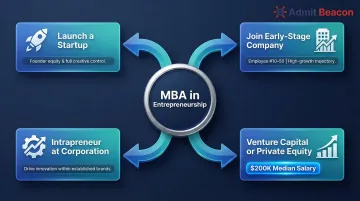
The entrepreneurship MBA opens four main career paths:
Launch Your Own Startup: Accelerators, prize competitions, and alumni investor networks give you direct access to early-stage capital. MIT's delta v accelerator now offers up to $75,000 in equity-free funding to student teams.
Join an Early-Stage Company: Joining as employee #10-50 at a high-growth startup puts you in leadership roles across operations, business development, or product. Early-stage companies actively recruit MBA graduates for the credibility and structured thinking they bring.
Become an Intrapreneur: Large corporations increasingly carve out roles for people who can launch new business units or lead digital transformation from the inside. The entrepreneurial mindset is valued by corporations seeking leaders who think like founders.
Move into Venture Capital or Private Equity: Evaluating deals and supporting portfolio companies from the investor side is a natural fit for MBA graduates with entrepreneurship training. Stanford GSB's 2024 graduates entering Private Equity reported a median base salary of $200,000 alongside a median expected performance bonus of $175,000.
Entrepreneurship Through Acquisition (ETA)
An emerging pathway is Search Funds — raising capital to buy and operate existing small-to-medium businesses. At Stanford GSB, 28% of the Class of 2024 graduates who pursued entrepreneurship opted to launch Search Funds rather than starting from scratch. It suits candidates who want operator-level ownership without building from scratch.
Salary Context
MBA graduates in business and financial roles earn well above the median wage for all occupations. Top executives and management analysts routinely exceed $100,000–$200,000 annually.
Founder income sits outside these figures entirely — it scales with your venture, not a salary band.
Whether you launch a company, join one early, or lead innovation inside a larger organization, the MBA positions you for roles where entrepreneurial thinking drives real decisions.
How to Choose the Right Program (and Actually Get In)
Five-Factor Framework for School Selection
Ecosystem Fit: Target networks, not prestige. MIT Sloan's science and engineering connections matter far more than a generalist network if you're building a biotech venture.
Geographic Advantage: Stanford GSB's Silicon Valley location delivers direct access to tech investors and talent. INSEAD's tri-campus model suits founders targeting global markets from day one.
Program Flexibility: Check whether the school goes deep in your domain — social entrepreneurship, family business, deep tech commercialization — not just whether entrepreneurship exists as a track.
Available Funding and Resources: Look beyond the curriculum. Schools like Rice Jones and MIT Sloan offer substantial non-dilutive capital through accelerators, prize competitions, and on-campus VC access.
Cultural Fit: Babson's pure entrepreneurship focus differs dramatically from Wharton's finance-heavy culture. Neither is wrong — but the mismatch will show up in your essays and your experience.
What Strong Entrepreneurship Applications Look Like
Admissions committees want to see evidence of a founder's mindset:
- Moments of real risk — initiatives you led without a playbook, bets you took under uncertainty
- A coherent "why entrepreneurship" through-line that connects your past to a specific venture direction
- Post-MBA goals concrete enough to name a target market, a problem, and why the MBA closes the gap
- School-specific details: the professor whose research overlaps with your domain, the accelerator cohort you'd apply to, the alumni you've already spoken with
A templated application rarely survives this process. Each school has a distinct entrepreneurial identity, and your narrative needs to align with that ethos without sounding like you've swapped in a school name. For founders and aspiring entrepreneurs working through this, Admit Beacon takes a non-templated approach — building application stories around each candidate's specific background and each school's culture, with limited client intake to keep the work genuinely personalized.
Frequently Asked Questions
Which MBA is best for entrepreneurship?
Harvard, Stanford, and Wharton consistently top PitchBook's founder rankings, but schools like MIT Sloan, Kellogg, and Rice Jones offer distinct ecosystem advantages. "Best" depends on your industry, geographic focus, and venture stage : Stanford maximizes VC access for high-growth tech, while MIT Sloan excels in deep tech commercialization.
Is an MBA worth it for entrepreneurship?
It depends on your career stage, the gaps you need to fill, and how actively you leverage the school's network. For founders lacking financial literacy, operational frameworks, or co-founder access, an MBA can meaningfully compress the learning curve. For experienced entrepreneurs with strong networks and a clear venture plan, it may be an unnecessary detour.
How much do MBA entrepreneurs make?
In corporate roles, MBA graduates earn substantially above median wages — top executives average $206,420 annually and management analysts $101,190. Founder income is harder to pin down: it varies widely by venture stage, funding, and equity structure, and many founders take below-market salaries early while building long-term equity value.
What can I do with an MBA in entrepreneurship?
You can launch your own venture, join a startup in a leadership role, move into VC or private equity, or drive corporate innovation as an intrapreneur. The degree is versatile across sectors, and the entrepreneurial frameworks and networks remain valuable whether you found immediately or build domain expertise first.
Do most entrepreneurs have an MBA?
No. Most successful entrepreneurs do not hold an MBA. That said, research shows MBA-trained founders tend to outperform in fundraising and financial management, with 86% of MBA-founded startups surviving past three years versus 10-40% for startups overall. The degree is a useful tool, not a prerequisite.
Is 30 too late to get an MBA?
No — the average MBA student is in their late 20s to early 30s, and 30 is well within the norm. In fact, more work experience often strengthens both your application and the value you extract from the program, as you bring deeper context to case discussions and clearer post-MBA goals.