Introduction
Choosing an MBA program is one of the highest-stakes professional decisions you'll make. With tuition, fees, and living expenses exceeding $250,000 at top schools—plus two years of foregone income—the total investment often surpasses $500,000. That cost buys more than a credential — it buys access to a network, a recruiting pipeline, and a career pivot that can define the next 20 years.
Yet with hundreds of accredited programs available, the selection process can feel overwhelming. Many applicants default to chasing prestigious names, assuming brand recognition alone guarantees the right outcome.
It doesn't. A program ranked #15 may serve your specific goals far better than a #3 program, depending on industry focus, location, teaching methodology, and cohort culture.
This guide covers both sides of the equation: what to look for in an MBA program, and what programs look for in you. Work through both, and you'll apply to the right schools for the right reasons — with a stronger application to show for it.
Key Takeaways
- Look beyond rankings: location, specialization, alumni network, teaching style, and ROI all matter
- Top programs seek academic readiness, demonstrated leadership, self-awareness, and authentic career vision
- Fit matters both ways: assess program alignment with your goals while positioning yourself as the right match
- Research via current students, alumni, and admissions events sharpens school-specific applications
- Financial reality check: M7 programs cost $250K+ over two years, with median starting salaries at $175K-$185K
Why Choosing the Right MBA Program Matters More Than You Think
MBA rankings provide a useful starting point, but they're a limited tool. A program ranked #15 may outperform a #3 program for your specific needs depending on industry focus, geographic placement strength, teaching methodology, or cohort culture. The Financial Times dedicates roughly 22% of its ranking weight to international and ESG metrics, which disadvantages US schools and can obscure true career outcomes.
That gap between ranking and reality is why fit matters more than prestige for long-term outcomes. According to GMAC's 2025 Prospective Students Survey, candidates are already shifting in this direction — ranking importance dropped from 37% to 29%, while ROI research and specific career outcomes moved up the priority list.
There's also a dynamic most applicants overlook: school selection runs in both directions. While you're evaluating programs, admissions committees are evaluating whether you belong in their community. This guide addresses both sides — what to look for in a program, and how to position yourself as the right fit for it.
What to Look for in an MBA Program
Choosing an MBA program is a $250,000+ decision. These factors give you a structured framework to evaluate schools against your specific career goals—not just their brand names.
Accreditation and Program Reputation
Accreditation is non-negotiable. The three globally recognized accreditation bodies are AACSB (Association to Advance Collegiate Schools of Business), EQUIS (EFMD Quality Improvement System), and AMBA (Association of MBAs). These credentials signal academic rigor, faculty quality, and employer recognition.
The exclusivity is real:
- AACSB accredits just 1,072 institutions across 70 countries—only 6% of business schools worldwide
- AMBA accredits programs from the top 2% of business schools globally
- EQUIS accreditation is often a strict prerequisite for major global rankings
Reputation goes beyond accreditation. Research industry-specific reputation—a school known for finance versus one dominant in tech entrepreneurship. This matters more than an overall ranking if you have a specific career path.
How to research reputation:
- Audit official employment reports for placement rates in your target industry
- Review which companies recruit on campus
- Connect with alumni working in your desired sector
- Attend industry-specific webinars or events hosted by the program
Specializations and Curriculum Depth
MBA specializations—Finance, Marketing, Technology, Analytics, Entrepreneurship—provide competitive advantages in target industries. Not all schools offer the same depth in every specialization, so audit whether your areas of interest are core strengths or afterthoughts.
Look beyond course listings:
- Research faculty expertise in your field
- Review available electives and experiential learning opportunities
- Check for active clubs, competitions, or research centers in your area
- Investigate industry partnerships and guest speaker series
M7 specialization strengths are clearly visible in placement data:
- Finance: Wharton (36.3%) and Columbia (35.9%) dominate financial services placements
- Consulting: Kellogg sends 38% of its class into consulting, followed by MIT Sloan at 32.3%
- Technology: Stanford GSB leads with 35% entering tech, while MIT Sloan places 23.3% in tech
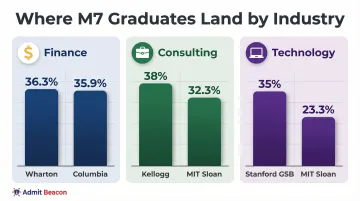
These patterns reflect genuine institutional investment—faculty depth, recruiting relationships, and curriculum design—not just student preference.
Location, Format, and Program Duration
Programs embedded in financial hubs, tech corridors, or global business capitals create proximity to internships and jobs that classroom learning cannot replicate. Where a school sits on the map often determines where its graduates end up working.
Regional gravity is powerful:
| School | Primary Region | Placement % | Secondary Region | Placement % |
|---|---|---|---|---|
| Stanford GSB | West | 45% | Northeast | 31% |
| Wharton | Northeast | 46.8% | West | 21.5% |
| Kellogg | Midwest | 39% | West | 24% |
| Columbia | US Total | 79% | Asia | 9% |
If you want Silicon Valley tech, Stanford's 45% West Coast placement is unmatched. For Wall Street, Columbia and Wharton's Northeast dominance provides the clearest path.
Format considerations:
- Full-time 2-year: Standard M7 format with summer internship; ideal for career switchers
- Full-time 1-year: INSEAD (10 months), LBS (15-21 months); accelerates ROI for industry accelerators
- Part-time: Maintains income while studying; limited recruiting access
- Online/hybrid: Flexibility for working professionals; less immersive networking
Choose format based on career stage, financial situation, and whether stepping away from work serves your goals. That decision directly affects which alumni networks and recruiting pipelines you can access.
Alumni Network and Career Services
A well-placed alumni network often delivers more value than the degree itself. Research not just network size but density in your target industry or geography—a smaller, tight-knit alumni community in the right sector can outperform a large but diffuse one.
Investigate career services quality:
- Employer relationships and on-campus recruiting access
- Internship placement support and success rates
- Average post-MBA salary and employment rates
- Industry-specific career coaching availability
M7 employment outcomes (Class of 2024/2025):
| School | Median Base Salary | Median Signing Bonus | Employment Rate | Top 2 Industries |
|---|---|---|---|---|
| Stanford GSB | $185,000 | $30,000 | 90% | Finance (33%), Tech (35%) |
| Harvard HBS | $184,500 | $30,000 | 90% | Finance (33%), Consulting (21%) |
| Wharton | $175,000 | $30,000 | 98.7% | Finance (36.3%), Consulting (25.2%) |
| MIT Sloan | $175,000 | $30,000 | 91% | Consulting (32.3%), Tech (23.3%) |
| Kellogg | $175,000 | $30,000 | 90% | Consulting (38%), Finance (21%) |
| Columbia | $175,000 | $30,000 | 86.4% | Finance (35.9%), Consulting (30.6%) |
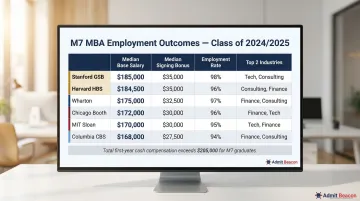
With median signing bonuses universally at $30,000, total first-year cash compensation exceeds $205,000 for M7 graduates.
Financial Investment and ROI
Treat this as a full ROI calculation: tuition + living expenses + lost income during the program + loan repayment, weighed against your expected post-MBA salary increase and career trajectory.
Annual Cost of Attendance (2025-2026):
| School | Annual Tuition | Living/Housing | Total Annual COA |
|---|---|---|---|
| Stanford GSB | $85,755 | $40,971 | $135,771 |
| Wharton | $87,970 | $28,320 | $132,404 |
| Chicago Booth | $87,354 | $26,010 | $129,403 |
| Kellogg | $86,370 | $22,059 | $128,852 |
| Harvard HBS | $78,700 | $28,000 | $126,536 |
Over two years, total investment exceeds $250,000 before factoring in foregone income. For experienced professionals, that opportunity cost adds another $200,000-$300,000 to the equation.
Scholarship and financial aid options:
- Most top programs offer merit-based scholarships
- Employer sponsorship is worth exploring early, particularly at large organizations with tuition reimbursement policies
- Federal loans and private financing options vary by citizenship status
Break-even timeline: With pre-MBA salaries averaging $85,000-$95,000 and post-MBA salaries at $175,000-$185,000, most graduates break even within 3-5 years, assuming consistent career progression.
Teaching Style and Campus Culture
Learning environment directly shapes skill development. Consider whether you thrive in case-method classrooms (Harvard Business School), lecture-based environments, or experiential project-driven formats.
Evaluate culture through:
- Campus visits and information sessions
- Conversations with current students
- Student blogs and social media
- Class observations (when permitted)
- Live webinars with current MBA students, such as those hosted by admissions consulting firms like Admit Beacon, offer candid program perspectives before you apply
Cultural dimensions to assess:
- Collaborative vs. competitive atmosphere
- Grade non-disclosure policies
- Cohort size and diversity
- Work-life balance expectations
- Club and extracurricular engagement levels
The best MBA for you creates the right conditions for your specific transformation—not just the most prestigious name.
What MBA Programs Look for in Applicants
Understanding what admissions committees evaluate helps you self-select the right programs and present yourself strategically. This is the other side of the fit equation.
Academic Readiness
GPA and GMAT/GRE scores signal quantitative and analytical capability — but top programs read them in context. Upward GPA trends, rigorous coursework, and strong test performance can compensate for an imperfect transcript.
Test choice is genuinely open. Admissions committees state no preference between GMAT and GRE, and at Harvard Business School, 44% of the Class of 2027 submitted GRE scores versus 34% submitting GMAT Focus.
M7 Academic Benchmarks (Class of 2026/2027):
| School | Median GPA | GMAT Focus Median | GRE Verbal/Quant Median |
|---|---|---|---|
| Harvard HBS | 3.76 | 685 | 164 / 164 |
| Stanford GSB | 3.76 | 689 | 164 / 164 |
| Wharton | 3.68 | Not Disclosed | 163 / 162 |
| Chicago Booth | 3.60 | 675 | 161 / 163 |
| Kellogg | 3.68 | 687 | 162 / 163 |
| MIT Sloan | 3.69 | 675 | 162 / 159-170 |
| Columbia CBS | 3.60 | 690 | 163 / 163 |
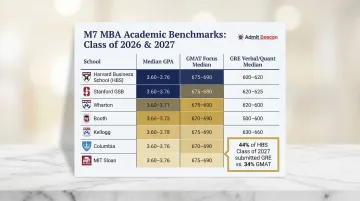
Key insight: GMAT Focus medians have settled between 675-690 across the M7. If your GMAT is lagging, pivot to the GRE, where medians of 162-164 per section are highly competitive.
Leadership and Professional Impact
Admissions committees want evidence of impact: that you've driven change, led initiatives, and grown over time — not merely accumulated job titles.
Leadership can be demonstrated in non-managerial roles through:
- Initiative and ownership of projects
- Cross-functional influence
- Measurable results and quantifiable impact
- Progression and increasing responsibility over time
Work experience expectations: Across every M7 program, average work experience is exactly 5 years. However, quality matters more than quantity.
Wharton notes: "We evaluate work experience not in terms of years, but the depth and breadth of an individual's position, contributions to the work environment, and level of responsibility and progression." They explicitly welcome early-career candidates (0-3 years) who exhibit strong managerial potential.
Audit your resume for:
- Scope of responsibility
- Cross-functional exposure
- Career progression trajectory
- Quantifiable achievements
- Leadership in formal and informal contexts
Self-Awareness and Clarity of Purpose
Self-awareness is one of the clearest differentiators in a competitive applicant pool. Candidates who articulate their career trajectory clearly, explain why an MBA is the right next step, and reflect honestly on their strengths and gaps stand out.
Clarity of purpose signals fit. When you understand precisely why School X is right for you—and can articulate it beyond rankings—it demonstrates both research depth and authentic interest.
Strong candidates can answer:
- Why do I need an MBA now versus in two years?
- What specific skills or experiences am I missing?
- How does this program's curriculum, culture, and network address my gaps?
- What will I contribute to the cohort and community?
- Where do I want to be in 5-10 years, and how does this MBA get me there?
Authenticity and Personal Story
Self-awareness and authenticity reinforce each other. Top MBA programs build intentionally diverse cohorts and look for what makes each candidate distinct. Authentic narratives — real motivations, unconventional paths, unique perspectives — stand out far more than polished but generic applications.
Essays, recommendations, and interviews should reflect a coherent and genuine picture of who you are and where you're going — not a story you've reverse-engineered from what you think the committee wants.
Authenticity shows through:
- Specific details and personal anecdotes
- Honest reflection on failures and lessons learned
- Genuine passion for your goals (not what sounds impressive)
- Consistency across all application components
- Natural voice that sounds like you, not a consultant
How Admit Beacon Can Help
Admit Beacon is a personalized MBA admissions consulting firm built for candidates targeting top business schools. By limiting client intake, the firm ensures every candidate receives genuine depth and strategic attention — not templated advice.
Lead Consultant Niketa works directly with each candidate on resume development, school selection, career narrative, and essay storyboarding — dedicating roughly 40% of total application effort to these foundational elements. Every engagement also includes a mock interview to prepare candidates for the real thing.
Here's what makes the firm different:
- Limits client intake so each application gets the time, strategy, and detail it deserves
- Builds narratives that align with each school's ethos without losing your authentic voice
- Maintains a Knowledge Base covering the top 25 MBA programs to support your school research at every stage
- Hosts live webinars with current MBA students and alumni so you hear honest program insight, not just admissions talking points
- Holds memberships in AIGAC, AIIEC, and TOC, keeping the team current on admissions trends and best practices
- Connects candidates to mentor and student networks at target schools for ground-level perspective

Conclusion
The right MBA program fits your career goals, learning style, financial reality, and values — not just a ranking. A name-brand school that doesn't match your trajectory adds cost and time without proportional return.
Successful MBA applications happen at the intersection of genuine self-awareness and strategic program research. Candidates who invest time understanding what they need from a program — and what programs need from them — navigate the process with more clarity and confidence. That dual awareness is what leads to decisions that hold up five years after graduation.
Frequently Asked Questions
What should I look for in an MBA program?
Evaluate program reputation and accreditation (AACSB, EQUIS, AMBA), specializations aligned with your career goals, location and regional placement strength, alumni network density in your target industry, career services quality, teaching style, and financial ROI. The best fit depends on your specific career objectives and learning preferences.
What qualities do MBA programs look for?
Top programs seek academic readiness demonstrated through GPA and test scores, evidence of leadership and professional impact (not just titles), self-awareness and clarity of career goals, authentic personal narratives that show what makes you distinct, and strong letters of recommendation that validate your potential.
Does MBA program ranking matter more than fit?
Rankings signal reputation and shape employer perception, but fit—alignment between your goals, learning style, and a program's strengths—has greater impact on actual outcomes and satisfaction. Ranking methodologies weight factors like starting salary heavily, which may not reflect what matters most for your career path.
How much work experience do top MBA programs typically require?
Most full-time top MBA programs expect meaningful professional experience, with M7 schools averaging around 5 years. Quality and trajectory matter more than years alone—programs prioritize the depth of your responsibility and career progression over hitting a specific time threshold.
Can I get into a top MBA program with a low GPA?
A lower GPA is not automatically disqualifying. Admissions committees consider context, upward trends, academic rigor, and strong GMAT/GRE scores as mitigating factors. The strength of your overall application—professional achievements, leadership, and compelling narrative—can compensate for academic weaknesses.
How early should I start researching MBA programs?
Start at least 12-18 months before your target application round. That window gives you time for GMAT/GRE prep, campus visits, recommender selection, essay development, and genuine conversations with current students and alumni to sharpen your school list.