Introduction
Top MBA program admissions remain fiercely competitive—acceptance rates at many M7 schools hover in the single digits to low teens. Stanford admits just 6.8% of applicants, while Harvard's rate sits at 11.3%. Yet thousands of strong candidates earn admission each year. The difference lies not in perfect credentials alone, but in how strategically and authentically they approach the process.
This guide breaks down what admissions committees actually evaluate, how to build a school list, when to apply, and what makes one application stand out over another. Whether you're an engineer, consultant, entrepreneur, or non-profit leader, the playbook is the same: know the process, position your story, and execute with intention.
Key Takeaways
- Top programs evaluate holistically: test scores, leadership narrative, career clarity, and authentic storytelling all carry weight
- Application rounds matter: Round 1 and Round 2 offer the best odds; start preparing 12–18 months before your target start date
- Essays, resume, recommendations, and interview must tell one cohesive, aligned story
- Quality beats quantity: focus on 4–6 schools where you genuinely fit and can articulate specific reasons why
What Top MBA Programs Look for in Applicants
Admissions committees don't run a simple formula of GPA plus GMAT. Schools build diverse classes by evaluating professional trajectory, leadership potential, community contribution, and likelihood of impact—not just individual metrics. Harvard seeks candidates who are "business-minded, leadership-focused, and growth-oriented", while Stanford evaluates "how you think, how you lead, and how you see the world".
Real-World Leadership Experience
Leadership isn't defined by title or seniority. Admissions committees look for candidates who identified problems, took initiative, influenced others, or drove meaningful change. Harvard explicitly states, "Leadership takes many forms in many contexts—you do not have to have a formal leadership role to make a difference."
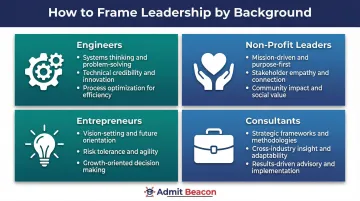
How non-traditional candidates can frame leadership:
- Engineers: Highlight technical problem-solving that influenced team decisions, process improvements that scaled across departments, or mentorship of junior engineers
- Non-profit leaders: Emphasize resource mobilization, coalition-building, or program design that created measurable community impact
- Entrepreneurs: Focus on team-building, pivoting under uncertainty, or stakeholder management rather than just venture outcomes
- Consultants: Showcase client influence, internal firm initiatives, or cross-functional leadership beyond project execution
Clarity of Career Goals
Schools want candidates who know why they need an MBA now, what they'll do with it, and how it bridges a specific gap in their trajectory. Vague goals like "I want to go into consulting" without demonstrating industry knowledge or a credible path signal underprepared thinking.
Strong career narratives include:
- Specific short-term role targets (not just "consulting" but "healthcare strategy consulting focused on payer-provider partnerships")
- Clear connection between past experience and future goals
- Honest acknowledgment of skill or network gaps the MBA will address
- Long-term vision that shows ambition without sounding unrealistic
Self-Awareness and Authentic Reflection
Self-awareness shows up across your entire application — not just in one essay. Committees look for it in three specific places:
- Optional essays: how you address resume gaps or academic weaknesses honestly
- Interview answers: how you reflect on leadership mistakes without deflecting blame
- Recommendations: whether your recommenders describe you as receptive to feedback and genuinely growth-oriented
Analytical and Quantitative Aptitude
Top MBA programs demand demonstrated quantitative ability. Schools assess this through GMAT/GRE scores, undergraduate performance in quantitative coursework, and professional evidence of data-driven decision-making. A strong GMAT can offset a weaker GPA and vice versa—the key is proving you can handle the analytical rigor.
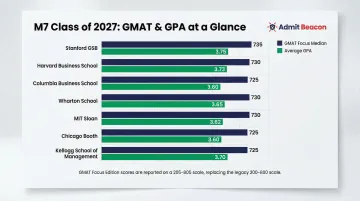
Current GMAT Focus Edition medians range from 670 at Chicago Booth to 690 at Columbia. These numerically lower scores represent elite percentiles equivalent to legacy scores of 720–738.
Commitment to Community
MBA programs build communities, not just credential individuals. Chicago Booth seeks applicants whose "unique personal and professional experience will contribute to a strong, congenial community."
Contributions evaluated by admissions committees include:
- Volunteer leadership or mentorship programs
- Organizing team-building or student-facing initiatives
- Diversity and inclusion efforts within professional or community settings
- Active involvement in clubs, cohorts, or industry groups
Breaking Down the MBA Application Requirements
Understanding what you're submitting and what each piece reveals to admissions committees helps you approach each component strategically.
GMAT/GRE and Academic Record
Most programs accept either the GMAT Focus Edition or GRE. The GMAT Focus Edition uses a new scoring scale—a 685 is now equivalent to a 730 on the legacy GMAT.
Competitive score ranges for M7 programs (Class of 2027):
| School | GMAT Focus Median/Avg | Average GPA |
|---|---|---|
| Stanford GSB | 689 | 3.76 |
| Harvard | 685 | 3.76 |
| Columbia | 690 | 3.60 |
| Wharton | 676 | 3.70 |
| MIT Sloan | 675 | 3.69 |
| Chicago Booth | 670 | 3.60 |
| Kellogg | 687 | 3.68 |
Schools weigh your undergraduate GPA alongside course rigor and institutional reputation. Strong performance in quantitative courses (calculus, statistics, economics) is weighted heavily. At Chicago Booth, 42% of admitted students submitted GRE scores, proving the GRE is a fully equal alternative.
Essays and Video Questions
Essays reveal personality, values, and future vision beyond the resume. Most top programs ask about career goals, leadership impact, and "why this school."
Don't skip optional essays if you have something meaningful to address. Use them for: a resume gap, an academic weakness, or a circumstance that changed your trajectory.
Video questions (now common at Kellogg, MIT Sloan, and Yale SOM) test spontaneous communication and presence. Kellogg requires three video questions within 96 hours of applying, while MIT Sloan gives you 10 seconds to prepare and 60 seconds to respond.
Practice on camera before you hit record. Schools use video questions specifically to screen out scripted and AI-generated responses — authenticity is what they're evaluating.
Resume and Letters of Recommendation
Your resume carries more weight than most applicants expect. MBA resumes follow a one-page, achievement-focused format: revenue generated, team size managed, measurable outcomes — all in bullet points that open with action verbs and close with specific numbers.
Strong recommendation letters include:
- Specific examples of your work quality and impact
- Observed performance in challenging situations
- Growth trajectory and receptiveness to feedback
- Context about your role and responsibilities
Choose recommenders who know your work quality, not just your title. Brief them on your application's key themes so their letter reinforces your narrative rather than contradicting it.
Admissions Interview
Schools use interviews to assess fit, communication skills, and the depth behind application claims. Formats vary: alumni interviews (most common), admissions office interviews, or team-based discussions at schools like Wharton and Yale.
Prepare to:
- Walk through your resume fluently, explaining transitions and choices
- Discuss industry trends relevant to your career goals
- Answer reflective questions with specific, prepared stories (not scripted answers)
- Ask thoughtful questions that demonstrate genuine research
How to Choose the Right MBA Programs
School selection should start with career goals and format fit, not rankings alone. Four program formats serve different profiles:
- Full-time MBA: Most common for career switchers with 3–5 years of experience
- Part-time MBA: For professionals continuing to work while earning their degree
- Executive MBA: Suited for candidates with 10+ years of experience in leadership roles
- Online MBA: Offers flexibility for those unable to relocate or pause careers
Building a Balanced School List
Criteria for selecting schools:
- Does the school emphasize collaboration (Kellogg) or analytical rigor (Booth)? Culture fit matters.
- Which schools have strong placement pipelines into your target industry?
- How active and accessible are alumni in your target geography?
- Do you see yourself reflected in the cohort's profile and diversity?
- Does the school's location align with your career goals or personal circumstances?
Visit campus and attend information sessions when possible—this pays dividends in essay specificity. Cap your list at 4–6 schools to protect application quality. Spreading yourself across 8–10 schools dilutes the depth and authenticity each application deserves.
For structured school research, Admit Beacon's Knowledge Base covers the top 25 MBA programs, and live webinars with current students and alumni add the on-the-ground perspective that rankings can't provide.
Crafting a Compelling "Why This School" Case
That school research directly feeds your essays. Admissions committees immediately spot copy-paste writing—generic praise like "your distinguished faculty and collaborative culture" could apply to any top program.
Uncover program-specific differentiators:
- Name specific electives that align with your goals (for example, Wharton's Private Equity course or Kellogg's Social Impact class)
- Identify student organizations you'd actively contribute to, not just join
- Cite faculty whose research connects directly to your post-MBA interests
- Highlight recruiting partnerships with employers relevant to your target role
- Reference actual conversations with alumni and what you took away from them
Navigating Application Rounds and Deadlines
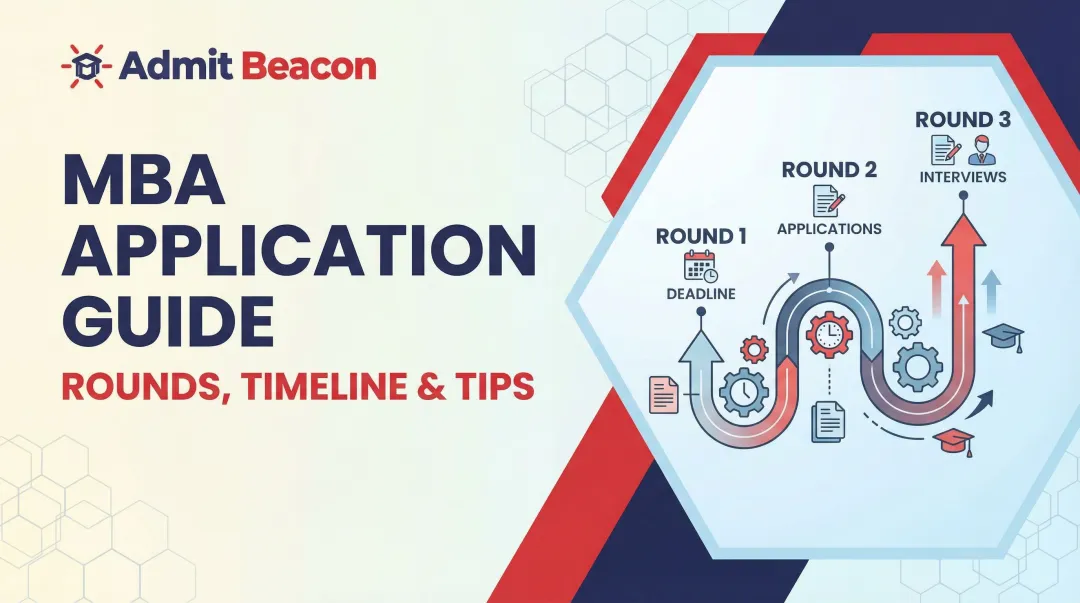
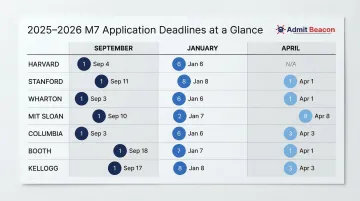
Most top MBA programs use a three-round structure. Round 1 typically falls in September–October, Round 2 in January, and Round 3 in late March–April.
2025-2026 Deadlines for M7 Schools:
| School | Round 1 | Round 2 | Round 3 |
|---|---|---|---|
| Harvard | Sept 3 | Jan 5 | N/A (two rounds only) |
| Stanford | Sept 9 | Jan 7 | Apr 7 |
| Wharton | Sept 3 | Jan 6 | Apr 1 |
| MIT Sloan | Sept 29 | Jan 13 | Apr 6 |
| Columbia | Sept 3 | Jan 6 | Mar 26 |
| Booth | Sept 16 | Jan 6 | Apr 2 |
| Kellogg | Sept 10 | Jan 7 | Apr 1 |
Round 1 vs. Round 2: Timing Strategy
MIT Sloan explicitly states, "The advantage of applying in Round 1 and Round 2 is that there are more available seats in the class." Columbia warns that for priority consideration for institutional funding, applications must be completed by Round 1 or Round 2.
Round 3 is far more competitive due to limited remaining seats and should be avoided if possible. The right round depends on readiness, not speed—submitting a polished Round 2 application beats rushing an underprepared Round 1 submission. Use this backward-planning framework to pace your preparation:
- 12–18 months before start date: Begin GMAT/GRE preparation
- 9–12 months out: Complete school research, attend information sessions, connect with alumni
- 6–9 months out: Begin drafting essays and developing your narrative
- 3–4 months before deadline: Finalize essays, secure recommendations, complete applications
Each phase builds on the last — candidates who compress this timeline typically feel it most in their essays, where rushed narratives rarely land.
What Separates a Strong MBA Application from a Generic One
Narrative Cohesion Across All Components
Every element—resume, essays, recommendations, interview—should tell the same consistent story about who you are, where you've been, and where you're going. Admissions committees notice when components feel disconnected or contradictory.
Identify your through-line before writing:
- What core values or motivations have driven your career choices?
- How do your past experiences connect to your future goals?
- What specific gaps will the MBA fill?
- How does each achievement or experience support your overall narrative?
Authenticity Over Templates
Schools immediately identify templated essays with generic phrases, overused frameworks, or copy-pasted "why MBA" stories. Authenticity—writing with specificity about real experiences, real failures, and real ambitions—makes essays memorable and persuasive.
Signs of authentic writing:
- Specific details only you could provide
- Honest reflection on mistakes and growth
- Unique perspectives shaped by your background
- Natural voice rather than overly formal language
School-Specific Tailoring
The "why this program" essay, interview preparation, and even how you frame career goals should reflect genuine understanding of each program's culture, pedagogy, and community. Applicants who reference specific professors, courses, clubs, or alumni they've connected with consistently outperform those who don't.

Demonstrate genuine research:
- Attend school-specific information sessions and reference what you learned
- Connect with current students or alumni and mention those conversations
- Cite specific program elements that align with your goals
- Show how you'll contribute to the community, not just what you'll gain
Strategic Depth Over Perfection
Depth and strategy matter more than a polished surface. Working with a personalized admissions consultant gives applicants the structural support to build stories with genuine impact — not just well-edited prose.
Admit Beacon limits client intake so each application gets the focused, school-specific attention it needs. That means helping applicants find their through-line, connect unrelated experiences into a single readable story, and walk into interviews with a narrative they actually believe.
Frequently Asked Questions
What is the process for applying to business school?
The process involves researching programs to identify the best fit, taking the GMAT or GRE, preparing application materials (essays, resume, letters of recommendation), submitting within your chosen round, and completing an admissions interview if invited. Most applicants should plan for 12–18 months from initial preparation to matriculation.
When should I apply for business school?
Most top programs use three rounds, with Round 1 (September–October) and Round 2 (January) offering the best admission odds and scholarship opportunities. Round 3 (March–April) is significantly more competitive with limited seats. Begin preparation 12–18 months before your intended start date to allow adequate time for testing, research, and application development.
What GPA do you need to get into business school?
Top programs favor strong undergraduate GPAs—M7 averages range from 3.60 to 3.76—but evaluate them in context of course rigor and school reputation. A lower GPA can be offset by strong GMAT scores, exceptional work experience, or a well-framed story showing clear analytical ability.
How hard is it to get into business school?
Top MBA programs are highly competitive, with M7 acceptance rates ranging from 6.8% at Stanford to 28.7% at Chicago Booth. However, a strategic, well-prepared application that demonstrates authentic leadership, clear career vision, and strong community contribution significantly improves your odds beyond raw statistics.
Is 25 too early for an MBA?
Most full-time MBA programs prefer candidates with 3–5 years of post-undergraduate work experience, making 25 appropriate depending on your professional trajectory. The average age at M7 schools is 28, with average work experience of 4.9 to 5.3 years. At the younger end of that range, use your essays to make an explicit case for why now is the right time.
What is the typical MBA salary after graduation?
M7 graduates command median base salaries of $175,000 to $185,000, well above the national MBA average of roughly $120,000. Stanford and Harvard top $184,000, driven by placements in private equity and venture capital—and that's before signing bonuses (typically $30,000) and performance bonuses are factored in.