
Introduction
Every MBA applicant hits the same wall: "Is my GMAT score good enough?" With the GMAT Focus Edition now standard, understanding what "competitive" actually means has gotten harder—particularly when schools still report scores on two different scales.
This article covers verified score benchmarks for the world's top MBA programs, how to read those numbers against your specific profile, and a clear action plan depending on where you land.
Key Takeaways
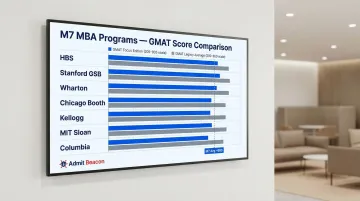
- M7 programs average 670–690 on GMAT Focus (720–740 on Legacy)
- Target the specific average for each program you're applying to, not a generic benchmark
- GMAT Focus uses a 205–805 scale — 655 Focus ≈ 700 Legacy, and schools account for the difference
- A below-average score raises the bar on the rest of your application — it doesn't disqualify you
- Top programs accept GMAT and GRE equally; GMAT medians are just reported more consistently across school profiles
Why Your GMAT Score Matters in Top MBA Admissions
The GMAT functions as a standardized academic signal that lets admissions committees compare a software engineer from Bangalore, a non-profit leader from Lagos, and a consultant from London on a common analytical benchmark. GMAC explicitly advises that the test should never be the sole admissions criterion, advocating instead for holistic review.
That said, the GMAT remains critical because it provides an objective measure of academic readiness — one that schools rely on in two very practical ways: rankings and scholarships.
Standardized test scores directly affect where programs land in the rankings. U.S. News & World Report weights median GMAT and GRE scores at 13% of a school's overall ranking methodology for 2025. That creates a structural incentive for programs to prioritize higher scores — especially when comparing otherwise equal candidates.
Above-average scores also improve your scholarship odds. Dartmouth Tuck explicitly warns that the absence of a test score may place applicants at a disadvantage for merit-based scholarship awards. MIT Sloan and Chicago Booth both award merit fellowships based on criteria that include "academic excellence," with GMAT scores serving as a primary indicator.
GMAT Score Requirements for Top MBA Programs
The GMAT Focus Edition uses a 205–805 scale; the Legacy exam used 200–800. These scores cannot be directly compared across editions — percentile-based comparison is the right approach. According to the official GMAC Concordance Table, a 655 on Focus Edition equals approximately 700 on Legacy (both around the 90th percentile).
Most top programs don't publish hard minimums, but they release average scores and middle 80% ranges annually. These are the most reliable benchmarks to use when gauging where your score stands.
M7 Programs
| School (Class 2027) | GMAT Focus Avg/Median | GMAT Legacy Avg/Median | Middle 80% Range | Notes |
|---|---|---|---|---|
| Harvard Business School | 685 (Median) | 730 (Median) | Focus: 645–735 Legacy: 690–770 |
Official Class Profile |
| Stanford GSB | 689 (Avg) | 738 (Avg) | Focus: 615–785 Legacy: 540–780 |
Poets&Quants |
| Wharton | 676 (Avg) | 735 (Avg) | Not published | Poets&Quants |
| Chicago Booth | 670 (Avg) | 729 (Avg) | Focus: 615–725 Legacy: 690–770 |
Official Profile |
| Kellogg | 687 (Avg) | 733 (Avg) | Focus: 680–770 | Official Class Profile |
| MIT Sloan | 675 (Median) | 720 (Median) | Focus: 645–735 Legacy: 710–760 |
Clear Admit |
| Columbia | 690 (Avg) | 734 (Avg) | Focus: 615–805 Legacy: 610–780 |
Official Class Profile |
Top 15 + International Programs
| School (Class 2027) | GMAT Focus Avg/Median | GMAT Legacy Avg/Median | Middle 80% Range | Notes |
|---|---|---|---|---|
| Dartmouth Tuck | 671 (Avg) | 727 (Avg) | Focus: 595–775 Legacy: 690–770 |
Official Profile |
| Berkeley Haas | 675 (Median) | 730 (Median) | Focus: 637–725 Legacy: 669–767 |
Official Profile |
| Yale SOM | 675 (Median) | 740 (Median) | Focus: 638–715 Legacy: 691–760 |
Official Profile |
| Virginia Darden | 671 (Avg) / 665 (Median) | 725 (Avg) / 730 (Median) | Focus: 626–715 Legacy: 690–750 |
Admissions Blog |
| Michigan Ross | 681 (Avg) | 731 (Avg) | Focus: 635–725 Legacy: 700–770 |
Official Profile |
| NYU Stern | 682 (Avg) | 737 (Avg) | Focus: 645–725 Legacy: 690–760 |
Official Profile |
| London Business School | ~645 (Avg) | 708 (Avg) | Focus: 555–805 | Official FAQ |
| INSEAD | 655 (Median) | 710 (Avg) | Focus: 615–715 Legacy: 670–750 |
Secondary sources; verify directly |
| HEC Paris | 635 (Avg) | 690 (Avg equivalent) | Not published | Official Requirements |
The middle 80% range is more useful than the average when sizing up your score. Falling below the bottom of that range signals a real weakness; landing above the top makes your score a genuine differentiator. At HBS, for instance, the Legacy middle 80% runs 690–770 — a 680 is close, but it sits below the range and below the median.
Always verify scores directly on each school's official class profile page, since data updates annually.
How to Set Your Target GMAT Score
Step 1 — School List First, Score Target Second
The biggest mistake applicants make is picking a generic target ("I want a 720") before knowing their school list. Your target score should be derived from the specific programs you're applying to, not the other way around. Start by identifying 6–8 schools that align with your career goals, culture preferences, and profile strengths—then look at their published score ranges.
Step 2 — Read Your Position in the Applicant Pool
Understand whether your background is overrepresented or underrepresented. Indian male engineers applying to M7 programs, for instance, face highly competitive pools and often need scores above the class average. Candidates from underrepresented industries, geographies, or career paths may be competitive with scores slightly below the median. Where you sit in the pool shapes what score is actually "enough."
Step 3 — Use the Middle 80% Range as Your Floor and Ceiling
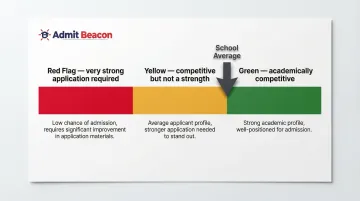
Scoring within the middle 80% range (not just at or above average) is the practical goal:
- Above the average: Green zone—you're academically competitive
- Within the range but below average: Yellow zone—competitive but not a strength
- Below the bottom of the range: Red flag requiring a very strong rest-of-application
Step 4 — Aim 10–15 Points Above the Program Average for Stretch Schools
This buffer accounts for score volatility and test-day performance. It also gives the admissions committee no reason to question your academic readiness, so they can focus on the rest of your candidacy.
Benchmarking your score against your full profile—GPA, work experience, industry, geography—requires program-specific data. Admit Beacon's Knowledge Base covers admissions statistics for the top 25 MBA programs, giving applicants the context to assess where they actually stand before committing to a target.
What to Do If Your GMAT Score Falls Short
Retake with a Structured Plan
A retake makes sense when your score is more than 20–30 points below the class average, or when your prep was genuinely incomplete. Before committing, though, look at what the data actually shows.
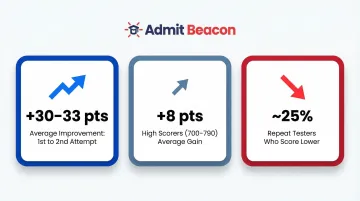
GMAC research puts the average improvement from first to second attempt at roughly 30–33 points. Test-takers who already score between 700 and 790 gain only about 8 points on a retake — and nearly 25% of repeat testers score lower.
Strengthen the Rest of Your Application
A below-average GMAT doesn't doom an application — it shifts the burden of proof onto other elements. A low score paired with a flat overall application is the actual liability. To counterbalance it, focus on:
- Demonstrating quantitative capability through concrete work achievements
- Highlighting specific leadership impact with measurable outcomes
- Crafting a narrative that makes your trajectory feel intentional and compelling
Consider the GRE or a Test Waiver
Most top MBA programs accept GRE scores equally and don't preference one test over the other. Some schools offer GMAT/GRE waivers for candidates with strong academic or professional credentials. For example:
- UVA Darden offers waivers evaluated case-by-case based on academic and professional accomplishment
- Dartmouth Tuck offers waivers to applicants demonstrating quantitative reasoning through their background
- NYU Stern offers waivers for candidates with analytical degrees, certifications (CFA, CPA), or NYU undergrad degrees with 3.20+ GPA
Harvard, Stanford, and Chicago Booth do not offer waivers (Booth makes one exception for UChicago alumni with a 3.4+ GPA). Waiver policies shift frequently, so confirm directly with each program before applying.
Revisit Your School List
A score that lands 30 points below Harvard's median might sit right at the average for a strong program like Vanderbilt Owen or Notre Dame Mendoza. Build a balanced list — reach, target, and likely schools — rather than one where your score is an outlier across the board.
Frequently Asked Questions
What GMAT score do I need for MBA?
Requirements vary by program, but most top 20 MBA programs expect scores in the 650–690 range on GMAT Focus Edition (roughly 700–740 on Legacy). The right score depends on your specific target programs and overall profile strength.
What's a good GMAT score for M7?
M7 programs (HBS, Stanford, Wharton, Booth, Kellogg, Sloan, Columbia) have Focus Edition averages in the 670–690 range and Legacy averages around 725–740. Scoring at or above the class average is the baseline goal; 10+ points above strengthens your application significantly.
Do M7 schools prefer GMAT or GRE?
M7 schools officially accept both equally. That said, GMAT data is more prominently featured in class profiles, and candidates with strong quant skills often find the GMAT a sharper tool for demonstrating that strength.
Will a 750 GMAT get me into Harvard?
A 750 (Legacy scale) sits above HBS's reported median of 730, which removes one barrier—but HBS admission is holistic. Essays, work experience, recommendations, and interview performance carry equal or greater weight.
Is 685 a good GMAT score?
685 on GMAT Focus Edition is competitive at the M7 level—it sits near Stanford's reported mean of 689 and matches HBS's median of 685. Whether it's enough depends on the rest of your profile, particularly GPA and work experience.
What is a top 10% GMAT score?
According to the official GMAC percentile data, a 655 on GMAT Focus Edition corresponds to the 90.5th percentile. However, top programs care more about your score relative to their class average than your percentile ranking among all test-takers globally.