
Introduction
Stanford GSB's average GPA hovers near 3.8, and that number stops a lot of applicants cold. If your transcript doesn't look like that, it's easy to assume the door is closed — but that's rarely how admissions actually works.
This post covers what you actually need to know: real GPA averages at top programs, what "low" means in context, and how to build a competitive case even when your undergraduate transcript isn't perfect.
Key Takeaways
- M7 programs report average GPAs between 3.6–3.8; T15 programs typically fall in the 3.4–3.6 range
- Schools publish 80% GPA ranges—meaning admits regularly fall below the reported average
- Below 3.0 is considered a significant hurdle at elite programs, though not an absolute disqualifier
- A high GMAT/GRE score and strong work experience can meaningfully offset a below-average GPA when paired with a well-framed application
- Framing a GPA weakness strategically—not just acknowledging it—can shift how admissions committees read your entire profile
Average GPA at Top MBA Programs: What the Data Shows
Most top business schools publish average or median incoming class GPAs annually as part of their class profiles. These figures have been rising steadily — Stanford GSB's average climbed from 3.70 in 2019 to 3.76 by 2024–2025, while Kellogg's moved from 3.60 to 3.72 in the same period.
One reason for this upward pressure: U.S. News & World Report's methodology allocates 10% of a school's total ranking to median undergraduate GPA, giving schools a reason to favor high-GPA applicants.
2024–2025 GPA Benchmarks at M7 and T15 Programs
| Business School | Average/Median GPA | 80% Range or Full Range | GMAT Focus Median/Average |
|-----------------|-------------------|-------------------------|---------------------------|
| Stanford GSB | 3.76 Average | Not published | 689 Average |
| Harvard Business School | 3.76 Average | Not published | 685 Median |
| Wharton (Penn) | 3.68 Average | Not published | 676 Average |
| Kellogg (Northwestern) | 3.72 Avg / 3.76 Median | 2.6–4.0 (Full Range) | 687 Average |
| MIT Sloan | 3.70 Average | Not published | 675 Median |
| Chicago Booth | 3.60 Average | 2.36–4.0 (Full Range) | 670 Avg / 675 Median |
| Columbia Business School | 3.60 Average | 3.2–3.9 (80% Range) | 690 Average |
| Dartmouth Tuck | 3.60 Average | 2.8–4.0 (Full Range) | 671 Average |
| Berkeley Haas | 3.65 Average | 3.38–3.9 (80% Range) | 675 Median |
| Yale SOM | 3.68 Median | 3.31–3.94 (80% Range) | 675 Median |
| Duke Fuqua | Not published | 3.16–3.91 (80% Range) | Not published |
| Michigan Ross | 3.43 Average | 3.0–3.84 (80% Range) | 681 Average |
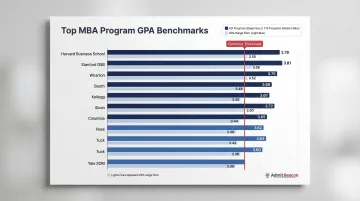
Data sourced from official 2024-2025 class profiles.
What the 80% Range Really Means
While averages dominate headlines, the 80% ranges tell a different story. When schools publish an 80% range, it means 10% of the matriculating class falls below the bottom of that range. Columbia's 80% range starts at 3.2, meaning 10% of admits had GPAs below that. Berkeley Haas's range starts at 3.38—again, 10% scored lower.
Schools publishing full ranges reveal how far the outliers go. Chicago Booth admitted a candidate with a 2.36 GPA in the 2023-2024 cycle, and Kellogg's published range extends down to 2.6. These figures confirm that top programs will accept a statistical hit to their rankings if a candidate's profile is strong enough in other dimensions.
Average vs. Median: Why the Distinction Matters
Some schools (like MIT Sloan and Yale SOM) report medians rather than averages. The median represents the middle value in a dataset, meaning 50% of admits scored above it and 50% below. Averages, by contrast, can be skewed by a handful of very high or very low scores.
For applicants, this distinction matters in practice. A median is often slightly higher than an average — so if a school reports a 3.70 median, the actual average across the class might be closer to 3.65.
What Counts as a Low GPA for MBA Admissions?
Defining "low GPA" requires context. Admissions experts commonly treat a GPA more than one full point below a program's average as meaningfully below-threshold. Graham Richmond, co-founder of Clear Admit, calls the 3.0 GPA a "magical line" below which applicants face a real structural disadvantage at elite programs.
The Spectrum of "Low"
- 3.2–3.4 at an M7 program: Below average but workable with strong compensating factors — you need to shine elsewhere in the application
- Below 3.0: Requires a compelling explanation and exceptional strengths; the optional essay becomes critical here
- Below 2.7: Extremely difficult at T10 programs without extraordinary circumstances — expect to demonstrate quantitative readiness through alternative means
- Relative to your target school: A 3.3 is competitive at Michigan Ross (average 3.43) but below average at Stanford (average 3.76), so always benchmark against specific programs
Why a Low GPA Isn't an Automatic Rejection
Top MBA programs are explicit: your GPA is one data point, not a verdict. Stanford GSB states: "In assessing your application, we believe you are far more than your grade point average or standardized test scores". Harvard Business School echoes this: "your application will be read holistically – we consider all elements of the application together." What that means in practice is worth unpacking.
The Multivariable Admissions Equation
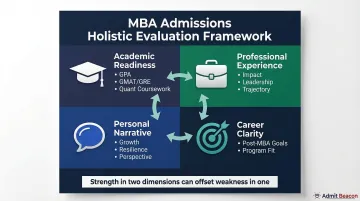
MBA admissions committees evaluate candidates across multiple dimensions:
- Academic readiness: GPA, GMAT/GRE, quantitative coursework
- Professional experience: Impact, leadership, trajectory
- Personal narrative: Growth, resilience, unique perspective
- Career clarity: Post-MBA goals, fit with program
A standout in two of three can offset weakness in the third. Work experience plays a particularly strong compensating role here.
Admissions committees recognize that a 30-year-old professional's undergraduate GPA from nearly a decade ago is less predictive of future success than their track record of impact, leadership, and growth in demanding roles.
Why Programs Admit Academic Outliers
MBA programs value what each cohort member contributes beyond classroom metrics. They actively seek candidates who bring diversity of experience and perspective, even if their undergraduate records are imperfect. As Poets & Quants notes, "a low undergraduate GPA does not have to be the end of an applicant's MBA dreams. Anyone with a low GPA can get into Booth, Tuck or Kellogg—or Stanford, Harvard or Wharton—if they work hard enough and play to their strengths in other areas". The key is knowing which strengths to lead with — and how to frame them.
How to Strengthen Your MBA Application When Your GPA Falls Short
If your GPA is below your target program's average, you have multiple levers to pull. Here's how to build a competitive case.
1. Use GMAT/GRE as Your Primary GPA Compensator
A strong standardized test score—particularly in the quant section—is the single most effective lever for applicants with below-average GPAs. Admissions experts confirm: "If you had a little bit lower GPA, but you nailed your GMAT, that's the compensation to get to the next level".
Target scores for low-GPA applicants:
- M7 programs: Aim for GMAT Focus scores of 675+ (95th percentile)
- T15 programs: Aim for 665+ (90th percentile)
Both the GMAT Focus Edition and GRE are widely accepted. While some schools offer test-optional policies, submitting a strong score is strategically advantageous for low-GPA applicants—it's your clearest opportunity to prove quantitative readiness.
2. Build an "Alternative Academic Transcript"
You can demonstrate academic readiness through post-undergraduate coursework. MIT Sloan explicitly invites applicants to submit "academic evidence not already on your transcripts, such as: professional certifications CFA, CPA, ACCA; non-degree coursework such as MITx MicroMasters, CORe, edX, MBA Math".
Options to consider:
- Quantitative courses through community college or extension programs
- Finance or analytics certifications (CFA Level I, Financial Modeling & Valuation Analyst)
- Online coursework in statistics, accounting, or economics
List these on your resume and reference them in your optional essay. The goal: show that your past GPA doesn't reflect your current capabilities.
3. Use the Optional Essay Strategically
Most top programs provide an optional essay or addendum space. If your GPA is significantly below a program's average, use this space to briefly explain contextual factors—but don't make excuses.
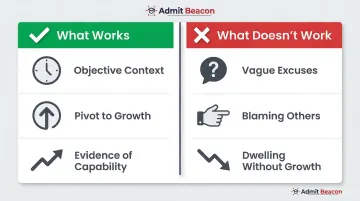
What works:
- Objective context: "I worked 30 hours per week to fund my education, which impacted my ability to focus on coursework during my sophomore and junior years"
- Immediate pivot to growth: "Since graduation, I've completed three graduate-level finance courses through UCLA Extension, earning A grades in all three"
- Evidence of capability: "My GMAT Focus score of 685 demonstrates my quantitative readiness for the academic rigor of [School Name]"
What doesn't work:
- Vague excuses: "I wasn't focused during college"
- Blaming others: "My professors graded unfairly"
- Dwelling on the negative without showing growth
Wharton explicitly states: "Acknowledging something you view as a weaker part of your application will not disadvantage you". The key is to address it directly, provide context, and move forward confidently.
4. Craft a Narrative-Driven Main Application
Essays, recommendations, and interviews are where below-average GPA applicants close the gap. The strongest applications show a clear through-line: where you've been, what you've learned, and where you're headed. Admissions committees want evidence that you've grown beyond your transcript—not just a disclaimer about it.
Working with a consultant on career narrative development, essay storyboarding, and school-specific positioning (as Admit Beacon does with each client) can help you structure that story before you write a single word. The GPA becomes context. The application becomes the argument.
5. Target Schools Strategically
Build a balanced school list that includes:
- Reach schools: Programs where your GPA is below the 80% range but within the full range
- Target schools: Programs where your GPA falls within or near the 80% range
- Safety schools: Programs where your GPA is at or above the average
Fit, post-MBA goals, and cohort dynamics matter as much as raw stats. Don't apply only to reaches—be strategic about where your profile will be most competitive.
What About International GPAs?
International applicants face an additional layer of complexity: grading scales vary significantly across countries. A First Class Honours in the UK, an 8.5/10 in India, or a 15/20 in France do not translate directly to a U.S. 4.0 scale.
WES Evaluations and School Policies
Many top U.S. programs use World Education Services (WES) for credential evaluation. WES provides a Course-by-Course evaluation that includes a U.S. GPA on a 4.0 scale. School policies vary:
- Required upfront: Michigan Ross requires a WES evaluation with your application
- Required upon admission: Harvard Business School and Chicago Booth require WES evaluations after admission
- Evaluated in-house: MIT Sloan and Wharton do not require WES—they evaluate international transcripts directly
GMAT/GRE as a Universal Benchmark
For international applicants, standardized test scores carry more weight than GPA alone — they provide a common benchmark that admissions committees can compare across nationalities. If you're applying from a country with an unfamiliar grading system, a strong GMAT or GRE score is your clearest signal of quantitative ability.
Global programs like London Business School and INSEAD calibrate GPA expectations to applicants' home country norms. That said, a competitive GMAT score (typically 700+) removes ambiguity regardless of where your undergraduate transcript is from.
Frequently Asked Questions
What's a good GPA for an MBA?
A "good" GPA for MBA admissions is generally 3.5 and above at most top programs, with M7 averages ranging from 3.6 to 3.8. What counts as "good" is relative to the program tier you're targeting—a 3.5 is competitive at Michigan Ross but below average at Stanford.
What GPA is too low for MBA?
Below 3.0 is widely considered a serious disadvantage at elite programs, and applicants in this range need exceptionally strong compensating factors. That said, schools like Kellogg and Booth have historically admitted applicants with GPAs in the low-to-mid 2s under the right circumstances.
What GPA do you need for Ivy League MBA?
Ivy League-affiliated programs like Wharton and Columbia report average GPAs of 3.6–3.7, and competitive applicants typically fall within the 3.4–4.0 range. Applicants below 3.4 are not disqualified but must compensate strongly in other areas—particularly with GMAT/GRE scores and professional experience.
Can I get into an MBA program with a 2.8 GPA?
Target programs where a 2.8 falls within or near the bottom of the 80% range, and pair it with a strong GMAT/GRE score—675+ for M7 programs. Use the optional essay to contextualize the GPA directly; admissions committees respond better to confident framing than to avoidance.
Can I get an MBA with a 2.0 GPA?
A 2.0 GPA makes admission to top MBA programs extremely unlikely without significant extenuating circumstances. Lower-ranked programs may be more accessible; building a strong post-baccalaureate academic record first is the more viable long-term path.
Is a 3.7 GPA too low?
No. A 3.7 GPA is strong and at or above the average at most top programs including Wharton, Kellogg, and MIT Sloan. At Stanford (average 3.76) it is slightly below average but still very competitive. A 3.7 GPA is not a weakness in any meaningful sense.