Introduction
Most professionals spend months deciding whether to apply. The harder question comes after: which format actually fits your situation. For most professionals, this choice shapes everything: which schools you can target, how quickly you advance, and how much debt you'll carry. A full-time MBA means pausing your career for 18–24 months to gain immersive recruiting access and deep networking. A part-time MBA lets you keep working while studying over 3–4 years, maintaining income and applying concepts in real time.
The stakes are real. Pick full-time when staying in the workforce would have worked just as well, and you've walked away from $200,000+ in foregone salary. Pick part-time when your goal was a full industry pivot, and you've missed the recruiting infrastructure that could have gotten you there faster.
This guide compares both formats across structure, cost, networking, career impact, and admissions—so you can decide with clarity based on where you are and where you want to go.
Key Takeaways
- Full-time MBA runs 18–24 months; you leave the workforce and gain full access to on-campus recruiting—best for career switchers
- Part-time MBA (evening, weekend, or EMBA) keeps you employed while you study over 3–4 years—suited for professionals advancing in their current field
- Both lead to the same degree with similar curriculum; key differences are structure, pace, and career outcome
- Your decision hinges on four factors: career goal (pivot vs. advance), years of experience, finances, and target school format availability
- The right format becomes clear once you map your career goal against your current professional standing—that's exactly what this guide walks through
Full-Time MBA vs Part-Time MBA: Quick Comparison
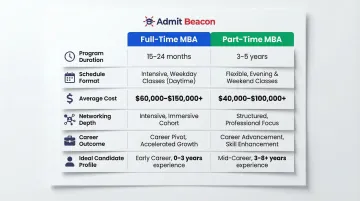
The table below covers the six most decision-relevant dimensions across both MBA formats.
| Dimension | Full-Time MBA | Part-Time MBA |
|---|---|---|
| Program Duration | 18–24 months | 2.5–4+ years |
| Schedule Format | Full-time, on-campus, cohort-based | Evenings/weekends while working full-time |
| Average Cost | $260,000–$270,000+ (tuition + living) | $100,000–$150,000 (tuition only, paid over time) |
| Networking Depth | Tight cohort bonds through shared classes, clubs, and study abroad | Moderate networking with working professionals |
| Career Outcome Strength | Strong for career switchers; summer internship pipeline | Strong for internal advancement; 76% pivot rate at top programs |
| Admissions Selectivity | Highly competitive; GMAT/GRE emphasis | Moderately selective; experience-weighted |
| Ideal Candidate Profile | 2–6 years experience, career switchers, targeting M7/T15 | 5–8 years experience (EMBA: 10–15 years), career accelerators |
Note: This comparison covers traditional part-time/evening programs. Executive MBAs (EMBAs) are a separate variant designed for senior professionals with 10+ years of experience, typically featuring weekend-intensive formats and higher employer sponsorship rates (though only 18% of EMBA students receive full sponsorship in 2025).
What is a Full-Time MBA?
The full-time MBA is an 18–24 month in-person program requiring students to leave the workforce entirely. It's structured around cohorts, with core curriculum in year one, electives and recruiting in year two, and a summer internship between them. Most people picture this format when they think "business school."
Recruiting Access and Career Switching
The summer internship serves as a structured pipeline into new industries or functions, and campus recruiting gives students direct access to firms in consulting, finance, tech, and beyond. Slightly more than half of full-time MBA students plan to switch industries upon graduation, which is why full-time programs are the dominant path for career switchers.
Career outcomes across M7 programs:
- Median base salaries range from $170,000 at Kellogg and MIT Sloan to $185,000 at Stanford GSB
- Signing bonuses consistently hit $30,000 across elite programs
- Access to on-campus recruiting from top consulting firms, tech companies, and investment banks
Tuition, Scholarships, and Total Cost
Full-time programs at top schools exceed $100,000–$200,000 in tuition alone. Annual Cost of Attendance for single students reaches:
- $135,771 at Stanford GSB
- $137,571 at Columbia Business School
- $132,404 at Wharton
- $126,536 at Harvard Business School
Full-time students have significantly better access to merit scholarships and fellowships. But the hidden cost is massive: two years of forgone salary. For a professional earning $120,000 pre-MBA, the foregone income is $240,000. When added to direct costs, the Total Cost of Ownership approaches $450,000–$500,000.
Campus Life and the Immersive Experience
That investment funds more than coursework. Full-time students are residential, moving through the program alongside a cohort, with full access to clubs, case competitions, study abroad, and leadership programs. Nearly three-quarters of global employers believe that in-person/residential MBA programs impart stronger leadership and communication skills than online/hybrid programs, according to the GMAC Corporate Recruiters Survey.
Key immersive elements:
- Cohort-based learning with 400–500 classmates
- 80+ student clubs and professional associations
- International study trips and exchange programs
- Direct access to executive speakers and company presentations

School Availability Matters
Some top schools are exclusively full-time and have no part-time equivalent. Harvard Business School, Stanford GSB, and Dartmouth Tuck only offer the full-time format. This matters for applicants with specific target schools—if your dream school doesn't offer part-time, the format decision is made for you.
Use Cases: Who Should Choose Full-Time?
Ideal candidates:
- Professionals 2–6 years into their careers who want to pivot industries, functions, or geographies and need the recruiting infrastructure to make that leap
- Candidates targeting elite M7 or T15 programs where brand prestige and networking density are maximized in the full-time format
What is a Part-Time MBA?
The part-time MBA has two main formats, both designed to keep you employed while you earn the degree:
- Evening & Weekend MBA — for professionals roughly 3–8 years into their careers, attending classes outside work hours
- Executive MBA (EMBA) — for senior professionals with 10+ years of experience, often employer-sponsored
Both formats let students keep their jobs. They differ mainly in experience level, cohort dynamics, and cost structure.
Financial and Career Continuity Advantage
Students can apply coursework directly on the job — a built-in advantage over full-time programs. They also maintain their salary throughout, and many employers offer some form of tuition support. That said, 52.1% of EMBA students are entirely self-funded, with only 18% receiving full sponsorship according to the 2025 EMBA Council Survey.
Financial benefits:
- No foregone salary (continue earning $100,000–$200,000+ annually)
- Tuition paid over 3–4 years, easing cash flow
- Potential employer reimbursement (30% receive partial sponsorship)
- Total program cost: $100,000–$150,000 spread over multiple years
Flexibility Mechanics
Classes are held evenings, weekends, or online/hybrid depending on the school. Some programs allow 3–6 years to complete the degree; some offer accelerated tracks. Part-time students typically skip the summer internship since they're already employed.
Program structures:
- Evening cohorts meet 2–3 nights per week, typically 6:00–9:30 PM
- Weekend cohorts run Friday evenings and all day Saturday
- Hybrid options blend in-person intensives with online coursework
- Accelerated tracks compress the degree into 24–30 months instead of 36–48
Career Impact: The Pivot Myth Debunked
Part-time MBAs are better suited for career advancement within an existing trajectory—promotions, expanding scope, building credibility—but the data shows they're also effective for career switchers. At Chicago Booth, 76% of part-time students seeking a career change successfully made one, with 56% moving to an entirely new organization. At Berkeley Haas, 87% changed their level, company, or both while still in the program, and 49% pivoted to a new function or industry.
Salary outcomes:
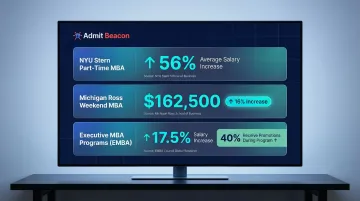
- NYU Stern reports a 56% average salary increase by the end of the program
- Michigan Ross Weekend MBA graduates reported a median salary of $162,500, a 16% increase
- EMBA graduates see a 17.5% salary increase from program start to completion, with 40% receiving promotions during the program
School Availability
Many top schools offer part-time programs, including:
- Chicago Booth (Evening and Weekend formats)
- Northwestern Kellogg (Evening & Weekend)
- Berkeley Haas (Evening & Weekend)
- NYU Stern (Part-Time)
- Michigan Ross (Weekend)
However, some flagship programs do not offer part-time formats (HBS, Stanford GSB, Tuck, MIT Sloan for traditional part-time). If your target list includes schools that only offer full-time programs, the format question is partly settled.
Use Cases: Who Should Choose Part-Time?
Ideal candidates:
- Professionals on an upward career track who want to deepen business knowledge without pausing income
- Those who cannot — or prefer not to — step away from their current role or employer
- Professionals with 7+ years of experience who would be at the older end of a full-time cohort and would be a stronger fit in a part-time or EMBA program
Full-Time MBA vs Part-Time MBA: Which One Is Right for You?
The right format is not about prestige—it's about fit. Walk through these five practical decision filters and apply them to your own situation.
Decision Filter 1: Career Goal — Pivot or Advance?
If the goal is a fundamental career switch (new industry, new function, new geography), a full-time program's internship pipeline and recruiting access make it the stronger path. Advancing within the same track—a promotion, a leadership role, expanding skills—is where a part-time program delivers without interrupting momentum.
Choose full-time if:
- You're moving from engineering to consulting
- You're switching from non-profit to tech
- You need structured recruiting to break into investment banking
- You're relocating internationally and need a new network
Choose part-time if:
- You're moving from individual contributor to management in your current company
- You want to build credibility for a promotion you're already tracking toward
- You're expanding into adjacent functions (operations to strategy, marketing to product)
- Your company values the MBA for internal advancement
Decision Filter 2: Years of Experience and Age
Full-time programs are typically built for candidates with 2–6 years of post-undergraduate experience, with an average age of 27–28 at top programs. Wharton, Chicago Booth, and Harvard Business School all report an average of 4.9 to 5 years of pre-MBA experience.
Part-time MBA students skew slightly older with more experience:
- Chicago Booth's Part-Time MBA reports a median of 6 years of work experience
- Berkeley Haas EWMBA reports a median of 7 years of experience and a median age of 31
EMBA cohorts average 13–15 years of experience:
- Chicago Booth's EMBA reports an average of 15 years
- Wharton's EMBA averages 13–14 years
- Global EMBAC average is 15 years of professional experience with an average age of 39
Candidates significantly beyond the 2–6 year range may find their profiles better positioned in part-time or EMBA cohorts where their experience is a strength, not an outlier.
Decision Filter 3: Financial Reality
Full-time requires forgoing income while paying tuition, offset by scholarship potential and faster post-MBA earnings. Part-time preserves your salary while you pay per-credit tuition, often with employer support. Neither format is automatically cheaper — long-term ROI matters more than upfront cost.
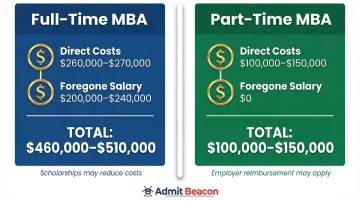
Full-time total cost of ownership:
- Direct costs: $260,000–$270,000 (tuition + living)
- Foregone salary: $200,000–$240,000 (two years at $100,000–$120,000)
- Total: $460,000–$510,000
- Offset by: Merit scholarships, fellowships, faster career progression
Part-time total cost of ownership:
- Direct costs: $100,000–$150,000 (tuition only, spread over 3–4 years)
- Foregone salary: $0 (you continue working)
- Total: $100,000–$150,000
- Offset by: Employer reimbursement (30% receive partial), immediate salary bumps during program
Decision Filter 4: Target School Availability
Not every school offers both formats. If your target list includes schools that only offer full-time programs (HBS, Stanford GSB, MIT Sloan, Tuck), the format question is partially answered for them. Conversely, if you target a school with a strong part-time program (Kellogg Evening & Weekend, Booth Flex, Haas EWMBA), you may get equivalent brand value with more flexibility.
Exclusively full-time (no part-time MBA):
- Harvard Business School
- Stanford Graduate School of Business
- Dartmouth Tuck
- MIT Sloan (offers EMBA but no traditional part-time)
Strong part-time options:
- Chicago Booth (Evening, Weekend)
- Northwestern Kellogg (Evening & Weekend)
- Berkeley Haas (Evening & Weekend)
- NYU Stern (Part-Time)
- Michigan Ross (Weekend)
Decision Filter 5: Application Strategy Differs by Format
Full-time applications are more competitive, weight GMAT/GRE scores heavily, and require a sharp narrative around career change credibility. Part-time applications lean on demonstrated performance and a clear plan for balancing work and study — still demanding, just differently.
Application differences:
| Element | Full-Time | Part-Time |
|---|---|---|
| GMAT/GRE weight | High (often 700+ for M7) | Moderate (experience weighted more heavily) |
| Career narrative | Must justify leaving workforce | Must justify balancing work + study |
| Recommendation focus | Leadership potential, pivot readiness | Current performance, promotion trajectory |
| Interview emphasis | Why now? Why this career change? | How will you manage workload? Why this program? |
Whichever format you pursue, the application itself needs to be built around your specific story — not a generic framework. That's where working with an admissions consultant like Admit Beacon makes a practical difference: every narrative is built for the individual, not the average applicant.
Conclusion
Full-time and part-time MBAs are both legitimate paths to the same credential, but they suit different career moments. If you need to pivot industries, build a network from scratch, or step back and commit fully, the full-time path makes sense. If you're building momentum in a career you want to advance — without leaving it — part-time works. The right format is the one that matches your timeline, your finances, and your actual goal.
Once the format question is settled, the application itself becomes the next critical decision point. The strength of your essays, the clarity of your career narrative, and the strategy behind your school list can make or break your admissions outcome. Explore Admit Beacon's Knowledge Base covering the top 25 MBA programs, or reach out for a personalized strategy session to build an application with depth and direction.
Frequently Asked Questions
Is it better to do a full-time or part-time MBA?
It depends on career goals: full-time is better for career pivots requiring internship and recruiting access, while part-time suits professionals advancing within their current track who can't or won't leave the workforce. Neither format is universally superior.
Are full-time MBAs worth it?
Full-time MBAs offer strong ROI for career switchers and those targeting top-tier recruiting pipelines. The full cost includes forgone income ($200,000+) and tuition ($260,000+), so the target outcome — a new career or higher compensation — needs to justify a $450,000+ total investment.
Is a part-time MBA respected?
Yes. Part-time MBAs from accredited, top-ranked schools are fully respected by employers — both formats lead to the same degree.
Do employers care if your MBA is online?
According to the GMAC Corporate Recruiters Survey, nearly three-quarters of employers believe in-person programs convey stronger leadership and communication skills. However, program reputation and school brand often matter more than format to most hiring managers.
Is 30 too old for a full-time MBA?
No, 30 is not too old, but the average age at most full-time programs is 27–28. Applicants who are 30–33 with strong profiles are admitted regularly, though those significantly older may find part-time or EMBA programs a better cohort fit.
What is an evening and weekend MBA?
An evening and weekend MBA is a part-time format where working professionals attend classes outside business hours — evenings or weekends. This allows them to maintain full-time employment while completing the degree, typically over 2.5 to 4 years.