Introduction
Choosing between an online MBA and an on-campus MBA is one of the most consequential decisions an applicant makes. The format affects career trajectory, network access, and return on investment — and the right answer is rarely the same for any two people.
The decision has grown genuinely difficult. According to the AACSB's 2025 Enrollment Trends Report, fully online MBA enrollment climbed from 30% of all MBA enrollments in 2020–21 to 38% in 2024–25, while face-to-face enrollment dropped to 46%.
Accredited institutions and improved learning technology have given online MBAs real legitimacy — a genuine choice where one barely existed five years ago.
Key Takeaways
- Online MBAs let you keep your salary and job title while earning the degree; on-campus programs mean two years out of the workforce
- Career outcomes: On-campus MBAs win for industry pivots and elite recruiting; online MBAs accelerate advancement within your current field
- Cost: On-campus programs run $400k+ all-in (tuition plus foregone income); top online programs cost $94k–$146k
- Prestige access: M7 and other top-tier programs remain exclusively on-campus, full-time experiences
- The right choice hinges on your career goals, life stage, target schools, and whether you're switching industries or moving up within one
Online MBA vs On-Campus MBA: Quick Comparison
Cost
Online MBA: Tuition ranges from $94k–$147k at top programs like Indiana Kelley Direct, CMU Tepper, and USC Marshall. Students avoid room, board, and relocation costs while continuing to earn their current salary, substantially reducing opportunity cost.
On-Campus MBA: Higher total investment when factoring in living expenses and foregone income. At Stanford GSB, the annual cost of attendance is $135,771 including housing and living expenses. Over two years, students face $60k–$80k in living costs plus two years of lost wages, often adding $200k+ to the total price tag. That said, elite programs tend to deliver stronger average salary uplifts post-graduation.
Flexibility
Online MBA: Asynchronous or hybrid formats allow students to study around work and family commitments. That said, top programs like Kelley Direct and Tepper now require periodic on-campus residencies and weekly live sessions. This is no longer purely self-paced learning.
On-Campus MBA: Fixed class schedules, in-person attendance requirements, and full-time commitment. Very limited ability to maintain employment simultaneously, though some part-time on-campus evening/weekend programs exist.
Networking Depth
Online MBA: Digital networking tools, alumni communities, and virtual collaboration exist, but relationship-building lacks the organic depth of daily in-person interaction. You'll connect with peers, though rarely through the spontaneous moments — shared late-night study sessions, hallway conversations — that tend to produce lasting professional relationships.
On-Campus MBA: Daily peer interaction, club activities, recruiting events, and campus culture create a network that compounds over a career. The cohort-based model builds relationships through lived, shared experience, not through scheduled video calls alone.
Career Outcomes
Online MBA: Best suited for vertical advancement within your current industry or employer.
- Indiana Kelley Direct: 79% of students started a new job or received a promotion six months before graduation
- CMU Tepper: 53% of online graduates received promotions; 69% received raises directly attributed to their degree
On-Campus MBA: Stronger pipeline for career pivots, consulting and finance recruiting, and roles that rely heavily on school brand. Elite programs deliver median starting salaries of $175k+ with $30k signing bonuses, primarily through on-campus recruiting infrastructure.
Admission Requirements
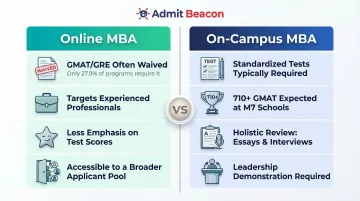
Online MBA: More likely to waive GMAT/GRE requirements — only 27.9% of ranked online MBAs now require standardized tests. Programs often target applicants with significant work experience and slightly less competitive profiles at comparable institutions.
On-Campus MBA: Typically more rigorous standardized test and selectivity requirements, especially at top-ranked programs. Holistic evaluation includes essays, interviews, and demonstrated leadership potential, with high average GMAT scores (710+ at M7 schools).
What is an Online MBA?
An online MBA is a fully accredited graduate business degree delivered primarily through digital platforms, allowing students to earn the same credential as on-campus counterparts without relocating or leaving the workforce. What began as a niche alternative has evolved into a mainstream option—driven by learning technology improvements, employer attitudes that have shifted markedly since 2020, and a broad acceleration of remote education.
Top online MBA platforms now offer live sessions, virtual case studies, real-time peer collaboration tools, and interactive simulations that replicate the rigor of in-person classrooms. The format has come a long way from recorded lectures and mailed coursework.
Core benefits include:
- Maintain your current salary and benefits while adding credentials
- Access nationally ranked programs without relocating or uprooting your family
- Apply classroom concepts directly to your current job role in real time
Format variations matter:
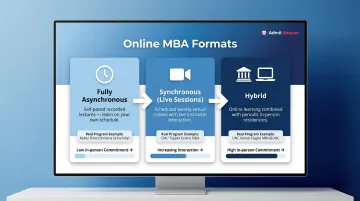
- Fully asynchronous (self-paced): Watch recorded lectures and complete assignments on your schedule
- Synchronous (live weekly sessions): Attend scheduled virtual classes with real-time interaction—increasingly common at top programs
- Hybrid programs: Blend online learning with periodic on-campus residencies for immersive experiences, networking, and team projects
For example, Indiana Kelley Direct requires an average of two live 75-minute evening sessions per week, plus mandatory "Kelley On Campus" and "Kelley On Location" immersions. CMU Tepper's Online Hybrid MBA features live classes two evenings weekly and mandates in-person "Access Weekends" in Pittsburgh and other major cities.
Who Should Choose an Online MBA?
Online MBAs are best suited for professionals aiming to advance within their current industry or company. Think of a senior engineer targeting a VP role, a consultant seeking a promotion, or a finance professional adding credentials without stepping away from work. If you're pursuing a complete career pivot into a new industry, an on-campus program is typically the stronger play.
You're an ideal online MBA candidate if:
- You have a clear upward trajectory in your current field
- You cannot afford to step away from work for two years
- You're geography-bound due to family, visa status, or employer ties
- You're targeting programs outside the M7/T15 tier where on-campus experience is less differentiated
- You want to apply new skills immediately in your current role
Profile snapshot: Online MBA students average 7–13 years of work experience compared to 5–6 years for full-time students. At BU Questrom, the average online student is 37–38 years old with 12–13 years of experience. At UNC Kenan-Flagler, online students average 10 years of experience versus 5 years for full-time students.
What is an On-Campus MBA?
An on-campus MBA is a full-time graduate business degree, typically two years, where students leave the workforce for a structured, cohort-based academic experience. Every M7 and top-15 program — Harvard, Wharton, Stanford, Kellogg, Booth, Columbia, MIT Sloan — is built on this residential model.
This format is inseparable from the institutions that define MBA prestige. The on-campus experience combines peer learning across industries and geographies, exclusive recruiting access from employers like McKinsey, Goldman Sachs, and Google, and an alumni network built through years of shared experience — not just a shared login.
Core benefits include:
- Daily interaction with peers from consulting, tech, finance, non-profits, and startups
- Exclusive recruiting pipelines: on-campus career fairs, company presentations, and interview access
- Clubs, case competitions, global treks, and social events that build lifelong relationships
- Summer internships that function as 10-week job interviews for a new industry
Format variations within on-campus:
- Full-time two-year programs (the standard U.S. model)
- Accelerated one-year programs, common at INSEAD, LBS, Oxford, and Cambridge
- Part-time evening/weekend programs for professionals who can't step away from work
- Executive MBA (EMBA) formats for senior professionals with 10+ years of experience, typically meeting monthly or bi-weekly
Who Should Choose an On-Campus MBA?
On-campus MBAs are particularly effective for career-switchers — someone moving from engineering to product management, from the military into consulting, or from a regional firm into global investment banking. The school's brand, on-campus recruiters, and peer network accelerate that transition in ways an online program cannot replicate.
You're an ideal on-campus MBA candidate if:
- You're targeting a career pivot into consulting, finance, or tech
- You're applying to M7 or T15 programs where on-campus recruiting drives ROI
- You can step away from work for two years, financially and professionally
- You want summer internships as a structured bridge into a new field
- In-person networking — spontaneous, deep, relationship-building — matters to your goals
Career outcomes data: The numbers reflect what these recruiting pipelines deliver:
| School | Median Base Salary | Signing Bonus | Top Destinations |
|---|---|---|---|
| Stanford GSB | $185,000 | $30,000 | Tech, VC, Consulting |
| Wharton | $175,000 | $30,000 | Finance (36%), Consulting (25%) |
| MIT Sloan | $175,000 | — | Consulting (32%), Tech (23%) |

For career-switchers targeting these outcomes, the on-campus recruiting infrastructure is often the deciding factor — not the curriculum.
Online MBA vs On-Campus MBA: Which is Right for You?
The decision hinges on two primary questions: What are your career goals (advancement vs. pivot)? And what does your life currently allow (full commitment vs. continued employment)? Neither format is universally superior—the right answer depends on the intersection of ambition, access, and life stage.
Choose an Online MBA If:
- You have a clear career trajectory within your current industry and want to accelerate it
- You cannot step away from work due to financial obligations, family commitments, or visa restrictions
- You're targeting programs outside the M7/T15 tier where the on-campus experience is not as differentiated
- You want to apply classroom learning immediately to your current role
- You value flexibility and the ability to study around your existing life
Choose an On-Campus MBA If:
- You're targeting a career pivot into consulting, finance, tech, or another competitive sector
- You're applying to elite programs (Harvard, Stanford, Wharton, Booth, Kellogg, MIT Sloan, Columbia) where the in-person experience is baked into the program's value proposition
- You can afford the opportunity cost of two years without income
- You want access to on-campus recruiting, summer internships, and the full depth of peer networking
- You're willing to relocate and commit fully to the MBA experience
The Prestige Factor: What the Data Shows
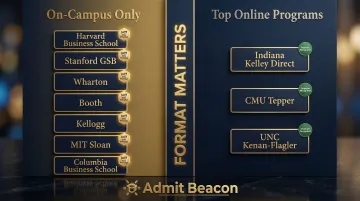
None of the M7 programs offer a full-time online MBA equivalent to their flagship residential programs. Harvard Business School, Stanford GSB, Wharton, Chicago Booth, Kellogg, MIT Sloan, and Columbia Business School are exclusively on-campus, full-time experiences. If securing a credential from these institutions is your primary goal, you must commit to the on-campus format.
That said, online MBAs are far from a fallback. Programs like Indiana Kelley Direct, CMU Tepper, and UNC Kenan-Flagler carry genuine weight with employers. If your school list includes M7 institutions, though, the format question answers itself.
How Admit Beacon Helps You Decide
Whichever format fits your situation, the application strategy you build around that choice is what determines outcomes. Admit Beacon works with applicants to identify which programs match their format needs, career narrative, and profile — then develops applications tailored to each school's specific culture and values. The goal is an application that reflects who you actually are, not a templated version of what admissions committees expect to see.
Conclusion
This is not an either/or debate with a universal winner. The best MBA is the one that matches your career intent, life circumstances, and school access. The wrong choice isn't picking online over on-campus or vice versa—it's defaulting to one format simply out of habit, fear, or incomplete information.
Connect the key factors—career goals, networking needs, school prestige tier, flexibility requirements—back to real outcomes: salary growth, career pivots, alumni access, and long-term ROI.
- Advancing within your current field? An online MBA offers stronger financial value and immediate applicability to your day-to-day work.
- Switching careers or targeting elite programs? The on-campus experience is the more viable path — for the network, the recruiting access, and the credential signal.
Treat this as a business decision. Map the format to your five-year target, stress-test it against your financials, and choose based on evidence — not the format everyone around you happened to pick.
Frequently Asked Questions
Is it better to get an MBA online or in person?
Neither is universally better. Online works best for career advancement within an existing field, while on-campus is better for career pivots and elite-program access. The right choice depends on your individual goals, target schools, and life flexibility.
Are online MBAs as respected as on-campus MBAs?
Online MBAs from accredited, reputable programs are increasingly respected by employers, especially for non-consulting/banking roles. However, on-campus degrees from top-ranked programs still carry stronger brand recognition in highly selective hiring pipelines.
Do employers care if your MBA is online or in person?
Employer attitudes are shifting—GMAC research shows 55% of global employers now value online and in-person degrees equally. However, in sectors like management consulting, investment banking, and top tech companies, school brand and on-campus recruiting relationships still carry real weight.
Are online MBA programs easier to get into than on-campus programs?
It depends on the school. An online MBA at a top-ranked institution can be just as selective as its on-campus counterpart, while online programs at regional schools may be more accessible. Many online programs also waive GMAT/GRE requirements for experienced applicants.
What is the true cost difference between an online and an on-campus MBA?
Tuition alone may be similar, but on-campus students also face living expenses, relocation, and two years of foregone income—making online programs considerably cheaper in total. On-campus programs, however, often yield higher salary uplifts at top-tier schools, especially for career-switchers.
Can you network effectively in an online MBA program?
Online programs offer virtual networking, alumni communities, and digital collaboration. That said, the depth and spontaneity of in-person connections—formed through shared classes, events, and campus life—remain a structural advantage of on-campus programs.