Introduction
Most college seniors don't realize they can lock in an MBA spot at Harvard before ever setting foot in the workforce—and that this window closes faster than most realize. The application deadline for Harvard Business School's 2+2 program typically falls in April of senior year, giving you a narrow window to make one of the most consequential decisions of your early career.
The deferred MBA path offers a rare strategic advantage: a confirmed seat at HBS secured before you begin your professional journey. But applying too early or for the wrong reasons can hurt more than help. Understanding whether this path fits your actual goals—not just your resume—is what separates a strong application from a premature one.
This guide breaks down what the HBS 2+2 program is, how it works, whether it aligns with your goals, and what it takes to build a competitive application.
Key Takeaways
- The HBS 2+2 lets college seniors secure an MBA spot before graduating, then work 2–4 years before enrolling
- Acceptance rate is approximately 8–12%, making it more selective than the standard HBS MBA program
- Best suited for students with a clear long-term vision, demonstrated leadership, and a compelling personal story
- Essays and interviews carry the most weight — authentic, specific narratives consistently outperform polished but generic ones
- Locks in your HBS seat now, letting you build real-world experience without the pressure of reapplying mid-career
What is the HBS 2+2 Deferred MBA Program?
The HBS 2+2 program is Harvard Business School's deferred enrollment pathway, open to final-year undergraduate and eligible graduate students. Admission is granted before professional experience begins, with matriculation deferred 2–4 years into the future. You secure your seat now, gain work experience, then join the MBA program when you're ready.
The Deferred Path vs. The Direct MBA Path
The direct MBA path requires applicants to apply the year before they plan to enroll, typically with 2–6 years of work experience already in hand. The deferred path offers admitted students the security of a confirmed MBA seat before entering the workforce.
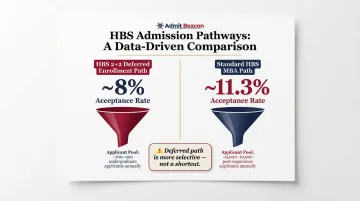
Here's a counterintuitive fact: the deferred path is more competitive than the direct path, not less. Third-party sources estimate the 2+2 acceptance rate at approximately 8%, while the standard HBS MBA acceptance rate sits at 11.3% for the Class of 2027. The deferred path is not an easier back door—it's a more selective one.
Why This Program Exists
HBS designed the 2+2 structure to capture high-potential candidates early while ensuring they still build the real-world context that makes the MBA valuable. Students who enter with practical work experience get significantly more from the curriculum.
The case method relies on exchanging perspectives—students draw on their professional experiences when analyzing cases with peers. The 2+2 program creates a pathway for promising undergraduates to eventually bring those experiences to the classroom.
How the HBS 2+2 Program Actually Works
Understanding eligibility, application mechanics, and what happens after admission is essential before you invest time in this process.
Who is eligible:
- Final-year undergraduate students
- Students in joint bachelor's/master's degree programs
- Full-time master's students who went directly from undergrad to grad school and have not held full-time professional positions (internships and co-ops don't disqualify you)
Who is not eligible: PhD, law school, and medical school students must apply through the regular MBA admissions process.
Application Components
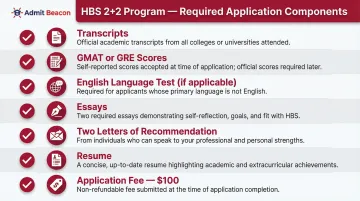
The application mirrors the standard HBS MBA application—same rigor, different timeline. Required materials include:
- Transcripts from all undergraduate and graduate institutions
- GMAT or GRE scores (HBS has no preference between the two)
- English language test (TOEFL, IELTS, PTE, or Duolingo) for international students whose undergraduate instruction was not in English
- Essays specific to 2+2 deferred applicants
- Two letters of recommendation
- Resume
- Application fee of $100 (reduced from the standard MBA fee; need-based and active-duty military waivers available)
The application deadline is typically in April of senior year. HBS extends interview invitations to a select portion of applicants.
The Deferral Period
After admission, accepted students pay a $1,000 deposit to secure their place and must withdraw from all other MBA programs, including deferred ones. You then enter the workforce for a minimum of 2 years and a maximum of 4 before enrolling. Extensions to 3 or 4 years require HBS approval on a case-by-case basis.
The MBA experience itself is identical to that of direct-path students: same classes, same scholarships, same fellowships, same cohort integration. Once 2+2 students begin their MBA, they are fully integrated into the HBS community with all other students. There is no "second-class" deferred track once enrolled.
Understanding who HBS wants to admit can sharpen how you frame your application. HBS has stated a preference for students from lower socioeconomic backgrounds, first-generation students, and those entering underrepresented industries — and this shapes how the admissions committee reads every file.
Is a Deferred MBA Program Right for You?
This is a decision guide, not a checklist. The question is not whether you are qualified, but whether the deferred path aligns with where you are going and why.
Signs It Is a Strong Fit
The deferred path is most powerful for students who already have a directional sense of their long-term career mission. You don't need a rigid five-year plan, but you should be able to articulate a coherent narrative about the kind of leader you want to become and where an MBA fits in that arc. Applicants who cannot yet articulate this often struggle in the interview stage.
Practical benefit of locking in a seat: Removing the stress of reapplying mid-career—often while working 70+ hours a week in finance or consulting—is a real advantage. The deferred path eliminates that pressure entirely.
Factors That Should Give You Pause
Not every strong candidate is ready for this path. A few situations that should prompt honest reflection:
- Applying for prestige, not purpose — Admissions committees identify applicants chasing brand recognition quickly. Applying without a clear "why" rarely survives the interview stage.
- Unresolved school preference — Accepting a deferred offer means withdrawing from all other MBA programs. Students who are still comparing HBS to Wharton or Stanford should resolve that before depositing.
- Premature timing — A rejected deferred application can complicate future direct-admit applications to the same school. Applying before your narrative is ready carries real risk.
HBS evaluates deferred candidates on demonstrated leadership, intellectual strength, and a clearly articulated sense of mission — not just academic credentials. The strongest profiles show a specific problem they want to solve and a reasoned case for why the MBA accelerates that path.
What It Takes to Get Into HBS 2+2
With an acceptance rate lower than the regular MBA path, the HBS 2+2 demands a holistic application that goes beyond test scores and GPA. This section breaks down the components that actually influence admissions decisions.
The Essay: Your Most Important Asset
Essays are the single highest-leverage part of the application. They are the only place where you can tell a story no one else can tell. The goal is not to list achievements—that's what the resume is for—but to humanize those achievements and convey why you are the way you are, what drives you, and what kind of impact you intend to create.
What separates strong essays from weak ones:
- Vulnerability, specificity, and authenticity consistently outperform polished but generic essays
- Admissions readers process thousands of applications and immediately recognize templated narratives
- The essays that stand out are the ones that feel like a real person wrote them
Recommendations That Advocate, Not Evaluate
The quality of the relationship between applicant and recommender matters more than the recommender's title. Recommenders need to be specific, enthusiastic advocates who can speak to concrete moments of performance, growth, and character—not vague endorsers with impressive job titles.
How to prepare recommenders:
- Share the story you want to tell
- Highlight the strengths you want emphasized
- Provide specific examples the recommender can draw on
- Do this without ghostwriting the letter
Test Scores and GPA in Context
GMAT and GRE scores matter but are not gatekeepers on their own. A wide score range exists in every admitted class. A lower test score can be offset by a uniquely compelling narrative, exceptional GPA, or an application profile that is differentiated.
HBS Class of 2027 medians provide a realistic benchmark:
- GMAT Focus Edition: 685 (middle 80% range: 645–735)
- GMAT (10th Edition): 730 (middle 80% range: 690–770)
- GRE Verbal: 164 (middle 80% range: 158–168)
- GRE Quantitative: 164 (middle 80% range: 159–169)
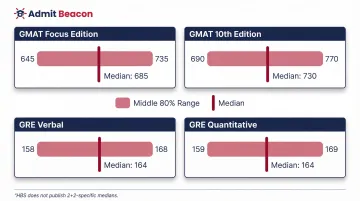
HBS does not publish 2+2-specific medians, so these overall MBA figures are your best reference point.
The Interview: Authenticity Over Performance
The interview is a fit and authenticity check, not a competence test. By the time you are invited, the committee believes you belong. The interview is their way of confirming that the person in your essays is the real you.
Approach it as a conversation:
- Resist the urge to perform
- Stay grounded in the narrative you have already built
- Answer the simple question being posed, not the question you wish they had asked
- Former HBS Managing Director of Admissions Dee Leopold noted that a common reason for interview rejection is when an applicant sounds "scripted" or attempts to get all their points across rather than cleanly answering the question
Building a Profile That Stands Out Before You Apply
The most competitive 2+2 applicants have typically spent their undergraduate years building a distinctive profile—leadership in meaningful roles, internships in competitive or unusual industries, personal projects or research that reflect genuine curiosity. This is not about resume padding but about having a real story to tell.
If you feel your profile is underdeveloped, the work is less about adding experiences and more about framing the ones you have. That's where Admit Beacon's profile assessment and narrative-building process helps — turning existing experiences into a story with a clear through-line.
How Admit Beacon Can Help
Admit Beacon is a personalized MBA admissions consulting firm that deliberately limits client intake to ensure every applicant receives depth, strategy, and genuine attention—not mass-produced advice. The firm works with candidates applying to HBS, Stanford GSB, Wharton, and other top programs.
For 2+2 applicants specifically, Admit Beacon covers:
- Resume positioning that highlights leadership and impact
- School selection strategy to identify the best program fit
- Career narrative development that connects past experiences to future goals
- Essay storyboarding that uncovers your unique story
- Mock interview preparation to build confidence and authenticity
Niketa, the lead consultant, dedicates roughly 40% of total application effort to offline comments and reviews — well beyond what most consulting engagements include.
Admit Beacon holds memberships in AIGAC, AIIEC, and TOC, ensuring Niketa stays current on evolving admissions criteria and school-specific shifts. The firm's network of alumni and current students at target schools offers ground-level perspective on what each program actually values.
Frequently Asked Questions
Does Harvard offer a deferred MBA program?
Yes, Harvard Business School offers the 2+2 Deferred Enrollment Program, open to final-year undergrad and eligible graduate students who secure admission before entering the workforce and enroll after 2–4 years of professional experience.
What is the acceptance rate for Harvard's deferred MBA program?
The HBS 2+2 acceptance rate is approximately 8–12% based on third-party reporting. This figure is not officially published by HBS, so verify the most current data from credible sources before making application decisions.
Are Harvard's deferred MBA admissions harder to get into than the regular MBA?
Yes. The 2+2 acceptance rate of roughly 8–12% sits below the standard HBS MBA rate of approximately 11.3%, making the deferred path more selective — not a shortcut to admission.
Is the HBS 2+2 program worth it?
For candidates with a clear mission and demonstrated leadership, it's an exceptional option. It eliminates future reapplication stress and locks in one of the world's most valuable graduate credentials early in your career.
Who is eligible to apply for the HBS 2+2 program?
Final-year undergrad students, students in joint BA/MA programs, and full-time master's students who have not yet accumulated professional work experience are eligible. PhD and MD students are not eligible. International students must submit English proficiency scores if applicable.
What should you do during the deferral period between acceptance and enrollment?
Admitted students are expected to work full time during the 2–4 year deferral window, gaining professional experience that will enrich their MBA. HBS views this period as a critical part of the program's design.