Introduction: Harvard Business School MBA Essays 2025-2026 — What's New and What's at Stake
Harvard Business School made a significant shift for the 2025-2026 cycle by replacing its long-standing single open-ended essay with three shorter, focused prompts—each mapped to one of HBS's three core admission criteria: Business-Minded, Leadership-Focused, and Growth-Oriented. The change reframes how HBS evaluates candidates, not just how they're asked to respond.
Many applicants assume shorter word limits mean easier writing. The opposite is true. Tight constraints demand precision, self-awareness, and purposeful storytelling. You can't hide behind generalities or elaborate context—every word has to pull weight.
This guide breaks down each essay prompt, explains what the admissions committee actually looks for, and shows you how to build an authentic narrative across all three essays. We'll cover the three core prompts, the Career Goals short answer, the Post-Interview Reflection, and the Re-Applicant Essay—plus the most common mistakes that sink otherwise strong applications.
TLDR:
- HBS replaced one open essay with three short prompts aligned to Business-Minded, Leadership-Focused, and Growth-Oriented criteria
- Shorter word limits (250-300 words) require extreme precision and authentic storytelling, not resume recaps
- Each essay must reveal a distinct facet of who you are — repeating the same experience signals a narrow profile
- Cross-essay coherence matters — your three responses should form one layered, connected narrative
What HBS Is Actually Looking For (Before You Write a Single Word)
The admissions committee at HBS uses the same three criteria to evaluate every part of your application — not just the essays. HBS's official admissions page names them explicitly: Business-Minded, Leadership-Focused, and Growth-Oriented. Understanding what each one actually means shapes how you write, select stories, and frame your entire profile.
| Criterion | What HBS Means | What They Look For |
|---|---|---|
| Business-Minded | "Passionate about using business as a force for good—who strive to improve and transform companies, industries, and the world" | Evidence of interpersonal skills, quantitative abilities, and plans to create change through business |
| Leadership-Focused | "Aspire to lead others toward making a difference in the world... recognize that to build successful organizations, they must develop and nurture diverse teams" | Leadership impact in extracurriculars, community initiatives, or professional work |
| Growth-Oriented | "Desire to broaden their perspectives through creative problem solving, active listening, and lively discussion" | Ways you have grown, developed, and how you engage with the world around you |
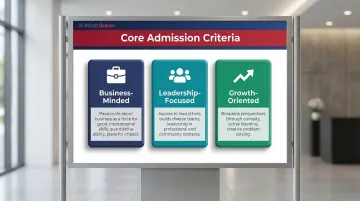
These criteria tie directly to HBS's mission: "We educate leaders who make a difference in the world." Each essay is an opportunity to show your values and decision-making patterns — not simply list credentials or accomplishments.
HBS explicitly expects applicants to draw on different experiences in each essay. Each response should reveal a new, distinct facet of who you are. An applicant who uses the same story or theme across multiple essays presents a one-dimensional picture.
Building a layered narrative — one where each essay adds something the others don't — is the strategic challenge most applicants underestimate. Admit Beacon's story-first approach helps applicants surface distinct moments from their professional and personal lives that map naturally to each criterion, so the full application shows depth rather than repetition.
Essay 1 — Business-Minded: Please Reflect on How Your Choices Have Influenced Your Career Path and Aspirations (300 words)
The Prompt: Please reflect on how your choices have influenced your career path and aspirations. (300 words)
What "Business-Minded" Really Means:
According to HBS, being business-minded isn't just about commercial acumen—it's about "passion for using business as a force for good and solving meaningful problems." The admissions committee will look for evidence of your interpersonal skills, quantitative abilities, and the ways you plan to create impact through business in the future.
What This Essay Must Do:
Within 300 words, you need to accomplish three things simultaneously:
- Convey career motivation—the "why" behind your professional journey
- Connect past choices to future aspirations in a coherent thread
- Show a clear point of view on impact, not just a chronological resume recap
How to Approach It:
Anchor your essay in one or two specific anecdotes or pivotal decisions rather than listing every role. The goal is to show the "why" behind your career path, not just the "what."
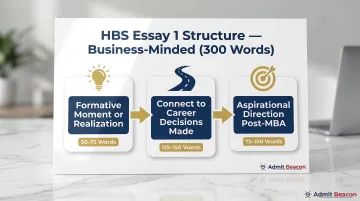
Here's one structure that works well within the 300-word constraint:
- Open with a formative moment or realization (50-75 words): What sparked your interest in your field or shaped how you think about business impact?
- Connect it to career decisions made (125-150 words): How did that realization influence specific choices—roles you took, projects you pursued, skills you developed?
- Close with aspirational direction (75-100 words): Where does this logic lead you post-MBA, and what impact do you want to create?
Common Mistake to Avoid:
Don't treat this as a pure goals essay. While your post-MBA direction should be clear, the emotional core is about how experiences have shaped who you are becoming professionally. The admissions committee wants to understand your decision-making patterns and what drives you—your five-year plan is secondary.
Keep your voice authentic rather than formulaic. Avoid hollow openers like "I have always been passionate about" or "business has always been my true calling." Show motivation through specific moments and concrete decisions instead.
Essay 2 — Leadership-Focused: What Experiences Have Shaped How You Invest in Others and How You Lead? (250 words)
The Prompt: What experiences have shaped how you invest in others and how you lead? (250 words)
What "Investing in Others" Means:
"Investing in others" is deliberately broad—it's not limited to formal mentorship. It includes any action that created meaningful impact on another person's growth, access, or opportunity. HBS notes that "Leadership takes many forms in many contexts—you do not have to have a formal leadership role to make a difference."
What the Admissions Committee Is Assessing:
This essay evaluates collaborative leadership style, empathy, and the ability to enable others. It's a strong fit for stories that show personal maturity, not just authority or achievement.
Recommended Structure for 250 Words:
- Establish context (50-75 words): What experiences shaped your leadership philosophy? This could be a moment when someone invested in you, or when you witnessed the impact of enabling others.
- Focus on one vivid example (125-150 words): Describe a specific instance where you invested in someone else. What did you do for them specifically? What did you make possible, enable, or change?
- Close with lasting impact (50-75 words): How has this shaped your approach to leadership going forward?
What to Emphasize:
Don't write purely about leading a team toward a business outcome. The focus should be on what you did for other people specifically—for example:
- Mentoring a struggling colleague through a critical transition
- Advocating for someone's promotion or visibility
- Creating access or opportunities for junior team members
- Enabling someone to build a skill they didn't have before
Stories from personal life—advocacy work, community leadership, navigating institutions on behalf of others—are equally compelling. What the admissions committee wants to see is leadership as service: the moments where you made someone else's growth possible, not just your own.
Essay 3 — Growth-Oriented: Curiosity Can Be Seen in Many Ways. Please Share an Example of How You Have Demonstrated Curiosity and How That Has Influenced Your Growth. (250 words)
The Prompt: Curiosity can be seen in many ways. Please share an example of how you have demonstrated curiosity and how that has influenced your growth. (250 words)
Why HBS Cares About Curiosity:
The case study method demands active listening, intellectual humility, and the drive to keep learning. HBS states that "students do the majority of the talking (and lots of active listening)," and that their learning methods "depend on the active participation of curious students who are excited to listen and learn from faculty and classmates." Showing curiosity tells the committee you're wired for that environment — not just capable of surviving it.
Recommended Structure:
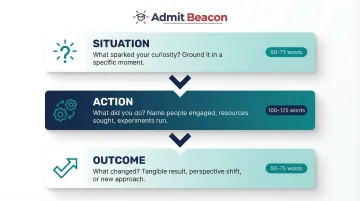
Use a clear Situation-Action-Outcome framework within 250 words:
- Situation (50-75 words) — What sparked your curiosity? Ground it in a specific moment, not a general trait.
- Action (100-125 words) — What did you actually do? Name the people you engaged, the resources you sought, the experiments you ran, the questions you pressed on.
- Outcome (50-75 words) — What changed? A tangible result, a shift in perspective, or a new way of approaching problems all count.
Make It Specific and Personal:
That framework only works if the story underneath it is real. Choose a specific moment — not a vague claim about being a lifelong learner. The admissions committee wants to see intellectual or personal pursuit that led somewhere unexpected or meaningful.
Examples that work well:
- Learning a new technical skill outside your domain to solve a work problem
- Pursuing an unexpected conversation that changed your perspective
- Diving into a topic or community that initially seemed unrelated to your career
- Challenging an assumption by seeking out contrary viewpoints
What to Avoid:
Don't use this essay to talk about HBS's programs or resources. The word limit is too tight, and the focus should remain on your story of growth—not on fitting HBS into the narrative. The admissions committee already knows what HBS offers; they want to know what drives you to learn.
Beyond the Three Essays: Career Goals, Post-Interview Reflection, and Re-Applicant Essay
Career Goals Short Answer (500 characters)
HBS requires applicants to select an industry group and function from dropdown menus, then briefly elaborate with goals that are aspirational yet realistic (around 80–85 words).
What to Include:
- Near-term target role and industry
- Connection between short-term steps and long-term impact
- Consistency with Essay 1's narrative about career motivation
Key Principle: This short answer must align seamlessly with your Business-Minded essay. If Essay 1 describes how your choices led you toward social impact through technology, your Career Goals should reflect that same thread—not pivot to investment banking without explanation.
The Post-Interview Reflection
Applicants invited to interview must submit a written reflection within 24 hours of their interview. According to HBS's official logistics page, the reflection should be 300-450 words and is "not intended to be another formal essay. Think of it instead as a reflection after a meeting."
How to Prepare:
- Take detailed notes immediately after your interview
- Identify key candidacy themes you want to reinforce
- Note anything meaningful that wasn't covered in the interview
- Consider what new insight or perspective you gained from the conversation
What HBS Is Assessing:
The Post-Interview Reflection is your closing argument — and HBS evaluates it differently from your formal essays. HBS explicitly states they "will be much more generous in our reaction to typos and grammatical errors than we will be with pre-packaged responses."
The qualities they're looking for:
- Self-awareness about how the interview went
- Composure and clarity under time pressure
- The ability to synthesize a conversation, not just recap it
The Re-Applicant Essay (250 words)
HBS asks re-applicants to share how they have reflected, grown, and updated their candidacy since their previous application. HBS is "reapplicant friendly" and notes that "the focus of a candidate's evaluation will always be on the current application."
What to Focus On:
This essay should highlight concrete, material improvements since your last application:
- New responsibilities or expanded scope in your current role
- Stronger results or measurable impact
- Community involvement or leadership outside work
- Retaken GMAT/GRE with improved score
- New skills or certifications gained
What to Avoid:
Don't write about renewed enthusiasm for HBS or how much you've learned about the program. The admissions committee wants tangible growth in your profile, not deeper knowledge of the school. Every paragraph should point to something new — a result, a role, a responsibility — that didn't exist in your last application.
Common Mistakes That Sink HBS Essays (and How to Avoid Them)
Using the Same Experience Across Multiple Essays
The most common structural mistake is drawing from the same experience or theme across multiple essays. HBS expects each essay to introduce something new. A candidate who uses their startup experience in all three essays—even if framed differently—presents a narrow, one-dimensional picture.
How to avoid it: Before you start writing, map out which experiences you'll use for each essay. Ensure each one reveals a distinct facet of who you are.
The Achievement Laundry List Trap
Many applicants mistake impact for impressiveness and write essays that read like a highlights reel rather than a reflective narrative. HBS is looking for self-awareness and meaning-making, not a second resume.
Ask yourself: "Why did this matter to me, and what did it change?" rather than "What did I accomplish?"
Compare these two approaches:
Laundry list: "I led a team of 15 engineers, increased revenue by 40%, launched three new products, and received the company's top performer award."
Reflective: "When our product launch failed, I realized I had optimized for speed over team input. I restructured our process to include weekly feedback sessions, which slowed us initially but ultimately led to our most successful launch because the team felt ownership over the direction."
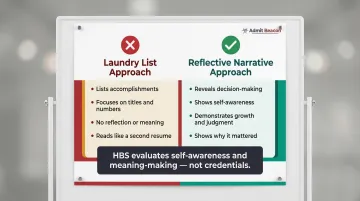
The second version reveals judgment, self-awareness, and growth — the qualities HBS actually evaluates.
Over-Polishing to the Point of Losing Authentic Voice
HBS readers review thousands of applications and can identify templated, consultant-speak essays. The essays that land are those where the applicant's genuine perspective, values, and specific details come through.
Warning signs your essay is over-polished:
- Every sentence is perfectly structured with no variation in length
- You've removed all personal details in favor of abstract language
- The essay could apply to dozens of other candidates
- You've used phrases like "leverage synergies," "big shift," or "meaningful change"
Admit Beacon works specifically to avoid this pattern — surfacing each applicant's real story in their own voice, with a narrative that aligns with the school's ethos while keeping the writing authentically theirs.
Frequently Asked Questions
What are the HBS MBA essay prompts for 2025-2026?
The three prompts are: Business-Minded (300 words) — Please reflect on how your choices have influenced your career path and aspirations; Leadership-Focused (250 words) — What experiences have shaped how you invest in others and how you lead?; and Growth-Oriented (250 words) — Curiosity can be seen in many ways. Please share an example of how you have demonstrated curiosity and how that has influenced your growth. A 500-character Career Goals short answer is also required.
How long are the HBS MBA essays?
The three essays have limits of 300 words, 250 words, and 250 words respectively. HBS expects applicants to stay within these limits—brevity and precision are part of the challenge, not a suggestion.
Is 740 a good GMAT score for Harvard?
According to HBS's Class of 2027 profile, the median GMAT 10th Edition score is 730, with a middle 80% range of 690-770. A 740 is competitive and above the median, but HBS evaluates applications holistically—your essays, leadership experience, and overall profile matter just as much as test scores.
What GPA do you need for Harvard MBA?
The average GPA for the HBS Class of 2027 is 3.76. There is no hard minimum, and a strong overall application—including compelling essays, demonstrated leadership, and competitive test scores—can offset a lower GPA.
Can I use personal (non-professional) examples in my HBS essays?
Yes — personal examples are encouraged where relevant. What matters is that the story is authentic, specific, and tied to the traits HBS is assessing in that prompt. Community leadership, advocacy, or navigating challenges on behalf of others can be just as compelling as professional examples.
What is the HBS Post-Interview Reflection and how should I prepare for it?
Submitted within 24 hours of your interview, the Post-Interview Reflection follows HBS word guidance of 300-450 words and should read like a post-meeting debrief, not a formal essay. Take notes immediately after your interview and treat it as a closing argument — reinforcing your candidacy themes and addressing anything meaningful that wasn't covered.