Introduction
You've made it to the MBA interview. That alone puts you ahead of the majority of applicants — at most top programs, interview invitation rates hover between 15–25%, depending on the school. But the interview is also where strong profiles either hold up or fall apart. This guide breaks down the hardest questions you'll face and exactly how to answer them.
The most consequential moments aren't the easy questions. They're the ones that seem manageable on the surface but are engineered to reveal self-awareness, emotional maturity, and genuine fit. Candidates who haven't anticipated these traps tend to give polished but empty answers that read as rehearsed.
At schools like Harvard Business School, where interviews are non-blind and admissions committees (AdComs) have already read your entire application, inconsistencies between your written narrative and your spoken answers are immediately visible.
Key Takeaways
- Hard MBA interview questions test self-awareness and emotional intelligence, not obscure knowledge
- The riskiest questions involve failure, conflict, school concerns, peer perception, and school-specific fit
- Build a story bank first, then match your experiences to likely question types
- Practice for conversational fluency, not script memorization
- STAR and CARL frameworks help, but strong content always outweighs clean structure
What Makes Certain MBA Interview Questions So Hard?
These questions are hard because they demand self-awareness under pressure, not factual recall. Questions about your flaws, past conflicts, or doubts about a major life decision push you into uncomfortable territory. The instinct to self-protect or over-polish produces exactly the vague, evasive answer that raises red flags.
Many of the hardest questions look deceptively benign. A question like "How would your close colleagues describe you?" appears soft, but it's actually testing alignment between self-perception and how you present across your application. In non-blind interviews at schools like HBS and MIT Sloan, the evaluator has already read your recommendations. If your word choices contradict how your recommenders described you, that gap gets noticed.
Admissions committees use these questions to surface traits the rest of the application can't fully capture:
- Intellectual honesty — willingness to acknowledge real limitations, not polished ones
- Resilience — how you've processed setbacks, not just survived them
- Comfort with complexity — the ability to hold ambiguity without becoming defensive
These qualities matter because MBA programs run on peer critique and collaborative learning. You can't fake them for long.
The Hardest MBA Interview Questions — And How to Answer Each One
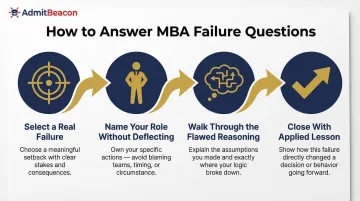
Describe a failure you were involved in
This question is a trap for most candidates. They either pick something that's actually a disguised success ("we missed the deadline but delivered an exceptional product"), choose something so minor it signals low self-awareness, or something so catastrophic it raises real concerns.
The admissions committee wants to see that you can own a genuine failure, understand your role in it, and demonstrate that you've changed because of it. Admissions directors consistently cite a lack of ownership and "fake failures" as top reasons candidates fail behavioral interviews.
How to answer well:
- Select a real failure where you had meaningful agency
- Name your specific role without deflecting blame to circumstance or team
- Walk through the reasoning that led you astray and what you've since corrected
- Close with a more recent example that shows you applied the lesson — giving the story a completed arc rather than just a cautionary tale
Describe a conflict at work and your role in it
This question tests emotional intelligence above all else. The evaluator is watching whether you can discuss a disagreement without throwing colleagues under the bus, positioning yourself as the blameless hero, or appearing too detached to have real skin in the game. Even subtle phrasing that implies a colleague was difficult or wrong will register negatively.
How to answer well:
- Select a conflict with genuine stakes
- Show that you understood the other party's perspective before acting
- Describe specific steps taken to address the tension constructively
- Share what the experience changed about how you handle disagreement going forward
What other schools are you applying to?
Schools asking this question are gauging yield risk — they want to avoid admitting candidates who will clearly choose a competitor. The question also reveals whether your school list reflects a coherent, researched strategy or a top-10 ranking copied wholesale.
Yield rates vary wildly across top programs: Stanford GSB at 85.1%, Harvard at 84.5%, Wharton at 57.8%, and Kellogg at 35.1%. Those gaps explain why schools pay close attention to where else you're applying — and whether your answer suggests you'll actually show up if admitted.
How to answer well:
- Answer honestly
- Briefly explain the shared logic behind your list (program culture, learning style, geographic preference, career focus)
- Make a specific, substantive case for why the school in the room is genuinely your top choice — reference concrete program elements, not generic reputation language
- List 3-4 peer schools maximum to prove intentionality
What concerns do you have about getting an MBA?
This question is rarely asked but devastating when candidates are caught unprepared. The instinct is to deflect ("I don't really have concerns, I've thought this through") — but that reads as either dishonest or incurious. Interviewers are looking for a mature decision-maker who can sit with the complexity of a major investment — not someone who's walled off legitimate doubt.
How to answer well:
- Choose a concern that is real, proportional, and ultimately resolvable
- Strong examples include opportunity cost for someone leaving a high-trajectory role, or re-entry anxiety for a candidate several years out of formal education
- Follow with a specific explanation of how you've stress-tested the decision and why the program's fit justifies the risk
How would those close to you describe you in three words?
This question directly assesses self-awareness and consistency across your entire candidacy. In non-blind interviews, the evaluator may already have read your recommendations — if the words you choose contradict how your recommenders actually described you, that gap is noticed.
How to answer well:
- Choose words that are authentic and demonstrable — not aspirational
- Be prepared to back each one with a concrete example
- Informally ask a trusted peer or mentor how they'd describe you before the interview to check your own blind spots
How will you take advantage of the resources this program offers?
This question goes further than "Why this school?" — it requires a specific plan for your time at the program, not just reasons for wanting to attend. Candidates who answer with "great network, rigorous curriculum, diverse cohort" miss the point entirely.
How to answer well:
Anchor your answer in at least three dimensions:
- Specific courses or electives tied to a knowledge gap relevant to your post-MBA goal
- Clubs or initiatives that connect to your professional or personal interests
- Career services resources tied to your target function or industry
Show how these aren't general appeal points but precise responses to where you are in your own trajectory.
The Frameworks That Make Tough Answers Land
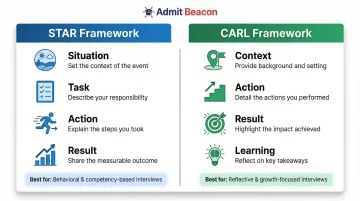
STAR: For Competency and Execution
STAR (Situation, Task, Action, Result) is the most widely used framework for behavioral questions. Its power lies in keeping answers structured without requiring candidates to memorize scripts.
Components:
- Situation: Set the scene briefly — one or two sentences maximum
- Task: Clarify what you were responsible for achieving
- Action: Detail your specific contributions — this should take up most of the answer
- Result: Close with a quantifiable outcome wherever possible
Common failure mode: Spending too long on Situation and too little time on Action and Result, which buries your actual contribution.
CARL: For Failure and Conflict
CARL (Context, Action, Result, Learning) is particularly valuable for questions about failure, conflict, or feedback — because reflection is built into the structure. Admissions committees are evaluating not just what you did but what you understood about it afterward.
Components:
- Context: Briefly describe what made the situation challenging
- Action: Walk through the steps you took and why
- Result: Share the outcome honestly, even if it was a setback
- Learning: Name the specific lesson and show how it changed your approach
How to Choose Between Frameworks
- Use STAR for questions focused on concrete achievement or leadership
- Use CARL for questions that explicitly ask what you took away from an experience or how you've changed
- For particularly complex questions, layer elements of both
Knowing which framework fits is one thing — executing it cleanly under interview pressure is another. Admit Beacon's mock interview coaching, part of the core engagement with lead consultant Niketa, helps candidates pressure-test their stories under follow-up questioning, identify which framework best serves each narrative, and calibrate how much detail each component actually needs before the real interview.
How to Prepare Without Sounding Over-Rehearsed
Admissions committees can tell when candidates are reciting rather than conversing. When that happens, it raises doubts about authenticity and fit — the opposite of what you're going for. The goal of preparation is to internalize the logic of each answer, not the exact wording.
Build a Story Bank First
Start by developing 8-10 real professional and personal experiences, then map them to likely question categories: leadership, failure, conflict, teamwork, goals, and values. This gives you flexible material you can adapt to unexpected questions, rather than going blank when a prompt doesn't match a script you memorized.
Practice Out Loud
Work with a trusted peer or coach, focusing on two things:
- Whether the answer is concise enough (most interview answers should stay within 1-2 minutes)
- Whether the "so what" — the reflection or result — is prominent enough to be memorable, since interviewers are writing summaries immediately after each session
Common Mistakes Candidates Make on Hard Interview Questions
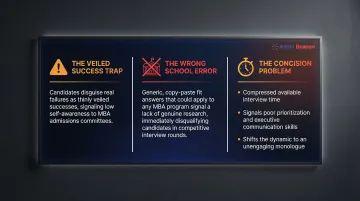
The "Veiled Success" Trap
Choosing a failure that clearly worked out fine — or reframing a weakness as a hidden strength ("I work too hard") — signals you're not willing to be honest about yourself. That's a problem in programs built on peer critique and collaborative learning. Interviewers notice immediately.
The "Wrong School" Error
Citing a resource from the wrong program, or giving a "Why MBA" answer that fits any school in the top 20, kills credibility fast. At HBS, Stanford, and Wharton, specificity is the baseline — not a differentiator. Careful preparation eliminates this mistake entirely.
The Concision Problem
Giving answers that are correct but far too long. Most interviewers are moving through 6-10 questions in under an hour — and they're evaluating communication under constraints as much as content. Overly long answers create real problems:
- They compress time for later questions, often the harder ones
- They signal poor prioritization, which programs treat as a leadership red flag
- They shift the conversation from dialogue to monologue
Brevity is a skill. Practice answering in 90 seconds before you practice anything else.
Frequently Asked Questions
What to expect in an MBA interview?
Most MBA interviews run 30-60 minutes and include a mix of behavioral questions, goal-clarity questions, and school-fit questions. Some programs conduct blind interviews (where the interviewer hasn't seen the application), while others are non-blind, which affects how much context you need to establish in your answers.
How to start preparing for MBA interviews?
Three steps that matter most:
- Build a story bank of professional experiences organized by theme (leadership, failure, conflict, growth)
- Research each program specifically enough to speak to its curriculum and culture — not just its ranking
- Run timed practice sessions out loud to build conversational fluency
What are the 5 C's of interviewing?
The 5 C's — Competence, Confidence, Communication, Connection, and Character — is an informal coaching framework. MBA programs emphasize Connection and Character heavily, since admissions committees are assessing who you are, not just what you've accomplished.
What is the 30-60-90 question in an interview?
This question asks candidates to outline their plan for the first 30, 60, and 90 days in a new role. In MBA interviews, it surfaces as a goals question — testing whether you have a realistic, phased plan for using the program to reach your post-MBA target, not just a vague aspiration.
What is the STAR method for MBA interviews?
STAR stands for Situation, Task, Action, Result — a framework for structuring behavioral answers. Strong candidates emphasize the Action and Result portions most, since those reveal what you actually contributed rather than just the circumstances you inherited.
How long should my answers be in an MBA interview?
Most behavioral answers should run 90 seconds to 2 minutes — long enough to be substantive, short enough to leave room for follow-up and the remaining questions on the interviewer's list. Practicing with a timer is one of the most effective and underused preparation techniques.