Introduction
An MBA interview invitation means your application cleared the first filter. Now comes the part that trips up even strong candidates. According to GMAC survey data, interviews account for 21% of the admissions decision—edging out standardized test scores at 20%. Scripted answers, thin school research, and difficulty discussing failure authentically are the most common reasons qualified applicants don't advance.
This guide covers what evaluators are actually looking for, how to prepare without over-rehearsing, how to handle tough questions, and the mistakes most worth avoiding.
Key Takeaways:
- MBA interviews test what essays can't show: self-awareness, communication clarity, and cultural fit
- Build a story bank of 4–6 experiences using STAR/CARL frameworks instead of scripted answers
- Research each school specifically—courses, professors, and clubs, not just rankings
- Cap behavioral answers at 2–3 minutes; longer responses hurt more than they help
- Avoid the common fatal mistakes: mixing up schools, robotic delivery, and skipping the follow-up email
What MBA Interviewers Are Actually Evaluating
MBA interviews are not a formality—they are a structured evaluation of traits that essays and test scores cannot fully convey. Admissions committees use interviews to assess self-awareness, communication clarity under pressure, leadership potential, and cultural fit with the program's community and values.
Key Qualities Commonly Assessed
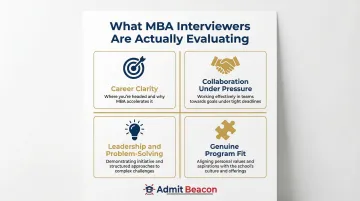
Most programs evaluate candidates across four consistent dimensions:
- Career clarity: Can you articulate where you're headed and why an MBA accelerates that path? Vague answers like "I want to transition into consulting" without specifics signal poor preparation.
- Collaboration under pressure: Wharton's team-based discussions, for example, actively score how you listen, build on others' ideas, and contribute to shared outcomes—not just how confidently you speak.
- Leadership and problem-solving: Harvard evaluates candidates on business acumen, leadership trajectory, and growth mindset. Stanford puts it plainly: they want to understand "how you think, how you lead, and how you see the world."
- Genuine program fit: Interviewers probe whether your research goes beyond rankings—whether you can name specific faculty, courses, or communities that connect to your actual goals.
How Interviewer Type Shapes Your Approach
These criteria don't disappear based on who interviews you—but the emphasis shifts considerably depending on who's sitting across the table:
| Interviewer Type | Evaluation Focus | Typical Tone |
|-----------------|------------------|--------------|
| Admissions Officers | Structured assessment of all criteria; probing follow-ups | Formal, evaluative |
| Alumni | Cultural fit, career trajectory relevance | Conversational, variable length |
| Current Students | Day-to-day program fit, authenticity | Casual, peer-to-peer |
Understanding who is interviewing you shapes how you tailor your tone and examples. An alumni interviewer may appreciate career-focused questions about their post-MBA path, while an admissions officer expects you to demonstrate thorough program knowledge.
How to Prepare Before Your MBA Interview
Build Your Story Bank
The "story bank" concept is your foundation: curate 4–6 professional experiences that can flex across multiple question types—leadership, failure, conflict, teamwork, initiative. Prepare stories first (macro prep) before mapping them to question types (micro prep), rather than memorizing answers to individual questions.
Essential story themes to cover:
- At least one example of failure or setback where you played a direct role
- One conflict resolution example demonstrating emotional intelligence
- One instance of leading without formal authority
- One story demonstrating measurable impact or initiative
This approach prevents you from being caught unprepared by unexpected questions. When an interviewer asks, "Tell me about a time you influenced someone without authority," you can adapt your leadership story rather than scrambling.
Use the STAR and CARL Frameworks
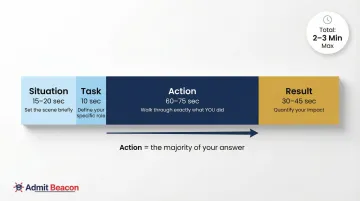
STAR Framework (Situation, Task, Action, Result) STAR is the standard structure for behavioral answers. However, most candidates over-explain context and rush through "Action" and "Result"—which are what interviewers actually want to hear.
Allocate time proportionally:
- Situation/Context: 15-20 seconds
- Task: 10 seconds
- Action: 60-75 seconds (the bulk of your answer)
- Result: 30-45 seconds (quantify impact when possible)
CARL Framework (Context, Action, Result, Learning) CARL is particularly useful for questions about failure, feedback, and growth because it forces you to articulate what you took away from the experience—showing interviewers you're self-aware and open to growth. The "Learning" component demonstrates that you don't just experience setbacks—you extract lessons and apply them forward.
Once your stories are sharp, the next preparation layer is making them land in the right context—which means knowing your target schools cold.
Research the School—Beyond the Website
Surface-level research (rankings, program length, famous alumni) is not enough. Admissions officers consistently cite "lack of specific school research" as a top red flag. Candidates must reference specific courses, professors, clubs, or career pathways relevant to their goals—and connect these to their short- and long-term career vision.
Go deeper:
- Identify 2-3 specific courses that align with your career goals and explain why
- Name professors whose research interests intersect with your professional focus
- Reference student clubs or initiatives that match your leadership experience
- Connect these specifics to your post-MBA career trajectory
This level of specificity takes real legwork. Admit Beacon's Knowledge Base covers the top MBA programs in depth—program culture, essay expectations, and application context—and their network of current students and alumni gives you firsthand insight that no website can replicate. A mock interview session is also part of their consulting package, so you can stress-test your stories and school-specific answers before the real conversation.
Strategies to Ace the Interview Itself
Craft Your Opening: The "Walk Me Through Your Resume" Answer
Nearly every MBA interview begins with "Tell me about yourself" or "Walk me through your resume." This is not a passive recap—it's an opportunity to frame your narrative arc: where you've been, what you've built, why now, and where the MBA fits.
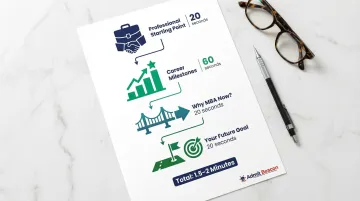
Structure your 1.5-2 minute answer as a story:
- Opening (20 seconds): Your professional starting point and early interests
- Middle (60 seconds): Key experiences that shaped your skills and revealed gaps
- Transition (20 seconds): Why you need an MBA now (not earlier, not later)
- Close (20 seconds): Where you're headed post-MBA
The goal is to make the interviewer curious to ask follow-up questions, not to summarize a resume they may not have read. Done well, the answer feels less like a summary and more like the opening chapter of something the interviewer wants to keep reading.
Be Concise, Direct, and Conversational
Concision is a professional signal. Most MBA interviews run under an hour, and rambling answers reduce the number of questions you can answer well—which directly affects the evaluator's written summary.
Practice keeping behavioral answers to 2-3 minutes maximum:
- Set a timer during mock interviews
- Record yourself and review for unnecessary tangents
- Ask a practice partner to interrupt if you exceed time limits
On scripting: you should have key points anchored in memory, not a word-for-word script. Interviewers are trained to detect rehearsed monologues, and a conversational tone creates stronger rapport. Kellogg Admissions puts it plainly: "There is a difference between being prepared with lots of examples and stories top of mind to share and being scripted or repeating memorized answers that don't really address the questions asked."
Ask Thoughtful Questions at the Close
The question period at the end is not optional filler—it's a final opportunity to demonstrate genuine program knowledge, intellectual curiosity, and cultural fit. Generic questions ("What's the campus culture like?") are a wasted opportunity.
Prepare 3-4 specific questions tailored to the interviewer's background:
- Alums respond well to: "How did [specific program element] shape your transition from [previous industry] to [current role]?"
- Current students appreciate: "What surprised you most about [specific course or club] compared to your expectations?"
- Admissions officers engage with: "How has [recent program initiative] changed the student experience?"
Your questions should reflect deep research and genuine curiosity — not anything a five-minute website visit would answer.
How to Answer the Hardest MBA Interview Questions
"Describe a Failure You Were Involved In"
This question is difficult because candidates default to disguised success stories ("I'm a perfectionist"). Evaluators actively screen out veiled strengths.
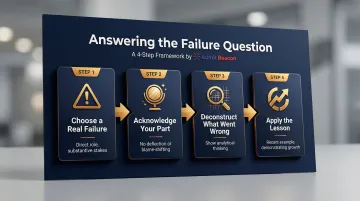
How to handle it:
- Choose a real, substantive failure where you played a direct role
- Acknowledge your part honestly without deflecting blame
- Walk through how you deconstructed what went wrong
- Close with a recent example demonstrating you applied the lesson learned
Example structure: "Early in my product management role, I launched a feature without involving the sales team. Usage was low because the feature didn't align with how customers actually worked. I owned the mistake in our post-mortem, interviewed sales reps to understand their workflow, and rebuilt the feature collaboratively. In my next launch six months later, I involved sales from day one—adoption increased 300%."
"Describe a Conflict at Work and Your Role In It"
This question tests emotional intelligence and how you speak about colleagues. The trap is "throwing someone under the bus" or appearing detached. Playing the blame game is a major red flag.
Strong responses:
- Show your specific role in the conflict
- Demonstrate empathy for other perspectives
- Explain how the situation was resolved or what you changed in future interactions
- Avoid describing resolution as a solo win—show it as a mutual outcome
Example: "My engineering counterpart and I disagreed on project priorities—he wanted to fix technical debt; I needed new features for a client deadline. Instead of escalating, I scheduled a working session where we mapped both priorities against business impact. We agreed to allocate 70% of the sprint to features and 30% to debt reduction, which satisfied both needs and established a framework we used for future sprints."
"What Concerns Do You Have About Getting an MBA?"
This question probes self-awareness and realistic thinking. Candidates should acknowledge a genuine concern—financial investment, opportunity cost, career pivot uncertainty—then show they've weighed it carefully against long-term goals, reinforcing why the MBA is still the right move.
How to handle it:
- Name a real concern, not a fabricated one
- Show you've done the math or thought through the tradeoff
- Connect it back to why your goals still make the MBA the right choice
Example: "I'm mindful of the opportunity cost—two years out of the workforce means forgoing salary and promotion opportunities. However, I've reached a ceiling in my current role where I need formal business training and a broader network to transition into strategy. The long-term ROI of the MBA, both in skills and access, outweighs the short-term cost."
"What Other Schools Are You Applying To?"
This question is often a yield-management tactic. Answer it directly, then use it as an opportunity to show the logic behind your school list and why this program ranks highest.
How to handle it:
- Name your other schools without hesitation or hedging
- Explain the common thread connecting your list (curriculum style, geography, culture)
- Make a specific case for why this school leads your list—cite a course, initiative, or resource
- Frame it as research-backed reasoning, not flattery
Example: "I'm also applying to Kellogg and Booth because all three schools have strong general management curricula and collaborative cultures. What sets your program apart for me is [specific course or initiative], which directly aligns with my goal to [specific career objective]. I'm also drawn to [specific club or resource] that I haven't found as developed elsewhere."
Common MBA Interview Mistakes to Avoid
Mixing Up Schools
Citing a program, club, or resource from one school during an interview for another is a clear signal of low genuine interest. Keep separate notes for each program and review them immediately before each interview — this mistake is entirely avoidable with school-specific preparation.
Lacking Concision
Spending too much time on context and not enough on actions and results leaves interviewers with an incomplete picture. Many top programs cap interviews at 30 minutes, so every answer needs to earn its place. Lead with the result, then provide just enough context to make it land.
Failing to Follow Up
Not sending a brief, personalized thank-you email within 24 hours is a missed opportunity. The follow-up signals professionalism and keeps you top of mind after a packed interview day. Reference a specific moment from the conversation — it shows you were present, not just performing.
Virtual vs. In-Person MBA Interview Tips
Virtual Interviews
Post-2020, schools like MIT Sloan and Kellogg have shifted to fully virtual interview formats. Master these non-negotiables:
- Test audio, camera, and internet connection at least 24 hours in advance
- Ensure a quiet, well-lit, distraction-free background
- Dress fully professionally even on camera
- Log on 5-10 minutes early to handle technical issues
- Look at the camera when speaking, not at the person on screen
- Mute computer notifications and close unnecessary applications
Yale SOM advises treating virtual interviews with the same professionalism as in-person meetings, emphasizing that candidates should "arrive" early and dress in typical interview attire.
In-Person Interviews
In-person interviews reward candidates who handle both the visible and subtle details well:
- Wear business formal attire — suit and tie or equivalent
- Arrive 10-15 minutes early to account for building navigation
- Bring a portfolio with extra resume copies, even if not requested
- Maintain appropriate eye contact without staring
- Nod and take brief notes to show active engagement
- Watch body language — project confidence, not arrogance
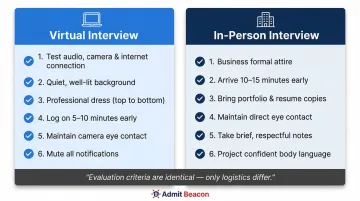
The questions and evaluation criteria are identical across both formats. What differs is logistics — and candidates who prepare for those specifics avoid the small stumbles that signal unpreparedness.
Frequently Asked Questions
How long does an MBA admissions interview typically last?
Most MBA interviews run approximately 30-60 minutes, with variation by school. HBS, MIT Sloan, and Yale SOM interviews are strictly capped at exactly 30 minutes, while Stanford GSB and INSEAD interviews can extend to 60 minutes. Knowing the expected length helps you pace your answers appropriately.
What is the difference between a blind and non-blind MBA interview?
A blind interview means the interviewer has only seen your resume (not your full application or essays), while a non-blind interview means they have reviewed your complete application. Schools like HBS and MIT Sloan conduct non-blind interviews, while Booth, Kellogg, and Yale SOM use blind formats.
How many stories should I prepare for my MBA interview?
Prepare at least 4-6 flexible stories covering key themes: leadership, failure, conflict, initiative, and teamwork. This lets you adapt to unexpected questions and tailor the same experience to different angles, rather than relying on memorized scripts.
Is it acceptable to ask for clarification if I don't understand an interview question?
Yes, it is not only acceptable but advisable to ask for clarification before answering. Attempting to answer an unclear question and missing the point is far more damaging than pausing to clarify. Simply say, "To make sure I address your question fully, are you asking about [your interpretation]?"
How soon should I send a thank-you note after my MBA interview?
Send a brief, personalized thank-you email within 24 hours of the interview. Address the interviewer by name and reference a specific moment from the conversation to make it feel genuine rather than templated. It signals professionalism and keeps you memorable after a competitive interview day.
Can a strong MBA interview overcome a weaker written application?
A strong interview can tip the scales for a borderline candidate, but it is most powerful when it reinforces—not rescues—the story told in your essays and recommendations. It rarely overcomes significant application weaknesses on its own.