Introduction
MBA applications to top-tier programs like Harvard Business School, Stanford GSB, and Wharton are complex. You're juggling multiple components—test scores, transcripts, essays, recommendations—all moving on different deadlines with school-specific requirements. One missed detail can cost an otherwise strong candidate their seat.
That's what this checklist is for. It covers every required application component, what actually strengthens your profile, a realistic timeline, and the mistakes that trip up even qualified candidates. Whether you're targeting Round 1 or Round 2, use it to make sure nothing slips through.
Key Takeaways
- MBA applications require test scores (GMAT/GRE), transcripts, a professional resume, school-specific essays, recommendation letters, and an application fee
- Round 1 (Sept–Oct) and Round 2 (January) offer the strongest admission and scholarship odds at most top programs
- A complete application tells a coherent career narrative across every component—not just a collection of documents
- Begin preparing 12–18 months before your target deadline to allow time for test prep and recommender selection
Before You Apply: Build Your School List and Choose Your Round
Creating a Balanced School List
Before diving into applications, build a strategic school list targeting reach, match, and safety programs across different formats (full-time, accelerated, deferred enrollment). Requirements vary significantly by school, so your checklist will have school-specific variations.
To build a list that actually informs your essays and interviews, go beyond rankings:
- Attend school-specific information sessions and virtual events
- Connect with current students through official or alumni networks
- Research each program's culture, curriculum, and post-MBA career outcomes
- Note what makes each program distinct — this feeds directly into your "Why this school?" essays
Admissions committees at top programs spot generic responses immediately. Specific, researched answers are what separate competitive applicants from the rest.
Understanding Application Rounds
Once your school list is set, timing your applications matters just as much as building them. Most top schools operate on a round system:
- Round 1 (R1): September–October deadlines
- Round 2 (R2): January deadlines
- Round 3 (R3): April deadlines
Wharton explicitly warns that space becomes "more limited for Round 3 applicants, resulting in a more competitive round." R1 and R2 are your strongest options for admission and scholarship consideration. R3 is highly competitive and rarely yields scholarship offers.
Apply R1 if you belong to an overrepresented demographic — consulting, finance, or Indian IT — where earlier timing reduces competition. R2 makes sense if you need the extra runway to retake the GMAT or GRE and hit median scores.
The Complete MBA Application Checklist
Academic Transcripts and GPA
What you need: Official or verified transcripts from all undergraduate and graduate institutions attended.
Timing: Most programs accept unofficial copies during application review, requiring official records only upon admission. Request transcripts early—processing can take weeks, especially for international institutions.
How GPA is evaluated: Admissions committees assess:
- Grade trends (upward trajectory matters more than a single weak semester)
- Coursework rigor and difficulty of major
- STEM vs. non-STEM context
A low GPA isn't fatal. Strong test scores, the optional essay explaining context, or additional coursework can address concerns.
International applicants: Stanford and Wharton explicitly instruct you not to convert non-4.0 grading scales. Submit transcripts in their original format with certified English translations if required.
Test Scores: GMAT, GRE, or Executive Assessment
Which exams are accepted: All top programs accept the GMAT Focus Edition, GMAT Classic (10th Edition), and GRE General Test. The Executive Assessment is accepted only by select programs (Columbia accepts it; MIT Sloan does not). Scores remain valid for five years.
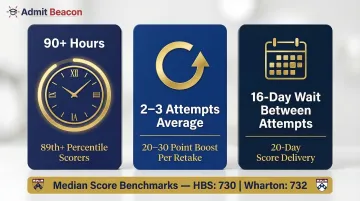
Benchmarking your preparation: Research median scores for your target programs. Harvard reports a median GMAT Classic score of 730 and GMAT Focus score of 685. Wharton's average GMAT Classic is 732. These aren't minimums, but they indicate competitive ranges.
Practical guidance: GMAC data shows top scorers (89th+ percentile) study 90+ hours over 2-3 months. Many successful admits take the exam two or more times, with retakes yielding an average 20-30 point boost. Build time into your schedule: GMAT requires a 16-day waiting period between attempts. Official score delivery can take up to 20 additional days.
Professional Resume
What to include:
- Professional experience in reverse chronological order (employer, title, dates)
- Key responsibilities and quantifiable achievements
- Education credentials
- Relevant extracurriculars or community involvement
Length: Most programs recommend one page; one to two pages is acceptable for candidates with 10+ years of experience.
MBA-specific formatting: Your MBA resume differs from a job-search resume. Emphasize:
- Leadership examples with scope of impact
- Career progression and increased responsibility
- Quantified achievements (team size managed, revenue influenced, costs reduced)
Avoid jargon specific to a single industry. Admissions readers review hundreds of resumes from diverse backgrounds, so plain language beats insider terminology every time.
MBA Essays and Short Answers
Essays are the most individualized and time-intensive application component. Common prompts include:
- Post-MBA career goals
- Why this specific school
- Leadership or teamwork examples
- Personal reflection on values or identity
Word limits vary widely, from 50-character short answers to 750-word essays. That range makes precision essential.
What makes essays strong: Strong essays don't just answer the prompt. They advance a coherent narrative connecting past experience to future goals while demonstrating genuine school fit. Generic essays that could be sent to any program significantly weaken applications.
Harvard recently restructured to three focused prompts: Business-Mindedness (300 words), Leadership (250 words), and Growth/Curiosity (250 words). Stanford maintains its iconic "What matters most to you, and why?" (650 words). Each school's prompts reflect their distinct values.
School-specific customization: Each essay must reflect the specific school's culture, language, and community. Name specific professors, clubs, courses, or initiativesand explain how they connect to your goals. Vague "Why this school?" answers are among the most common weaknesses in top-school applications.
Working with an admissions consultant on essay storyboarding and career narrative development can help ensure each essay aligns with a specific school's ethos while retaining your authentic voice. Admit Beacon's consultants take this approach rather than applying the same framework to every applicant.
Letters of Recommendation
How many: Most full-time programs require one to two letters.
Who should write them: The strongest recommenders are direct supervisors or senior colleagues who can speak to specific professional impact, leadership, and growth. A high-ranking executive who barely knows you adds little value.
Preparing recommenders:
- Share your resume, career goals, and target schools
- Provide at least 6-8 weeks' lead time
- Discuss specific projects or achievements they can reference
Critical integrity rule: Never draft your own recommendation letters. Harvard, Stanford, and Columbia explicitly state this violates application terms and can result in rescinded offers. If your recommender isn't fluent in English, use a paid, third-party translation service, not your own.
The MBA Interview
Invitation-only: Interviews at most top programs aren't guaranteed; they're extended only to shortlisted candidates. Receiving an invitation is a positive signal.
Format variations:
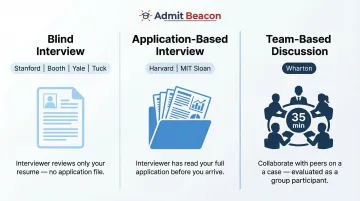
- Blind interviews (Stanford, Booth, Yale, Tuck): Interviewer has only your resume
- Application-based interviews (Harvard, MIT Sloan): Interviewer has reviewed your full application
- Unique formats: Wharton uses a 35-minute Team-Based Discussion where 5-6 applicants solve a problem together
Preparation strategy: Tailor your prep to the format. For blind interviews, be ready to walk through your background and tell core stories. For application-based interviews, prepare to defend nuanced details from your essays.
Many programs now use pre-recorded video interview platforms like Kira Talent, where you record 60-90 second responses to randomized questions with minimal prep time. Practice timed, unedited responses focusing on authentic presence.
Application Fee and Final Submission
Fee range: Application fees typically range from $75 to $275 per school. Stanford and Wharton charge $275 for full-time programs.
Fee waivers: Most programs offer waivers for:
- Active-duty military and veterans
- Peace Corps and AmeriCorps alumni
- Teach for America participants
- Candidates facing financial hardship
Request waivers 1-3 weeks before submitting your application.
Submission timing: Once your waiver is confirmed and fees are handled, submit well ahead of the deadline. Last-minute submissions risk technical issues. Double-check that all components are marked complete before finalizing.
What Actually Looks Good on an MBA Application
Admissions committees at top programs seek "complete" candidates, not just those who clear minimum thresholds. A strong application demonstrates:
Clear career progression: Your resume should show increasing responsibility, leadership scope, and measurable impact. Lateral moves or stagnation raise questions about ambition and readiness for an MBA.
Narrative coherence: Every component—resume, essays, recommendations—should reinforce a consistent story about who you are, what you've accomplished, and where you're going. Inconsistencies or vague goals raise red flags.
Compelling "why MBA, why now": Top programs want to understand why an MBA is the logical next step, not just a credential. Your goals should be specific, realistic, and clearly connected to your background.
Differentiation within your pool: Admissions committees evaluate candidates within demographic pools (Indian IT males, US consultants, etc.). What makes your profile stand out?
According to a detailed Stanford admissions analysis by Poets & Quants, 62% of admitted students come from elite consulting and finance firms. If your background overlaps with that majority, differentiation becomes critical. Profiles that cut through tend to share at least one of these traits:
- Geographic mobility or meaningful international experience
- Cross-functional pivots showing range beyond a single function
- Significant community leadership or demonstrated social impact
- Non-traditional trajectories that bring a perspective the cohort lacks
Demonstrated school-specific fit: Applicants who name specific professors, clubs, courses, or initiatives—and explain how those connect to their goals—signal genuine interest and preparation. Generic "Why this school?" answers weaken otherwise strong applications.
The MBA Application Timeline
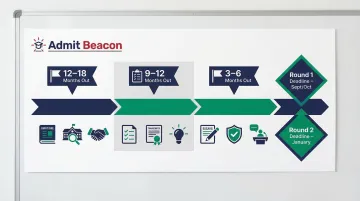
12–18 Months Before Deadline
- Take the GMAT or GRE
- Begin school research and attend information sessions
- Identify potential recommenders
9–12 Months Before Deadline
- Finalize school list (4–8 programs recommended)
- Request official transcripts
- Begin essay brainstorming and career narrative development
3–6 Months Before Deadline
- Draft and refine essays with multiple iterations
- Confirm recommenders have submitted letters
- Prepare for interviews with mock sessions
Round 1 deadlines fall in September–October, which means serious preparation needs to start by January of that same year. Round 2 deadlines land in January — workable, but your essays still need to be polished before the holiday period hits.
Most candidates spend 8–12 weeks on test prep and retake once or twice before hitting their target score. Build in extra lead time: official GMAT scores can take up to 20 days to reach schools electronically.
Common MBA Application Mistakes to Avoid
Most applicants know what to do — fewer realize what quietly kills an otherwise strong application. Watch out for these five patterns:
- School list size: Target 4-8 programs. Applying to 12 schools with generic applications hurts more than applying to 6 with tailored ones.
- Recycled essays: Admissions committees at top programs spot templated writing immediately. Each essay needs to reflect that specific school's values — not a lightly edited version of another school's response.
- Skipping the optional essay: This space exists for a reason. A low GPA, employment gap, or score anomaly addressed with context and self-awareness can strengthen your candidacy rather than raise questions.
- Wrong recommender: A senior executive who barely knows you is a weaker choice than a direct supervisor who can speak to specific achievements and growth.
- Deadline-day submission: Technical issues happen. Submit at least 24-48 hours early.
Frequently Asked Questions
What are the requirements for an MBA application?
Standard requirements include academic transcripts, test scores (GMAT/GRE/EA), a professional resume, school-specific essays, letters of recommendation, and an application fee. Requirements vary by program—some schools require one recommendation letter, others require two.
What looks good on an MBA application?
Beyond meeting minimum thresholds, strong applications share a few consistent traits:
- A coherent career narrative connecting past, present, and future
- Demonstrated leadership with measurable, specific impact
- Clear post-MBA goals tied to realistic paths
- Genuine school fit backed by detailed research
What is the MBA application cycle?
Most top programs have 2-3 rounds annually. Round 1 (September–October) and Round 2 (January) are the most competitive and scholarship-friendly. Round 3 (April) is generally discouraged except for exceptional cases, as space is limited and scholarships are rarely available.
How early should I start my MBA application?
Begin preparing 12–18 months before your target deadline. Test prep should start earliest, followed by school research, recommender conversations, and essay drafting in the months leading up to your chosen round.
How many schools should I apply to for an MBA?
Four to eight schools is a practical range—enough to provide a safety net, but not so many that personalization suffers. Quality and customization matter more than volume.