Introduction
MBA applicants routinely spend months perfecting GMAT scores and refining essays, yet many invest shockingly little time managing their recommendation letters. This oversight is costly. A strong letter can tip borderline candidates into the admit pile at schools like Harvard Business School or Stanford GSB, while a weak one can quietly undermine an otherwise competitive profile—even if every other component shines.
Most top MBA programs require two professional recommendation letters, and admissions committees treat them as a candid outside view of your candidacy, not a formality. Unlike essays you control or test scores you can retake, recommendations give admissions committees insight into how you handle feedback, how you compare to peers, and whether your interpersonal strengths match what you claim.
This guide covers how recommendation letters function in admissions review, who to choose as recommenders, how to ask effectively, what to include in a recommender brief, and the mistakes that quietly cost applicants their spot.
TLDR:
- Recommendation letters are one of the most impactful—and most neglected—components of your MBA application
- Most top programs require two professional letters; at least one must come from a direct supervisor
- Strong letters cite specific examples of leadership, impact, and interpersonal skills, not generic praise
- Brief your recommenders on your goals, target schools, and key accomplishments, but never draft the letter yourself
- Give recommenders six to eight weeks of lead time and follow up with thanks once decisions arrive
How Many MBA Recommendation Letters Do You Need—And Why Do They Matter?
Most top MBA programs require two letters, though requirements vary by school. Wharton recently reduced its requirement from two to one, while Georgetown McDonough requires only one letter. Some programs accept three, and in those cases, one academic source may be acceptable—but professional references remain strongly preferred. Always verify school-specific requirements before selecting recommenders.
What Admissions Committees Actually Look For
From the admissions committee's viewpoint, recommendation letters function as a "guarantor" of your potential. They offer perspective you cannot provide yourself—particularly on character, interpersonal dynamics, how you handle feedback, and how you compare to peers at similar career stages.
Even mediocre letters hurt applications. What a recommender fails to say speaks as loudly as what they do say. If a letter lacks specific examples or avoids addressing how you respond to constructive criticism, adcoms notice.
Recommendations are not passive checkboxes—they actively shape how committees evaluate your candidacy.
Key insight: Admissions officers use letters to forecast your success in collaborative, analytically focused MBA environments. Vague praise raises questions about whether your recommender truly knows your work or whether you lack meaningful professional relationships.
Who Should Write Your MBA Recommendation Letter
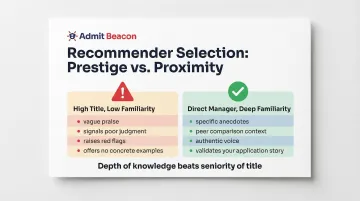
Choose recommenders who know you well and can speak to specific, recent examples of your professional impact—not the person with the most impressive title who barely knows your name. Admissions committees are skilled at identifying vague, generic letters regardless of the recommender's seniority.
Professional Recommenders vs. Academic Sources
Top programs like HBS and Wharton strongly prefer professional recommendations, ideally from direct supervisors. Academic references are generally acceptable only as a third letter or for deferred programs like HBS 2+2.
If you cannot provide a recommendation from your current supervisor:
- Use a former direct supervisor
- Select an indirect manager or senior colleague
- Consider a professional client or business partner
This situation is common—many applicants cannot approach current supervisors due to confidentiality concerns or recent job changes. When using an alternative recommender, briefly note the reason in your application's optional essay.
First Recommender vs. Second Recommender
For your first recommender: Your current direct supervisor is the gold standard. This person can speak to your day-to-day performance, how you handle challenges, and how you compare to other professionals at your level.
For your second recommender: Choose someone who adds a different dimension—a different project context, a cross-functional perspective, or a different facet of your leadership. Avoid selecting two recommenders who will repeat the same stories.
Note that Stanford GSB removed the peer recommendation option in recent cycles. The school now requires two letters from supervisors.
When You Don't Have Two Strong Recommenders
If you don't have two strong recommenders, cast a wider net across past managers, former colleagues, or clients before defaulting to a weak option. Sometimes the right move is to delay your application cycle and build stronger professional relationships. Submitting mediocre letters will undermine an otherwise competitive profile.
What Makes a Strong MBA Recommendation Letter
The most common mistake recommenders make is relying on general praise ("she is brilliant and hardworking") without grounding it in specific examples. Admissions committees discount unsubstantiated claims. The best letters paint a vivid picture through concrete stories, anecdotes, and measurable contributions.
Specific Examples Over Generic Praise
Weak letter approach: "John is an exceptional leader who consistently delivers results and works well with his team."
Strong letter approach: "When our largest client threatened to leave due to service delays, John took ownership of the relationship. He restructured our delivery process, personally visited the client site twice in one week, and coordinated a cross-functional team to resolve bottlenecks. Within 30 days, client satisfaction scores improved from 6.2 to 8.9 out of 10, and we retained $2.3 million in annual revenue. This example illustrates John's ability to diagnose problems quickly, mobilize resources under pressure, and rebuild trust through action rather than promises."
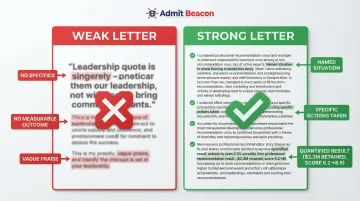
Notice what the strong version does: it names the situation, the specific actions, and a measurable result. That combination is what gives a recommendation real weight.
Key Qualities Adcoms Look For
Admissions committees want recommenders to address:
- Leadership: How you influence others and drive results
- Interpersonal skills: How you communicate, collaborate, and resolve conflicts
- Analytical ability: How you approach complex problems
- Innovation: How you generate new ideas or improve processes
- Integrity: How you handle ethical dilemmas or difficult decisions
- Coachability: How you respond to criticism or setbacks
- Peer comparison: How you rank against others in similar roles
In competitive applicant pools — finance, consulting, tech — the recommendation letter is often the deciding factor. Adcoms want to hear that you stand at the very top of your peer group, not simply that you are competent.
The Importance of Authentic Voice
Admissions officers are experienced at identifying letters that have been overly coached or ghost-written. A letter that sounds like your essays raises immediate red flags. The goal is to give recommenders enough context to write compellingly — not to script their words.
The most memorable letters include a small personality detail — an offhand remark the recommender remembers, or a specific moment that reveals how the candidate handles pressure. These details signal a genuine relationship, which no amount of polished prose can replicate.
How to Ask for an MBA Recommendation Letter—and How to Brief Your Recommender
The Right Way to Ask
Make your request in person or over a call rather than via email . The conversation should briefly cover:
- Why you're pursuing an MBA
- Why you've chosen this person specifically
- Your target schools
- The application deadline
Asking in person conveys respect and gives you the opportunity to gauge enthusiasm. A reluctant recommender is a risk—if someone hesitates or seems unsure, offer them an "out" and select someone who can wholeheartedly advocate for you. A half-hearted letter does more harm than good.
Timeline: Give recommenders at least six to eight weeks of runway before the application deadline. Rushed recommendations produce vague, unpersuasive letters.
What to Include in a Recommender Brief
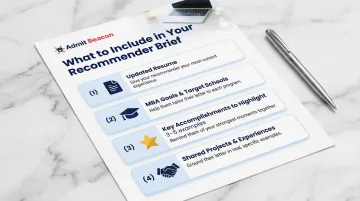
A recommender brief is a one-page document (or clear email) that gives your recommender the context they need to write a specific, compelling letter.
Key components to include:
- Your updated resume
- A summary of your MBA goals and why you chose these specific schools
- 3–5 key professional accomplishments or moments you'd like the letter to address
- Reminders of specific projects or experiences you worked on together
The Boundary Between Guidance and Ghostwriting
There's a clear line between helpful context and crossing into ghostwriting territory.
You can appropriately:
- Provide talking points and specific examples to recall
- Share context about target schools and your goals
- Remind them of projects you worked on together
Writing the letter yourself—even as a "draft for edits"—violates ethical boundaries. Admissions committees can detect applicant-written letters through stylistic analysis, plagiarism software, and metadata tracking.
Confirm Logistical Details
Before your recommender begins writing, confirm:
- The submission system (online portal vs. email)
- The exact deadline (share a date one week earlier than the actual deadline as a buffer)
- Whether the recommender has received the system invitation link after you entered their information
If you're working with an admissions consultant like Admit Beacon, this is a good moment to cross-check that your recommender brief aligns with the narrative running through your essays and resume—consistency across all components strengthens the overall application.
Common Mistakes to Avoid When Managing MBA Recommenders
Not Giving Enough Lead Time
This is the most frequently cited mistake from admissions committees. A rushed recommender produces a generic letter. Aim to complete all recommender conversations at least six to eight weeks before your earliest application deadline, with reminders sent one to two weeks before submission is due.
Choosing Prestige Over Proximity
Selecting a CEO or prominent executive who barely knows you over a direct manager who can speak to your work in detail is a fatal error. A letter from someone with an impressive title who offers vague praise is actively harmful—it signals either poor judgment in recommender selection or a gap in meaningful professional relationships.
Letting Recommendation Letters Contradict Your Application Story
If your essays emphasize one set of strengths and your recommenders highlight different or conflicting qualities, adcoms notice. Each recommender should reinforce a distinct facet of the same core narrative—not introduce new angles or contradict your essays. This is precisely the work Admit Beacon's LOR Guidance addresses: mapping each recommender's story to your overall application before a single word gets written.
Frequently Asked Questions
How important are letters of recommendation for an MBA?
Recommendation letters carry significant weight because they give admissions committees a third-party view of your candidacy that essays and test scores cannot provide. A weak letter can raise doubts about your professional relationships and undermine an otherwise strong application.
How many recommendation letters do you need for an MBA?
Most top MBA programs require two letters, ideally from professional supervisors. Some programs like Wharton and MIT Sloan now require only one, while others accept up to three. Always check each school's specific requirements before selecting recommenders, as policies vary by institution.
How to get a letter of recommendation for an MBA?
Ask in person at least six to eight weeks before the deadline, and provide a detailed brief covering your resume, MBA goals, target schools, and specific accomplishments to highlight. Confirm submission logistics and set an internal deadline one week ahead of the program's cutoff.
Can I write my own MBA recommendation letter?
No — it's an ethical violation, and admissions officers are skilled at detecting it through writing pattern analysis. Guide your recommenders with context, examples, and talking points, but let them write the letter in their own voice.
What should an MBA recommendation letter include?
Strong letters cover specific examples of leadership and contributions, how you compare to peers, how you handle feedback, and personal observations that reinforce your character — all backed by concrete anecdotes with measurable outcomes rather than generic praise.
What if I can't get a recommendation from my current supervisor?
This is common. A former supervisor, indirect manager, or professional client works as an alternative. Note briefly in your optional essay why you couldn't approach your current supervisor — admissions committees understand that confidentiality concerns or recent job changes make this a reasonable choice.