Introduction
The closing paragraph of a recommendation letter is the last thing an admissions committee reads—and for MBA applications to top programs like HBS, Stanford GSB, or Wharton, that final impression carries real weight in a competitive review process. With acceptance rates at Stanford GSB hovering around 6.8% and Harvard Business School at 11.2%, every element of your application package must deliver.
Recommenders often spend the most effort on the body of the letter, but the closing is frequently rushed or generic. A vague or lukewarm closing can damage an otherwise competitive application — former INSEAD admissions directors have flagged this as an underappreciated risk in the review process.
This article walks through 5 steps to write a compelling recommendation letter closing, explains what to include and avoid, and provides concrete examples that recommenders can adapt.
Key Takeaways
- The closing should summarize the candidate's top strengths in one to two sentences—not introduce new information
- Explicitly state your recommendation (e.g., "I recommend X without reservation") rather than leaving it implied
- Tying the candidate's strengths to the specific program makes the closing feel targeted, not templated
- Offering to answer follow-up questions signals genuine investment and adds credibility
- Use a professional sign-off ("Sincerely," "Regards") with your full name, title, and contact information
Why the Closing Paragraph of a Recommendation Letter Matters
While the body of a recommendation letter provides evidence, the closing is where the recommender delivers a verdict. Admissions committees at top MBA programs read dozens of letters per cycle—Harvard Business School alone received 9,409 applications for the Class of 2027—and they pay close attention to how firmly and specifically a recommender endorses a candidate.
A closing that is vague, overly brief, or fails to restate the recommendation can create doubt where the rest of the letter built confidence. This is consequential for MBA applications where recommenders are often asked structured questions through templates like the GMAC Common Letter of Recommendation.
The closing is the final unstructured judgment call—the moment where the recommender shifts from describing to endorsing. It carries disproportionate weight precisely because it is the last thing a reader sees.
Top programs state that strong recommenders must speak to "specific strengths and abilities" rather than offering general endorsements. A closing that names the candidate's most distinctive quality—and connects it directly to their fit for the program—leaves a sharper impression than any amount of praise in the paragraphs above it.
How to Close a Recommendation Letter: 5 Steps
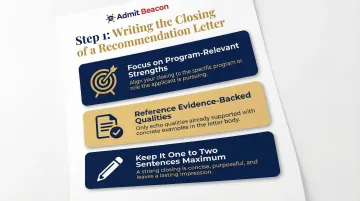
Step 1: Summarize the Candidate's Core Strengths in One to Two Sentences
The closing paragraph should not introduce new evidence. Instead, it should distill the one or two qualities the recommender most wants the reader to remember.
How to do this effectively:
- Pick strengths most relevant to the opportunity—for an MBA program focused on leadership, center the summary on leadership moments rather than technical skills
- Reference qualities already discussed in the body with supporting evidence
- Keep it concise—one to two sentences maximum
Example: "Throughout our three years working together, Sarah has consistently demonstrated exceptional strategic thinking and the ability to lead cross-functional teams through complex operational challenges."
Step 2: State Your Recommendation Explicitly and Without Hedging
Phrases like "I believe she would do well" or "I think he has potential" signal uncertainty — and admissions committees are trained to read between the lines. According to AIGAC guidelines, explicit endorsement language signals genuine confidence, while hedging undermines credibility.
The closing should use direct, affirmative language with no qualifiers.
Strong endorsement language:
- "I recommend [Name] without reservation"
- "I give [Name] my highest recommendation"
- "I enthusiastically endorse [Name]'s application"
- "[Name] has my strongest possible recommendation"
Weak language to avoid:
- "I believe [Name] would do well"
- "I think [Name] has potential"
- "[Name] would likely benefit from this program"
Step 3: Connect the Candidate to the Specific Program or Opportunity
Once the endorsement is on record, the closing gains more weight when it names the school and explains the fit. A generic sign-off reads as recycled; a targeted one reads as intentional.
Stanford GSB explicitly warns that "outdated or general letters do not strengthen a candidate's application." The comparison below shows the difference in practice:
| Example | |
|---|---|
| Generic (weak) | "I recommend her for any graduate program she chooses to pursue." |
| Targeted (strong) | "I am confident that Sarah's background in operational leadership and her track record of driving cross-functional collaboration make her an ideal fit for the Wharton MBA program." |
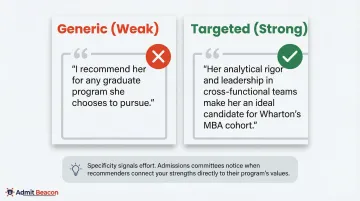
The targeted version works because it connects the candidate's specific strengths to a specific program — not a category of programs.
Step 4: Invite Follow-Up Questions
With the core endorsement and program fit established, a single sentence offering to answer questions closes the letter on a credible, open note. Admissions committees do occasionally follow up, and this offer signals that the recommender stands behind what they've written.
One sentence is enough. Include a contact method either inline or in the signature block:
- "Please do not hesitate to contact me at [email] if you have any questions"
- "I am happy to discuss [Name]'s qualifications further at your convenience"
- "I welcome the opportunity to provide additional information"
Step 5: Choose a Professional Closing Phrase and Format the Signature Correctly
Appropriate closing phrases for formal recommendation letters:
- Sincerely, — The safest, most universally accepted closing
- Respectfully, — Appropriate for highly traditional committees
- Cordially, — A strong alternative that maintains professional distance
- Best regards, — Acceptable for a slightly warmer yet professional tone
Skip "Best," "Cheers," "Thanks," and "Warmly" — all are too casual for a formal MBA recommendation.
Proper signature formatting:
- Closing phrase (capitalize only the first word, followed by a comma)
- Two line breaks
- Full name
- Title/position
- Institution or company
- Contact information (email and/or phone)
When submitting on letterhead, a handwritten signature adds a layer of professionalism that matters to selective admissions offices.
Recommendation Letter Closing: 3 Examples
These three closings illustrate the difference between a forgettable sign-off and one that reinforces a candidacy at the moment it matters most. As you read, note how each uses endorsement language, program specificity, and signature format.
Example 1: Strong Closing from a Direct Manager (MBA Application)
"Throughout our four years working together at Deloitte, Michael has consistently demonstrated exceptional analytical rigor and the ability to lead teams through ambiguous, high-stakes client engagements. I recommend Michael without reservation for the Wharton MBA program—his combination of strategic thinking and collaborative leadership will make him an outstanding addition to your community. Please do not hesitate to contact me at jennifer.wong@deloitte.com if you have any questions.
Sincerely,
Jennifer Wong
Senior Manager, Strategy & Operations
Deloitte Consulting LLP
jennifer.wong@deloitte.com | 415-555-0198"
Why this closing works for admissions committees:
- Summarizes two core strengths (analytical rigor, team leadership) already backed by the letter body
- Uses explicit endorsement language ("without reservation") — no hedging
- Names the target program (Wharton MBA) directly
- Closes with a contact invitation and a complete professional signature block
Example 2: Strong Closing from an Academic Recommender (MBA Application)
"Over the past two years, I have watched Elena develop from a talented undergraduate researcher into a confident thought leader capable of bridging academic theory and real-world business application. I give Elena my highest recommendation for the Stanford GSB MBA program, where her intellectual curiosity and commitment to social impact will thrive. I welcome the opportunity to discuss her qualifications further at david.chen@stanford.edu.
Respectfully,
Dr. David Chen
Associate Professor of Economics
Stanford University
david.chen@stanford.edu"
Academic recommenders tend to highlight intellectual growth and long-term development, while managers emphasize business impact and leadership in action. The tone shifts — but both closings still require explicit endorsement language and a program-specific reference.
Example 3: Weak Closing vs. Revised Strong Closing (Side-by-Side)
Weak Version: "I think Alex would benefit from this program and I recommend him for admission. Good luck with your decision.
Best,
Tom"
Revised Strong Version: "Alex's proven ability to drive operational efficiency and mentor junior team members positions him as an ideal candidate for the MIT Sloan MBA program. I recommend Alex enthusiastically and without reservation. Please feel free to contact me at thomas.rivera@amazon.com with any questions.
Sincerely,
Thomas Rivera
Operations Manager
Amazon Logistics
thomas.rivera@amazon.com | 206-555-0147"
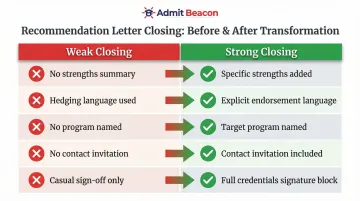
Five changes turn a weak closing into a strong one:
- Specific strengths summary added (operational efficiency, mentoring)
- Hedging language ("I think he would benefit") replaced with explicit endorsement ("enthusiastically and without reservation")
- Target program named directly (MIT Sloan)
- Professional contact invitation included
- Casual sign-off ("Best, Tom") replaced with a full credentials signature block
Dos and Don'ts for the Recommendation Letter Closing
Do: Keep the closing focused and concise One solid paragraph of three to five sentences is sufficient. Longer closings that repeat content already in the body dilute impact.
Don't: Introduce new qualities or anecdotes in the closing The closing should feel like a landing, not a new runway. If a strength wasn't addressed in the body with supporting evidence, don't mention it in the closing.
Don't: Use templated, generic language Phrases like "I recommend [Name] for any position or program they pursue" signal to admissions committees that the recommender didn't tailor the letter, which weakens its credibility. Applicants can prevent this by briefing their recommenders with program-specific context before they write.
Do: Align the closing with your overall endorsement rating If you selected "Enthusiastically recommend" on the GMAC Common Letter of Recommendation form, your closing language should reflect that same level of conviction.
Do: Proofread the signature block Ensure your title, company name, and contact information are accurate and current. Admissions offices may verify letters directly—Harvard Business School, for example, uses third-party verification to follow up with recommenders after interviews.
Conclusion
The closing paragraph of a recommendation letter is where a recommender delivers their final verdict—and doing it well requires summarizing strengths, endorsing the candidate explicitly, referencing the specific program, and formatting the sign-off professionally.
Recommenders who follow these five steps will produce a closing that feels purposeful and persuasive. MBA applicants can support that outcome by briefing their recommenders clearly, providing program-specific context, and sharing the guidance outlined here—because a well-equipped recommender writes a stronger letter.
Frequently Asked Questions
What is the difference between the closing paragraph and the closing sign-off in a recommendation letter?
The closing paragraph is the final substantive section that summarizes strengths and restates the recommendation. The closing sign-off is the valediction and signature ("Sincerely, [Name]"). Both are distinct elements that serve different purposes—one delivers the final judgment, the other provides professional formatting.
How long should the closing paragraph of a recommendation letter be?
Three to five sentences is the right length—enough to restate key strengths and invite follow-up without overstaying the point.
Should a recommender always offer to be contacted in the closing?
Yes. A contact invitation signals genuine investment in the candidate and adds credibility. The recommender should include their email in the closing paragraph or signature block to make follow-up easy.
Can an MBA applicant suggest what their recommender writes in the closing?
Applicants can and should brief their recommenders—sharing career goals, qualities to emphasize, and relevant school values helps produce a targeted closing. However, AIGAC guidelines explicitly warn that applicants must never draft the letter themselves, as this violates honor codes and can result in denial.
What closing phrases are appropriate for MBA recommendation letters?
Appropriate formal valedictions include "Sincerely," "Regards," "Respectfully," and "Cordially." Avoid casual closings like "Best," "Cheers," or "Thanks"—professional tone in the sign-off is especially important for top MBA programs with formal admissions processes.
What should you never include in the closing of a recommendation letter?
Avoid introducing new claims not supported in the body, using hedging language ("I think," "I believe"), and writing a closing so generic it could apply to any candidate for any program. Specificity and conviction are non-negotiable.