Introduction
Most MBA applicants spend weeks perfecting their prose but little time thinking about what the essay actually needs to accomplish — which means polished writing that fails to land because the strategy behind it is missing. Generic advice like "be specific" or "show don't tell" doesn't address the harder problems.
Building a coherent narrative across multiple essays, demonstrating genuine school fit, and making your candidacy legible to a time-pressed reader all require a deliberate approach before any drafting begins.
This guide covers how to decode what admissions committees are really evaluating, how to build a story architecture before writing, how to handle the most common essay types, and which mistakes to avoid — so your final essays work as a unified, strategic package.
Key Takeaways
- Treat your essays as a portfolio: each one should complement the others and build a single coherent picture of your candidacy
- Every prompt maps to specific "admission drivers" — know what a school evaluates before you write a single word
- Storyboard first: map experiences to admission drivers across your full essay set to avoid repeating yourself
- Specificity and factual depth outperform broad claims and subjective language every time
- "Why This School" essays fail on vague praise; genuine school-specific research is what separates strong responses from forgettable ones
Understand What the Admissions Committee Is Really Looking For
Admission Drivers vs. Essay Prompts
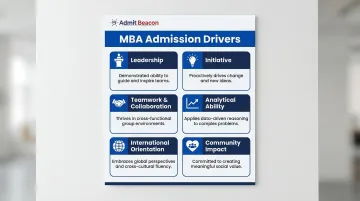
Behind every essay prompt is a layer of criteria — commonly called "admission drivers" — that admissions committees use to evaluate candidates. These drivers vary meaningfully by school and represent the specific qualities each institution values most:
- Leadership: Evidence of influence, team management, and decision-making authority
- Initiative: Demonstrated ability to identify problems and take action without being directed
- Teamwork and collaboration: How you work across functions, cultures, and hierarchies
- Analytical ability: Problem-solving skills, quantitative reasoning, and structured thinking
- International orientation: Cross-cultural experience, language skills, and global perspective
- Community impact: Contributions beyond professional achievements, including service and mentorship
For example, Harvard Business School evaluates candidates on three core characteristics: "business-minded, leadership-focused, and growth-oriented." Stanford GSB seeks to learn "how you think, how you lead, and how you see the world." Kellogg looks for candidates who possess "a blend of analytical, creative and social intelligence and who can uplift teams to their full potential."
Identifying the admission drivers for each target school before writing — through the school's website, student conversations, and admissions forums — allows applicants to deliberately showcase the qualities the committee values.
What Adcoms Actually Do With Essays
Admissions reviewers process hundreds of applications on tight timelines — and multiple people read each one. Wharton mandates "two independent reads" for every full-time MBA application by reviewers "with no knowledge of what the other reader's feedback is."
HBS similarly confirms that "at least two different members of the Admissions Board will read every application submitted," with applications "divided into industry groups for the Admissions Board to review."
This reading environment means key messages must surface quickly. Essays must pass a "skim test" — anything that doesn't advance the candidate's core story is a liability. Reviewers prioritize a clear, coherent story over stylistic flair.
That clarity extends across the full application. Essays are evaluated as a portfolio, not in isolation — each one must complement the others. Two essays telling the same story, or presenting conflicting pictures of the candidate, signal a lack of self-awareness and waste space that could show range.
Build Your Narrative Before You Start Writing
Before drafting any essay, map the full arc of your candidacy — key professional and personal experiences, inflection points, leadership moments, and the thread connecting past to future. This pre-writing step prevents the most common structural failure: essays that are individually competent but collectively incoherent.
Poets&Quants advises: "Before sitting down to write, consider the big picture. Your ability to be both genuine and reflective about some fundamental questions will set you up for success." They recommend a specific sequence: "Brainstorm: What factors have driven your personal life and professional career? Reflect: What key messages do you want to convey? Frame: Start with a bullet point version and show a logical flow in your path."
The experience audit: Make a list of 8–10 defining experiences, identify which admission driver each supports, then allocate them across the school's essay set so no two essays lean on the same moment or message — ensuring the full application covers the breadth of your candidacy.
The most compelling applications show a logical, nearly inevitable connection between past experience, the MBA's role as a bridge, and the candidate's future goals. This thread should remain consistent across the goals essay, the "Why MBA" section, and the "Why This School" essay — so all essays read like chapters of the same book, not separate submissions.
Applicants who struggle to identify their strongest themes — or who find their drafts feeling disconnected — can benefit from working with a consultant who specializes in essay storyboarding. Admit Beacon's lead consultant Niketa dedicates roughly 40% of total application effort to career narrative development, helping applicants surface one compelling candidacy story rather than a scattered list of accomplishments.
Craft Your Career Goals Essay with Clarity and Specificity
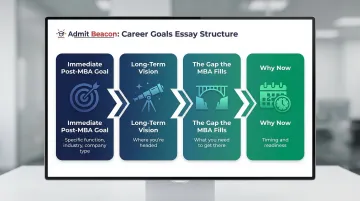
The structure of a strong goals essay: immediate post-MBA goal (specific function, industry, and company type) → long-term vision → the gap the MBA fills → why now. Each element must connect logically to the next; a goals essay that jumps between vague ambitions without this connective tissue will not be persuasive.
Short-Term vs. Long-Term Goals
Most top schools now prioritize short-term goals over long-term projections. A global GMAC survey found that "50-60% of MBA graduates managed to switch either industry or job function as a result of their degree," making ambitious 10-year plans less credible to adcoms.
Short-term goals should be specific enough to be actionable and realistic enough to be credible.
Short-term goals must connect backward to the candidate's existing experience and forward to a longer-term ambition. Schools that ask for a "Plan B" scenario want to see a contingency that feels equally grounded — not a completely different field, but a logical adjacent path using the same skills and interests.
The specificity test: Contrast weak framing (broad industry, generic role) with strong framing (named sector, specific function, named company types or deal structures). Specificity signals that the goal has been thought through. Wharton instructs applicants: "Be specific and direct. What job do you want right after Wharton? Think title, function, industry, etc."
Objective, factual language ("I led three cross-border transactions at X") consistently outperforms subjective claims ("I'm passionate about finance"). State what you did; the adcom will draw its own conclusions.
Write the "Why This School" Essay with Genuine Depth
Vague praise like "your renowned faculty, strong alumni network, and collaborative culture" is the single most common failure in "Why This School" essays. Adcoms immediately recognize language that applies equally to any top program. The prompt is designed to test whether the candidate has done serious school-specific research, not to invite compliments.
Genuine school research looks like this:
- Named professors and their specific research areas
- Particular courses or curriculum structures (case method, action learning, specific electives)
- Student clubs and their activities
- Dual degree options
- Insights from current students or alumni
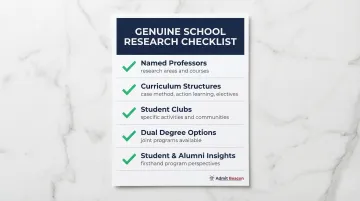
For example, Harvard Business School's curriculum features "The Case Method" and "The Field Method." MIT Sloan offers "Action Learning Labs" and the "LGO program" (Leaders for Global Operations dual degree). Chicago Booth is known for its "Flexible Curriculum" and "LEAD" program.
Building this level of specificity takes more than a quick browse of a school's website. Admit Beacon's Knowledge Base covers the top 25 MBA programs in depth, and live webinars with current students and alumni give applicants the school-specific texture that no brochure can replicate.
The strongest responses demonstrate fit in both directions — not just what the program offers you, but what you'll bring to that classroom and community. Anchor your answer in your background, goals, and perspective as they connect to specific student groups, curriculum design, or program values.
Make Your Writing Sharp, Specific, and Authentic
Four principles anchor strong MBA essay writing:
- Use active voice over passive construction
- Keep sentences and paragraphs short (3–5 lines maximum)
- Choose objective language over unsubstantiated claims
- Edit relentlessly for economy — compression almost always improves clarity
In short-answer essays especially, every word must earn its place.
Show, Don't Tell
Rather than claiming a quality ("I am a strong leader"), demonstrate it through a specific moment — a concrete situation, the action taken, and the measurable or observable result. Write episode essays — prompts beginning with "tell us about a time when…" — as vivid, narrative chapters with specific details, dialogue if relevant, and a clear arc.
The Authenticity Imperative
Essays that present a flawless candidate often feel hollow. Showing self-awareness — including a setback, an error in judgment, and what was learned — signals maturity and genuine reflection. Stanford GSB explicitly warns that "there is a big difference between 'feedback' and 'coaching.' You cross that line when any part of the application ceases to be exclusively yours in either thought or word," noting that inappropriate coaching "will result in denial of your application or revocation of your admission."
Adcoms at Kellogg, Stanford, and MIT Sloan aren't looking for polished self-promotion — they're looking for someone who knows themselves well enough to write honestly about it.
Avoid These Common MBA Essay Mistakes
The most damaging mechanical mistakes:
- Not directly answering the prompt — read the question carefully and address what's actually being asked
- Exceeding the word limit — signals difficulty operating within constraints
- Submitting an essay with another school's name in it — an immediate credibility killer
- Relying heavily on pre-professional or high school achievements — focus on recent, relevant experience
- Filling essays with industry jargon — obscures rather than communicates
Beyond these mechanical slip-ups, two subtler strategic errors trip up otherwise strong applicants.
The "Vacuum" Trap
Writing each essay in isolation — without checking how the full application reads as a whole — is a common planning failure. Essays that contradict each other or retell the same story signal poor self-awareness and waste space that could have showcased additional dimensions of your candidacy.
The Résumé Restatement Problem
The essay is not the place to list accomplishments already visible elsewhere in the application. It's the space to reveal context, character, and the thinking behind decisions — the "why" and "how," not just the outcomes themselves. HBS explicitly warns against using the employment section or essays as a "repeat of your resume."
Frequently Asked Questions
How long should an MBA essay be?
Word limits vary by school and prompt , typically ranging from 250 to 700 words. Staying within the stated limit, without going significantly under, signals good judgment and editing discipline.
How do you start an MBA essay?
Strong openings drop the reader directly into a specific moment, challenge, or decision rather than opening with broad context or a summary of what the essay will cover . Avoid "in this essay, I will discuss…" constructions entirely.
What do MBA admissions committees look for in essays?
Adcoms look for evidence of leadership, clear and credible goals, genuine school fit, self-awareness, and strong communication . The essay should map to the school's specific admission drivers rather than presenting a generic profile.
How do you write a "Why This School" MBA essay?
The strongest responses name specific programs, professors, learning models, or communities and demonstrate both what the school offers the applicant and what the applicant will contribute to that community.
Can I use the same MBA essay for multiple schools?
While core stories and frameworks can be adapted across applications, every essay must be customized to the school's prompt, values, and culture. Submitting an essay clearly written for a different school is a serious mistake that damages candidacy.
How many drafts should I write for my MBA essay?
Most strong essays go through five to eight drafts. Early drafts establish content and structure. Middle drafts sharpen specificity and narrative clarity. Final drafts focus on trimming language so every sentence earns its place.