Introduction
Applying to Columbia Business School means joining one of the most competitive MBA programs in the world — set in the heart of New York City, with an admissions process that demands more than a strong resume. CBS accepted just 19.5% of applicants for the 2025 entering class, and the application has a specific structure: two short-answer questions (50 characters each) and three required essays (500, 250, and 250 words), plus an optional essay.
Most applicants focus on what they want to say. CBS cares about how your goals, values, and program fit connect into one coherent narrative. Its culture — collaborative, ambitious, NYC-oriented — is not a checkbox; it runs through every prompt and should shape every response you write.
TLDR:
- CBS requires two 50-character short answers and three essays (500, 250, 250 words)
- Essay 2 moved away from its previous "PPIL" leadership format toward broader collaborative examples
- Fit and "co-creation" are non-negotiable; generic answers fail
- The 50-character limit includes spaces — precision is essential
- Start with clear goals before drafting any essay
At a Glance: What CBS Requires
Short answers:
- Two responses capped at 50 characters each (not words)
- One on immediate post-MBA goals
- One on summer plans (August entry) or J-term preference (January entry)
Required essays:
- Essay 1 (500 words): Career goals over the next 3–5 years and your long-term dream job
- Essay 2 (250 words): An example of making a team more collaborative, inclusive, or community-driven
- Essay 3 (250 words): How you would co-create your ideal MBA experience at CBS
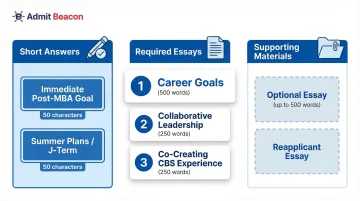
Supporting materials:
- Optional essay (up to 500 words) to explain gaps, low grades, or extenuating circumstances
- Separate reapplicant essay if applicable
Before You Write: Building Your CBS Foundation
Clarify your goals before drafting anything
Before drafting a single sentence, map out your goals. A clear post-MBA role, a credible 3–5 year path, and an ambitious long-term vision give the entire application its backbone — and Essay 1 its answer.
Goal-setting framework:
- Name the specific function, industry, and type of organization for your post-MBA role
- Show how that role builds toward your 3–5 year trajectory, not just fills a résumé gap
- Set an ambitious long-term goal — CBS rewards scalable impact over predictable career paths
Research CBS with depth and intention
Go beyond the admissions website. Identify specific courses, professors, and centers tied to your goals:
- Eugene M. Lang Entrepreneurship Center: Launch, Invest, and Scale tracks for innovators
- Heilbrunn Center for Graham & Dodd Investing: Value Investing Program for 40 second-year students
- Tamer Institute for Social Enterprise and Climate Change: Fellowships and the Tamer Fund for Social Ventures
- Chazen Global Immersion Program: 3-credit courses bridging classroom lessons with business practices abroad
Knowing which CBS resources directly advance your goals — not just their names — is what separates a compelling "Why CBS" answer from a generic one.
Network with current students and alumni
Reach out to CBS community members through the Hermes Society, info sessions, or direct LinkedIn outreach. These conversations surface insights no admissions page will tell you — and give you specific names, stories, and details to reference authentically in Essays 1 and 3.
That specificity is what signals genuine fit to the admissions committee.
CBS Short Answer Questions
Short Answer Q1 — Immediate Post-MBA Goal (50 Characters)
The constraint: 50 characters including spaces, not words. With this limit, complete sentences are unnecessary. Focus on conveying role, industry, and function in the most precise language possible.
Good example: "Join MBB to lead healthcare strategy work"
Bad example: "Enter consulting"
Alignment with Essay 1: This short answer is not standalone — it previews the deeper narrative. Draft Essay 1 first, then work backward to compress the core post-MBA goal into 50 characters.
The second short answer shifts from goal-setting to timing — how you plan to use the summer or why J-Term fits your path.
Short Answer Q2 — August Entry (Summer Plans) or January Entry (Why J-Term)
August entry applicants should connect summer internship goals directly to the post-MBA career path:
- Name the industry and function you're targeting for the internship
- Reference specific firms or organization types that recruit through CBS's Career Management Center
- Show how the internship bridges your background to your long-term goal
January entry applicants should explain why the 16-month J-Term program fits their situation:
- Returning to a current employer, joining a family business, or launching a venture are the most common valid reasons
- State the reason directly rather than just saying "no internship needed"
- Adcoms want to see that J-Term is a deliberate choice, not a default
Essay 1: Career Goals — 500 Words
What CBS is actually asking
The prompt explicitly states the AdCom already has a clear sense of your professional path from your resume and recommendations. This means applicants should not recap their work history. The essay is about why — the personal motivations, values, and long-term vision behind the goals.
How to open
Begin with a personal hook — a defining moment or a problem that ignited your direction. This might come from formative years, a professional turning point, or direct exposure to an issue at scale. The hook should anchor the entire essay's "why."
Framing short-term goals
Be specific: name a post-MBA role, the type of organization, and the problem you aim to solve — then connect that role directly to the skills your long-term goal requires. Generic aspirations like "enter finance" will not differentiate you.
Structure:
- Role: Product Manager, Strategy Consultant, Investment Associate
- Organization type: Tech startup, MBB firm, impact investment fund
- Work focus: What specific problems will you solve in this role?
Framing the long-term "dream job"
CBS chose the word "dream" deliberately. The AdCom wants applicants who think ambitiously and aspire to make scalable impact — not those who follow well-worn paths. Your long-term goal should be bold, rooted in authentic motivation, and tied directly to the short-term role you've outlined.
How to use the CBS-specific section (final ~150 words)
Reserve the last third of the essay for explaining how CBS specifically enables your path.
What to include:
- Academic offerings: Name specific courses or professors relevant to your goals
- Experiential programs: Reference the Entrepreneurial Greenhouse Master Class or Chazen GIP
- Extracurricular opportunities: Mention clubs, centers, or initiatives by name
- Conversations: Reference discussions with current students or alumni to add credibility
Skip the generic praise. Show exactly how CBS's specific resources address gaps in your own background — that precision is what makes this section persuasive.
Essay 2: Collaborative Leadership — 250 Words
What Changed in the 2025–2026 Prompt
CBS simplified this prompt from the prior year's PPIL-focused version. The focus is now squarely on a specific example of making a team more collaborative, more inclusive, or fostering community — giving applicants more flexibility while still centering interpersonal leadership values.
How to Pick the Right Story
Choose an example from a professional context when possible, as it signals readiness for the CBS classroom. A leadership role is a plus but not required — CBS cares more about your values, judgment, and the impact of your actions than your formal title.
Keep these criteria in mind when evaluating your options:
- Context: Professional settings carry the most weight, but strong community or academic examples work too
- Role: Formal authority isn't necessary — influence and initiative matter more
- Reveal: The example should expose character and judgment, not just a positive outcome
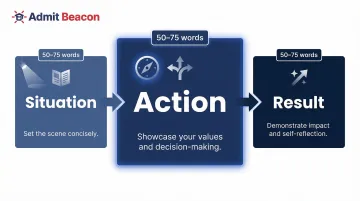
Structuring Your 250 Words
Recommended structure:
- Situation (50–75 words): Establish context quickly — don't over-explain; admissions readers need just enough to understand the stakes
- Action (100–125 words): This is the core; show the specific decisions you made, how you navigated friction, and what values drove your choices
- Result (50–75 words): Close with a concrete outcome and one honest reflection on what the experience taught you
The Most Common 250-Word Mistake
Don't spend too much time describing the situation and too little on the actions. Admissions committees evaluate your thought process and values, not the complexity of the setting.
Essay 3: Co-Creating Your CBS Experience — 250 Words
What "co-create" signals to the AdCom
CBS admissions leadership emphasizes that community contribution is "not just fluff." CBS is not looking for a list of clubs you plan to join. They want to see an active contributor — someone who will give as much as they take. The word "co-create" implies initiative, partnership, and a willingness to leave a tangible mark on the community.
Research framework across three dimensions
Address all three areas named in the prompt:
- Academic: Specific courses, professors, or research projects
- Cultural: Identity-based clubs, traditions, community-building initiatives
- Professional: NYC network, industry panels, leveraging current expertise for classmates
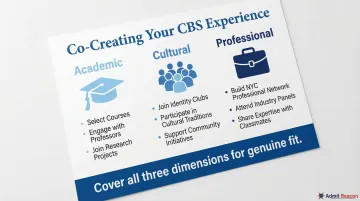
Covering all three angles signals genuine fit — and sets up your contributions section with real specificity.
How to frame contributions with specificity
Contributions should be concrete, realistic, and tied to your background.
Examples of strong contributions:
- A current consultant offering to run mock case interviews for classmates
- A healthcare professional proposing a cross-industry panel with industry contacts
- An engineer leading a hackathon through the Lang Center
Vague intentions like "I will be an active participant" waste scarce word count.
Note on authenticity
Personalized approaches are what separate strong Essay 3 responses from generic ones. A strong Essay 3 reflects your unique perspective and actual interests — not a list of CBS programs copy-pasted from the website. When your contributions connect directly to what you've done and what you plan to do, the AdCom can picture you in the room — which is exactly the goal.
Optional Essay and Reapplicant Essay
Optional Essay
Use the optional essay only when there is a genuine concern that could raise a red flag for the AdCom — a GPA weakness, low standardized test score, employment gap, or an unusual circumstance.
Best practices:
- Keep the response concise and solution-oriented
- Avoid defensiveness
- CBS explicitly permits bullet points, and that format works well here
- Focus on what you learned or how you addressed the issue
Reapplicant Essay
CBS's reapplicant prompt asks how you have enhanced your candidacy since last applying. Focus on concrete, proactive improvements:
- A promotion or expanded responsibilities
- Higher test score
- New community involvement
- More developed or refined goals
- Demonstrated intentionality — progress should be deliberate, not passive, and you should not re-explain original goals
Frequently Asked Questions
How many essays does Columbia require?
CBS requires two short-answer responses (50 characters each) and three required essays: Essay 1 (500 words), Essays 2 and 3 (250 words each), plus an optional essay of up to 500 words for applicants with concerns to address.
Is Columbia MBA hard to get into?
CBS is among the most selective MBA programs in the world, with a 19.5% acceptance rate for the 2025 cycle. Beyond strong test scores (average GMAT of 734) and GPA (3.6), CBS places significant weight on fit, clear goals, and demonstrated knowledge of and connection to the school.
What is the STAR method in MBA?
STAR stands for Situation, Task, Action, and Result — a narrative framework used to structure behavioral essays. For CBS Essay 2 specifically, the Action component should receive the most word count, as it reveals your values and decision-making process.
Should MBA essays be double spaced?
CBS does not specify formatting requirements for spacing, and most essay responses are submitted through an online application portal that controls text display. Focus on word count compliance rather than spacing formatting.
What does CBS look for in MBA applicants?
CBS prioritizes ambitious career goals, demonstrated fit with the school's collaborative and NYC-driven culture, strong interpersonal and leadership values, and a clear sense of what you will contribute to — not just take from — the community.
How important is the "Why CBS" element in the Columbia essays?
Fit is one of the most weighted factors in the CBS evaluation process. The theme runs across all three essays — not just Essay 3 — and applicants who cannot articulate a specific, credible reason for choosing CBS over peer programs are unlikely to advance.
Need personalized guidance for your CBS application? Admit Beacon works with each applicant to build a focused strategy across essays, short answers, and interview prep — tailored to CBS specifically, not mass-produced advice. Book a consultation to get started.