The paradox CBS applicants face is straightforward: meeting the average benchmarks—GMAT 732, GPA 3.6, five years of work experience—is not enough. Approximately 4 out of 5 qualified candidates are rejected. Quantitative credentials alone won't carry you. The admissions committee uses a holistic "reading to admit" framework that prioritizes leadership impact, authentic fit with the CBS community, and a clear, specific connection to why Columbia serves your goals.
This article breaks down what the numbers mean, who actually gets in, what CBS values beyond test scores, how your background affects your odds, and concrete strategies to strengthen your application before you submit.
Key Takeaways
- CBS's acceptance rate sits at approximately 20–21%, with nearly 7,500 applications and 982 students enrolled across August and January intakes
- Average admitted student: GMAT 734, GPA 3.6, five years of work experience
- Finance (30%), consulting (23%), and technology (12%) dominate the class — candidates in these fields compete against direct peers
- CBS weighs leadership, community contribution, and fit with New York City's business ecosystem — not just test scores
- A 27% application surge in the latest cycle reversed three years of declines, making competition sharper than it's been in years
Columbia MBA Acceptance Rate: The Numbers at a Glance
Current Acceptance Rate and Application Volume
Columbia Business School does not officially publish its acceptance rate or admit counts. Based on data compiled by Poets & Quants, the estimated acceptance rate for the class entering in 2025 is 19.5%, drawn from 7,477 applications and an estimated 1,450 admits. The enrolled class size is 982 students.
The previous cycle saw a massive 27% surge in applications—jumping from 5,895 to 7,487—which reversed three years of declines and set a new school record.
Historical Acceptance Rate Trends
| Entry Year | Applications | Estimated Acceptance Rate | Enrolled Class Size |
|---|---|---|---|
| 2025 | 7,477 | 19.5% | 982 |
| 2024 | 7,487 | 20.9% | 972 |
| 2023 | 5,895 | 22.4% | 900 |
| 2022 | 6,177 | 22.1% | 844 |
| 2021 | 6,535 | 18.6% | 847 |
| 2020 | 6,971 | 16.2% | 782 |
| 2019 | 5,876 | 19.1% | 754 |
CBS has grown its enrolled class by nearly 30% since 2019. This expansion has been gradual and demand-driven across successive cycles, not the result of a single announced policy change.
August vs. January Intake Structure
CBS splits its student body across two intakes:
- August cohort: 758 students divided into 10 clusters
- January (J-Term) cohort: 224 students divided into 4 clusters
No published data indicates one intake is more selective than the other. That said, international J-Term applicants are explicitly advised to apply early to allow time for visa processing and logistics.
M7 Acceptance Rate Context
Understanding CBS's selectivity in isolation only tells part of the story. Here's how it ranks within the M7 based on 2024 cycle data:
| M7 Business School | 2024 Acceptance Rate |
|---|---|
| Stanford GSB | 6.8% |
| Harvard Business School | 11.2% |
| MIT Sloan | 14.1% |
| Wharton | 20.5% |
| Columbia Business School | 20.9% |
| Northwestern Kellogg | 28.6% |
| Chicago Booth | 28.7% |
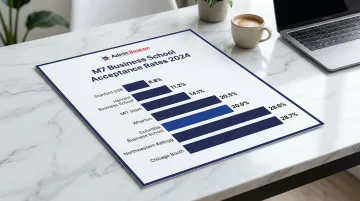
CBS sits closer to Wharton than to Stanford or Harvard in raw selectivity. But with nearly 7,500 applicants competing for roughly 1,450 spots, the applicant pool is deep and credentialed — a 20% acceptance rate does not translate to a forgiving one.
CBS Class Profile: Who Actually Gets In
Test Scores and Academic Standards
The academic bar at CBS continues to rise. For the class entering in 2025, the average GMAT score hit a record 734, with the GMAT Focus average at 690. The GRE average is 163 verbal and 163 quantitative.
CBS officially published a middle 80% GMAT range of 700–760 for the class entering 2023, though more recent middle-range data has not been released. The full GMAT range for 2025 spans 610–780.
CBS's core curriculum covers finance, statistics, and economics at a demanding pace. Applicants from non-quantitative backgrounds need to demonstrate readiness—typically through strong quantitative scores on the GMAT/GRE or post-graduate analytical coursework.
GPA Benchmarks
The average GPA is 3.6. CBS does not publish a hard minimum, but applicants below 3.4 should anticipate needing to offset this through:
- Strong GMAT/GRE scores (especially quantitative)
- Demonstrated analytical work post-graduation
- Advanced coursework in quantitative subjects
The prestige and rigor of your undergraduate institution also factors into how the admissions committee contextualizes GPA.
Work Experience Profile
The average admitted student has approximately five years of post-undergraduate experience. However, CBS values quality of impact and leadership progression over raw years. Exceptional candidates with fewer years can gain admission when they demonstrate clear growth and responsibility.
Class Diversity Snapshot
| Metric | Class Entering 2025 |
|---|---|
| Women | 46% |
| International Students | 41% |
| U.S. Minorities | 48% |
| Average Work Experience | 5 years |
Women's representation hit a new school record of 46% in 2025, up from 44% in the three prior years. Conversely, international student enrollment has declined steadily—from 51% in 2022 to 41% in 2025.
Undergraduate Majors and Feeder Schools
The distribution of undergraduate majors for the class entering 2025:
- Business: 30%
- Economics: 19%
- Engineering: 19%
- Social Sciences: 13%
- Sciences: 8%
- Humanities: 6%
- Technology: 4%
- Other: 2%
Business, economics, and engineering together account for nearly 70% of the class — a signal that quantitative fluency is a common thread across admitted students, regardless of industry background.
Pre-MBA Industry Breakdown
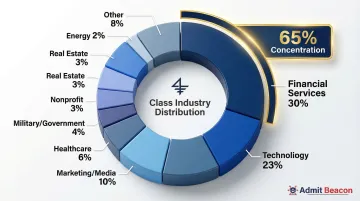
Finance, consulting, and technology dominate the CBS classroom:
- Financial Services: 30%
- Consulting: 23%
- Technology: 12%
- Marketing/Media: 10%
- Healthcare: 6%
- Military/Government: 4%
- Nonprofit: 3%
- Real Estate: 3%
- Energy: 2%
- Other: 8%
What this means for applicants:
- Finance and consulting applicants face direct comparisons against peers with nearly identical backgrounds — differentiation comes from trajectory, impact, and perspective, not employer name alone.
- Applicants from healthcare, nonprofit, or government bring class diversity, but should proactively address analytical rigor to show they can handle the curriculum's quantitative demands.
What CBS Admissions Really Looks For
Holistic Review and "Reading to Admit"
CBS uses a holistic review process that approaches each file looking for reasons to say yes, not reasons to eliminate. A below-average GMAT or GPA does not automatically disqualify you if the rest of your application makes a compelling, coherent case.
The admissions committee looks for:
- Intellectually driven people from diverse backgrounds
- Record of achievement and strong leadership
- Ability to work in teams
- Genuine enthusiasm for the CBS community and New York City's business ecosystem
The Centrality of Fit
CBS admissions officers specifically look for evidence of involvement outside work, leadership or leadership potential, and authentic connection to New York City. Applicants who cannot articulate what makes Columbia the right fit—as opposed to any other M7—weaken their candidacy no matter how strong their credentials.
CBS explicitly states that "Located in the heart of New York City, CBS offers unmatched networking opportunities and hands-on engagement with industry leaders." You are expected to demonstrate how you will leverage this specific ecosystem.
What the CBS Essays Surface
CBS's current essay prompts are designed to surface pragmatic career goals, past evidence of inclusive leadership, and a specific plan for community engagement. The current prompts include:
Short Answer 1: "What is your immediate post-MBA professional goal?" (50 characters maximum)
Short Answer 2: "How do you plan to spend the summer after the first year of the MBA?" — or, for January-entry applicants: "Why do you prefer the January-entry term?" (50 characters maximum)
Essay 1 (500 words): "What are your career goals over the next three to five years and what is your long-term dream job?"
Essay 2 (250 words): "Please share a specific example of how you made a team more collaborative, more inclusive or fostered a greater sense of community within an organization."
Essay 3 (250 words): "How would you co-create your optimal MBA experience at CBS? Please be specific."
Generic essays that could apply to any top program are a red flag. Strong essays reference specific CBS resources—immersion seminars, faculty, clubs, location advantages—in concrete terms.
Recommendations That Differentiate
CBS requires only one letter of recommendation, ideally from a current supervisor. The school provides strict guidance: "We expect that you, the applicant, will not participate in the drafting of your recommendation."
CBS asks recommenders to address two prompts:
- "How do the candidate's performance, potential, background, or personal qualities compare to those of other well-qualified individuals in similar roles? Please provide specific examples."
- "Please describe the most important piece of constructive feedback you have given the applicant. Please detail the circumstances and the applicant's response."
The committee wants specific anecdotes, not broad praise. Strong recommendations illustrate how you:
- Collaborate across teams and functions
- Work through problems analytically
- Show integrity when things get difficult
Generic praise that could describe any professional does not move the needle.
How Your Background Affects Your Odds
Overrepresented Pools: Finance, Consulting, and Technology
Approximately 65% of the CBS class comes from just three industries. Applicants from consulting, finance, and large-brand technology companies face direct comparisons against many peers with nearly identical backgrounds.
What differentiation requires:
- Articulate a specific story of impact — not a resume recap of titles and promotions
- Use Essays 2 and 3 to show community involvement and specific CBS programs, clubs, or professors that connect to your goals
Prestigious employers open the door — they do not carry you through it. CBS wants to understand what you've built, changed, or led, not just where you've worked.
International Applicants
CBS builds a globally diverse class (41% international), but applicants from countries that consistently send large applicant volumes face stiffer within-country competition.
Key considerations:
- CBS recommends applying in Round 1 or Round 2 to allow time for visa processing
- CBS does not require TOEFL or IELTS; your GMAT/GRE verbal score is sufficient
- For J-Term applicants, CBS explicitly advises applying early: "We recommend applying as soon as you can to ensure you have ample time to arrange logistics such as housing, travel, and visas"
Non-Traditional and Underrepresented Backgrounds
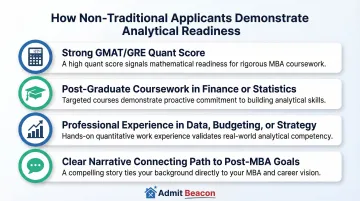
Applicants from nonprofit, government, military, healthcare, or entrepreneurial backgrounds bring class diversity that CBS values. However, you must proactively demonstrate analytical rigor to reassure the admissions committee you can handle the curriculum's quantitative demands.
How to establish credibility:
- Strong GMAT/GRE quantitative scores
- Post-undergraduate coursework in finance, statistics, or economics
- Professional experience involving data analysis, budgeting, or strategic planning
- A clear narrative connecting your non-traditional path to your post-MBA goals
Strategies to Strengthen Your Application
Benchmark Your Profile Honestly
Target these benchmarks before applying:
- GMAT 730+ (or GRE equivalents: 163V/163Q)
- GPA 3.6+
- Approximately five years of relevant work experience
If you fall significantly below these on multiple dimensions, consider whether additional GMAT preparation, advanced coursework, or one more year of high-impact professional experience would meaningfully improve your odds.
Invest in School-Specific Essays
Research CBS deeply before writing:
- Immersion seminars relevant to your goals
- Specific faculty whose work aligns with your interests
- Student clubs tied to your post-MBA path
- The NYC network advantage for your industry
Reference concrete program elements in your essays to demonstrate genuine fit, not generic M7 interest. The admissions committee can quickly identify applicants who have not done the specific research needed to write a CBS-tailored application.
Work with Advisors Who Understand CBS
Generic MBA advice does not differentiate strong CBS applications. Working with an advisor who knows CBS specifically helps you move beyond surface-level research into the program's actual culture and expectations.
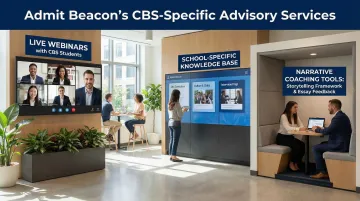
Admit Beacon supports CBS applicants through:
- Live webinars with current CBS students and alumni
- A school-specific Knowledge Base covering CBS's program ethos and essay approach
- Narrative coaching tailored to backgrounds in consulting, engineering, and non-traditional fields
- Story development that connects your professional arc to CBS's NYC-focused strengths
Frequently Asked Questions
What is the acceptance rate for Columbia MBA?
The most recently reported acceptance rate is approximately 19.5–20.9%, based on an estimated 1,450 admits out of 7,477 applications with 982 students enrolled. CBS does not publish official admit counts, so this figure is derived from available data.
How hard is it to get into Columbia MBA?
While CBS's acceptance rate is slightly higher than Stanford (6.8%) or Harvard (11.2%), the competitive intensity is equally fierce due to record-high application volumes. Approximately 4 out of 5 qualified applicants are rejected, and credentials alone do not guarantee admission.
What GPA do you need for Columbia MBA?
The class average GPA is 3.6 with no published minimum. Applicants below approximately 3.4 should compensate through strong GMAT/GRE quantitative scores and exceptional professional achievements.
What is the class profile for Columbia MBA 2026?
The Class of 2026 (entering Fall 2024/January 2025) includes an average GMAT of 732, average GPA of 3.6, and a class size of 972 — with 44% women and 46% international students. Finance, consulting, and technology are the top pre-MBA industries represented.
Is Columbia increasing class size by 20%?
CBS's class has grown nearly 30% since 2019, but there is no formal announcement of a planned 20% expansion. A larger class does not necessarily improve your odds if applications grow at a similar or faster pace.