This isn't a "how to game the system" guide. It's a reality check on what the acceptance rate actually means, what Kellogg's admissions committee truly values beyond the stats, and how to build an application that reflects the school's collaborative DNA rather than just your resume highlights. We'll cover current acceptance data, class profile benchmarks, the interview-all-applicants policy that makes Kellogg unique, and the most common mistakes that sink otherwise strong candidates.
Key Takeaways
- Kellogg's acceptance rate sits at approximately 28.6% for the Class of 2026—higher than most M7 peers, though selectivity has tightened steadily
- Admitted students average a 733 GMAT (or 687 Focus Edition), a 3.68–3.72 GPA, and ~5 years of work experience
- Kellogg seeks high-impact, low-ego leaders who demonstrate collaborative behavior, not just solo achievement
- Every applicant gets an interview—cultural fit and communication skills carry real weight in the decision
- Generic "I love Kellogg's culture" essays are the easiest mistake to fix—specificity wins
Kellogg MBA Acceptance Rate: What the Numbers Actually Show
For the Class of 2026, Kellogg's acceptance rate dropped to 28.6%, down from 33.3% the previous year. A 23% surge in applications drove this shift—roughly 5,216 applicants competing for 524 spots. The yield rate (the percentage of admitted students who enroll) held steady at 35.1%, signaling that even highly qualified admits weigh Kellogg against peer programs.
Recent Acceptance Trends:
| Entering Class | Acceptance Rate | Yield Rate | Total Applications |
|---|---|---|---|
| Class of 2026 (2024) | 28.6% | 35.1% | 5,216 |
| Class of 2025 (2023) | 33.3% | 36.8% | 4,316 |
| Class of 2024 (2022) | 31.4% | 55.2% | 4,187 |
The 28.6% figure represents a return to historical competitiveness after a post-pandemic softening. That said, the reported acceptance rate and your individual odds aren't the same thing. Kellogg's pool is self-selecting—unqualified candidates rarely apply, which means the competition is more intense than the raw percentage suggests.
Why Application Volume Fluctuates:
Application demand responds to economic cycles, MBA market trends, and program innovation. The 2025 GMAC Application Trends Survey shows that full-time, in-person MBA programs saw the strongest growth industry-wide, while flexible and online formats declined. Candidates increasingly prioritize immersive networking and community-building, areas where Kellogg's team-based learning model and collaborative culture are a natural draw.
Other Kellogg MBA Formats:
Acceptance rates vary across Kellogg's portfolio:
- Full-Time Two-Year MBA: 28.6% (Class of 2026)
- One-Year MBA: Approximately 120 students annually; specific acceptance rate not disclosed
- Evening & Weekend MBA: Median work experience 3-9.5 years; acceptance rate not disclosed
- Joint Degrees (MMM, JD-MBA, MBAi): Acceptance rates not publicly reported
How Kellogg Stacks Up Against Other M7 Programs
M7 Acceptance Rate Comparison (Class of 2026):
| M7 Business School | Acceptance Rate |
|---|---|
| Stanford GSB | 6.8% |
| Harvard Business School | 11.2% |
| MIT Sloan | 14.1% |
| Wharton School | 20.5% |
| Columbia Business School | 20.9% |
| Kellogg School of Management | 28.6% |
| Chicago Booth | 28.7% |
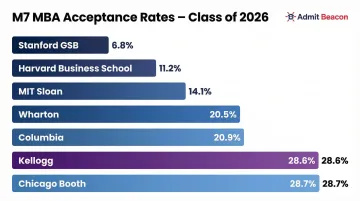
A higher acceptance rate doesn't mean "easier to get in" — it means Kellogg receives a more self-selected applicant pool. Candidates apply specifically because they want Kellogg: its collaborative culture, marketing strength, strong Chicago-area recruiting, and Northwestern's broader alumni network.
That self-selection doesn't lower the bar. Kellogg's culture-fit filter is exceptionally rigorous — the admissions committee actively eliminates candidates who look great on paper but don't align with its low-ego, team-oriented ethos. A 760 GMAT won't save an application that reads like a solo operator rather than a collaborative leader.
Outcomes back up the school's elite standing. Kellogg consistently ranks in the top 5–10 globally:
- U.S. News 2025: No. 2 (tie)
- Bloomberg Businessweek 2025-26: No. 5
- Financial Times 2026: No. 11 globally
The Class of 2025 achieved 90% employment within six months, with median total compensation of $205,000 (base salary $175,000). These outcomes attract a high-caliber pool regardless of acceptance rate.
Who Gets In: Kellogg's Class Profile at a Glance
| Metric | Class of 2026 | Class of 2027 |
|---|---|---|
| Class Size | 524 | 534 |
| Average GPA | 3.72 | 3.68 (Range: 2.7-4.0) |
| Average GMAT (Legacy) | 733 | N/A |
| Average GMAT Focus | N/A | 687 |
| Average GRE | 162 Verbal / 163 Quant | N/A |
| Women | 50% | Not reported |
| International Students | 40% | 37% |
| Average Work Experience | ~5 years | ~5 years |
Pre-MBA Industry Breakdown (Class of 2026):
- Consulting: 30%
- Technology: 18%
- Financial Services: 18%
- Other industries: 34%
Undergraduate Major Distribution (percentages exceed 100% due to double majors):
- Business/Economics: 49%
- STEM: 39%
- Humanities: 24%
Top Feeder Employers:
McKinsey, Bain, BCG, Deloitte, Amazon, Apple, Google, JPMorgan, and Goldman Sachs consistently hire from—and feed into—Kellogg's program. That said, non-traditional backgrounds from military, nonprofit, and healthcare sectors are actively represented and valued in the class.
Kellogg publishes no minimum GPA or test score threshold. The range is wide (GPA 2.7–4.0), and context matters. A 3.4 GPA from a rigorous engineering program with strong career progression can outweigh a 3.8 from a less demanding major with limited career advancement.
What Kellogg Actually Looks For in Applicants
The "Kellogg DNA" Concept
Kellogg's admissions committee seeks "high IQ, high EQ" candidates who demonstrate collaborative leadership. This framing shapes how they evaluate every essay, recommendation, and interview response. Evidence of impact matters, but self-aggrandizement kills applications.
Collaborative Leadership and Career Clarity
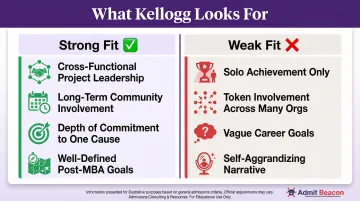
Kellogg wants proof of teamwork, not just individual achievement. This can come from:
- Cross-functional project leadership at work
- Undergraduate team sports or club leadership
- Long-term community involvement or nonprofit board service
Depth of commitment matters as much as breadth. Five years leading one cause demonstrates more than token involvement in five different organizations.
Kellogg also looks for well-defined post-MBA goals and a logical story connecting past experience, the MBA, and future ambitions. Vague goals or an "I want options" narrative weakens your application.
What works: "I want to transition from engineering to product management at a tech company, focusing on AI-driven consumer applications, then eventually launch my own B2B SaaS startup."
What doesn't: "I want to explore opportunities in consulting or tech and see where the MBA takes me."
The Interview-All Policy and Its Strategic Significance
Unlike most schools that use interviews as a selective filter, Kellogg invites all applicants to interview. This makes the interview a critical differentiator: a weak interview can eliminate an otherwise strong candidate.
What this means for you:
- Cultural alignment is assessed through the interview itself, not inferred from written materials alone
- Communication style matters — can you articulate ideas clearly and authentically?
- Genuine enthusiasm for Kellogg is tested through specific questions about why the program fits your goals
Note: Due to high application volume, some applicants may receive an interview waiver. Invitations are sent on a rolling basis through the decision date, and timing doesn't signal candidate strength.
The Most Common Essay Mistake
Defaulting to "I love Kellogg's culture and collaborative spirit" without specificity. Admissions readers see this constantly. Strong applicants name specific professors, courses, labs, clubs, or initiatives — and explain why those align with their personal goals and learning style.
Generic: "Kellogg's collaborative culture and strong marketing program align with my goals."
Specific: "Professor Mohan Sawhney's research on digital innovation directly relates to my goal of building AI-driven consumer products. I plan to take his Technology Strategy course and participate in the Zell Fellows Program's New Venture track to develop my startup idea with hands-on mentorship."
How to Build a Stronger Kellogg Application
Essays: Make Your Research Tangible
Visit campus or attend virtual events to gather material. Reference particular courses, faculty research, student-led initiatives, or lab programs rather than generic features.
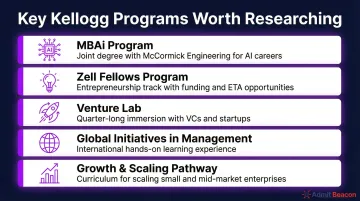
Kellogg Programs to Research:
- MBAi Program — a joint degree with McCormick Engineering designed for AI-focused careers
- Zell Fellows Program — entrepreneurship track with funding, mentorship, and ETA (Entrepreneurship Through Acquisition) opportunities
- Venture Lab — a quarter-long immersion with venture funds, incubators, or early-stage startups
- Global Initiatives in Management (GIM) — classroom learning paired with hands-on international experience
- Growth & Scaling Pathway — curriculum built around scaling small- and middle-market enterprises
GMAT/GRE and GPA: Know the Benchmarks
While Kellogg sets no minimum threshold, being close to or above the class average (GMAT 733 legacy / 687 Focus; GPA 3.68-3.72) removes a potential concern and lets qualitative elements carry your application.
If you're below the median:
- Address score context directly (e.g., rigorous undergrad program, non-native English speaker)
- Strengthen other application elements (leadership impact, unique career trajectory)
- Consider retaking if you're significantly below average and other elements are strong
Recommendations: Highlight Collaborative Behavior
Choose recommenders who can speak to collaborative behavior and leadership impact—not just seniority or title. Kellogg's collaborative culture means a recommendation that only highlights solo achievement misses the mark.
What recommenders should emphasize:
- Specific examples of cross-functional teamwork
- How you elevated others' performance
- Instances where you prioritized team success over individual recognition
- Your receptiveness to feedback and ability to adapt
Round Timing: When to Apply
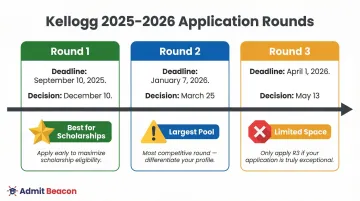
2025-2026 Application Deadlines:
| Round | Deadline | Decision Date |
|---|---|---|
| Round 1 | September 10, 2025 | December 10, 2025 |
| Round 2 | January 7, 2026 | March 25, 2026 |
| Round 3 | April 1, 2026 | May 13, 2026 |
Strategic considerations:
- Round 1 offers the largest pool of merit scholarships and maximum class spots
- Round 2 is the largest applicant pool and remains highly competitive
- Round 3 has limited space and is only advisable if you have a compelling reason for delaying (e.g., recent promotion, significant achievement, improved test score)
Where Personalized Guidance Pays Off
Moving beyond surface-level "why Kellogg" messaging requires genuine school-specific research and a narrative that holds together across every component. Admit Beacon works with applicants through this process directly, drawing on a network of current Kellogg students and alumni to build stories that reflect the program's actual culture — not a templated version of it.
Frequently Asked Questions
How hard is it to get into Kellogg's MBA?
With an acceptance rate of approximately 28.6%, Kellogg is selective but has one of the higher rates among M7 programs. That said, the applicant pool is self-selecting and highly competitive, and cultural fit is a stronger filter at Kellogg than at most peer schools — many qualified candidates on paper don't make it past that screen.
How prestigious is Kellogg's MBA?
Kellogg consistently ranks in the top 5-10 globally and is a member of the M7—the most elite group of U.S. business schools. It carries particular strength in marketing and management consulting recruitment, and its peer-elected leadership culture is a distinguishing feature among M7 programs.
What is the average GPA for a Kellogg MBA?
The current average GPA is approximately 3.68-3.72, with a reported range of 2.7-4.0. Kellogg has no minimum GPA requirement and evaluates the full application in context, including undergraduate institution rigor and major difficulty.
What is the average age for a Kellogg MBA?
The average Kellogg MBA student enters with approximately 5 years of work experience, placing the typical age at matriculation in the mid-to-late 20s.
Does Kellogg interview all applicants?
Yes, Kellogg invites all applicants to interview—unlike most programs that use interviews as a selective cut. Due to high application volume, some applicants may receive an interview waiver, but for everyone else, interview performance carries significant weight in the final decision.
What GMAT score do I need for Kellogg?
While there is no official minimum, the class average is approximately 733 on the legacy GMAT and 687 on the GMAT Focus Edition. Applicants below the median are admitted regularly — a lower score is most effectively offset by a strong quant track record or a supplemental explanation in the optional essay.