TLDR: Key Harvard Admissions Stats
- Harvard's overall acceptance rate for the Class of 2029 is 4.2%
- Early Action applicants see a meaningfully higher acceptance rate (~8–9%) compared to Regular Decision (~2.7%)
- Competitive admitted students typically have unweighted GPAs around 3.9+ and SAT scores in the 99th percentile
- 45% of admitted students attend tuition-free under Harvard's financial aid program
- Harvard received over 56,000 applications for the Class of 2029 — more than double the volume from a decade ago
Harvard Acceptance Rate for the Class of 2029: The Current Picture
Harvard's official acceptance rate for the Class of 2029 is 4.2%, based on 47,893 total applicants and 2,003 admitted students. If you've seen a lower figure—around 3.6%—that was a third-party estimate published before Harvard released its official data in fall 2025.
What does 4.2% actually mean? For every 100 students who apply, roughly 4 are admitted. That puts Harvard among the most selective universities in the world—more competitive than Princeton (3.9% in 2029) and well below the average admit rate across all Ivy League schools.
Key Class of 2029 Statistics:
| Metric | Figure |
|---|---|
| Total Applicants | 47,893 |
| Total Admitted | 2,003 |
| Total Enrolling | 1,675 |
| Admitted from Waitlist | 75 |
| Yield Rate | 83.6% |
Harvard's yield rate—the percentage of admitted students who choose to enroll—sits at 83.6%. The university filled its target class size while pulling just 75 students from the waitlist, a narrow margin that reflects how tightly calibrated Harvard's admissions model has become.
Two structural changes shaped this cycle and will affect how future applicants interpret the data:
- Reporting change: Harvard now releases admissions data once annually in October/November, after enrollment closes. Previously, interim stats appeared after Early Action and Regular Decision rounds—so applicants can no longer track their odds in real time.
- Testing reinstated: The Class of 2029 was the first required to submit SAT or ACT scores after Harvard ended its test-optional policy in April 2024. Application volume fell 11.3%—from 54,008 to 47,893—a contraction Harvard officials tied directly to the testing requirement returning.
How Harvard's Acceptance Rate Has Changed Over the Years
Harvard's acceptance rate has remained below 5% for eight consecutive years, driven by surging application volumes and a relatively stable class size.
Historical Acceptance Rate Trends: Selected Years (2016–2029):
| Class Year | Applicants | Admitted | Acceptance Rate | Yield Rate | |------------|-----------|----------|-----------------|------------|\n| 2029 | 47,893 | 2,003 | 4.2% | 83.6% | | 2028 | 54,008 | 1,970 | 3.6% | 83.6% | | 2027 | 56,937 | 1,965 | 3.5% | 83.7% | | 2026 | 61,221 | 1,984 | 3.2% | 83.0% | | 2025 | 57,786 | 2,318 | 4.0% | 84.2% | | 2024 | 40,248 | 2,015 | 5.0% | 69.8% | | 2020 | 39,041 | 2,110 | 5.4% | 78.8% | | 2016 | 34,303 | 2,076 | 6.1% | 80.2% |
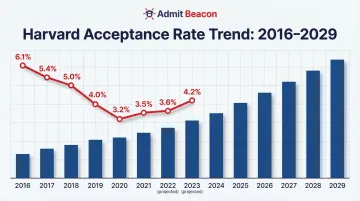
Application volume has grown dramatically—from roughly 34,000 for the Class of 2016 to over 56,000 at peak for the Class of 2027—while the enrolled class size has held steady around 1,650–1,700 students. (The admitted figures in the table are higher because not every admitted student enrolls; yield rates determine the final class.) More applicants competing for the same number of seats is what compresses acceptance rates year over year.
During COVID-era test-optional years, application numbers surged over 40%, with the Class of 2025 receiving 57,435 applications — temporarily pushing rates even lower. The Class of 2029's drop in applicants marks a normalization, though volumes remain far higher than pre-pandemic levels.
Year-to-year fluctuations exist, but the overall trajectory is clear: Harvard's selectivity isn't easing. A 0.3% swing in acceptance rate changes little for any individual applicant — what moves the needle is how well your application is positioned within that pool.
Early Action vs. Regular Decision: Does Timing Matter?
Harvard's Restrictive Early Action (REA) program offers a statistically higher acceptance rate than Regular Decision, but the advantage comes with important caveats.
Understanding Restrictive Early Action (REA)
Harvard's REA is non-binding, meaning admitted students have until May 1 to decide whether to enroll. However, it's restrictive: applicants may not apply Early Decision or Early Action to other private universities simultaneously. You may apply Early Action to public universities or institutions outside the U.S.
The Numbers: REA vs. RD
Recent Early vs. Regular Decision Acceptance Rates:
| Class Year | REA Acceptance Rate | RD Acceptance Rate | % of Class Filled Early |
|---|---|---|---|
| 2028 | 8.74% | 2.70% | ~42% |
| 2027 | 7.56% | 2.57% | ~44% |
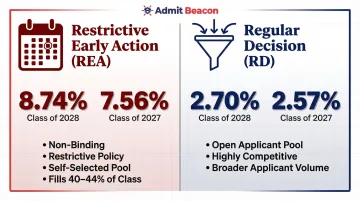
Harvard no longer publishes official REA/RD splits for the Class of 2029 due to its new reporting policy, but historical data shows REA acceptance rates hovering between 7.5% and 8.7%, compared to RD rates below 3%.
Should You Apply Early?
The higher early rate reflects a self-selected pool: recruited athletes, legacies, and exceptionally prepared students who have Harvard as their clear first choice. Applying early doesn't make you more likely to get in; the pool is simply stronger to begin with.
Early admits typically fill 40–44% of the enrolling class, meaning a significant portion of seats is effectively allocated before Regular Decision. That makes the RD pool even more competitive than the headline rate suggests.
Apply REA if Harvard is genuinely your first choice and your application is ready. Applying early purely for statistical advantage rarely works — admissions readers evaluate demonstrated fit and genuine commitment, not just timing.
Who Gets In? A Profile of Harvard's Admitted Class
The Class of 2029 drew admits from every U.S. region and 82 countries — and 45% of them pay no tuition at all. Here's what the data actually looks like.
Geographic Distribution
Class of 2029 Geographic Breakdown:
- Middle Atlantic: 21%
- New England: 18%
- South: 16%
- International: 16% (includes non-U.S. citizens abroad and U.S. citizens living abroad)
- Pacific: 14%
- Midwest: 10%
- Mountain/Central/Territories: ~5%
Intended Fields of Study
Harvard students lean heavily toward the sciences and engineering:
- Social Sciences: 35%
- Natural Sciences: 27%
- Engineering: 25%
- Humanities: 12%
Harvard calls academic programs "concentrations" rather than majors, and most students explore broadly before committing to one.
Demographics and Financial Accessibility
For U.S. citizens and permanent residents who self-reported race/ethnicity:
- Asian American: 41%
- African American or Black: 11.5%
- Hispanic or Latino: 11%
- First-Generation College Students: 20%
Financial Aid Reality: 45% of the Class of 2029 attends tuition-free, and 26% attends entirely for free (including room and board). Starting in 2025–26, families earning $100,000 or less with typical assets pay nothing, and families earning up to $200,000 attend tuition-free.
For many middle-income families, Harvard's net cost ends up lower than a state university's sticker price.
GPA and Test Score Benchmarks Harvard Applicants Should Know
Standardized Test Scores
Harvard reinstated standardized testing requirements for the Class of 2029, making SAT or ACT scores mandatory for the first time since the pandemic.
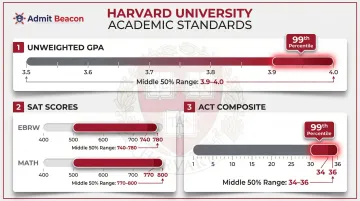
Middle 50% Test Score Ranges (Class of 2029):
- SAT Evidence-Based Reading and Writing: 740–780
- SAT Math: 770–800
- ACT Composite: 34–36
These ranges place admitted students in the 99th percentile nationally. While scores outside this range don't automatically disqualify you, they're rare.
GPA Expectations
Harvard does not publish an official median or minimum GPA. However, third-party aggregators show that most admitted students carry the following academic profiles:
- Unweighted GPA: 3.9 or higher, with most at or near 4.0
- Weighted GPA: Typically averages around 4.2
- Course rigor: Strong preference for the most challenging curriculum your school offers
A 3.9 earned through rigorous AP and IB coursework carries more weight than a 4.0 built on less demanding classes. Harvard's admissions committee reads every transcript relative to what your school actually offers — not against a universal standard. These benchmarks set the academic floor; the holistic review process determines what gets you above it.
What Harvard Really Looks for Beyond the Numbers
Grades and test scores are necessary but not sufficient. Harvard evaluates the "whole person," explicitly welcoming students with "diverse backgrounds and far-ranging talents and interests."
Depth Over Breadth
Harvard consistently signals that it values depth over breadth in extracurricular engagement. Dean of Admissions William R. Fitzsimmons has explained that the committee looks favorably upon students who have:
"pursued some activity to an unusual degree... They have made a commitment to pursue something they love, believe in, and value—and to do so with singular energy, discipline and plain old hard work."
One or two activities pursued with genuine passion and measurable impact outweigh a long list of clubs where you were merely a member.
Well-Rounded vs. Well-Lopsided
Harvard notes that successful applicants can be "well-rounded" contributors to their communities or "well-lopsided" with demonstrated excellence in one particular endeavor. Both profiles can succeed—what matters is authenticity and impact.
These same principles — authenticity, demonstrated impact, and a coherent personal narrative — carry into graduate admissions. For professionals applying to Harvard Business School, the evaluation remains holistic, just oriented around career trajectory rather than high school achievements. Admit Beacon works with applicants to translate this philosophy into application strategy, helping each candidate identify and articulate the through-line in their professional story.
Frequently Asked Questions
What GPA do you need to get into Harvard?
Harvard has no official minimum GPA, but admitted students typically have near-perfect GPAs—typically 3.9 or higher, unweighted. Course rigor matters as much as the number itself, so taking the most challenging courses available at your school is essential.
How to get a 100% scholarship at Harvard?
Harvard offers need-based financial aid, not merit scholarships. Families earning $100,000 or less pay nothing starting in 2025–26, and those earning up to $200,000 attend tuition-free — a threshold that now covers 45% of the current class.
What are the admission requirements for Harvard?
Applicants must submit the Common App or Coalition App, transcripts, two teacher recommendations, a counselor report, and SAT or ACT scores (now required again). Alumni interviews are optional and assigned based on availability. See Harvard's official Application Requirements page for the complete list.
What are Harvard's top 3 majors?
Based on Class of 2029 intended fields, Social Sciences (35%), Natural Sciences (27%), and Engineering (25%) are the most popular broad categories. Harvard calls them "concentrations," not majors, and students often explore widely before declaring.
What is the lowest GPA Harvard has accepted?
Harvard has in rare cases admitted students with GPAs below the typical range when other aspects of their profile were exceptionally compelling. These are genuine outliers — if your GPA falls short, the rest of your application needs to be unusually strong across every other dimension.