
Introduction
Decision day arrives. Instead of an acceptance or rejection, you get a deferral or waitlist notification. It feels like limbo — but neither is a rejection, and how you respond from here can still determine whether you get in.
The two statuses work differently and call for different strategies. A deferral typically moves your Round 1 application into Round 2 for full re-evaluation — you're guaranteed another look. A waitlist decision usually comes after final rounds, placing you in a holding pool where admission opens up only if accepted candidates decline their offers.
Misunderstanding your status — or failing to respond appropriately — can cost you an admission you're still very much in contention for.
Key Takeaways
- A deferral moves your MBA application from Round 1 into Round 2 or 3 for fresh evaluation alongside a larger applicant pool
- A waitlist decision places you in a contingent holding status after final rounds—admission depends on enrollment yield
- Deferrals are generally more promising because they guarantee a second full review by the admissions committee
- Both require a Letter of Continued Interest (LOCI), though timing, tone, and permissible updates differ school to school
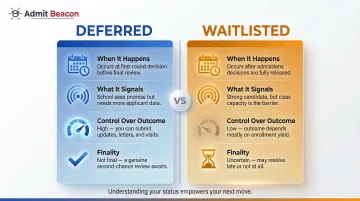
Deferred vs. Waitlisted: Quick Comparison
| Factor | Deferred | Waitlisted |
|---|---|---|
| When it happens | After Round 1 (early application rounds) | After final decision rounds (Round 2 or 3) |
| What it signals | Adcom sees potential but wants to compare you against a larger pool | Class is provisionally full; you're qualified but no space yet |
| Control over outcome | High—you can strengthen your file with new scores, essays, or recommendations | Limited—admission depends on yield (how many admits decline) |
| Finality | Guaranteed second review in next round | May expire without movement if enrollment targets are met |
A deferral keeps you in active consideration with a fresh evaluation cycle. A waitlist ties your admission to external factors: whether enough admitted students decline their offers to open seats.
What is Deferred Admission?
The Round 1 to Round 2 Roll
Deferred admission in the MBA context occurs when a business school moves a Round 1 applicant into the Round 2 (or occasionally Round 3) pool rather than issuing a final accept or reject decision. This is not a soft rejection—it's a deliberate postponement for re-evaluation. The admissions committee has already reviewed your application favorably enough to keep it in active consideration, but wants to assess you against a broader applicant pool before making a final decision.
Why Schools Defer Candidates
Admissions committees defer MBA candidates for two primary reasons:
- Comparative evaluation: The school sees genuine promise in your profile but wants to compare you against the larger Round 2 applicant pool before committing a seat
- Awaiting updates: The committee wants to see new information—such as an improved GMAT/GRE score, a promotion, completed coursework, or a stronger quantitative track record—before making a final decision
Top MBA programs do not publish the proportion of Round 1 applicants they defer to Round 2, nor do they release conversion rates for deferred candidates. That opacity is intentional—so don't expect to benchmark your odds against published figures.
What Makes Deferral Distinct
Your application remains active and competitive throughout the deferral period. The committee has already invested time reviewing your materials and determined you're worth a second look. At programs like Stanford GSB and Harvard Business School, where acceptance rates sit at 6.8% and 11.2% respectively, staying in active consideration is a real signal.
What Happens After Deferral
Your application moves into the next round for re-evaluation, and most schools allow you to submit:
- A Letter of Continued Interest (LOCI)
- An updated resume
- New test scores
- Supplementary materials (through sanctioned channels only)
The committee reviews your file alongside Round 2 applicants with a clearer picture of the class they're building—which can work in your favor if your profile fills a gap.
Note on Early Decision programs: Being deferred from a binding ED program—such as Columbia Business School's, which requires a $6,000 non-refundable deposit—does not necessarily retain the binding obligation. Policies vary by school, so verify directly before assuming you're released from other application withdrawals.
What is Waitlisted Admission?
How the MBA Waitlist Works
The MBA waitlist is a holding status issued after a final admissions round, indicating that the admissions committee considers you qualified but the class is provisionally full. Admission from the waitlist depends entirely on whether admitted candidates decline their offers—typically after deposit deadlines in late spring.
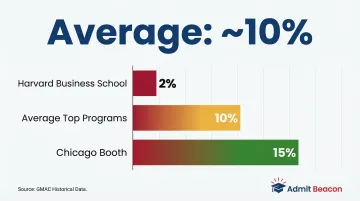
Business schools cannot perfectly predict how many admitted students will actually enroll. Historical data from the Graduate Management Admission Council (GMAC) indicates that waitlist acceptance rates at top programs range from as low as 2% at Harvard to 15% at Chicago Booth, with an average of approximately 10%.
Unranked Waitlists at Top Programs
Major MBA programs confirm their waitlists are unranked. You're not placed in a sequential queue. Instead, schools re-evaluate waitlisted candidates holistically as class needs evolve:
- Stanford GSB: "No, our waitlist is not ranked"
- Northwestern Kellogg: "Candidates on our waitlist are not ranked"
Harvard Business School and Chicago Booth state the same policy explicitly on their admissions pages.
Movement is driven by institutional needs—filling specific industry backgrounds, geographic regions, or demographic gaps—not purely merit ranking.
Timeline Uncertainty
Waitlisted MBA applicants may wait weeks or months with no resolution. Unlike a clear admit or deny, there's no guaranteed decision date:
- Harvard: Decisions made on a rolling basis through the end of July
- Stanford GSB: Process can extend through summer with unpredictable movement
- Kellogg: Rolling decisions between January and August
- Dartmouth Tuck: Offers may be extended as late as August
What Waitlisted Applicants Can and Cannot Do
Waitlisted candidates must:
- Formally accept their waitlist position (schools require explicit confirmation)
- Submit a Letter of Continued Interest (LOCI) if the school permits
- Deposit at an alternate school by the deadline to protect their enrollment
One hard constraint: you cannot submit entirely new application materials—only updates to existing components. Wharton bans all supplemental materials outright, while HBS limits updates to a single 300-word portal submission. This restriction is a key strategic difference from deferral.
Deferred vs. Waitlisted: Which is Better?
The Direct Answer
Being deferred is generally the more promising outcome. It guarantees a second full review of your application within the admissions cycle, whereas a waitlist decision is contingent on factors largely outside your control—yield, class composition, and institutional priorities.
Why the Gap Matters at Elite Programs
The distinction is particularly significant at top MBA programs where acceptance rates are in the single digits:
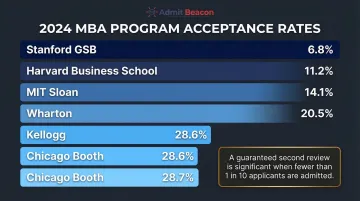
| School | Acceptance Rate (2024) |
|---|---|
| Stanford GSB | 6.8% |
| Harvard Business School | 11.2% |
| MIT Sloan | 14.1% |
| Wharton | 20.5% |
| Kellogg | 28.6% |
| Chicago Booth | 28.7% |
Source: U.S. News & World Report
Even a guaranteed second look represents a significant opportunity when fewer than 1 in 10 applicants gain admission. Waitlist pull rates at elite programs can be very low in competitive cycles—Harvard has historically admitted 50-60 candidates from the waitlist annually, but this represents a small fraction of those who accept waitlist positions.
The Nuanced Exception
That said, the deferral advantage isn't absolute. A waitlist at a slightly less selective or yield-challenged MBA program can carry better odds than a deferral at an ultra-elite program with a very small class. Context and school-specific data matter. A program with historically high waitlist movement and a larger class may offer better conversion prospects than a deferral at a school that admits fewer than 400 students annually.
Practical Decision Framework
If deferred: Treat it as an active application and invest in strengthening it. You have a guaranteed second review, so use that window to address any gaps the admissions committee may have flagged.
If waitlisted: Treat it as a backup possibility while securing your best alternative offer. The waitlisted applicant's priority is locking in a strong fallback — not waiting indefinitely on a slot that may never open.
What To Do Next
If You've Been Deferred
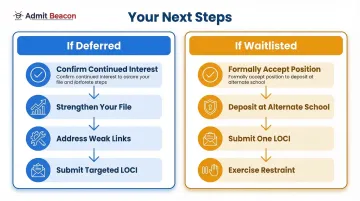
Confirm your continued interest immediately. Don't assume silence signals enthusiasm. Contact your admissions officer or confirm through the school's portal that you want to remain in consideration for the next round. Document this confirmation.
Strengthen your file before the next round deadline:
- Identify weak links: GMAT/GRE score, thin career progression narrative, unclear post-MBA goals
- Address them directly: retake tests, secure a promotion, complete quantitative coursework
- Submit updated materials only through official channels
- Only add information that genuinely strengthens your candidacy
Write a targeted LOCI:
- Keep it to one page maximum
- Reference specific program attributes by name: a professor's research, a student club, a curriculum component
- Briefly highlight meaningful professional updates since submission
- Avoid restating your original application
If You've Been Waitlisted
Accept your waitlist position formally and immediately. Most schools require explicit confirmation to remain in consideration. Missing this step removes you from the pool entirely.
Deposit at your best alternative admit by the deadline. Do not delay or gamble on waitlist movement. Secure your spot at another strong program while keeping the waitlist option open in parallel.
Submit one well-crafted LOCI and then exercise restraint:
- Write a single, substantive letter reaffirming your commitment to attend if admitted
- Note any significant professional update: a promotion, a major project outcome, a new certification
- Avoid repeatedly emailing the admissions office, which signals poor judgment to the committee
- Craft each LOCI for the specific school, not from a template — Admit Beacon works with applicants on exactly this kind of targeted positioning
Conclusion
Being deferred is typically the stronger position because it guarantees a second review, while being waitlisted leaves your fate tied to the school's enrollment math. Neither is a closed door, though, and a focused response can improve your odds in both.
What matters most is how you respond to each status:
- Deferral: Treat it as a compressed second application cycle — identify your weakest components, strengthen them, and submit a targeted update letter.
- Waitlist: Move forward confidently with your next-best option while keeping one door open with a single, well-crafted communication.
Frequently Asked Questions
Is it better to get waitlisted or deferred?
Deferral is generally more favorable because it secures a full second review of your application in the next admissions round. A waitlist outcome depends on unpredictable enrollment yield and may never convert to an offer if the school meets its class targets without pulling from the waitlist.
Is it harder to get off the waitlist or get deferred?
Getting off a waitlist is typically harder. Waitlist admission is contingent on enrolled students declining offers, whereas a deferred applicant is actively re-evaluated by the admissions committee in the next round regardless of yield. That active re-evaluation gives you meaningfully more control over the outcome.
What percent of deferrals get accepted?
Top MBA programs do not publish deferral-to-acceptance conversion rates. Acceptance rates for deferred applicants vary widely by school, year, and applicant pool strength. Schools guard this data to maintain flexibility in class composition and avoid creating expectations that may not align with each cycle's unique dynamics.
Can I apply to other schools if I'm waitlisted or deferred?
Yes. Your deferral or waitlist status at one school does not affect your applications elsewhere. Waitlisted applicants should deposit at another school by the deadline to protect their enrollment, and deferred applicants should continue pursuing other programs in parallel—Round 2 applications are fully independent.
How do I write a strong Letter of Continued Interest (LOCI)?
A strong LOCI is brief (one page or less), names specific programs, faculty, or communities at that school, and leads with something new—a promotion, a completed certification, or a measurable win since you applied. Avoid restating your original application or using a generic template across schools.
Does being deferred or waitlisted mean my application was weak?
No. Neither status indicates a weak application. Deferrals and waitlists typically reflect class composition needs or round-specific volume, not a flaw in your profile. Strong candidates receive these decisions regularly at programs with single-digit acceptance rates.