This guide walks through every MBA requirement clearly, explains what strong looks like at competitive programs, and helps you understand how these pieces fit together into a compelling application that demonstrates not just qualifications, but genuine fit and readiness.
TLDR: MBA Requirements at a Glance
- A bachelor's degree from an accredited institution is required by every accredited MBA program
- GMAT, GRE, or Executive Assessment scores demonstrate quantitative and analytical readiness — though test-optional policies are growing at select programs
- Work experience (typically 2–5 years for full-time MBAs) shows real-world impact and career progression
- Resume, essays, recommendations, and an interview round out your application — and show fit with each program
- International applicants need English proficiency scores and may require credential evaluation
Academic Requirements: The Foundation of Your Application
Undergraduate Degree and Transcripts
Virtually all MBA programs require a bachelor's degree from an accredited institution, but your undergraduate major does NOT need to be in business. MBA cohorts intentionally include engineers, liberal arts graduates, social scientists, and more—diversity of academic background strengthens classroom discussions and brings varied perspectives to case studies.
Admissions committees look beyond GPA to evaluate transcripts holistically. They examine:
- Upward grade trends - Did you improve academically over time?
- Performance in quantitative coursework - Can you handle statistics, finance, and analytical courses?
- Overall course rigor - Did you challenge yourself with demanding coursework?
Admissions committees read GPA within its context. Stanford GSB explicitly states "No minimum GPA is required for admission," and their committee looks "far beyond" raw scores to assess academic readiness within the context of your specific university and educational system.
What competitive GPAs look like:
While most top programs don't publish minimum GPA thresholds, they do provide averages that help benchmark your profile. Wharton's Class of 2026 averaged a 3.68 GPA, giving applicants a clear reference point. Stanford GSB and MIT Sloan deliberately choose not to publish average GPAs on their class profiles, underscoring their emphasis on broader academic context over numbers alone.
If your GPA falls below these benchmarks, don't assume you're automatically out of contention. Strong test scores, exceptional work experience, and compelling essays can offset a lower GPA—especially if you can demonstrate an upward trajectory or explain extenuating circumstances in an optional essay.
Standardized Tests: GMAT, GRE, and EA
Top full-time MBA programs still require standardized test scores, though you have flexibility in choosing which exam to take. The three main options break down as follows:
| Exam | Sections Tested | Score Range | Best For |
|---|---|---|---|
| GMAT Focus Edition | Quantitative Reasoning, Verbal Reasoning, Data Insights | 205–805 | MBA-focused applicants; most widely used |
| GRE General Test | Verbal Reasoning, Quantitative Reasoning, Analytical Writing | 130–170 per section | Applicants also considering non-MBA graduate programs |
| Executive Assessment (EA) | Integrated Reasoning, Verbal Reasoning, Quantitative Reasoning | 100–200 | Senior professionals applying to EMBAs |
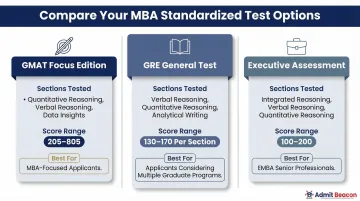
Note: GMAC explicitly warns against directly comparing GMAT Focus scores to legacy GMAT scores — use percentile rankings to contextualize your result instead.
Stanford GSB, Harvard Business School, Wharton, and MIT Sloan all accept both GMAT and GRE with no stated preference. Most applicants take free official practice tests for both before committing — your stronger percentile score is the better choice.
Competitive score benchmarks:
| School | GMAT Focus (Legacy) | GRE Verbal | GRE Quant |
|---|---|---|---|
| Harvard Business School (Class of 2027) | 685 (730) | 164 | 164 |
| Chicago Booth (Class of 2027) | — (729) | 163 | 164 |
| Wharton (Class of 2026) | — (732) | 163 | 162 |
A growing number of schools offer test waivers or are test-optional, particularly for applicants with strong professional track records or graduate degrees. At top full-time programs, however, waivers remain the exception — check each school's admissions page directly, as policies can shift between application cycles.
Professional Requirements: Experience, Impact, and Leadership
Work Experience
Work experience expectations vary dramatically by program type:
Full-time MBA programs typically expect 2–5 years of professional experience. Harvard Business School's Class of 2027 averaged 4.9 years (middle 80%: 3–7 years), Wharton averaged 5 years, and Stanford GSB averaged 5.3 years.
Executive MBA programs often require 8–15 years of progressively senior experience. Wharton's EMBA averages 13-14 years, while Kellogg's EMBA averages 15 years. These programs also require employer time sponsorship to ensure you can balance rigorous academics with full-time executive responsibilities.
Deferred/early-career programs are designed for those with little to no experience. Harvard's 2+2, Stanford's Deferred Enrollment, and Yale's Silver Scholars programs target current undergraduates or recent graduates.
Quantity matters less than quality. Admissions committees want to see:
- Influenced outcomes, led projects, or mentored others—even without a formal title
- Increasing responsibility and impact across your resume, not just lateral moves
- Experience across departments, geographies, or stakeholder groups
- Real challenges you've navigated that will add perspective to classroom discussions
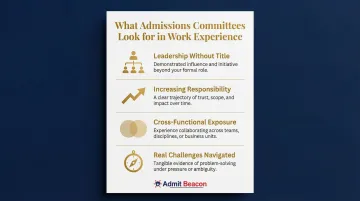
Diverse professional backgrounds are actively valued. Technology, consulting, healthcare, non-profits, entrepreneurship, and military roles all bring unique perspectives. You don't need a "traditional" business role to be competitive—you need to demonstrate impact and leadership within your context.
Resume
An MBA resume differs fundamentally from a job-search resume. It should frame professional accomplishments through the lens of growth, leadership, and impact—not just duties. Use quantifiable results wherever possible: revenue generated, costs reduced, team members managed, processes improved.
Common resume mistakes to avoid:
- Listing responsibilities instead of achievements ("Managed team" vs. "Led 8-person team to deliver $2M project 3 weeks ahead of schedule")
- Exceeding one page without strong justification
- Failing to explain employment gaps or career transitions
- Using vague language instead of specific metrics
Your resume is often the first document admissions committees read. Show clear progression, concrete impact, and evidence that you're ready for what comes next.
Letters of Recommendation
Most programs require 2–3 letters. The best recommenders can speak to specific examples of your leadership, problem-solving, and character—not those with the most impressive titles. A director who worked closely with you and witnessed your growth will write a stronger letter than a CEO who barely knows your name.
Brief your recommenders thoroughly so their letters complement rather than repeat what's already in your application:
- Share your resume, goals, and the key themes you want reinforced
- Help them understand what makes each target school unique
- Point them toward specific moments that showcase resilience, creativity, or leadership under pressure
The most effective letters tell stories admissions committees can't find anywhere else in your file.
The Application Package: Where Your Story Comes to Life
MBA Essays and Personal Statement
Essays are the single most differentiated part of the application—the place where candidates move from "qualified" to "compelling." They answer the core admissions questions: who you are, why you want an MBA now, and why this program specifically.
Strong essays use specific, concrete storytelling rather than vague generalities. They connect past experiences to future goals and demonstrate genuine school fit by referencing program-specific resources, culture, or values—not generic praise.
Admissions committees read thousands of applications. The essays that stand out reveal authentic self-awareness and show that the applicant genuinely understands what makes each program distinctive.
Each school's essay prompts are intentionally different, and submitting recycled answers is one of the fastest ways to weaken an application. Tailoring each essay to the school's ethos while retaining your authentic voice is the standard at top programs. Admit Beacon works with applicants to build narratives that align with each school's values without flattening the individuality that makes an application memorable.

Strategic use of optional essays:
If a program offers an optional essay, use it strategically to address a GPA dip, employment gap, test score below the school's average, or other concern. Silence often raises more questions than a candid, confident explanation. Frame the context clearly, explain what you learned, and demonstrate how you've grown or compensated in other areas.
Admissions Interview
The MBA interview is typically the final evaluation step, assessing communication skills, clarity of goals, self-awareness, and fit with the program community. It's not a test of whether you're likeable, but whether you can articulate your story under light pressure and engage authentically with the interviewer.
Most commonly asked interview questions:
- Walk me through your resume
- Why an MBA? Why now? Why our school?
- Tell me about a time you demonstrated leadership
- Describe a challenge or failure and what you learned
- What are your short-term and long-term career goals?
- What will you contribute to our community?
Prepare through structured practice using the STAR format (Situation, Task, Action, Result) for behavioral questions, but keep responses conversational rather than scripted. Mock interviews sharpen delivery and surface follow-up questions you might not anticipate alone.
The interview runs both ways. Asking specific, well-researched questions signals genuine interest and shows you're actively evaluating fit—not just hoping to get in.
Application Fees and Deadlines
Application fees typically range from $250–$275 per school at top programs. Stanford GSB charges $275, Harvard Business School charges $250, and Wharton charges $275. Applying to 6–8 schools is common, so costs add up quickly to $1,500–$2,200.
Many programs offer fee waivers for veterans, active-duty military, applicants facing extreme financial hardship, and participants in partner programs like Peace Corps or Teach For All. Don't let fees prevent you from applying if you qualify for a waiver.
Understanding application rounds:
Most top programs operate on a three-round system:
| Round | Typical Deadline | What to Know |
|---|---|---|
| Round 1 | Early September | Most competitive for scholarships; early submission signals strong intent |
| Round 2 | Early January | The most popular round; majority of the class fills from R1 and R2 combined |
| Round 3 | March/April | Riskier at competitive programs—most seats are already filled |
Strategic timing matters. If your application is ready and strong in September, submit in Round 1. If you need additional time to improve test scores, secure stronger recommendations, or refine essays, Round 2 remains an excellent choice.
How MBA Requirements Differ by Program Type
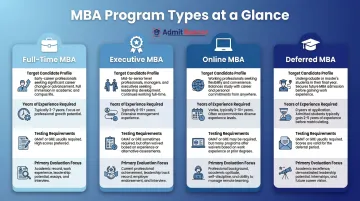
Understanding which MBA format aligns with your career stage and goals is essential before you begin the application process. Applying to the wrong format wastes time and reduces competitiveness.
Full-Time MBA — For early-to-mid-career professionals with 2–5 years of experience, focused on career pivots or acceleration.
- Requires GMAT or GRE
- Includes summer internships and on-campus recruiting
- Evaluation centers on academic readiness, leadership potential, and post-MBA trajectory
Executive MBA — Targets senior professionals with 8–15 years of experience and significant managerial responsibility.
- Accepts GMAT, GRE, or Executive Assessment; some programs waive testing for quantitative backgrounds
- Requires employer time sponsorship, often financial support as well
- Evaluation weights leadership scope, organizational impact, and ability to balance work with academics
Online MBA — Built for working professionals who can't relocate or pause their careers.
- Work experience expectations range from 3–10 years depending on program
- Testing requirements vary; many programs accept GMAT, GRE, or neither
- Evaluation focuses on self-direction, time management, and career goals suited to an online format
Deferred MBA — Designed exclusively for current undergraduates or graduate students with little to no full-time work experience.
- Requires GMAT or GRE
- Students defer enrollment 1–4 years to build professional experience before starting
- Evaluation emphasizes academic excellence, leadership potential, and upward trajectory rather than an established track record
The core application components—essays, recommendations, and interviews—remain consistent across formats, but the focus of evaluation shifts dramatically. EMBAs assess whether you can lead at scale and contribute senior-level perspectives. Deferred programs assess whether you have the raw potential and trajectory to thrive after gaining experience. Getting this match right is the first strategic decision in your application—and one of the most consequential.
Additional Requirements for International Applicants
International applicants face additional requirements around English proficiency and transcript verification. Policies vary significantly by school, so verify current requirements for each program on your list.
English Proficiency Requirements
Most programs require TOEFL, IELTS, or PTE scores from applicants whose undergraduate education was not conducted primarily in English, but minimum score thresholds vary by program:
| School | TOEFL iBT | IELTS | PTE | Notes |
|---|---|---|---|---|
| Stanford GSB | 100 | 7.0 | 68 | Hard minimums |
| Harvard Business School | 109 | 7.5 | 75 | Unofficial bar; DET 145 also accepted |
| MIT Sloan | Not required | Not required | Not required | Proficiency assessed at interview |
Waivers are typically available if your undergraduate or graduate degree was earned at an institution where English was the sole language of instruction. Check each school's specific waiver policy—don't assume consistency across programs.
Credential Evaluation Requirements
Some U.S. programs ask international applicants to have transcripts assessed by third-party agencies like World Education Services (WES) to establish GPA equivalency. However, this is not a blanket requirement.
How top programs handle this differs considerably:
- Harvard Business School: Requires admitted international students to send an official original-language transcript directly to WES for third-party verification
- Wharton: Does not require third-party evaluation for standard MBA applicants, though English translations are needed
- MIT Sloan: Accepts WES as a translation service but does not mandate credential evaluation
Schools require visa documentation—including bank statements and financial affidavits—once you're admitted, not during the application process itself. Plan ahead for these requirements to avoid delays in securing your student visa after admission.
Frequently Asked Questions
What qualifications do you need for an MBA?
You need a bachelor's degree from an accredited institution, standardized test scores (GMAT or GRE, with growing test-optional exceptions), relevant work experience (typically 2–5 years for full-time programs), and a complete application including essays, recommendations, and an interview.
Is an MBA hard to obtain?
Top programs are highly selective—many accept fewer than 15% of applicants—and the curriculum itself is demanding. That said, thorough preparation across test scores, essays, and demonstrated impact significantly improves your odds.
Do I need a business degree to apply for an MBA?
No. MBA programs actively seek diverse academic backgrounds including engineering, liberal arts, sciences, and social sciences. Strong quantitative skills (demonstrated through test scores or coursework) matter more than your specific undergraduate major.
What GMAT score do I need for top MBA programs?
Top programs typically see competitive scores in the 700–740+ range (legacy GMAT) or 685+ on the GMAT Focus Edition. The GRE is widely accepted, and a strong score can offset a lower GPA or non-traditional background.
Can I apply to an MBA without work experience?
Deferred MBA programs like Harvard's 2+2, Stanford's Deferred Enrollment, and Yale's Silver Scholars accept applicants with minimal or no full-time experience. Traditional full-time programs typically expect at least 2 years of professional experience.
How important are MBA essays compared to test scores?
At top programs where most applicants clear a baseline academic threshold, essays often become the primary differentiator. They reveal fit, self-awareness, and authentic narrative in ways no test score can convey. A well-crafted essay that connects your past, present, and future goals concisely is what moves an application from waitlist to offer.