Introduction
Picture this: You're a senior marketing director with 12 years of experience, leading a regional team, and eyeing an EMBA at Wharton or Kellogg. Your application is strong—proven leadership, strategic wins, clear career trajectory. Then you hit the standardized testing requirement. The last time you took an exam like this, you were in your early twenties. The thought of spending months relearning algebra feels absurd when you've been running P&L for years.
This is exactly why the Executive Assessment (EA) exists. Unlike the GMAT—designed for early-career MBA applicants fresh out of undergrad—the EA was built by GMAC specifically for experienced professionals like you. It runs 90 minutes (vs. over two hours for the GMAT), focuses on business reasoning you already use daily, and was built for professionals juggling applications with a full-time career.
This guide covers what the EA is, how it's structured, how it compares to the GMAT and GRE, what top EMBA programs expect score-wise, and how to prepare without derailing your career.
TLDR:
- The EA is a 90-minute, 40-question exam built exclusively for EMBA applicants
- Wharton and Chicago Booth report average EA scores in the mid-150s (out of 200)
- You can take the EA up to four times total (two at a test center, two online)
- Most professionals need 2–3 months to prepare, not the 4 weeks GMAC suggests
- A strong EA score matters—but your leadership story and essays decide admission
What Is the Executive Assessment?
The Executive Assessment is a standardized exam developed by GMAC specifically for senior professionals applying to Executive MBA programs. Unlike the GMAT, which targets early-career candidates with two to three years of experience, the EA evaluates the analytical and business reasoning skills you already use on the job. Academic recall and abstract test-taking stamina are not the point.
Why GMAC Created the EA
GMAC recognized that a 35-year-old VP with 15 years of experience shouldn't be evaluated the same way as a 24-year-old consultant with two years of work history. The EA reflects this by testing practical judgment: interpreting data, evaluating arguments, and solving applied quantitative problems. Content memorization isn't part of it.
Who the EA Is For
The EA targets working professionals typically with 8+ years of experience applying to EMBA programs. It's not universally accepted—only specific programs have opted in. Over 100 schools and 200 programs worldwide now accept the EA, including top-tier programs like:
- Wharton EMBA
- Kellogg EMBA
- Columbia Business School EMBA
- Chicago Booth EMBA
- MIT Sloan EMBA
- London Business School EMBA
Before you register, verify that your target programs accept the EA. Check the current list on the GMAC website.
Registration Logistics
- Cost: $350 USD globally
- Availability: Year-round at 600+ test centers and online (at-home proctored)
- Score delivery: Test center results arrive within 24 hours; online scores take up to seven business days
- Reporting: You self-report scores and control which programs receive them—schools only see the specific test instances you choose to send
Important: If you're testing close to an application deadline, opt for a test center appointment to avoid delays. Online scores can take up to a week to process.
EA Exam Structure: Sections, Timing, and Scoring
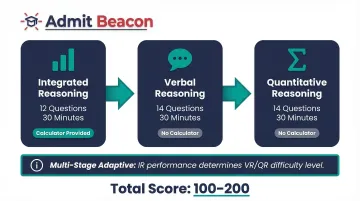
The EA is a 90-minute exam with 40 total questions across three sections, administered with no scheduled breaks. The total score ranges from 100 to 200, and each section is scored 0 to 20. All three sections are equally weighted in determining your total score.
Integrated Reasoning (IR)
- 12 questions, 30 minutes
- Calculator provided (on-screen)
- Question formats: Multi-Source Reasoning, Graphics Interpretation, Two-Part Analysis, Table Analysis
This section tests your ability to interpret and synthesize data from graphs, charts, tables, and multi-source passages—the kind of analysis you routinely perform as an executive. You'll evaluate trends, compare datasets, and draw conclusions under time pressure—familiar territory for most executives.
Verbal Reasoning (VR)
- 14 multiple-choice questions, 30 minutes
- No calculator
- Question types: Reading Comprehension, Critical Reasoning, Sentence Correction
Verbal Reasoning evaluates logical argumentation and communication skills. This isn't about grammar trivia—it's about understanding arguments, identifying assumptions, and recognizing effective communication. If you regularly review strategy memos, evaluate proposals, or critique presentations, you're already practicing these skills.
Quantitative Reasoning (QR)
- 14 multiple-choice questions, 30 minutes
- No calculator
- Question types: Data Sufficiency, Problem Solving
This section covers arithmetic and algebra—applied numerical reasoning, not advanced mathematics. You'll solve problems involving percentages, ratios, basic equations, and logical deduction. Mental math fluency matters here, but the content doesn't go beyond high school-level math.
Multi-Stage Adaptive Format
The EA uses a multi-stage adaptive (MSA) design. Unlike the GMAT Focus Edition, which adapts question-by-question, the EA adapts by stage—groups of questions are selected based on your performance on the previous group. Your performance on the initial Integrated Reasoning section determines the difficulty level of the subsequent Verbal and Quantitative modules.
In practice, you cannot skip individual questions and return to them later. Every question within a stage carries equal weight regardless of difficulty—meaning a lapse mid-block hurts just as much as missing a hard question. Strong, steady execution across all 30 minutes of each section matters more than heroics on any single problem.
EA vs. GMAT vs. GRE: Which Test Should You Choose?
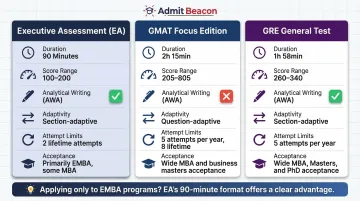
Most top EMBA programs accept multiple tests—GMAT, GRE, or EA. Here's how they compare:
| Feature | Executive Assessment (EA) | GMAT Focus Edition | GRE General Test |
|---|---|---|---|
| Duration | 90 minutes (no breaks) | 2 hours, 15 minutes | 1 hour, 58 minutes |
| Sections | 3 (IR, VR, QR) | 3 (QR, VR, Data Insights) | 3 (Analytical Writing, VR, QR) |
| Score Range | 100–200 Total | 205–805 Total | 130–170 per V/Q section |
| Analytical Writing | No AWA section | No AWA section | One 30-minute AWA task |
| Adaptivity | Stage-adaptive (by module) | Question-level adaptive | Section-level adaptive |
| Attempt Limits | 4 lifetime (2 center, 2 online) | 5 per 12 months, 8 lifetime | 5 per 12 months |
| Cost | $350 USD | Varies by location | $220 USD (most regions) |
| Acceptance | 100+ schools / 200+ programs | 7,700+ programs | 1,300+ business schools |
EA vs. GMAT
Both exams are made by GMAC, but the EA is the more focused choice for experienced professionals applying exclusively to EMBA programs. Key differences:
- Length: EA is 90 minutes vs. GMAT's 2 hours 15 minutes
- No essay: The EA has no Analytical Writing Assessment
- Target audience: The EA is designed for senior professionals; the GMAT serves a broader MBA applicant pool
Important: Some top EMBA programs still prefer or require the GMAT. Verify requirements for each school on your list before committing to the EA.
EA vs. GRE
The GRE is accepted by virtually all MBA and EMBA programs, making it the most flexible option if you're targeting a mix of program types (such as part-time MBA, full-time MBA, or EMBA programs).
Key differences:
- The GRE is more vocabulary-heavy; the EA focuses on business reasoning and integrated analysis
- The GRE adds a 30-minute Analytical Writing task; the EA skips it entirely
- Applying only to EA-accepting EMBA programs? The EA's shorter format is a clear practical advantage. Casting a wider net across program types? The GRE's near-universal acceptance makes it the stronger strategic pick.
What Is a Good EA Score for Top EMBA Programs?
EA scores range from 100 to 200, with section scores from 0 to 20 each. Because the EA is designed as a readiness threshold rather than a ranking tool, many programs don't publish EA averages. However, data from programs that do publish metrics provide clear benchmarks.
Published EA Scores at Top Programs
- Wharton EMBA (Class of 2027): Average EA score of 156
- Chicago Booth EMBA (Matriculated 2025): Average EA score of 153
Target range: For top-tier EMBA programs, aim for a score in the mid-150s. If your target program doesn't publish EA statistics, use the Wharton and Booth benchmarks as your guide.
Context Matters: Holistic Admissions
Hitting that benchmark matters—but a score alone won't carry your application. Programs evaluate EA results alongside:
- Professional experience and leadership trajectory
- Career narrative and post-MBA goals
- Essays and recommendations
- Interview performance
A slightly below-median score won't automatically disqualify you if the rest of your application is strong—and vice versa. Think of the EA as the entry requirement; everything else determines whether you're admitted.
Retakes and Reporting Policy
GMAC strictly limits EA retakes to four lifetime attempts: two at a physical test center and two online, with a minimum 24-hour wait between attempts.
Unlike the GMAT, GMAC does not allow EA score cancellations. You do, however, control score visibility entirely—schools only see the specific test instances you choose to send, and there's no extra fee to share results with additional programs.
Score sending tip: Wait until your official results are finalized before selecting recipients. That way, you send only your best scores.
How to Prepare for the Executive Assessment
How Much Time Do You Need?
While GMAC states the EA can be prepared for in as little as four weeks, Wharton EMBA alumni commonly recommend 2–3 months. The right timeline depends on your baseline.
Step 1: Take a diagnostic practice test to assess your starting point. If you score significantly below your target (especially in Quantitative Reasoning), allocate 8–12 weeks. If you're close to your goal, 4–6 weeks of focused study may suffice.
Official Prep Resources
GMAC's Official Practice materials are the most credible option—they mirror the real test's adaptive format and scoring algorithm:
- Official Practice Assessments 1–4: Four full-length, adaptive exams
- Official Practice Questions: A bank of 300 questions (100 per section) with full explanations
- Section-Specific Question Banks: Additional 50-question banks for IR, VR, and QR
- 4-Week Study Planner: A free, self-guided worksheet available on mba.com

If you score significantly below target on your diagnostic, consider supplementing with a tutor or prep course.
Test-Day Strategy for Busy Executives
A 90-minute, no-break exam punishes poor pacing more than poor knowledge. Here's how to approach it:
Pacing guidelines:
- Integrated Reasoning: 12 questions / 30 minutes (~2.5 min per question)
- Verbal Reasoning: 14 questions / 30 minutes (~2 min per question)
- Quantitative Reasoning: 14 questions / 30 minutes (~2 min per question)
Because the EA's adaptive format does not allow skipping or returning to previous questions, you must commit to each answer and move on. Train for this by practicing under timed conditions and simulating test-day settings — quiet room, no interruptions, full 90-minute blocks.
Practical test-day details:
- Online: Test your equipment in advance and confirm a distraction-free environment
- Test center: Arrive 30 minutes early with a valid government-issued ID
The EA Is One Piece—Your EMBA Application Strategy Matters More
Even a strong EA score doesn't guarantee admission to a top EMBA program. Admissions committees at schools like Wharton, Kellogg, and Columbia evaluate the full picture:
- Evidence of driving meaningful change—promotions earned, teams built, problems solved at scale
- A coherent career narrative connecting your past, present, and future goals
- Essays with specific, authentic examples tied to each program's identity
- Interview answers that clearly explain why an EMBA, why now, and why this school
The EA opens the door. Your application tells the story.
Test Waivers for Highly Senior Candidates
Some EMBA programs offer test waivers for highly senior candidates. Waiver policies vary:
- Wharton: No waivers—a GMAT, GRE, or EA score is strictly required
- Chicago Booth: Case-by-case waivers based on resume, transcripts, advanced degrees, and analytical work
- Kellogg: Test-optional for most applicants
- Columbia: Case-by-case waivers with a waiver request form submitted at least two weeks before the deadline
- MIT Sloan: Test-optional
If you have a strong quantitative background, an advanced degree, or a CPA/CFA, explore waiver eligibility before committing to the EA.
How Admit Beacon Can Help
Admit Beacon works with a limited number of EMBA applicants at a time, giving each candidate direct access to Lead Consultant Niketa across resume development, school selection, career narrative, and essay storyboarding. That hands-on commitment accounts for roughly 40% of the total application effort—offline reviews and comments included.
Memberships in AIGAC, AIIEC, and TOC keep the firm current on shifting admissions standards, while an extensive network of alumni and current students provides school-specific context that generic prep services simply don't offer.
If you're ready to move beyond standardized testing and build an application that tells your full story, explore how Admit Beacon can help at admitbeacon.com.
Frequently Asked Questions
What is the executive assessment test?
The EA is a 90-minute standardized exam developed by GMAC for senior professionals applying to EMBA programs. It tests Integrated Reasoning, Verbal Reasoning, and Quantitative Reasoning across 40 questions, with a total score range of 100–200.
How hard is the executive assessment exam?
The EA is not a trivial exam—GMAC itself cautions against taking it without preparation. However, it's shorter and more applied than the GMAT, making it more manageable for experienced professionals who study consistently over 4–12 weeks.
Is EA easier than GMAT?
The EA is shorter (90 minutes vs. ~2 hours 15 minutes), has no AWA essay, and is specifically designed for professionals. However, it tests a comparable level of reasoning and analytical skill—just in a more compressed, professionally relevant format.
What is a good EA score for MBA?
Total scores range from 100–200. Competitive scores at top EMBA programs typically fall in the mid-150s. For example, Wharton EMBA's Class of 2027 reported an average EA score of 156, and Chicago Booth reported an average of 153.
How to prepare for the executive assessment test?
Start with a diagnostic practice test, then use GMAC's Official Practice materials to guide your prep. Allocate 4–12 weeks based on your baseline, and focus extra time on Quantitative if that's your weakest section.
Do you need a GMAT for an EMBA?
Most top EMBA programs accept the GMAT, GRE, or EA, and some offer test waivers for highly senior applicants. Check each program's admissions page directly—requirements differ more than most applicants expect.