Yet many applicants still face uncertainty: Will my GRE score be viewed equally to a GMAT? What score do I need for M7 programs? How do I choose between the two tests? And most importantly—how much does my test score actually matter when admissions committees review my entire profile?
This article addresses these questions head-on. You'll learn which programs accept the GRE, what scores are competitive at top schools, how to choose between the GRE and GMAT based on your strengths, and how admissions committees really use test scores in holistic review.
Key Takeaways
- The GRE is accepted at nearly all major MBA programs and treated equally to the GMAT at most schools
- Competitive scores for M7 programs cluster between 324–328 total, with Verbal and Quant sections weighted separately by admissions committees
- Choose the GRE if your verbal skills outpace your quant; choose the GMAT if the reverse is true
- Test scores are evaluated holistically alongside work experience, essays, and career narrative
- Scores above the median matter less than how clearly your application articulates post-MBA goals
GRE Acceptance in MBA Programs: What You Need to Know
The GRE is now accepted at virtually all top U.S. and international MBA programs, including Harvard Business School, Stanford GSB, Wharton, Chicago Booth, MIT Sloan, Kellogg, Columbia, London Business School, and INSEAD. This makes it a mainstream alternative to the GMAT, not a fallback for non-traditional applicants.
How Common Are GRE Submissions?
Recent class profiles show substantial GRE adoption at elite programs:
- Harvard Business School (Class of 2027): 44% submitted GRE scores
- Chicago Booth (Class of 2027): 42% submitted GRE scores
GRE test-takers are far from outliers — they represent nearly half of admitted students at some of the world's most selective programs.
Important Nuances to Verify
While the vast majority of full-time MBA programs accept the GRE, a handful of specialized formats (such as certain Executive MBA programs) may have different policies. Always verify the current admissions requirements directly on each school's website before finalizing your test choice.
Strategic Advantages of the GRE
- Score validity: Valid for five years from your test date, giving you flexibility in application timing.
- ScoreSelect: You choose which test date scores schools see. Per ETS, score reports include no notation of other attempts — so retakes stay private. Note that some programs still require you to self-report all scores, so check each school's policy.
- Wide acceptance: With adoption at nearly every top program, the GRE opens the same doors as the GMAT without restricting your school list.
GRE Format and Structure: What MBA Applicants Are Tested On
The GRE was revised in 2024 — trimmed to under two hours, with the experimental section removed entirely. Knowing what that means for your prep time and test-day strategy matters before you sit down to study.
Current GRE Structure
The GRE General Test now takes 1 hour and 58 minutes and consists of five sections:
Analytical Writing (30 minutes):
- One "Analyze an Issue" essay task
- Scored 0–6 in half-point increments
Verbal Reasoning (41 minutes total):
- Section 1: 12 questions in 18 minutes
- Section 2: 15 questions in 23 minutes
- Scored 130–170
Quantitative Reasoning (47 minutes total):
- Section 1: 12 questions in 21 minutes
- Section 2: 15 questions in 26 minutes
- Scored 130–170
What Changed in 2024
The unscored experimental section and scheduled break have been eliminated, meaning every question now counts toward your final score. This reduces test fatigue and removes the uncertainty of not knowing which section is experimental.
Section-Level Adaptivity
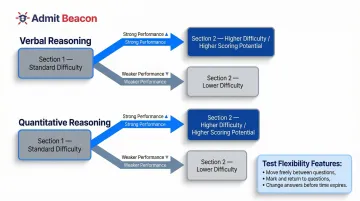
The GRE uses section-level adaptivity, not question-by-question adaptivity. Your performance on Section 1 determines the difficulty of Section 2 — for both Verbal and Quantitative. This means:
- You can move back and forth within each section
- You can mark questions and return to them
- You can change answers as many times as you like before time expires
- Strong performance on the first section unlocks a higher-difficulty (and higher-scoring potential) second section
What Each Section Tests
Understanding what each section measures helps you allocate prep time efficiently.
Verbal Reasoning emphasizes reading comprehension, critical reasoning, and vocabulary. The vocabulary-dependent questions make this section a natural fit for applicants with strong reading backgrounds or humanities degrees.
Quantitative Reasoning tests algebra, geometry, data interpretation, and arithmetic. It's less advanced than the GMAT's quant focus, but still demands solid mathematical reasoning — the kind you'll apply in finance, operations, and analytics coursework.
Analytical Writing assesses your ability to articulate complex ideas, construct arguments, and sustain a coherent discussion. It's rarely the deciding factor in MBA admissions, but scores below 4.0 can draw scrutiny around written communication skills.
Average GRE Scores at Top MBA Programs
Understanding where you stand relative to admitted students is critical for setting realistic targets and deciding whether to retake the test.
Important Context on Reported Data
Most schools report GRE averages or medians in their class profiles, but reporting is inconsistent. Some schools share Verbal and Quant separately, others report only a combined total, and some provide ranges rather than averages. Additionally, several top programs (including Stanford GSB, MIT Sloan, Kellogg, and Berkeley Haas) do not currently publish GRE data on their official class profiles.
GRE Score Benchmarks at M7 and T15 Programs
| School | Class Year | GRE Verbal | GRE Quant | Notes |
|---|---|---|---|---|
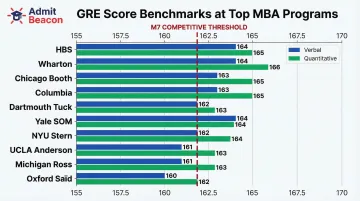
| Harvard Business School | 2027 | 164 | 164 | Median; 80% range V 158-168, Q 159-169 |
| Wharton | 2026 | 163 | 162 | Average |
| Chicago Booth | 2027 | 163 | 164 | Average |
| Columbia | 2027 | 163 | 163 | Average; range V 150-170, Q 150-170 |
| Dartmouth Tuck | 2027 | 162 | 160 | Average; range V 146-170, Q 142-170 |
| Yale SOM | 2027 | 158-163 | 160-166 | 80% range |
| NYU Stern | 2027 | 163 | 164 | Average; 80% range V 158-168, Q 160-170 |
| UCLA Anderson | 2027 | 162 | 163 | Average; range V 157-166, Q 156-169 |
| Michigan Ross | 2027 | 160 | 163 | Average; 80% range V 154-166, Q 155-170 |
| Oxford Saïd | Current | 160 | 160 | Median |
What the Data Reveals
M7 programs cluster around 324–328 total score. The most competitive programs expect both Verbal and Quantitative scores in the 162–164 range.
Quantitative scores tend to be slightly higher. This reflects the quantitative rigor expected in MBA coursework, particularly in finance, accounting, and operations.
Scoring at or above the average improves your admission odds and boosts your merit scholarship prospects.
Should You Retake?
If your score falls below a target school's average, consider whether a retake is worthwhile:
- Retake if: You can realistically improve by 5+ points total (or 3+ points in a critical section like Quant)
- Skip the retake if: Your score is within 2-3 points of the average and the rest of your profile is strong
- Use ScoreSelect strategically: Since you can choose which scores to send, a retake carries minimal downside—unless the school requires you to report all attempts
International Program Guidance
London Business School prefers scores over 160 for both Verbal and Quantitative sections.
INSEAD recommends scoring at or above the 80th percentile in both sections.
Other top international programs (HEC Paris, Oxford Saïd) accept the GRE but publish limited score data. Applicants should focus on holistic profile strength and direct communication with admissions offices.
GRE vs. GMAT: How to Choose for Your MBA Application
Choosing between the GRE and GMAT is one of the most strategic decisions you'll make during the application process. Neither test is objectively harder—difficulty depends on your individual strengths.
Structural Differences
| Feature | GRE | GMAT Focus Edition |
|---|---|---|
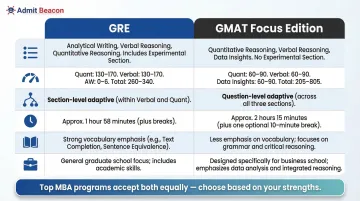
| Sections | Analytical Writing, Verbal Reasoning, Quantitative Reasoning | Quantitative Reasoning, Verbal Reasoning, Data Insights |
| Scoring Scale | Verbal: 130-170; Quant: 130-170; AW: 0-6 | Total Score: 205-805 |
| Adaptivity | Section-level (performance on first section determines second section difficulty) | Section-level |
| Test Duration | 1 hour 58 minutes | Approximately 2 hours 15 minutes |
| Vocabulary | Heavy emphasis on vocabulary in Verbal section | Minimal vocabulary focus |
| Business Focus | General graduate-level reasoning | Business-oriented scenarios and data analysis |
What Admissions Committees Say
Top MBA programs explicitly state they have no preference between the GMAT and GRE:
- Stanford GSB: "We have no preference for one test over the other."
- Harvard Business School: "There is no minimum GMAT or GRE to apply and we do not have a preference towards a particular test."
- Wharton: "There is no minimum GMAT or GRE score requirement to apply to the Wharton MBA program, and we don't have a preference for one test over another."
- MIT Sloan: "We view scores from both tests equally. We have no preference."
Some programs may convert GRE scores to GMAT equivalents using the ETS comparison tool for internal benchmarking, but this does not indicate a preference—it's simply a way to standardize evaluation across different score scales.
Who Should Consider the GRE
The GRE tends to be the stronger choice if you:
- Come from a humanities or social sciences background and score stronger on Verbal than Quant
- Are applying to non-business programs as well (law, policy, joint degrees) that accept the GRE
- Already have a solid GRE score from a previous application
- Find vocabulary-based verbal questions more natural than business-oriented data problems
Who Should Consider the GMAT
The GMAT is typically the better fit if you:
- Have a strong quantitative background and want to signal analytical readiness directly
- Prefer business-oriented scenarios and data interpretation over vocabulary-heavy reading
- Score noticeably higher on GMAT practice tests than GRE equivalents
- Are targeting programs where GMAT has historically been the dominant submission (though this gap has largely closed)
Test Waiver Policies in 2025-2026
While some programs offered widespread test waivers during COVID, most top MBA programs have reinstated standardized testing requirements for the 2025-2026 admissions cycle. Waivers are now rare and typically reserved for specific criteria:
- Harvard Business School: "We do not offer GMAT/GRE waivers. Every applicant must take the GRE or GMAT by the application deadline."
- Stanford GSB: All applicants must submit a valid GMAT or GRE score.
- Chicago Booth: Waivers are limited to current UChicago undergraduate students or alumni with a cumulative GPA of 3.4 or above. "Outside of the above circumstance, we do not waive our GMAT or GRE requirement for any reason."
Relying on a waiver is a mistake. If you're applying to top programs, plan to take a standardized test.
Should You Take Both Tests?
Taking both the GRE and GMAT is uncommon and rarely necessary. A better approach:
- Take official practice tests for both exams
- Identify which format plays to your strengths
- Prepare thoroughly for one test
- Submit only your strongest score
How MBA Adcoms Really Evaluate Your GRE Score
Test scores are important, but they don't exist in a vacuum. Admissions committees use a "threshold and context" model when evaluating GRE scores.
The Threshold Model
Rather than ranking applicants purely by score, admissions committees use GRE scores as a baseline filter for academic readiness. Once a score clears an informal threshold (typically around the school's reported average), the focus shifts to the rest of the application.
As Stanford GSB notes: "Your test scores are just one piece of your application. We consider your scores within the context of factors such as the resources available to you and the educational systems within your university and country."
Chicago Booth emphasizes the same principle: "Your GMAT/GRE score is one component of our evaluation process and we encourage you to keep that in mind when reviewing the Class of 2027 submitted score ranges and averages."
The Analytical Writing Section
While Analytical Writing is rarely a deciding factor, a notably low score (below 3.5) can raise concerns—especially for non-native English speakers. A score of 4.0 is generally acceptable; 5.0+ is strong.
However, the AW section cannot substitute for strong application essays. Some programs explicitly state they do not require AWA scores:
- MIT Sloan: "The Admissions Committee does not require GMAT or GRE AWA scores."
- Wharton: "The Analytical Writing Assessment section (AWA) is not currently required to apply to the Wharton MBA Program."
If you score poorly on the AWA, ensure your application essays and interview performance demonstrate strong communication skills.
How GRE Scores Interact with Your Profile
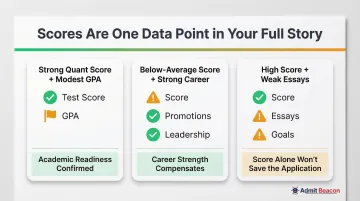
Your score doesn't operate in isolation — it interacts with every other part of your file. Here's how that typically plays out:
- Strong quant score, modest GPA: High Verbal and Quant scores can signal academic readiness even if your undergraduate GPA was from years ago or from a less rigorous program.
- Below-average score, strong career: Rapid promotions, quantitative accomplishments, or analytical leadership roles can carry more weight than a few points on a test.
- High score, weak essays: A 330 GRE won't rescue an application with generic goals, thin work experience, or essays that feel templated. Adcoms read your entire narrative — the score is just one data point in it.
How Admit Beacon Approaches Test Scores
Admit Beacon treats your GRE score as a starting point, not a verdict. Work with lead consultant Niketa covers resume positioning, school selection, career narrative, and essay storyboarding — the parts of your application where a score gap can be addressed or contextualized. The Knowledge Base spans the top 25 MBA programs, so you'll know exactly how each school tends to weigh test scores against the rest of your profile before you apply.
Frequently Asked Questions
Is the GRE required for an MBA?
The GRE is not universally required. Most top programs accept it alongside the GMAT, and some offer waivers under specific conditions—though a competitive score strengthens any application.
What GRE score is required for MBA programs?
There is no universal minimum. Competitive scores at M7 programs typically range from 320–330 total, with Quantitative scores around 160–165 for the most selective schools.
What is a good GRE score for MBA admissions?
325+ is widely considered strong for top-tier programs. Scoring at or above a target school's reported average meaningfully improves admission and scholarship prospects.
Which one is harder, the GRE or the GMAT?
Neither is objectively harder—difficulty depends on individual strengths. Verbal-strong candidates often find the GRE more manageable, while quantitatively focused candidates may prefer the GMAT's data-focused format.
Is the GRE requirement waived for MBA programs in 2026?
Most top MBA programs have reinstated standardized testing requirements for 2025–2026 after widespread waivers in prior years. Check each school's admissions page directly, as policies are still shifting.
Do MBA programs care about the GRE Analytical Writing score?
AW is rarely a primary evaluation criterion, but a notably low score (below 3.5) can raise a flag—especially for non-native English speakers. A score of 4.0–5.0 is sufficient and won't draw scrutiny.