
According to Poets&Quants analysis of 2023 admissions data, the average GMAT submission rate among top 10 U.S. business schools was 50%, while GRE submissions grew to 32.3%. This shift reflects a fundamental change in how elite programs evaluate standardized tests — but it doesn't mean the choice is trivial. Your test decision should reflect where you can score highest relative to your target school's admitted class benchmarks, while reinforcing the narrative you're building throughout your application.
Key Takeaways
- The GMAT is purpose-built for business school and remains the more common submission at elite programs like HBS, Stanford GSB, and Wharton
- The GRE is accepted at most top MBA programs and suits non-traditional applicants, liberal arts backgrounds, and dual-degree candidates
- Neither test is universally "better" — the right choice is the one where you can score highest relative to your target school's admitted class benchmarks
- Key structural difference: GMAT tests business reasoning and data interpretation; GRE tests broader academic aptitude with heavier vocabulary emphasis
- Practical first step: Take a full-length practice test for both before committing — your score gap between the two will often make the decision clear
GMAT vs GRE: Quick Comparison
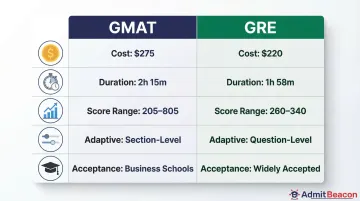
Here's how the GMAT and GRE compare across the five factors that matter most for MBA applicants.
Cost
- GMAT: Approximately $275–$300 depending on country and delivery method (test center or online)
- GRE: Approximately $220–$232 globally (slightly lower in most markets)
Test Structure and Duration
- GMAT: 3 sections — Quantitative Reasoning, Verbal Reasoning, and Data Insights — completed in 2 hours and 15 minutes
- GRE: 3 sections — Verbal Reasoning, Quantitative Reasoning, and Analytical Writing — completed in approximately 1 hour and 58 minutes
Score Range
- GMAT: Composite score from 205 to 805
- GRE: Verbal and Quantitative each scored from 130 to 170 (reported separately, no single composite)
Adaptive Difficulty
- GMAT: Question-level adaptive — each question adjusts in difficulty based on the previous answer, creating a more pressurized testing experience
- GRE: Section-level adaptive — the second section's difficulty adjusts based on overall performance in the first, giving test-takers more flexibility within each section
Program Acceptance
- GMAT: Accepted at 2,400+ graduate business programs worldwide; designed exclusively for business school admissions
- GRE: Accepted at approximately 1,300 business schools; also accepted across a wide range of non-business graduate programs
What is the GMAT?
The GMAT (Graduate Management Admission Test), administered by the Graduate Management Admission Council (GMAC), is the only standardized test designed specifically for graduate business school admissions. This specialization matters to admissions committees evaluating business readiness — the exam tests skills directly relevant to MBA coursework and business careers, not general academic aptitude.
GMAT Focus Edition: Current Format
The current GMAT Focus Edition, launched in 2023 and rebranded in July 2024, consists of three equally weighted sections:
- Quantitative Reasoning: Problem-solving with business-relevant math, testing arithmetic and elementary algebra
- Verbal Reasoning: Critical reasoning and reading comprehension, assessing your ability to evaluate arguments and interpret complex text
- Data Insights: Multi-source reasoning, table analysis, data sufficiency, graphics interpretation, and two-part analysis — unique to the GMAT and designed to mirror the analytical demands of MBA coursework
The Data Insights section is worth noting. GMAC designed it specifically to measure digital and data literacy, assessing your ability to synthesize multiple sources of information and apply them to real-world business scenarios — skills that appear repeatedly in MBA coursework.
Question-Level Adaptive Format
The GMAT rewards critical thinking, logical trap-spotting, and in-the-moment reasoning rather than memorized knowledge. Each question adjusts in difficulty based on your previous answer, and you cannot skip questions or return to them. This means a single shaky decision compounds — sustained focus throughout the exam is non-negotiable.
2023 Focus Edition Changes
The essay section was eliminated, the test was shortened from 3+ hours to 2 hours 15 minutes, and Data Insights was introduced. If you're preparing for the GMAT, ensure all prep materials reflect this current format — older materials covering the Analytical Writing Assessment are no longer relevant.
Use Cases of the GMAT
Certain applicant profiles are naturally suited to the GMAT:
- Finance, consulting, or engineering professionals with strong quant instincts who can apply those skills directly to the exam format
- Applicants from over-represented pools — such as Indian engineers and banking professionals — where a high GMAT score helps differentiate within a competitive segment
- Those with time for structured preparation to master the adaptive format and develop consistent trap-spotting instincts
Submitting the GMAT also carries a signaling effect. At Harvard Business School's Class of 2027, 62% of students submitted GMAT scores (34% Focus Edition, 28% 10th Edition), compared to 44% who submitted GRE scores. Schools generally read a GMAT submission as a clear indicator that business school is the applicant's primary — not backup — goal.
What is the GRE?
The GRE (Graduate Record Examinations), administered by ETS, is a general graduate admissions test accepted across disciplines. Its broad scope offers flexibility — though top programs officially state they hold no preference between the two tests.
GRE Section Breakdown
The GRE consists of three scored sections:
- Verbal Reasoning: Two sections testing reading comprehension and vocabulary — analyzing written material and word relationships
- Quantitative Reasoning: Two sections covering arithmetic, algebra, geometry, and data analysis, with calculator access throughout
- Analytical Writing: A 30-minute essay on argument construction — a section the GMAT does not include
Each Verbal and Quantitative section is scored from 130 to 170 and reported separately — there is no single composite score as with the GMAT.
Section-Level Adaptive Format
Because difficulty adjusts between sections rather than between individual questions, test-takers can tackle questions within a section in any order. You can skip questions, return to them, and change answers before time expires. This flexibility benefits applicants prone to test anxiety or those who prefer to manage time autonomously — answering easier questions first and returning to harder ones later.
Quant Rigor and Calculator Access
GRE quant is broadly considered less rigorous than GMAT quant. The test includes a calculator and covers more foundational math concepts. For applicants who are not math-strong or who experience math anxiety, this can result in a more competitive score profile. Calculator access reduces computational errors, letting you focus on logic rather than arithmetic.
Use Cases of the GRE
The GRE is best suited for specific profiles:
- Humanities, social sciences, or arts professionals without recent quant coursework
- Dual-degree applicants (MBA/MPP, MBA/JD, MBA/MA) — one GRE score covers both program applications
- Candidates with strong verbal and reading skills who need less prep time to reach a competitive score
The GRE plays a strategic role for non-traditional applicants at top programs. Some schools show greater flexibility with GRE score thresholds relative to their published averages. At UC-Berkeley Haas, 53% of the 2023 entering class submitted GRE scores — demonstrating the test is not just accepted but common at elite programs.

GMAT vs GRE: Which Is Better for Your MBA Application?
There's no universally "better" test. The right choice is the one where you score highest — and that fits your background, school targets, and application story. Every decision below flows from that.
Critical Thinker vs. Memorizer Framework
The GMAT rewards higher-order reasoning, logical analysis, and spotting deliberate traps in question design. It tests your ability to think through problems dynamically, adapting to increasing difficulty without the safety net of returning to previous questions.
The GRE rewards depth of vocabulary and retained mathematical knowledge. It allows you to approach questions strategically within each section, drawing on your existing academic foundation rather than demanding on-the-fly critical reasoning under pressure.
Ask yourself honestly: Do you excel at recognizing logical patterns and traps, or do you perform better when you can draw on memorized knowledge and manage your time flexibly?
Quant Strength as a Decision Factor
Applicants with strong quant backgrounds (engineering, finance, hard sciences) are generally better positioned for GMAT's more rigorous quant section. The question types demand deeper analytical reasoning and comfort with data sufficiency problems that have no direct parallel in the GRE.
Applicants with weaker quant histories or math anxiety tend to achieve stronger scores on GRE's more accessible quantitative section. The calculator access and more straightforward problem structures reduce computational pressure and allow you to demonstrate competence without the same level of rigor.
How Top MBA Programs Evaluate Each Test
Most programs, including Harvard, Stanford, and Wharton, use conversion tools to compare GMAT and GRE scores and officially treat them equally. Harvard explicitly states: "We do not have a preference for one test over the other." Stanford echoes this: "We have no preference for one test over the other."
That said, individual AdCom members may bring implicit preferences, and percentile performance — especially in the quantitative section — is closely scrutinized. On the conversion question, GMAC itself cautions that comparisons with scores from other tests "are not appropriate." The ETS GRE Comparison Tool carries a predicted score error margin of approximately +/- 50 points for the total GMAT score.
Score Target Benchmarks at Top Programs
Current median scores at elite programs provide concrete benchmarks:
| School | GMAT Focus Median | GMAT Legacy Median | GRE Verbal / Quant Medians |
|---|---|---|---|
| Harvard Business School | 685 | 730 | 164 / 164 |
| Wharton | Not published | 732 (Average) | 163 / 162 (Averages) |
| Chicago Booth | Not published | 729 (Average) | 163 / 164 (Averages) |
| London Business School | ~645 (Average) | Not published | >160 / >160 (Preferred) |
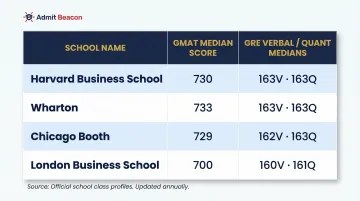
Always consult the school's official class profile directly, as these numbers are updated annually and vary by admissions cycle.
Applicant Scenarios: Who Should Choose Which Test
Choose the GMAT if:
- You come from traditional business backgrounds (finance, consulting, banking) where quant rigor is expected
- You're from an over-represented applicant pool and need a strong differentiator
- You're targeting programs where GMAT submission rates are significantly higher (e.g., Chicago Booth at 73%)
- You score meaningfully higher on GMAT practice tests than GRE practice tests
Choose the GRE if:
- You're struggling with GMAT quant after sustained preparation
- You're applying to dual-degree programs where one GRE score serves multiple applications
- You're a career-switcher or non-traditional candidate where the GRE can reinforce a distinctive narrative
- You score meaningfully higher on GRE practice tests than GMAT practice tests
- You have a strong vocabulary and excel at verbal reasoning
Test choice doesn't exist in isolation — it connects directly to your quant track record, the programs you're targeting, and how you're positioning your candidacy overall. If you want a personalized read on where you stand, Admit Beacon's consultants can map your test strategy to specific school expectations and application positioning.
Conclusion
There is no universal winner between the GMAT and GRE. The right answer depends on your profile — and a well-chosen test at a strong score will always outperform a default choice submitted at an average one.
A strategically chosen test does three things for your application:
- Reinforces your quant narrative with a score that reflects real ability
- Signals commitment to the specific programs on your list
- Fits coherently into the broader story you're telling admissions committees
Take full-length practice tests for both exams before committing. Your performance differential — combined with a clear-eyed assessment of your strengths, target schools, and application narrative — will point you in the right direction.
Frequently Asked Questions
Which is better for MBA admission: the GMAT or the GRE?
Neither test is universally better — the right choice depends on where you score higher and how it fits your target schools. GMAT is the default at most elite programs, while GRE tends to work better for non-traditional candidates, dual-degree applicants, and those with stronger verbal than quant skills.
Do top MBA programs (like Harvard and MIT) accept the GRE, or do they prefer the GMAT?
HBS, Stanford GSB, Wharton, and MIT Sloan officially accept both tests equally and state no preference. That said, GMAT submissions still represent the majority at these schools, and admissions committees use conversion tools to evaluate GRE scores alongside other applicants.
Is the GRE requirement waived for 2026 MBA admissions?
Test waiver policies vary by school and applicant profile. For the 2026 cycle, most top programs require standardized tests, with waivers granted only under highly specific conditions (for example, Chicago Booth grants waivers only to UChicago undergraduates or alumni with a 3.4+ GPA). Submitting a strong test score remains advisable, especially for candidates with weaker quant grades.
Is the GRE harder than the GMAT?
Difficulty depends on your strengths. GMAT quant is harder and its question-level adaptive format is more pressurized overall. GRE quant is more accessible with calculator access, but GRE verbal demands stronger vocabulary and reading comprehension.
What GRE score corresponds to the 70th percentile?
Based on ETS Interpretive Data for July 2021–June 2024, a Verbal Reasoning score of 156 corresponds to the 70th percentile, and a Quantitative Reasoning score of 166 corresponds to the 71st percentile. Most top MBA programs look for scores above the 70th percentile in both sections as a general benchmark.