Introduction
Choosing between a Full-Time MBA and an Executive MBA isn't just a scheduling decision. Program choice signals your career stage, shapes your peer network, and determines what admissions committees will expect from your story — and getting it wrong means building an application around the wrong narrative entirely.
The stakes are real. According to the AACSB's 2025 Enrollment Trends Report, overall MBA enrollments declined 6% over five years, yet Executive MBA programs are experiencing a surge in interest — average inquiries per program jumped from 795 in 2022 to 982 in 2023. That gap is widening as more mid-career professionals seek credentials without stepping away from their roles.
This article covers the key differences across student profile, structure, cost, career outcomes, and admissions — so you can identify which path fits your goals.
Key Takeaways
- Full-Time MBA targets early- to mid-career professionals (~5 years experience) who step away for 2 years of full-time campus study
- Executive MBA (EMBA) serves seasoned managers (~10–15 years experience) who keep working while attending weekend or hybrid classes
- Full-Time MBA is the better path for career pivots, internship recruiting, and building foundational business skills
- EMBA accelerates entry into senior leadership, deepens strategic thinking, and often comes with employer sponsorship
- The right choice turns on your experience level, career goals, and life stage — not which program sounds more prestigious
Executive MBA vs Full-Time MBA: Quick Comparison
| Feature | Full-Time MBA | Executive MBA (EMBA) |
|---|---|---|
| Target Candidate | Early- to mid-career professionals seeking career pivots or acceleration | Seasoned managers and executives deepening leadership capabilities |
| Work Experience Required | Avg. 5 years (Wharton: 5 years; Stanford: 5.3 years; Kellogg: 5.1 years) | Avg. 10–15 years (Wharton: 13–14 years; Kellogg: 15 years; Cornell: 14 years) |
| Program Format | Full-time, campus-based; students leave jobs for 2 years | Part-time, weekend/hybrid; students continue working full-time |
| Duration | 2 years (sometimes accelerated to 1 year) | 18–24 months (compressed schedule) |
| Cost and Who Pays | $150,000–$250,000 tuition; typically self-funded or loans | $130,000–$200,000 tuition; 30% partially sponsored, 18% fully sponsored, 52.1% self-funded |
| GMAT/Test Requirements | GMAT or GRE strictly required | Executive Assessment (EA) widely accepted; GMAT/GRE waivers common |
| Career Focus | Career pivots, summer internships, structured recruiting into consulting, banking, tech | Promotions, expanded scope, C-suite acceleration within current organization |
| School Availability | All top programs offer Full-Time MBA | HBS, Stanford GSB, and Dartmouth Tuck do NOT offer EMBA |
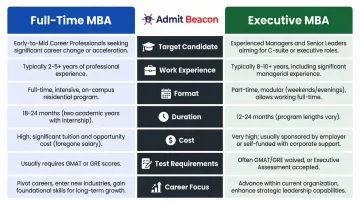
Both formats award the same MBA degree at most schools. Wharton puts it directly: "both programs require the same high admissions standards, follow the same rigorous curriculum, and confer the same Wharton MBA degree." What differs is delivery format, cohort profile, and career positioning — not the credential itself.
What is a Full-Time MBA?
The Full-Time MBA is a 2-year (sometimes accelerated to 1 year) immersive graduate business program where students leave their jobs to study full-time. It serves as the flagship business degree at top programs like Harvard, Stanford, and Wharton, representing the traditional path to business leadership and offering the most comprehensive recruiting infrastructure.
Program Structure
Full-Time MBAs follow a structured format:
- Intensive coursework covering core business functions (finance, marketing, operations, strategy)
- Summer internship between Year 1 and Year 2 — a critical recruiting milestone
- On-campus recruiting pipelines connecting students directly to brand-name employers
- Wide menu of electives and specializations (finance, marketing, entrepreneurship, social impact, etc.)
At Chicago Booth, for example, students complete the program in 21 months, taking classes in Fall, Winter, and Spring quarters, with the summer dedicated to a full-time internship. At MIT Sloan (Class of 2025), 62.9% of accepted offers were school-facilitated, with 35.7% stemming directly from summer internships.
Who It's Built For
The Full-Time MBA targets early- to mid-career professionals averaging 5 years of work experience. Ideal candidates include:
- Career switchers seeking structured access to new industries
- Professionals in their late 20s looking to accelerate into leadership roles
- Those needing brand-name recruiting pipelines into consulting, banking, and tech
Most top programs become difficult to enter once candidates are significantly beyond their late 20s or have more than 7-8 years of experience, as the cohort profile skews younger and the program design assumes limited prior management experience.
Career Outcomes
Full-Time MBA graduates achieve strong placement and compensation outcomes:
- Harvard Business School (Class of 2025): $184,500 median base salary; $30,000 median signing bonus; 90% of job seekers received offers within 3 months
- Wharton (Class of 2025): $185,000 median base salary; $30,000 median signing bonus; 90.7% job offer rate
- Stanford GSB (Class of 2025): $185,000 median base salary; $30,000 median signing bonus; 90% placement within 3 months
- MIT Sloan (Class of 2025): $175,000 median base salary; $30,000 median signing bonus; 91.0% job offer rate
Dominant industries include:
- Wharton: Financial Services (38.2%), Consulting (28.2%), Technology (15.3%)
- Stanford GSB: Technology (35%), Finance (33%), Consulting (11%)
- MIT Sloan: Consulting (32.3%), Technology (23.3%), Finance (20.6%)
The Full-Time MBA's summer internship model enables clean industry pivots — candidates can test a new field, build relevant experience, and convert internships into full-time offers.
Use Cases of the Full-Time MBA
- A 27-year-old engineer at a mid-size tech firm who wants to move into product strategy or consulting
- A nonprofit manager seeking to transition into private equity or venture capital
- A recent graduate from a non-business background looking to accelerate into leadership with a brand-name credential
Each of these profiles shares a common thread: a clear before-and-after story. Admissions committees evaluate future potential and expect a compelling narrative connecting your past experience, your post-MBA target role, and why this specific program is the right vehicle to get there.
What is an Executive MBA?
The Executive MBA (EMBA) is a part-time graduate business program designed for working professionals with significant managerial or leadership experience — generally 10–15 years. Students attend classes on alternating weekends, evenings, or in hybrid formats without leaving their jobs, allowing them to apply classroom concepts immediately in their organizations.
Program Structure
EMBA programs emphasize:
- Cohort learning — classmates are senior professionals who bring live leadership challenges into every discussion, not just hypotheticals
- Weekend or compressed schedules (e.g., every other weekend, Thursday–Sunday modules) that keep you employed full-time
- Curriculum focused on advanced leadership, strategic decision-making, and global business — fewer electives than Full-Time MBAs, but deeper peer-to-peer learning
- The same MBA degree as full-time counterparts at many top programs, including Wharton, Cornell, and Columbia
The cohort model creates tight-knit networks of senior professionals who often continue collaborating long after graduation. That network also shapes how the program gets paid for.
Financing Model
According to the 2025 EMBAC Student Exit Survey:
- 52.1% of EMBA students are entirely self-funded
- 30% receive partial employer sponsorship
- 18% receive full employer sponsorship
EMBA students continue earning their full salary throughout the program — which offsets tuition and eliminates the opportunity cost of leaving the workforce. That factor alone changes the financial calculus compared to a Full-Time MBA.
Career Outcomes
EMBA graduates pursue different outcomes than Full-Time MBA graduates:
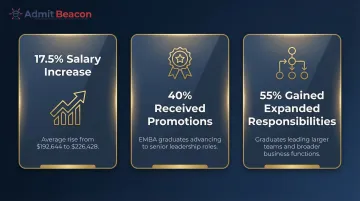
- Salary increases: EMBA graduates reported a 17.5% increase in salary from program start to completion (average salary rose from $192,644 to $226,428)
- Promotions during the program: 40% of EMBA students received a promotion while still enrolled
- Expanded responsibilities: 55% reported increased responsibilities during the program
Full-Time MBA graduates frequently change industries. EMBA graduates do the opposite — they accelerate within their current organization or sector, moving into VP or C-suite roles faster than they would have otherwise.
Use Cases of the Executive MBA
Ideal scenarios:
- A 38-year-old Director at a Fortune 500 company seeking to move into a VP or C-suite role
- An entrepreneur with an established business who needs to sharpen financial and strategic acumen
- A physician or attorney with a JD/MD looking to step into healthcare or legal management leadership
EMBA applicants must demonstrate leadership impact, organizational influence, and a clear rationale for why this degree accelerates their existing trajectory — not pivots it. Admissions committees want to see what you've already built and led, not a list of ambitions.
Executive MBA vs Full-Time MBA: Which Is Right for You?
The decision hinges on three core factors: career stage (where you are now), career goal (where you want to go), and life constraints (whether stepping away from work is feasible).
Decision Framework
Choose Full-Time MBA if:
- You have under 7 years of experience and are pre-30
- You want to pivot industries or functions (e.g., engineering → consulting, nonprofit → private equity)
- You need structured recruiting access to competitive industries
- You're building foundational business skills across functions
- You can afford to step away from work for 2 years
Choose EMBA if:
- You have 8+ years of experience and are in a management role
- You want to accelerate upward within your current industry or organization
- You need to continue earning your salary and maintain career continuity
- You're deepening strategic thinking and senior leadership capabilities
- You value peer learning from experienced executives
School Availability Factor
Some top programs — Harvard Business School, Stanford GSB, and Dartmouth Tuck — do not offer an EMBA track at all. If these are target schools, the Full-Time MBA is your only path.
Conversely, some schools' EMBA rankings exceed their Full-Time MBA rankings. For example:
- Columbia Business School: #9 Full-Time MBA (U.S. News 2025) vs. #4 EMBA (U.S. News 2025)
- Duke Fuqua: #13 Full-Time MBA (U.S. News 2025) vs. #5 EMBA (U.S. News 2025)
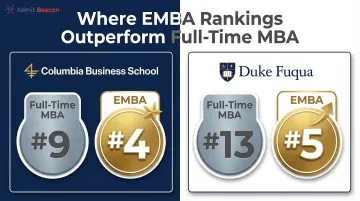
For these programs, the EMBA may be the more strategically sound choice if your profile fits the executive format.
Admissions Narrative Difference
Full-Time MBA applications are built around:
- Future potential and clear post-MBA goals
- Why you need this degree now to make your next career move
- How the program's resources (internship, recruiting, curriculum) enable your pivot
EMBA applications center on:
- Leadership accomplishments and organizational impact
- How the degree multiplies existing momentum
- Why you're ready for expanded scope and strategic responsibility now
These storytelling strategies diverge at every level. If you're unsure which path fits your profile and goals, Admit Beacon's admissions consulting can help clarify your direction — school selection, narrative development, and application positioning included.
Real-World Examples
A 28-year-old consultant at a mid-tier firm left to pursue a Full-Time MBA at Wharton. Her summer internship opened a pivot into tech product leadership at a major platform company — a move that would have been difficult to engineer otherwise.
Post-MBA, she joined full-time as a Senior Product Manager with a $180,000 base salary and equity package.
A 40-year-old senior operations executive at a Fortune 500 manufacturer completed a Kellogg EMBA without leaving his role. The program expanded his peer network to include C-suite leaders across industries and sharpened his strategic thinking.
Within 18 months of graduating, he was promoted to Chief Operating Officer.
The right choice comes down to where you are in your career, not just where you want to go. Get that framing right first, and the rest of the decision follows.
Conclusion
Neither program is objectively better. The right MBA is the one that fits where you are in your career, what gaps you need to close, and where you want to be in five years. Full-Time MBA suits pivots and early-career acceleration; EMBA suits leadership deepening and senior advancement.
Choosing the program is only the first step. How you frame your story in the application is what determines admission — and that's where most candidates lose ground. Whether you're targeting a Full-Time MBA at a top-10 program or building a case for a competitive EMBA, working with a team that takes a structured, personalized approach to your narrative (rather than a templated one) makes the difference between a strong application and the right one.
Frequently Asked Questions
Which is better, an Executive MBA or a full-time MBA?
Neither is universally better — the right choice depends on career stage, goals, and life constraints. Full-Time MBA suits early-career professionals seeking pivots and structured recruiting; EMBA suits experienced leaders accelerating existing trajectories without leaving their jobs.
Is an Executive MBA more prestigious than a full-time MBA?
Prestige depends on school and context. At institutions such as Wharton and Cornell, both programs award the identical MBA degree. Full-Time MBAs at Harvard and Stanford carry broader brand recognition partly because those schools don't offer an EMBA at all.
Is an Executive MBA easier to get into than a full-time MBA?
EMBA admissions weigh professional accomplishment and leadership impact heavily, and many programs accept the Executive Assessment (EA) or waive tests entirely. The bar is different, not lower — your narrative must demonstrate senior-level impact and organizational influence.
Which MBA do most CEOs have: Executive or full-time?
Most current Fortune 500 CEOs hold Full-Time MBAs from top programs, largely because EMBA programs gained widespread prominence more recently. However, this gap is narrowing as more executives use the EMBA path to accelerate into C-suite roles.
Can you do an Executive MBA without employer sponsorship?
Yes. Self-sponsorship is now the most common financing route — 52.1% of EMBA students pay their own way, according to the 2025 EMBAC Student Exit Survey. Financial aid, loans, and personal savings all work as funding alternatives.