Choosing the wrong format could cost you extra years or misalign entirely with your career goals. A full-time two-year MBA might be essential for a complete career pivot, but it could be overkill if you're simply looking to advance in your current field. Conversely, an accelerated one-year program might save time and money—but at the cost of networking opportunities and recruiting infrastructure that could be critical to your success.
This guide breaks down the four key variables that determine your MBA timeline: program type, program format, personal pace factors, and the application timeline. By the end, you'll understand not just how long an MBA takes, but which format aligns with your career stage and goals.
Key Takeaways
- Full-time MBA programs at top schools typically last 2 years
- Accelerated and one-year programs compress the curriculum into 12-18 months
- Part-time and Executive MBAs typically run 2-3 years, letting you stay employed throughout
- Online MBAs vary the most, ranging from 1 to 3 years depending on enrollment pace
- The application process itself can add 6-12 months to your overall timeline
MBA Program Types and How Long Each Takes
"MBA" isn't a single program—it's an umbrella term covering several distinct formats, each designed for a different career stage and life situation. Understanding these differences is the first step to planning your timeline accurately.
Full-Time MBA (The 2-Year Standard)
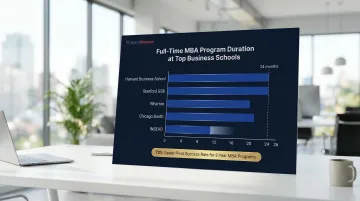
The traditional full-time MBA lasts two academic years, split between a first year of core fundamentals and a second year of electives, concentrations, and recruiting. This is the format used by most top-ranked programs including Harvard Business School, Stanford GSB, Wharton, Kellogg, and Chicago Booth.
Program structure:
- Year 1: Core curriculum covering accounting, finance, marketing, operations, organizational behavior, and strategy
- Summer: Internship period serving as a critical "10-week audition" for employers
- Year 2: Elective courses, specializations, and intensive recruiting activities
The two-year format is intensive and generally not compatible with full-time work. The internship between years one and two is a core part of the career transition value—not optional padding.
According to 2024 research on MBA outcomes, 73% of students in two-year programs successfully execute a complete career pivot (changing both industry and function), compared to just 18% of students in one-year programs.
Typical durations at top schools:
- Stanford GSB: 2 years
- Wharton: 20 months
- Chicago Booth: 21 months
Accelerated and One-Year MBA Programs
For those who don't need an industry pivot, accelerated programs compress the curriculum into 12-18 months. They do this by running shorter course terms (typically 6-8 weeks vs. 15-week semesters), cutting the summer internship break, and assuming stronger pre-MBA business knowledge.
Key characteristics:
- Demanding pace from day one with no ramp-up period
- Limited time for networking and extracurricular leadership
- No summer internship—recruiting happens concurrently with coursework
- Best suited for those who already know their post-MBA path
Top one-year programs:
- INSEAD: 10-12 months
- Kellogg 1-Year MBA: 12 months (June to June)
- Cornell Tech MBA: 12 months
- Cambridge Judge: 1 year
The trade-off: Less time for networking, recruiting, and exploring a career pivot. While you save on tuition and opportunity costs, you sacrifice the structured recruiting infrastructure that makes two-year programs so effective for career changers.
Part-Time MBA Programs
Part-time programs are designed for working professionals and typically take 2.5 to 3 years to complete. Students take fewer courses per term while maintaining full-time employment, making this a lower-disruption option.
Typical structure:
- Evening or weekend classes
- 1-2 courses per term (vs. 4-5 in full-time programs)
- Flexible pacing with maximum completion windows of 5-8 years
- No career disruption or income loss
Example timelines:
- Chicago Booth Part-Time: 2.5-3 years average (8 years maximum)
- Kellogg Part-Time: 1.25-5 years
Executive MBA (EMBA)
EMBA programs target mid-to-senior professionals (typically 10+ years of experience) and usually last 18-24 months. Classes are held on weekends or in modular intensive formats so participants never leave their jobs. These programs focus more on leadership and strategy than early-career fundamentals.
Key features:
- Weekend or modular intensive class formats
- Cohort-based learning with senior peers
- Emphasis on strategic leadership vs. career switching
- Employer often sponsors tuition
Typical durations:
- Wharton EMBA: 24 months
- Columbia EMBA: 20-24 months
Online MBA Programs
Online MBAs offer the widest timeline range—from 12 months (accelerated full-time) to 3+ years (self-paced part-time). Duration depends heavily on how many courses a student takes per term.
Timeline examples:
- UNC Kenan-Flagler Online MBA: 18-36 months
- Carnegie Mellon Tepper Online: 32 months (24 months accelerated)
- Indiana Kelley Online: 2 years
Most elite programs remain predominantly residential. Online formats work best for professionals who need geographic flexibility but can build their network independently—the structured recruiting pipelines of campus programs simply don't translate online.
Factors That Affect How Long Your MBA Takes
Program type sets the baseline, but these four variables are what actually determine your personal timeline:
Enrollment Status and Course Load
Full-time students (taking 4-5 courses per semester) move through programs faster than part-time students (taking 1-2 courses). Some programs allow students to switch between statuses, which is useful if your job demands shift mid-program.
Specializations and Dual Degrees
Choosing a concentration requires extra elective credits, potentially adding a semester. Dual-degree programs (e.g., MBA/JD, MBA/MPH) can add one to two years beyond the standard MBA timeline.
Dual-degree time savings:
- Wharton JD/MBA: 3 years (saves 2 years vs. completing separately)
- HBS MBA/MPP (Harvard Kennedy School): 3 years (saves 1 year)
- Wharton Lauder MBA/MA: 24 months (fully integrated)
The tradeoff: a longer MBA, but far fewer total years in school than pursuing both degrees back-to-back.
Transfer Credits and Prior Coursework
Some programs waive required foundation courses for applicants who demonstrate prior competency, potentially shortening time to degree. However, part-time and online programs do this more readily than elite full-time ones.
The "no transfer credit" rule at top schools:
- Harvard Business School: "HBS does not accept transfer credits of any kind. All students are expected to complete the full HBS MBA Program."
- Stanford GSB: Does not permit MBA students to request graduate residency transfer credit
- Wharton: Allows students to waive core classes via exams, but they must replace waived courses with electives—total credit requirement remains unchanged
Program Start Dates and Cohort Structures
Many top full-time programs have a single annual intake (fall), meaning if you miss one application cycle, you add a full year to your timeline. Some global programs offer more flexibility:
- INSEAD: January and August intakes
- Most U.S. top-25 programs: Single fall intake only
Missing a single deadline at these schools doesn't mean waiting a few months. It means waiting twelve.
Which MBA Format Fits Your Career Stage?
Your MBA format choice should be driven by two key variables: years of work experience and whether you need a career pivot. These factors matter more than timeline preferences alone.
Early-Career Professionals (3-6 Years of Experience)
Best fit: Full-time 2-year MBA
The traditional two-year MBA is the strongest option for professionals at this stage who want to break into consulting or finance, change industries, or move into leadership. Its internship and recruiting infrastructure are specifically built for that kind of transition.
Why the 2-year format works:
- Summer internship serves as a critical "trial run" and conversion opportunity
- Extended recruiting season with multiple interview rounds
- Time to explore new industries through coursework and networking
- Structured career services support for pivots
Mid-Career Professionals (7-15 Years of Experience)
Best fit: Part-time, EMBA, or Executive formats
Professionals deeper into their careers often benefit more from formats that allow them to apply learning in real time without stepping away from seniority or earning potential.
Advantages of working-professional formats:
- No income loss or career interruption
- Immediate application of concepts to current role
- Senior peer network
- Employer sponsorship opportunities
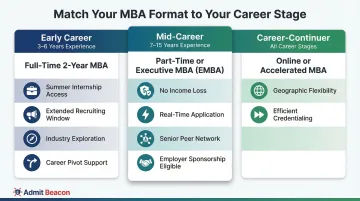
Career-Continuers Across All Stages
Best fit: Online or accelerated programs
Not every MBA applicant needs a dramatic career change. If your goal is skill-building or credential acquisition, online and accelerated programs can deliver the degree efficiently.
That said, for those targeting brand-name programs and the recruiting networks that come with them, the full-time format remains the most effective vehicle — even if it adds a year to your timeline.
How Long Does the MBA Application Process Take?
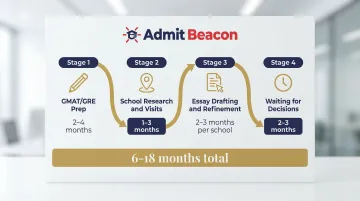
The MBA application timeline is a frequently overlooked part of the overall "how long" question. For most top programs, a competitive application takes 6-12 months to prepare properly—from initial school research and GMAT/GRE preparation to essay writing and interview prep.
The Typical Application Calendar
- GMAT/GRE preparation: 2–4 months
- School research and visits: 1–3 months
- Essay drafting and refinement: 2–3 months per school
- Waiting for decisions: 2–3 months after Round 1 or Round 2 deadlines
Applicants who rush this process often end up reapplying the following year, adding another 12 months to their timeline. According to GMAC's official guidance, prospective students should start the application process 12 to 18 months before the application deadline.
The Reapplicant Reality
If your first application doesn't result in admission, reapplying is highly viable. Harvard Business School is explicitly "reapplicant friendly," noting that approximately 10% of each MBA class includes individuals who previously applied. Admissions committees view reapplications as a sign of dedication, provided candidates demonstrate professional growth since their previous attempt.
How Professional Guidance Saves Time
Working with an admissions consultant can cut down on costly iteration. The biggest time losses come from misaligned school lists, unfocused essays, and narratives that don't connect—problems that compound into reapplication cycles.
Admit Beacon's lead consultant Niketa works personally with each candidate on resume development, school selection, career narrative, and essay storyboarding, dedicating roughly 40% of total application effort per client. By limiting intake, she can engage at a level of detail that prevents the structural mistakes most reapplicants trace back to their first attempt.
What to Expect After Your MBA: Salary and Career Outcomes
Post-MBA compensation varies significantly by program length, industry, and school — and it directly affects whether a 1-year or 2-year format makes financial sense for your situation.
The MBA Salary Premium
According to the GMAC 2025 Corporate Recruiters Survey, the projected median starting salary for MBA graduates in the U.S. is $125,000. This represents approximately 1.75 times the median starting salary of bachelor's degree holders, demonstrating the substantial earning premium an MBA provides.
Hiring Outlook and Employer Demand
The hiring outlook for MBA graduates remains strong. The 2025 GMAC survey revealed that more than a quarter of U.S. employers plan to expand their hiring of MBA graduates in 2025, with particularly high demand in consulting, technology, finance, and private equity.
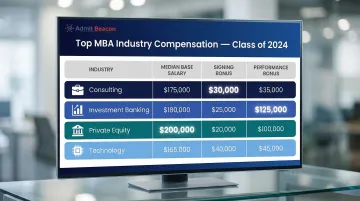
Top Industry Compensation (Class of 2024)
MBA graduates entering elite industries command exceptional starting packages:
| Industry | Median Base | Signing Bonus | Performance Bonus |
|---|---|---|---|
| Consulting | $190,000 | $30,000 | $40,000–$63,000 |
| Investment Banking | $175,000–$200,000 | $30,000–$50,000 | Varies |
| Private Equity | $200,000 | $25,000 | Varies |
| Technology | $163,500–$185,000 | $17,500–$45,000 | Varies |
ROI Calculation: 1-Year vs. 2-Year Programs
The time it takes to "recoup" your MBA investment (tuition + opportunity cost) differs significantly between program formats:
Total economic cost:
- 1-year MBA: ~$235,000 (tuition + 1 year lost salary)
- 2-year MBA: ~$470,000 (tuition + 2 years lost salary)
Breakeven timeline:
- 1-year MBA: 2.3 years
- 2-year MBA: 3.8 years
These numbers tell only part of the story. Research from MIT Sloan shows that 2-year graduates earn roughly 15% more by year three — the summer internship opens recruiting pipelines at top consulting firms and investment banks that 1-year programs typically cannot access. Lower upfront cost doesn't automatically mean better returns.
Frequently Asked Questions
How long does an MBA take?
An MBA typically takes 1-2 years full-time, 2-3 years part-time, and 18-24 months for Executive programs. The exact duration depends on program type and enrollment pace, with accelerated programs as short as 10-12 months and flexible part-time programs extending up to 8 years.
Is a 2-year MBA worth it?
A 2-year MBA is generally worth it for those targeting significant career transitions or top-tier recruiting networks. The summer internship and second-year recruiting access are difficult to replicate in shorter formats. Research consistently shows two-year students have a meaningful edge in career-switching outcomes compared to one-year program graduates.
Does an MBA increase salary?
Yes, MBA graduates consistently earn higher salaries than bachelor's degree holders. The median MBA starting salary of $125,000 represents approximately 1.75 times the bachelor's degree median, with the premium varying by school, industry, and prior experience.
What is the average MBA salary?
According to GMAC's 2025 Corporate Recruiters Survey, the projected median starting salary for MBA graduates in the U.S. is $125,000. Top-program graduates in consulting and finance typically earn significantly above this average, with median base salaries of $190,000-$200,000.
What is the highest salary for MBA graduates?
The highest MBA salaries are found in investment banking, private equity, and management consulting. At top firms recruiting from elite MBA programs, total first-year compensation (base + signing bonus + performance bonus) can exceed $250,000, with McKinsey, Bain, and BCG offering base salaries of $190,000-$192,000 plus bonuses.
Is an MBA harder than a master's degree?
MBAs and specialized master's degrees (such as MS Finance or MS in Management) differ more in scope and format than in difficulty. MBAs emphasize broad leadership and general management across a cohort, while specialized programs go deeper in a single discipline. They serve different purposes — neither is objectively harder.
Final Thoughts
The question "How long does an MBA take?" has no single answer—it depends entirely on your career stage, goals, and the format you choose. Each format serves a different need:
- Full-time two-year programs offer the most recruiter-friendly path for career pivots, with deep networking and structured recruiting access
- Accelerated one-year programs deliver faster ROI for professionals staying on the same career track
- Part-time and EMBA formats let working professionals advance without stepping away from their current roles
One detail many applicants overlook: your MBA timeline starts well before matriculation. Factor in 6-12 months for GMAT prep, school research, and essay development. Working with a specialized consultant like Admit Beacon can help you navigate this process efficiently, avoiding costly mistakes that lead to reapplication.
Ready to start your MBA journey? Contact Admit Beacon for personalized guidance on choosing the right program format and building a competitive application strategy.