Introduction
Ambitious professionals planning their next career move often find themselves stuck between two graduate business degrees — the MBA and the Masters in Management (MiM). Choosing the wrong one can set back your timeline by years — or cost you six figures in foregone salary and tuition.
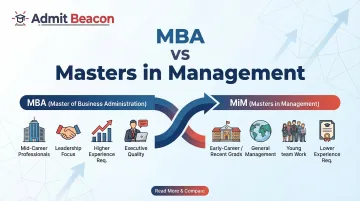
While both degrees teach business fundamentals, they're designed for very different career stages, goals, and timelines. The MBA targets mid-career professionals seeking leadership acceleration or career pivots. The MiM serves recent graduates building business foundations early.
This article breaks down the key differences — candidacy profiles, ROI, program structure, and long-term career outcomes — so you can make the call with confidence.
Key Takeaways
- The MBA is built for mid-career professionals (3–10+ years) pivoting industries, accelerating into leadership, or launching ventures
- The MiM targets recent graduates with little to no work experience who want a business foundation early
- MiM programs run about 1 year and cost $30,000–$60,000; top US MBA programs exceed $200,000
- MBA graduates enter senior roles with higher starting salaries; MiM graduates typically start as analysts or associates
- The MiM dominates European business schools; the MBA remains the gold standard in the US
- Career stage and target outcomes — not age alone — should drive this decision
MBA vs Masters in Management: At a Glance
MBA vs MiM: Key Differences at a Glance
Choosing between an MBA and a Master in Management often comes down to one question: where are you in your career? The two degrees serve different stages, carry different price tags, and lead to different roles — here's the breakdown.
Target Student Profile:
- MBA: Professionals with 3–10 years of work experience, typically aged 25–30, with top programs averaging 5 years of experience
- MiM: Recent graduates or early-career professionals with 0–2 years of experience, typically aged 21–24, with over 50% having zero work experience
Program Duration:
- MBA: Two years full-time at top US schools
- MiM: 12–18 months, with London Business School offering 12–16 months, HEC Paris 18 months, and ESCP two years
Cost Comparison: The financial gap is significant. For 2025–2026, top US MBA programs require massive investment:
- Stanford GSB: $135,771 per year
- Wharton: $132,404 per year
- Chicago Booth: $129,403 per year
- Harvard Business School: $126,536 per year
Over two years, total MBA costs exceed $250,000.
Top European MiM programs cost far less:
- HEC Paris: €57,700 total tuition
- London Business School: £52,950
- ESCP Business School: €25,200 per year (non-EU students)
Post-Graduation Roles:
| Degree | Typical Entry Roles |
|---|---|
| MBA | Management Consultant (Associate), Finance Manager, Product Manager, Operations Director, Startup Founder |
| MiM | Business Analyst, Associate Consultant, Marketing Analyst, Investment Banking Analyst |
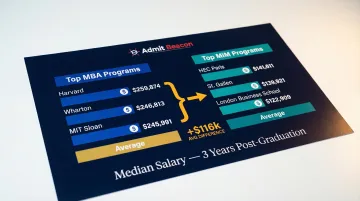
Salary Outcomes: According to Financial Times 2026 MBA ranking data, top US MBA graduates earn considerably more three years post-graduation:
- Harvard Business School: $259,874
- Wharton: $246,813
- MIT Sloan: $245,991
In contrast, top MiM graduates from the 2025 Financial Times ranking earn:
- HEC Paris: $141,611
- University of St Gallen: $139,921
- London Business School: $122,909
Curriculum & Admissions Requirements: Both degrees cover finance, strategy, marketing, operations, and analytics — but depth and application differ based on who each program is built for.
- MiM programs often waive GMAT/GRE for strong GPAs and accept zero work experience
- MBA programs at top schools require GMAT/GRE scores (averaging ~730) and expect 2–3 years minimum professional experience, with elite programs averaging 5+ years
What is an MBA?
The MBA is a generalist graduate business degree designed to sharpen strategic thinking, cross-functional leadership, and advanced business acumen. Harvard Business School established the world's first MBA program in 1908 to train general managers capable of leading large organizations. Today, it remains the dominant credential for senior business leadership in the US and globally.
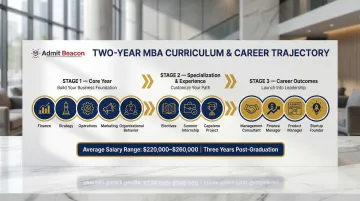
MBA Curriculum Structure
The typical MBA follows a structured format:
Core Year:
- Finance, strategy, operations, marketing, organizational behavior
- Taught using the case study method, placing students in leadership positions requiring time-sensitive decisions with limited information
Second Year:
- Elective specializations (consulting, entrepreneurship, finance, tech)
- Summer internships (critical for career pivots)
- Capstone projects
The MBA Student Profile
MBA students are seasoned professionals. According to GMAC Application Trends data, the typical full-time MBA applicant is aged 25–30 with 3–10 years of work experience. At elite M7 schools like Harvard Business School and Wharton, the average is 5+ years.
These professionals target senior roles, career pivots, or entrepreneurship. They bring real-world context to classroom discussions and case studies.
MBA Career Outcomes
MBA graduates are positioned for roles like:
- Management Consultant (Associate level)
- Finance Manager
- Product Manager
- Operations Director
- Startup Founder
The pay gap between MBA and MiM graduates widens considerably over time. At elite programs, MBA graduates report earning $100,000–$120,000 more annually by the three-year post-graduation mark — a differential driven by the seniority of roles MBA graduates typically enter.
Who is the MBA Best For?
The ideal MBA candidate has meaningful professional experience and wants to:
- Accelerate into senior leadership
- Change industries or functions
- Build a startup
- Gain access to a powerful alumni network
- Make a significant financial and time investment
What sets the MBA apart is what admissions consultants call the "triple jump": the ability to change location, industry, and function simultaneously. Few other credentials allow that kind of full-scope reinvention in a single move.
What is a Masters in Management (MiM)?
The MiM (also known as MSc in Management or Master of Science in Management/MSM) is a graduate business degree designed for early-career professionals or recent graduates who want to build foundational business and management knowledge before entering or advancing in the workforce.
European Dominance
The MiM is deeply rooted in European business education. According to the 2025 Financial Times Masters in Management ranking, 8 of the top 11 programs are European:
- University of St Gallen (Switzerland)
- HEC Paris (France)
- INSEAD (France)
- Nova (Portugal)
- ESCP (France)
- Stockholm School of Economics (Sweden)
- London Business School (UK)
- Essec (France)
MiM Curriculum
The MiM covers similar core subjects to the MBA — finance, strategy, marketing, HR, business analytics — but taught at an introductory-to-intermediate level without assuming prior work experience.
Typical Structure:
- 1 year full-time
- Core business fundamentals
- Internship module at the end
- Elective specializations available but less advanced than MBA electives
The MiM Student Profile
MiM students are recent undergraduates or professionals with 0–2 years of experience, typically aged 21–24. GMAC data shows over 50% of MiM applicants have zero work experience, and they come from a range of backgrounds — business, liberal arts, engineering, and science — all seeking a structured entry point into corporate careers.
MiM Career Outcomes
MiM graduates typically enter as:
- Business Analysts
- Associate Consultants
- Marketing Analysts
- Investment Banking Analysts
These are strong starting roles with clear upward mobility, especially in European markets. Salary data from the Financial Times MiM ranking shows top-program graduates earning $110,000–$141,000 three years post-graduation.
Who is the MiM Best For?
The ideal MiM candidate is:
- A recent graduate or early-career professional
- Someone wanting to enter management roles faster than peers
- A non-business undergraduate seeking business fundamentals
- A professional planning to build experience before pursuing an MBA
Many candidates follow a MiM-then-MBA path deliberately: the MiM builds business fundamentals early, and an MBA 4–6 years later accelerates into senior leadership. This sequencing makes strategic sense — going in the reverse order doesn't, since the MiM curriculum would offer little new ground after an MBA.
MBA vs Masters in Management: Which Should You Choose?
Both degrees can build strong careers — the right choice depends on where you are now and where you want to go. Four factors drive the decision: career stage, financial investment, geography, and long-term ambition.
Career Stage and Work Experience
Choose the MBA if:
- You have 3+ years of professional experience
- You've proven your competence in the workforce
- You want to pivot industries or functions
- You're targeting senior leadership roles
Choose the MiM if:
- You're a recent graduate or have 0–2 years of experience
- You want to enter the workforce with a competitive advantage
- You studied a non-business undergraduate subject
- You're planning to gain experience before an MBA later
Cost and ROI Comparison
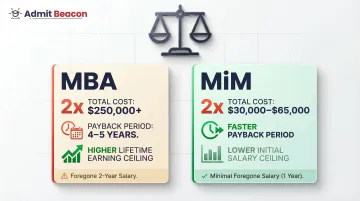
The MBA costs significantly more upfront, but the salary premium and access to senior roles can compress the ROI timeline for high-performing graduates from elite programs.
MBA ROI:
- Total cost: $250,000+ (tuition, fees, living expenses, foregone salary)
- Payback period: Approximately 4–5 years for top programs
- Higher lifetime earning ceiling
MiM ROI:
- Total cost: $30,000–$65,000 (tuition, fees, living expenses)
- Minimal foregone salary (1 year vs. 2 years)
- Faster payback but lower salary ceiling initially
Admissions Requirements as a Decision Filter
MiM Admissions:
- Strong undergraduate GPA
- GMAT/GRE often recommended but sometimes waived
- Limited work experience required
- Less competitive application process
MBA Admissions:
- GMAT/GRE scores required (averaging ~730 at top schools)
- Strong professional references
- Documented work experience
- Strategic, competitive application process
The MBA application is significantly more intensive, particularly at M7-level schools. Beyond a strong GMAT, candidates need a coherent career narrative, documented leadership impact, and a specific post-MBA goal. For applicants targeting top programs, a consultant like Admit Beacon — which limits client intake to build each application with strategy and depth — can make the difference between a generic submission and one that resonates.
Geographic and Industry Context
Choose the MBA if:
- Your goal is a career in the US
- You're targeting US-based leadership roles
- You want the most recognized credential globally
Choose the MiM if:
- Your goal is a career in Europe
- You want a globally-mobile career starting early
- You're targeting European markets where the MiM is well-regarded
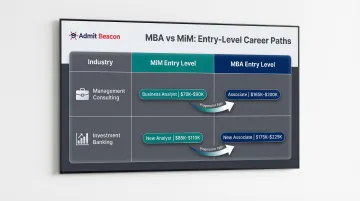
Specific industries (consulting, investment banking) have distinct hiring patterns:
| Industry | MiM Entry Level | MBA Entry Level |
|---|---|---|
| Management Consulting | Business Analyst | Associate |
| Investment Banking | New Analyst | New Associate |
Clear Situational Recommendations
Choose an MBA if you:
- Have 3+ years of experience
- Have a defined leadership or pivot goal
- Are ready to invest at the highest level
- Want access to the most powerful alumni networks
- Are targeting US-based senior roles
Choose a MiM if you:
- Are a recent graduate
- Want to start your career ahead of peers
- Are targeting European markets
- Plan to gain experience before returning for an MBA later
- Want a lower-cost, lower-risk entry into business
Conclusion
The MBA and MiM are not competing products but tools built for different career stages. The MiM is a career launchpad; the MBA is a career accelerator. Choosing between them comes down to where you are in your career, not which degree sounds more prestigious.
Assess your years of experience, target roles, geographic preferences, and financial readiness before deciding. For those pursuing the MBA route, the application process demands more than a strong profile — it requires a clear narrative, school-specific strategy, and the kind of preparation that separates admitted candidates from equally qualified ones who don't make the cut. That's exactly where working with an admissions consultant like Admit Beacon can make a measurable difference.
Frequently Asked Questions
Which is better: an MBA or a Masters in Management (MiM/MSc)?
Neither is universally better. The MBA suits mid-career professionals targeting senior leadership or career pivots, while the MiM is designed for recent graduates building foundational business skills. The best choice depends on work experience, career goals, and timeline.
Which pays more: an MBA or a Masters in Management (MiM/MSc)?
MBA graduates from top schools typically command higher salaries, particularly at the 3-year post-graduation mark, because they enter more senior roles. Top MBA graduates earn $220,000–$260,000 three years out, while top MiM graduates earn $110,000–$141,000. MiM graduates start at more junior levels but see strong returns.
What is the average salary after a Masters in Management (MiM)?
According to the 2025 Financial Times Masters in Management ranking, average salaries three years post-graduation range from $88,000 to $141,000 at top programs. Salary varies significantly by school ranking, industry, and geography.
Can I become a CEO without an MBA?
Yes. Many CEOs — especially in tech — never attended business school. That said, the MBA offers a structured path and network that accelerates leadership trajectories for those without a founder's origin story or an unconventional career behind them.
Are MBAs useful anymore?
Yes. The 2025 GMAC Corporate Recruiters Survey shows 90% of global employers plan to hire MBA talent in 2025. The network, credential, and career pivot potential the degree provides are hard to replicate elsewhere.
Will the MBA be replaced by AI?
No. While AI is transforming business functions, it is not replacing the MBA — it is reshaping what skills the MBA emphasizes. Top programs are integrating AI literacy, data analytics, and tech strategy into their curricula. The human elements of the MBA (leadership, network, negotiation, judgment) remain irreplaceable by automation.