Introduction
Most MBA applicants with strong GPAs and GMAT scores still get rejected — not because they can't write, but because their essays read like anyone else's. The difference between a passable essay and a compelling one is rarely writing skill. It comes down to strategy, self-awareness, and genuine alignment with a specific program.
Unlike test scores or transcripts, the essay is the one place you can speak in your own voice and show the admissions committee exactly why you belong in their cohort.
This guide covers what admissions committees actually look for, how to prepare before you write, actionable tips for crafting each major essay type, what makes essays stand out, and the common mistakes that cost strong candidates their spot.
Key Takeaways
- MBA essays help committees assess who you are beyond your resume; strategy matters as much as polish
- Preparation — story inventory, school research, career narrative — matters as much as the writing itself
- Every essay should answer: "Why you, why this program, why now?"
- Authenticity and specificity consistently outperform generic, polished responses
- Avoiding common pitfalls like template thinking, vague goals, and faux failures is just as critical as getting your story right
What Is an MBA Essay and Why Does It Matter?
An MBA essay (or personal statement) is a written component of your business school application that allows you to present your career goals, values, leadership experiences, and program fit—in your own words.
GMAT/GRE scores and GPA get you into the conversation. The essay determines who gets in. At the most competitive programs—Harvard, Stanford GSB, Wharton—most applicants are academically qualified. What separates them is how compellingly they tell their story.
Consider the numbers. For the Class of 2027, Harvard received 9,409 applications for just 943 enrolled spots. Stanford GSB's acceptance rate sits at just 8.4%, while Harvard's is 13.2%. When thousands of applicants carry similar credentials, the essay is where your candidacy either comes alive—or gets lost.
Main essay types you'll encounter:
- Career goals essays (short-term and long-term aspirations)
- Personal statement/values essays (what matters most to you)
- Behavioral/leadership essays (specific experiences demonstrating impact)
- School-fit or "Why MBA here?" essays (alignment with program culture)
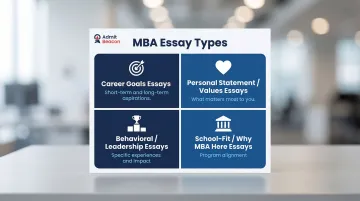
Most applications require two to three essays. Each one covers different ground—together, they build a complete picture of who you are and why this program, now.
What to Prepare Before You Start Writing
Most weak MBA essays share a common origin: the applicant started writing before they had anything clear to say. Two preparation steps make the difference between a focused, school-specific application and one that reads like a template.
Story Inventory and Career Narrative
Build a "story bank" before writing a single word. Document 8–10 professional and personal experiences that illustrate leadership, growth, failure, values, and impact. Then identify which stories are most distinct and transferable across multiple prompts.
Alongside your story bank, nail down your career narrative. Define your short-term post-MBA goal, long-term ambition, and the logical bridge from past experience to future aspiration. Vague goals like "I want to go into consulting or tech" are red flags for admissions committees.
School-Specific Research
Go beyond the course catalog. You need to understand each school's culture, values, teaching pedagogy, and student community to write a "Why this school?" response that doesn't read as copy-pasted boilerplate.
Effective research strategies:
- Connect with current students and alumni for authentic perspectives
- Attend information sessions and campus visits when possible
- Study each school's pedagogical approach (case method vs. lecture-based vs. experiential learning)
- Identify specific programs, clubs, or professors that align with your goals
If you're short on time, Admit Beacon's Knowledge Base covers the top 25 MBA programs in depth, and live webinars with current students give you the kind of school-specific insight that a website visit won't.
Tips for Writing a Winning MBA Program Essay
The actual writing process is where most candidates either differentiate themselves or blend into the pile. The following tips address the most impactful decisions you make at the draft stage.
Lead with a Specific Moment, Not a Summary
Show, don't tell. Rather than opening with "I have always been passionate about leadership," begin with a vivid, specific scene or decision that lets that quality emerge naturally.
Admissions readers review hundreds of essays. A concrete opening that places them in a moment is far more memorable than a generic claim. Avoid cramming too much biography into the opening paragraph—the goal is to hook the reader with a single, well-chosen moment that anchors the rest of the essay.
Answer the Real Question Behind the Prompt
Most essay prompts have a surface question and an underlying question. For example, "Describe a leadership experience" is really asking: "Are you self-aware enough to learn from setbacks, and do you understand how you affect others?"
Applicants who answer only the surface question produce safe but forgettable essays. Before drafting, ask what the school actually wants to learn about you from that prompt — then build your essay around that answer.
Write for This School, Not All Schools
School-specific tailoring is not cosmetic. Swapping a school's name in the last paragraph doesn't count. It means referencing specific programs, professors, clubs, or pedagogical features that connect to your stated goals and values. Admissions committees can identify a recycled essay immediately.
Align your essay with each school's culture and values. Whether that's Haas's "Question the Status Quo" or Tuck's emphasis on community, genuine research results in essays that feel like a natural fit rather than a generic submission.
Patricia Harrison, Director of Admissions at Tuck, puts it plainly: "The strongest essays are ones where the reader cannot simply replace the word 'Tuck' with any other school name without the essay losing its meaning."
Balance "I" with "We" in Leadership Essays
Behavioral essays, particularly around leadership, are a common trap. Applicants over-index on personal heroics when committees are looking for evidence of collaborative leadership, empathy, and the ability to make a team succeed. Shift the frame from "what I did" to "how I created an environment where we succeeded."
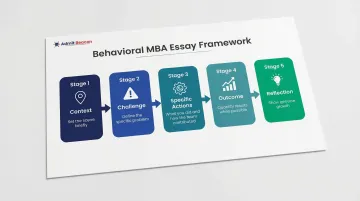
A clear structure keeps that collaborative framing intact from setup to reflection. Use this approach for behavioral essays:
- Context — set the scene briefly
- Challenge — explain the specific problem
- Specific actions — detail what you did (and how the team contributed)
- Outcome — quantify results when possible
- Reflection — show genuine growth, not a textbook lesson
Key Elements That Separate Great MBA Essays from Average Ones
Admissions readers can review 50 or more essays in a single day. What makes one stick is rarely polish — it's the specific, honest, human details that signal a real candidate behind the words.
Specificity Over Generality
Specificity is the single most reliable marker of a strong essay. Specific job titles, project names, quantified outcomes, named mentors, and precise decisions all signal authenticity and preparation.
Vague language like "I improved team performance" or "I developed strategic skills" reads as filler and wastes word count. Replace generalities with concrete details that only you could write.
Genuine Self-Awareness in Failure and Weakness Essays
Failure essays are among the most differentiating in the MBA application—and also among the most mishandled. The key is choosing a genuine failure with real stakes and showing credible reflection.
Avoid "faux failures" where you subtly frame a success as a setback (like "I'm too detail-oriented!"). Committees read these daily and see through it immediately.
INSEAD's guidance is definitive: "Don't sugarcoat the situation. Be honest about what went wrong, what you felt, and how you responded. A strong essay will demonstrate not only resilience but also humility and insight. Show that you're someone who doesn't just bounce back—you grow forward."
Close your failure essay by describing what you concretely changed in your behavior afterward—not a generic lesson, but a specific instance where you applied that learning.
A Consistent Narrative Thread Across the Application
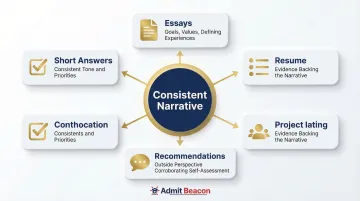
Top candidates treat the full application as a single coherent story rather than separate documents. Admissions committees read everything together. When your essays, recommenders, and resume all reinforce the same themes, the picture becomes far more compelling — and far more credible.
The components that need to align include:
- Essays — your goals, values, and defining experiences
- Resume — evidence that backs the narrative in your essays
- Recommendations — an outside perspective that corroborates your self-assessment
- Short answers — consistent tone and consistent priorities throughout
Authentic Voice, Not Polished Prose
The goal is not to write like a published author; it's to write in a voice that sounds genuinely like you. Overly formal, corporate, or thesaurus-heavy writing creates distance.
Stanford GSB explicitly warns: "Resist the urge to 'package' yourself into what you think Stanford wants to see. The most impressive essays are the most authentic." Similarly, HBS Managing Director Rupal Gadhia advises: "Be careful in all that refining that you don't edit out your personality. Be authentic and be yourself!"
Admissions officers repeatedly note that they're looking for the quality of thinking behind the essay, not literary skill.
School Fit Demonstrated Through Depth, Not Name-Dropping
Referencing a professor's research or a specific club is valuable when it connects meaningfully to your goals—but a list of program features without personal context reads as superficial.
The test is simple: "Does this reference explain why I specifically need this program to achieve my specific goals?" If you can't draw that direct connection, the reference doesn't belong.
The most persuasive "why this school" sections come from conversations — with current students, recent alumni, and professors — not from program websites. That on-the-ground perspective is what transforms a generic reference into a specific, credible one.
Common MBA Essay Mistakes to Avoid
Even applicants with strong profiles and well-constructed stories regularly undermine their applications through avoidable essay errors—most of which stem from predictable patterns.
Writing a Resume in Paragraph Form
One of the most common mistakes is using essay space to re-narrate your resume: listing accomplishments chronologically rather than telling a story.
The essay should add new dimensions to the application—revealing values, motivations, and self-awareness that numbers and bullet points cannot convey. Wharton's Director of Admissions Blair Mannix notes that a major pitfall occurs when "candidates rehash their resumes in list form instead of demonstrating effective synthesis in their writing."
If your essay could be summarized by reading your resume, it has failed its purpose.
Vague or Unrealistic Goals
Goals essays suffer when applicants either aim too low (signaling lack of ambition) or too high without grounding (signaling naivety). Goals need to be specific, logically connected to past experience, and credibly achievable within the MBA timeline.
Columbia Business School enforces this by restricting the "immediate post-MBA professional goal" to a strict 50-character maximum—forcing extreme precision. Well-calibrated goals show you've mapped a credible path, not just a wish list.
Using Templates or AI-Generated Content Without Adaptation
Copying sample essays or relying on AI-generated drafts produces essays that feel hollow. They lack the specific details, authentic voice, and school-specific nuance that committees are trained to identify.
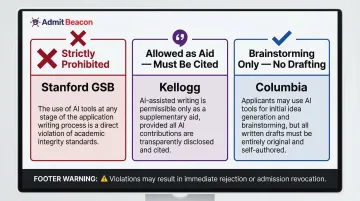
The AI policy landscape is highly fragmented. Stanford GSB strictly prohibits the use of AI tools for essay writing, while Kellogg allows AI as a "powerful aid" provided it is cited, and Columbia permits it for brainstorming but not drafting. Violating these policies can result in immediate rejection or revocation of admission.
Committees are evaluating the thinking behind the essay, not the polish of the prose. Every detail—the choice of story, the framing of goals, the tone relative to a specific school's culture—signals how well you understand yourself and the program. That's what no template can replicate.
Ignoring Word Limits and Over-Editing for Length
Submitting essays significantly over count signals poor judgment. Conversely, cutting so aggressively that the essay loses its narrative arc and specificity undermines its impact.
Treat the word limit as a design constraint that forces prioritization—every sentence should earn its place. Current-cycle limits vary significantly:
- Stanford GSB: 650 words (Essay A); 350 words (Essay B)
- HBS: 300 words (Essay 1); 250 words (Essays 2 & 3)
- Wharton: 50 words & 150 words (short-form); 350 words (long-form)
- Kellogg: 450 words per essay
Staying within limits demonstrates judgment and the ability to communicate concisely under constraints.
Frequently Asked Questions
What is an MBA essay?
An MBA essay is a written component of the business school application that allows applicants to present their goals, values, leadership experiences, and program fit in their own voice—giving admissions committees context that test scores and transcripts cannot provide.
Does an MBA application require an essay?
Most top MBA programs require at least one essay (and often two to three), covering career goals, personal values, or specific behavioral questions. Formats and word limits vary significantly by school, so check each program's specific requirements carefully.
How long should MBA essays be?
Word limits vary by program, typically ranging from 150 to 500 words per essay. Treat the stated limit as a firm ceiling—staying within it demonstrates judgment and the ability to communicate concisely under constraints.
How long does it take to write an MBA essay?
A well-crafted MBA essay requires multiple drafts over several weeks—the pre-writing phase alone (story inventory, school research) can take as long as the writing itself. Applicants targeting Round 1 deadlines should start 3–4 months out to allow time for reflection, drafting, and iteration.
Should you name drop in MBA essays?
Referencing specific professors, clubs, or programs is valuable when it authentically connects to your stated goals—but listing names without meaningful context reads as superficial. One well-explained connection to a specific resource or faculty member carries more weight than five names dropped without context.
What MBA admissions mistakes to avoid?
The most common mistakes to avoid:
- Rehashing your resume instead of adding narrative depth
- Setting vague or ungrounded post-MBA goals
- Using templated or AI-generated content without deep personalization
- Picking a "faux failure" that doesn't show real self-awareness
- Failing to tailor essays to each school's specific culture and values