

Introduction
Most professionals think of their career as a ladder to climb—a predictable sequence of promotions leading to the top. But for many ambitious professionals today, the reality looks more like a map: full of detours, pivots, lateral moves, and unexpected discoveries. If you've ever felt uncertain about whether you're "on track" or "falling behind," you're not alone. According to the Bureau of Labor Statistics, late baby boomers held an average of 12.9 jobs between ages 18 and 58—a clear signal that nonlinear careers are the norm, not the exception.
Navigating that map well takes a different mindset than climbing a ladder. It requires intentionality, resilience, and a willingness to reassess when circumstances shift. This guide covers what a career journey is, the key stages and path types you'll encounter, and concrete steps to plan your own.
TLDR:
- A career journey is the full arc of your professional life—roles, skills, pivots, and growth over time
- Modern careers cycle through five stages: Exploration, Establishment, Advancement, Transition, and Reinvention
- Four career path types (linear, specialist, lateral, entrepreneurial) help you identify your natural orientation
- Planning your path means combining self-assessment, skill-gap mapping, intentional networking, and regular review
- An MBA from a top program can accelerate a career pivot when the timing is right
What Is a Career Journey?
A career journey is the full arc of a professional life. It includes the jobs you've held, yes — but also the skills built along the way, the values tested under pressure, the pivots made when a path stopped fitting, and the growth that accumulates even when progress felt invisible. It's ongoing and rarely linear.
Career Path vs. Career Journey
The distinction between a "career path" and a "career journey" is worth understanding clearly. A career path is a planned, often linear sequence of roles within a specific field — think analyst to manager to director to VP in finance. A career journey is broader: it's the lived experience shaped by reflection, changing goals, unexpected opportunities, and deliberate repositioning.
Most modern professionals live the journey, not just the path. Career development experts now advocate replacing the "career path" metaphor—which implies visible, stable, and predictable progression—with a "career voyage" that intrinsically embeds unpredictability and continuous navigation.
Why the Journey Framing Matters
Thinking of your career as a journey rather than a rigid path encourages three critical mindsets:
- Intentionality: You make deliberate choices about direction rather than defaulting to whatever comes next
- Self-reflection: You regularly assess what's working, what's not, and why
- Resilience: When plans change, you reposition strategically rather than feeling "behind" or "off-track"
Your journey is context-dependent. A consultant pivoting to an operator role tells a different story than an engineer moving into product or a nonprofit leader pursuing an MBA to scale their impact. The through-line isn't the title sequence — it's the reasoning behind each move.
The 5 Stages of a Career Journey
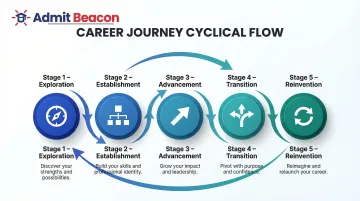
Career stages provide a useful framework for understanding where you are and what comes next. These aren't rigid or strictly sequential—professionals cycle through them multiple times, especially when pivoting industries or pursuing graduate education.
Exploration
The Exploration stage is your period of self-discovery. You're testing assumptions about what work actually suits you through:
- Informational interviews and job shadowing
- Internships or stretch assignments outside your comfort zone
- Researching industries, roles, and career trajectories
This stage isn't limited to college students—many mid-career professionals return to exploration when considering a major pivot.
Establishment
The Establishment stage covers your early-career years, focused on proving capability, building foundational skills, earning credibility, and identifying where you want to specialize or grow. This is also when many professionals encounter their first pivot moment: realizing the path they chose isn't quite right, or discovering new interests that pull them in unexpected directions.
Advancement
The Advancement stage is the mid-career phase of deepening expertise, taking on leadership responsibilities, and expanding your professional network. You begin defining a longer-term identity—not just a job title.
This is often when MBA consideration peaks. Professionals at this stage typically seek the credentials and peer networks needed to accelerate into senior or cross-functional roles.
Transition
The Transition stage is a deliberate inflection point—changing industries, pivoting functions, starting a venture, or pursuing further education. Transitions are not failures; they're strategic repositioning. A 2024 study in Management Science found that employees who make lateral moves across subfunctions have significantly higher chances of subsequent promotion and pay growth after 3 to 4 years.
Reinvention
The Reinvention stage is the reflection-driven reset that can happen at any career level. You're re-examining what fulfillment looks like, what legacy you want to build, and whether your current path still aligns with evolving goals. This stage often loops back to exploration—but this time, you bring a clearer sense of what you won't settle for.
What Are the 4 Types of Career Paths?
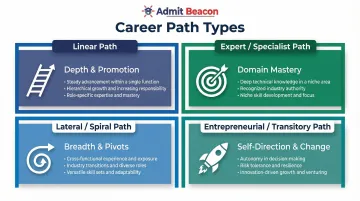
Understanding your natural career orientation helps you plan more strategically. Most professionals blend more than one type across their journey — and knowing where you lean shapes everything from which roles to pursue to how you frame your story for an MBA application or a new employer.
Linear Path
The linear path means steady upward progression within one field or function: analyst to manager to director to executive. It rewards deep expertise and patience, and suits professionals who find a domain they love early and want to master it.
Key characteristics:
- Builds credibility within a single organizational context over time
- Rewards long-term commitment and domain depth
- Best fit for professionals who prefer mastery over variety
Expert/Specialist Path
The expert path focuses on becoming a recognized authority in a narrow discipline. Think of a data scientist who becomes a thought leader, or a financial analyst who becomes a recognized domain expert. Unlike the linear path, the goal is depth rather than climbing the ladder.
Key characteristics:
- Prioritizes technical competence and quality over managerial scope
- Builds reputation through publications, speaking, or niche expertise
- Suits professionals who prefer influence through knowledge, not hierarchy
Lateral/Spiral Path
The lateral or spiral path involves deliberate sideways moves that build breadth: switching functions, industries, or geographies to develop a diverse skill set. Research shows this path often leads to senior general management roles because of the cross-functional perspective it builds. CEOs with general managerial skills gathered through diverse lifetime work experiences earn a 19% pay premium, nearly a million dollars in extra pay per year.
Key characteristics:
- Major moves into allied fields every 7–10 years
- Motivation driven by personal growth and creativity
- Competencies include skill diversity, teamwork, and lateral coordination
Entrepreneurial/Transitory Path
The entrepreneurial path is shaped by frequent change and self-direction. That might mean founding ventures, consulting independently, or moving between sectors driven by opportunity and curiosity. This path requires a strong personal narrative to connect the dots for future employers or investors.
Typical tenure in each role is just 3–5 years, with core competencies including speed, adaptability, fast learning, and networking.
How to Plan Your Own Career Journey
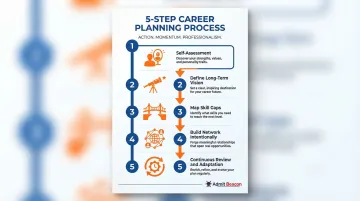
Planning your career journey isn't about predicting the future—it's about creating a flexible roadmap with clear short-term actions and directional long-term goals. Revisit your plan at least annually or after any major life or career event.
Step 1: Conduct an Honest Self-Assessment
Planning starts inward. Identify your core strengths, values, motivators, and non-negotiables.
Frameworks to use:
- List your technical and soft skills, rating each by proficiency and enjoyment
- Reflect on moments when you felt most energized and effective — what were you doing, and why did it land?
- Rank what matters most: autonomy, impact, prestige, work-life balance, financial security
Be brutally honest about what drains versus energizes you. A 2020 meta-analysis found that interest inventories have a 50.8% hit rate for predicting actual career choice, making them useful directional tools—but only if you answer honestly.
Step 2: Define Your Long-Term Vision (Even If It's Fuzzy)
You don't need a 20-year plan, but you do need a directional north star—a role, impact, or lifestyle you're working toward.
Try the "future self" visualization: Where do you want to be in 10 years, professionally and personally? The details can be hazy — direction matters more than precision. Your north star might look like:
- Leading a product organization at a scaling startup
- Moving from execution into strategy or general management
- Transitioning industries while maintaining hard-won expertise
Revisit this vision regularly. It will sharpen as you gain experience.
Step 3: Map the Skill and Experience Gaps
Compare your current capabilities to the requirements of your target role or stage, then identify what's missing.
Gaps may include:
- Certifications, technical training, or domain expertise you haven't yet built
- Leadership and communication skills that require deliberate practice
- Formative experiences: managing a team, cross-functional projects, P&L responsibility, or international exposure
Create a prioritized list. Which gaps are showstoppers versus nice-to-haves? Which can you address in your current role versus requiring a move?
Step 4: Build Your Network Intentionally
The people around you shape your trajectory as much as your skills do. Mentors, peers, sponsors, and industry communities open doors that individual effort alone won't.
Practical networking strategies:
- Reach out to people in roles you're targeting — informational interviews reveal what job descriptions don't
- Join professional associations for learning and peer connection
- Tap undergraduate and graduate alumni networks, which often respond faster than cold outreach
- Volunteer for boards or field committees to build visible credibility
Mentorship vs. Sponsorship: While mentoring improves psychological well-being, sponsorship—where a senior leader actively advocates for your advancement—is the critical driver for actual promotions, with sponsored employees promoted at nearly twice the rate.
Step 5: Commit to Continuous Review and Adaptation
A career plan is a living document. Set regular checkpoints every 6–12 months to assess progress, update goals, and adjust your approach.
Questions to ask during reviews:
- Am I building the skills and experiences I identified as priorities?
- Have my values or motivators shifted?
- Are there new opportunities I didn't anticipate?
- Do I need to accelerate, pivot, or double down?
Changing direction is not failure—it's the natural rhythm of a genuine career journey.
How an MBA Can Be a Strategic Step in Your Career Journey
The MBA is often the single most transformative lever at the Advancement or Transition stage. It builds leadership skills, expands networks exponentially, and signals a commitment to growth.
The Pivot Engine
Top MBA programs are explicitly designed to facilitate career transitions. At Wharton, 53.1% of the Class of 2025 changed both their industry and function, demonstrating the MBA's power as a deliberate career reset tool. At INSEAD, 65% of graduates changed their sector, country, or function.
The financial outcomes are substantial. Median base salaries for the Class of 2025 hit $185,000 at Harvard Business School, Wharton, and Stanford GSB, representing nearly double pre-MBA salaries for many graduates.
The Narrative Prerequisite
The most important prerequisite for a successful MBA application is a coherent career narrative. Top programs like Harvard Business School, Wharton, and Stanford GSB want to understand where you've been, where you're going, and why the MBA is the logical next chapter.
A fragmented or unclear career story is one of the most common reasons strong candidates are rejected. Admissions directors consistently cite "unclear career narratives" and "trying to say everything" as fatal application flaws.
Highly technical candidates often bury transferable leadership skills in jargon, obscuring what business schools actually seek: impact, influence, judgment, and collaboration. An MBA admissions consultant like Admit Beacon specializes in building exactly this kind of clear, connected story across your past experience, current role, and future goals.
Timing Matters
The MBA adds the most value when three conditions align:
- You have enough experience to contextualize the learning (typically 3–7 years)
- You have a clear direction you're accelerating toward
- There's a gap that classroom learning and the school's network can genuinely address
Median pre-MBA work experience at top programs is consistently 5 years.
Frequently Asked Questions
What is a career journey?
A career journey is the full arc of your professional life—encompassing roles held, skills developed, pivots made, and personal growth over time. It's ongoing, nonlinear, and uniquely personal, shaped by experience, reflection, and changing goals.
What are the 4 types of career paths?
The four types are:
- Linear — upward progression within one field
- Expert/Specialist — deep domain mastery over time
- Lateral/Spiral — breadth through sideways moves every 7–10 years
- Entrepreneurial/Transitory — self-directed, change-driven with 3–5 year tenures
How is a career journey different from a career path?
A career path is a planned sequence of roles, often within one field. A career journey is the broader lived experience—including the detours, pivots, lateral moves, and personal evolution that shape a professional life over time.
What are the 5 stages of a career journey?
The five stages are Exploration, Establishment, Advancement, Transition, and Reinvention—covering everything from early self-discovery to deliberate pivots and reflection-driven resets. Most professionals cycle through these stages multiple times rather than moving through them in order.
Can an MBA help with a career change?
An MBA from a top program is one of the most effective tools for a deliberate career pivot, providing new skills, a strong alumni network, and the credibility to enter new industries or functions. Success depends on having a clear post-MBA vision and showing how your past experience connects to your future goals.