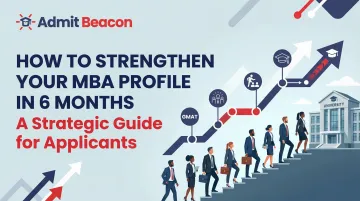
Introduction
Six months sounds like plenty of time. For most MBA applicants, it isn't — not because the work is impossible, but because they spend it unevenly. The components of a strong application are well known: GMAT scores, essays, recommendations, work experience.
The difference between admitted and waitlisted candidates often comes down to how deliberately those six months were used. Most applicants pour energy into test prep while leaving essays, recommender prep, and narrative development until the final weeks — exactly when pressure is highest and clarity is lowest.
This guide provides a structured 6-month action plan, outlines the key variables that shape outcomes, and identifies the most common mistakes that derail otherwise strong candidates. The stakes are high: median base salaries at HBS, Stanford, and Wharton hit $184,500 to $185,000 for the Class of 2025, and employer demand remains strong according to GMAC's 2025 Corporate Recruiters Survey.
Key Takeaways
- 6 months is enough to measurably strengthen most MBA profiles, provided you act with intention and target the right areas
- Start with a self-audit: compare your current profile against target school averages to identify your 2–3 most impactful improvement areas
- Profile-building means constructing a coherent career narrative—not just patching weaknesses
- The earlier you act in the 6-month window, the more options you create—some levers (GMAT, leadership roles) require time to move
Start Here: Assess Your MBA Profile Before You Build It
Conduct a Gap Analysis
Map your current metrics against published averages of your target programs. The data shows a highly condensed range of excellence across M7 schools: GPAs hover around 3.60–3.76, GMAT Focus scores average 670–690, and work experience is consistently around 5 years.
Latest M7 Class Profile Benchmarks (Class of 2027):
- Stanford GSB: 3.76 GPA (Avg), 689 GMAT Focus (Avg), 5.3 years experience
- Harvard Business School: 3.76 GPA (Avg), 685 GMAT Focus (Med), 4.9 years experience
- Wharton: 3.70 GPA (Avg), 676 GMAT Focus (Avg), 5.0 years experience
- Kellogg: 3.68 GPA (Avg), 687 GMAT Focus (Avg), 5.1 years experience
- MIT Sloan: 3.69 GPA (Med), 675 GMAT Focus (Med), 5.0 years experience
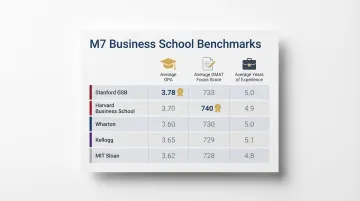
If your GPA sits at 3.3, you're significantly below the median at every M7 program. If your GMAT Focus score is 640, you're in the bottom quartile. Neither gap disqualifies you — but each requires a deliberate offset: stronger test scores, recent coursework, or a leadership narrative that commands attention.
Define Your Career Narrative First
Clarify your "why MBA, why now, why this school" arc before touching any application component. Every action in the next six months should ladder up to this story.
This is where working with a focused advisor pays off. Admit Beacon builds career narratives aligned to each school's specific ethos — not generic templates. One client described the process as helping them "connect the dots throughout my life, dig deeper into the past and narrate my motivations and aspirations in a cohesive manner."
Identify Your 2–3 Highest-Leverage Improvement Areas
Distinguish between what is genuinely improvable in six months and what needs to be contextualized rather than fixed. Some gaps have real solutions; others just need honest framing:
- Low GPA: Offset with a strong GMAT Focus score or an online course in a relevant quantitative subject
- Limited leadership: Create one concrete, quantifiable leadership outcome within the next 90 days
- Thin extracurriculars: Join or take a visible role in one initiative that connects to your post-MBA goals
Your 6-Month MBA Profile Strengthening Plan
Phase 1 (Months 1–2): Build Credibility Signals
Begin Structured GMAT or GRE Preparation
Take a diagnostic test first to establish a baseline. GMAC recommends two to three months of focused prep, and top scorers (89th+ percentile) consistently study over 90 hours total. For a 70–150+ point increase, Kaplan recommends 3–4 months at 8–12 hours per week.
The GRE is no longer an alternative test—it's a fully accepted option with zero bias. At Tuck, 54% of the Class of 2027 submitted GRE scores, while HBS and Stanford GSB both reported 44% GRE submission rates. If you're struggling with GMAT Focus, pivot to the GRE without hesitation.
Critical reality check: Do not rely on waivers. HBS, Stanford, Wharton, Columbia, and Booth explicitly state they do not offer GMAT/GRE waivers for standard applicants. Commit to test prep immediately.
Address GPA Concerns with Credibility Courses
If your undergraduate GPA is below 3.5, consider enrolling in a credibility-building course such as HBS CORe (Credential of Readiness) or a quantitative course through an accredited university extension program. While HBS admissions notes that CORe is "one of many application elements" and doesn't erase a low GPA, it signals academic readiness and quantitative capability.
Develop Your Career Narrative Framework
Create a working draft that connects past experience, current role constraints, and specific post-MBA goals. This narrative will anchor everything from essays to recommender conversations. Admit Beacon's process involves extensive discovery conversations, identifying threads that link different chapters of your journey, and ensuring the narrative feels intentional rather than random.
Phase 2 (Months 3–4): Create Visible Impact
Pursue One Concrete Leadership Opportunity
Admissions committees value demonstrated leadership at any level, not just titles. Stanford GSB explicitly states: "You do not need to hold a specific role nor reach a certain level or title to show leadership. We look for examples of when you have taken initiative, persisted through challenges, engaged others in your efforts, and supported those around you."
Actionable examples include:
- Leading a cross-functional initiative with measurable outcomes
- Formally mentoring a junior colleague and documenting their progression
- Owning a project outcome that can be quantified (revenue impact, time savings, error reduction)
Deepen School Research Beyond Website Reading
Attend virtual or in-person admissions events, connect with current students or alumni through LinkedIn or school forums, and note specific programs, clubs, or faculty whose work aligns with your goals. Admit Beacon maintains an extensive knowledge base covering the top 25 MBA programs and facilitates live webinars with current students and alumni to accelerate this research process.
Generic research reads as surface-level interest — and admissions committees notice. That groundwork also sets up your extracurricular narrative, which is where the next phase begins.

Begin Meaningful Extracurricular Engagement
Prioritize continuity and genuine involvement over adding new line items. If you have existing involvement, consider stepping into a more visible role. HBS notes that "your leadership impact may be most evident in extracurriculars, community initiatives, or your professional work."
Phase 3 (Months 5–6): Package and Position
Revise Your MBA Resume
Emphasize quantifiable impact, progression, and leadership. Each bullet should answer "so what?" with a metric or outcome. Top schools expect a one-page, action-oriented format that differs from standard professional resumes.
A strong MBA resume bullet follows this structure:
- Opens with an action verb (Led, Built, Reduced, Launched)
- Quantifies the outcome (%, $, headcount, timeframe)
- Signals scope or complexity where relevant
Draft Core Essays School-by-School
Each essay should connect your narrative to that school's specific ethos, not just mention the program name. Avoid the common trap of writing a universal essay and swapping in school names. As one Admit Beacon client noted, "their approach is far from templated; each narrative aligns with the ethos of the respective school while retaining authenticity."
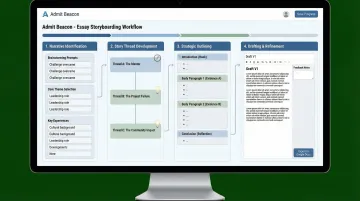
The essay storyboarding process involves identifying, organizing, and developing core narratives before drafting begins. This strategic approach ensures the essay's architecture is sound before any polishing occurs.
Prepare Your Recommenders Early
Choose people who have directly observed your impact. Give them your narrative, specific examples to draw on, and at least 6–8 weeks before the deadline. Generic, rushed letters rarely add value and can actively undermine otherwise strong applications.
Key Variables That Shape Your Admissions Outcome
Admissions decisions aren't made on a single factor. Four variables consistently determine whether an application clears the bar — and knowing how each one works lets you direct your energy where it counts.
GMAT or GRE Score
Scores serve as a proxy for academic readiness and factor into class-wide ranking. A below-average score isn't disqualifying, but it creates a risk that every other element of your application has to offset.
Middle-80% GMAT Focus ranges for admitted students:
- HBS: 645–735
- Kellogg: 630–770
- MIT Sloan: 645–735
Scores are also tied to scholarship eligibility at many schools. Tuck explicitly notes that a strong GMAT/GRE "may strengthen your position for competitive scholarship awards."
Career Trajectory and Leadership
Admissions committees want evidence of growth over time. A flat or unclear career trajectory is one of the most common reasons strong-on-paper candidates get rejected — title or employer prestige alone doesn't move the evaluation.
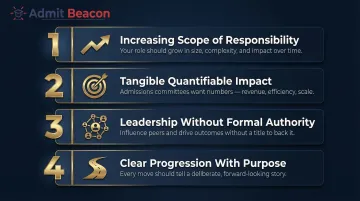
Specifically, adcoms look for:
- Increasing scope of responsibility across roles
- Tangible, quantifiable impact on teams or outcomes
- Leadership without formal authority (influencing peers, driving cross-functional work)
- Clear progression, not lateral moves without purpose
Wharton, for instance, evaluates "progression in job responsibilities, and total work experience" — not just the name of your employer. This is why the early phases of profile building focus on creating visible, narratable impact before applications open.
Narrative Coherence
A fragmented story — where career history, goals, and school choice don't logically connect — signals poor self-awareness. At top programs, that's a red flag that no amount of strong scores or recommendations can fully neutralize.
The narrative question every adcom asks is simple: Why this, why now, why here? If your application can't answer all three cleanly, the reader fills in the gaps themselves — usually not in your favor. Admit Beacon's approach focuses specifically on helping candidates connect past experiences to MBA goals and identify gaps in the narrative before schools do.
Demonstrated School Fit
Ranking alone doesn't make a fit argument. Adcoms want to see that you've engaged with their specific program — not just applied to its reputation.
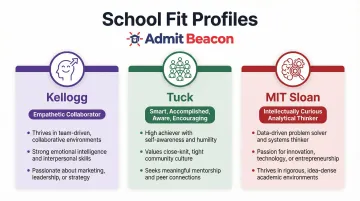
Candidates who reference faculty research, student clubs, or program formats they've actually explored come across as committed, not opportunistic. Each school screens for a distinct profile:
- Kellogg seeks "empathetic collaborators"
- Tuck screens for candidates who are "smart, accomplished, aware, and encouraging"
- MIT Sloan looks for "intellectually curious" applicants with "analytical strength"
Generic fit statements ("I love the collaborative culture") don't differentiate. Specific, firsthand engagement does.
Common Mistakes That Undermine MBA Profile Building
Starting Essays Before the Narrative Is Solid
Applicants who jump into essay drafts without a clear career arc end up rewriting multiple times, producing essays that read as descriptive rather than deliberate. Essay storyboarding needs to happen first — before a single draft line is written.
Treating GMAT as the Only Lever
Scores matter, but chasing an extra 10 GMAT points while neglecting leadership visibility, school research, and recommender preparation is a costly trade-off. Wharton explicitly states: "We do not use formulas or ranking systems, or give specific weight to individual sections of the application." Every application is read holistically by two people.
Leaving Recommenders Until the Last 4–6 Weeks
Recommenders need context, time, and specific talking points. Ambushing them with a deadline creates generic, rushed letters that rarely add value. The strongest letters come from recommenders who've had weeks — not days — to reflect on your specific contributions and frame them around your stated goals.
Generic School Research
Reading the admissions website and echoing program highlights in your essays signals surface-level interest. Tuck's admissions blog calls out this exact pattern — failing to show "conviction" and "genuine interest" in the specific program is one of the most cited reasons for rejection at competitive schools.
Avoiding these mistakes isn't about perfection. It's about starting earlier and being more deliberate than most applicants think necessary.
When 6 Months Is Enough—and When to Plan for More
Six months is a strong window if your test scores are already near your target range (within 20–30 points of the median) and your work experience is substantive—typically 3–5+ years. From there, the primary work is sharpening your narrative and application packaging.
You may need a longer runway if you are:
- Targeting a significant score improvement (more than 50–70 points on GMAT Focus)
- Lacking leadership examples that can be articulated clearly
- Making a career pivot that requires additional credibility signals such as coursework or new roles
Round timing matters regardless of where you are in the process. Wharton's admissions page explicitly warns that "space in the class becomes more limited for Round 3 applicants, resulting in a more competitive round." Target Round 1 (September) or Round 2 (January) to maximize your statistical odds.
Regardless of timeline, the quality of your plan matters more than its length. A focused 6-month sprint with a clear strategy will outperform an 18-month drift without one—so the next step is knowing exactly where to focus your effort.
Frequently Asked Questions
How can I strengthen my MBA application?
Five levers drive most profile improvements: test scores, leadership visibility, career narrative, school research, and application packaging. Strengthening even two or three of these in a focused six-month window meaningfully improves your competitiveness at top programs.
How long does it take to prepare for an MBA application?
Most competitive applicants spend 6–12 months preparing. Six months is sufficient for candidates with a strong foundation (test scores within range, clear work progression, identifiable leadership), while those needing significant score improvements or substantial profile building benefit from a longer runway.
How should I explain a low GPA in my MBA application?
Address it directly in the optional essay. Demonstrate academic ability through strong GMAT/GRE scores or recent coursework like HBS CORe. Upward GPA trends, difficult course loads, and strong quantitative performance all help frame the narrative.
Is a 3.3 GPA good for MBA admissions?
A 3.3 falls below the median at most M7 programs (which range from 3.60 to 3.76) but is not disqualifying. Course difficulty, an upward GPA trend, and strong quantitative performance all provide useful framing. A top-decile GMAT and compelling professional record can offset the gap.
Is an MBA still relevant in 2026?
Yes. GMAC's Corporate Recruiters Survey 2025 Report confirms that U.S. MBA graduates are expected to receive larger nominal and real starting salaries in 2025 compared to 2024. Top programs continue to produce strong post-MBA outcomes, particularly for those targeting leadership, strategy, consulting, or entrepreneurship roles.
Is 25 a good age to apply for an MBA?
25 is on the younger end — the average age at Wharton, Kellogg, and MIT Sloan is 28. It's viable if you have strong professional impact, clear goals, and at least 3 years of progressive work experience with demonstrated leadership.