Introduction
Many reapplicants operate from a dangerous assumption: that the second attempt is simply a better-polished version of the first. The instinct to refine the prose, tighten the resume, and resubmit is exactly what leads to the same result. A rejection from Harvard or Stanford doesn't mean your first application was poorly written. It means something structural didn't work, and until you identify what that something was, no amount of editing will change the outcome.
Successful reapplicants don't just improve their applications. They rebuild their candidacy from a genuine understanding of what went wrong the first time.
This guide covers four critical areas: diagnosing the real reason for rejection, making meaningful changes before reapplying, writing the reapplicant essay, and deciding on school list and timing. It's written for candidates targeting top MBA programs — M7 and beyond — who are serious about treating the second attempt as a strategic opportunity.
Key Takeaways
- Reapplying without diagnosing what actually failed nearly always produces the same outcome
- The four most common rejection causes: career goals misalignment, test score gaps, narrative weaknesses, and application execution problems
- Admissions committees want to see meaningful improvements, not cosmetic edits
- The reapplicant essay must demonstrate evidence of real growth, not reflection alone
- Most reapplicants benefit from waiting a full cycle rather than rushing into the next round
Why Top MBA Programs Welcome Reapplicants
Reapplying to a top MBA program doesn't signal weakness. Harvard Business School notes that approximately 10% of each MBA class includes individuals who previously applied, and that reapplicants have "no advantage or disadvantage" compared to first-time applicants. MIT Sloan goes further, stating that the acceptance rate for reapplicants is a few percentage points higher than their average. What admissions committees look for isn't persistence—it's evidence that something substantive has changed.
The survivorship bias in reapplicant success stories is real. The candidates who reapply and succeed are those willing to do the harder work of understanding their rejection and improving meaningfully.
Admissions committees admit reapplicants because the second application demonstrates genuine growth: a promotion with expanded scope, a test score that addresses an earlier signal problem, or goals that sharpened through real conversations with professionals in the target field.
There's a meaningful distinction between reapplying strategically and reapplying by default:
- Strategic reapplicants return because the program genuinely fits their goals and they've done the work to be ready.
- Default reapplicants return because it's the highest-ranked school that might still accept them.
Admissions readers make this call quickly. A second application built on real change reads differently than one that simply tries harder at the same pitch.
Diagnosing the Real Reason You Were Rejected
Most reapplicants skip true diagnosis. They re-read their essays, identify weaker passages, and begin rewriting—which edits the symptoms rather than diagnosing the cause. True diagnosis means following the rejection signal to something structural, even when it leads somewhere uncomfortable.
Career Goals Misalignment
Goals misalignment is the most common—and most underestimated—root cause at top programs. A former HBS Admissions Board director explicitly lists "scattered path or unconvincing goals" as a primary pillar of rejection, noting that applicants must "demonstrate that your professional path to date makes sense given your skills and passions and connect the dots to your future plans."
The issue isn't vague goals in general. It's goals that lack the specificity for an admissions reader to trace a logical path from your current role, through the MBA, to a concrete destination.
A candidate with strong test scores, an excellent GPA, and a prestigious employer can still be rejected due to an unrealistic career goal. The same candidate can succeed on reapplication with no other profile changes, simply by articulating a credible, specific post-MBA path.
Test Score Gaps
A score below program median doesn't just signal academic risk. It creates doubt that compounds across an otherwise strong application. The issue isn't intelligence. It's whether the score introduces a question the application can't overcome.
Current M7 medians provide context:
- HBS (Class of 2027): Median GMAT 730 (10th Edition), GRE 164 Verbal/164 Quantitative
- Wharton (Class of 2026): Average GMAT 732, GRE 163 Verbal/162 Quantitative
- Chicago Booth (Class of 2027): Median GMAT 730, GRE 163 Verbal/164 Quantitative
- MIT Sloan (Class of 2026): Median GMAT 730
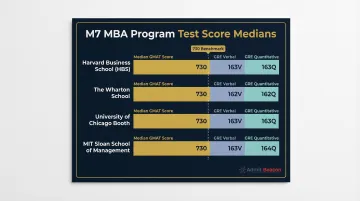
If your score falls meaningfully below these benchmarks, it almost certainly contributed to your rejection.
Narrative and Storytelling Gaps
A narrative gap differs from weak essays. The problem isn't clunky prose — it's that a reader couldn't follow the thread connecting your background, current role, MBA, and future goals.
Strong individual accomplishments without interpretive framing aren't self-evident. Without connective tissue tying them into a coherent story, they won't build a compelling case. Signs of a narrative gap include:
- No clear throughline from past experience to post-MBA goal
- Accomplishments that read as a list rather than a progression
- A "why MBA, why now" answer that could belong to any applicant
Application Execution Problems
Execution problems are the most visible failure mode and the ones reapplicants focus on most. They're fixable, but they're also the easiest to over-index on:
- Essays that describe experiences rather than reveal character or judgment
- Recommendations too generic to differentiate you from other strong candidates
- Resume that lists job responsibilities instead of communicating measurable impact
The danger is treating execution as the primary diagnosis. Polishing these elements matters, but if a structural issue (misaligned goals, a narrative gap, a score problem) is the actual cause of rejection, cleaner essays won't move the needle.
What to Actually Change Before You Reapply
A reapplication built on the same inputs produces the same output. The improvement phase is where the second attempt is actually won or lost. Work through this checklist before touching any application document.
Test Scores
If your score falls meaningfully below median for target programs, the default is to retake. The question isn't whether a retake looks bad (it doesn't, especially with improvement)—it's what a persistent low score signals in an otherwise strong profile.
Retake reality check:
- GMAC research shows the average gain on a second GMAT attempt is about 31 points
- Nearly 25% of retakers actually score lower the second time
- GRE repeaters gain an average of 26-27 points on Verbal and 23 points on Quantitative
Switching tests (GMAT vs. GRE) is a legitimate strategy when you've plateaued on one exam. All M7 schools explicitly state they have no preference between the two.
Career Goals and Narrative Clarity
If goals were the failure point, rewriting the goals essay is not the solution. The work has to happen in the thinking first—through real conversations with professionals in the target field, through informational interviews that force genuine commitment to a direction. Authentic, specific goals come from that process, not from better phrasing.
Once your direction is clear, the next question is whether your track record supports it.
Professional Achievements and Your Resume
The time between applications is an asset only if it's used with intention. A promotion with new scope, direct team leadership, or a measurable outcome now available to be cited are not just resume additions—they're evidence of trajectory, which is what top programs are actually evaluating.
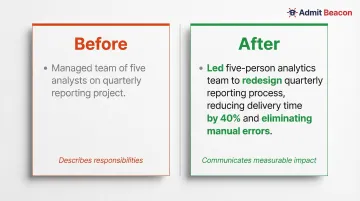
The shift from recording history to communicating impact:
- Before: "Managed team of five analysts on quarterly reporting project"
- After: "Led five-person analytics team to redesign quarterly reporting process, reducing delivery time by 40% and eliminating manual errors"
Recommendations
A weak recommendation rarely fails because something negative was said. It's weak because nothing specific was said. If previous recommenders wrote warmly but without concrete examples, either changing recommenders or substantially improving the briefing process is necessary.
Strong recommender selection:
- Someone with direct, recent, specific knowledge of your work
- Not necessarily the most senior person available
- Someone who can cite concrete examples of your impact, leadership, or growth
How to Write the MBA Reapplicant Essay
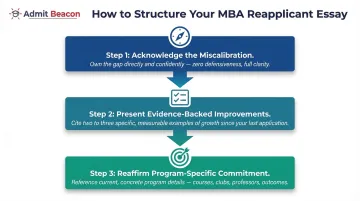
The reapplicant essay is not an opportunity to restate the original application or explain why the committee got it wrong. It's a reflection piece that must demonstrate three specific things: what has changed since the first application, what concrete improvements have been made, and why the commitment to this specific program remains grounded and current.
The single most common failure mode: abstraction. Statements about growth without evidence. Language about deepened self-awareness without examples. Specificity looks like this instead:
- A promotion with new scope and measurable outcomes
- A test score that corrects a signal problem
- Goals that sharpened through real conversations with professionals in the target field
Keep Your School Research Current
Restating why you wanted to attend a year ago is not the same as demonstrating that the commitment is still active and specific. The reapplicant essay must reflect engagement with the program as it exists now — current faculty, initiatives, concentrations, and community — not as it was understood at the time of the first application.
What Committees Are Actually Evaluating
Committees aren't just evaluating whether something changed — they're evaluating whether the candidate is genuinely different. Did the leadership assignment change how this person makes decisions under ambiguity? Did the goals shift reflect deeper professional maturity or just better research? The essay must show that updates represent real growth, not credential accumulation.
Structural framework:
- Name the prior miscalibration directly and without defensiveness
- Present two to three specific, evidence-backed improvements
- Reaffirm program-specific commitment with current, concrete details
One element no framework can fix is tone. Bitterness or grievance — even subtly worded — undermines everything else the essay accomplishes.
School List and Timing: Two Strategic Decisions
Same Schools or Different Programs?
If the issue was execution—essays that underdelivered, weak recommendations, poor resume framing—reapplying to the same schools with a materially stronger submission is a legitimate strategy. If the issue was structural fit—a score or GPA well below median, experience that didn't align with the program's typical profile, or goals that were incompatible with what the school delivers—a recalibrated school list is the more honest move. Answer this question after doing the diagnostic work, not before.
Reapplicants should generally add one or two programs to their list in addition to any schools they're returning to. A second cycle with no results puts you in a harder position. Adding schools that represent genuine fit—not just safety options—provides real alternatives.
When to Reapply
The most common timing mistake: reapplying too fast. The window between a Round 2 rejection and the following cycle's Round 1 deadline is typically four to five months. That's not enough time to retake a standardized test, earn a meaningful promotion, rebuild a goals framework, and construct a materially different application.
Candidates who try to do all of it on that timeline tend to produce a better-written version of the same application.
Round 1 versus Round 2 of the following cycle:
- Round 1 is stronger when there's genuine runway to make the application structurally different — MIT Sloan notes that more seats are available in both early rounds
- Round 2 is not a concession—for most reapplicants, it's the round where the improvements are actually complete
- The question to ask is not which round is stronger in the abstract, but which round gives enough time for the application to be fundamentally different from the one that was rejected
Frequently Asked Questions
Is it bad to be an MBA reapplicant?
Reapplicant status is not a disadvantage if the application demonstrates meaningful growth. Admissions committees evaluate reapplicants on the same criteria as first-time applicants, with added attention to what has specifically changed since the previous attempt.
How long should I wait before reapplying to an MBA program?
Most reapplicants return in the next admissions cycle (roughly one year after rejection). The right timeline depends on whether there has been enough time to make substantive improvements, not on racing to meet an earlier deadline.
What should I write in my MBA reapplicant essay?
The reapplicant essay should articulate what specifically changed: a promotion, an improved test score, or goals that sharpened through real engagement. It should also explain why your commitment to that specific program remains active and current.
Can I reapply if I was rejected without an interview?
A pre-interview rejection typically signals a gap in the written application (essays, resume, goals, or scores), all of which are addressable. Many candidates at top programs received pre-interview rejections in a prior cycle.
Should I apply to the same MBA programs or switch schools?
The decision depends on whether the original rejection was an execution problem (fixable with a stronger submission) or a structural profile mismatch, which may call for a revised school list.
How many times can you reapply to an MBA program?
Most programs allow multiple reapplications, but applying a third time without meaningful change rarely works in your favor. Candidates should verify individual school policies and ensure each reapplication represents a genuinely different candidacy.