This article isn't a collection of generic study tips. It's a strategic roadmap: from understanding what the GMAT Focus Edition actually tests, to section-specific tactics, to knowing precisely what score your target schools expect. Whether you're just starting prep or retaking after a disappointing result, the strategies here are designed to move the needle.
Key Takeaways
- The GMAT tests reasoning, not memory—grinding more questions without strategic review leads to diminishing returns
- Build foundational knowledge first, then layer in timed, high-difficulty practice
- Error analysis of wrong answers (and right ones) drives more improvement than volume alone
- Quant, Verbal, and Data Insights each require distinct prep strategies
- Anchor your prep to specific school medians, not generic round numbers
What the GMAT Actually Tests (and Why Most People Study It Wrong)
The GMAT Focus Edition measures executive reasoning—your ability to analyze data, prioritize under pressure, and solve unfamiliar problems. It's not a test of memorized formulas or vocabulary lists. The exam consists of three sections: Quantitative Reasoning (21 questions, 45 minutes), Verbal Reasoning (23 questions, 45 minutes), and Data Insights (20 questions, 45 minutes).
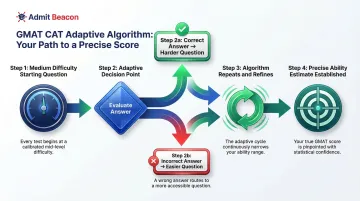
The test is computer-adaptive (CAT), meaning difficulty adjusts in real time based on your performance. The algorithm works like this:
- First question is medium difficulty
- Answer correctly → next question gets harder
- Answer incorrectly → next question gets easier
- This continues until the algorithm builds a precise estimate of your ability
Getting every question right is neither the goal nor expected. Even high scorers miss a significant percentage of questions. Harvard Business School reports a median GMAT Focus score of 685 for its Class of 2027—and those candidates still missed questions. The CAT adapts to challenge you at the upper edge of your ability, so occasional wrong answers are baked into the design.
The single biggest mistake? Treating the GMAT like a school exam. Test-takers memorize question types, plow through hundreds of problems, and hope pattern recognition will carry them through. It doesn't. The GMAT rewards reasoning through novel problems, not recalling memorized solutions. You must train your brain to think, not just recognize.
Build Your Knowledge Foundation Before Anything Else
Foundational knowledge—facts, formulas, grammar rules, and reasoning frameworks—drives GMAT performance. Even analytically strong thinkers will struggle to execute without it. Jumping straight to hard questions before locking in the basics almost always backfires.
Use a topic-by-topic approach:
- Master one topic completely before moving to the next (e.g., number properties, then rates, then geometry in Quant)
- Aim for a level where you cannot get foundational questions on that topic wrong—not "usually right," but consistently right
- Move systematically through each tested area rather than mixing question types randomly
Why easy and medium questions matter more than you think:
Missing foundational questions is more damaging than missing hard ones. The CAT algorithm uses Item Response Theory (IRT), meaning an item provides the most information when its difficulty matches your ability level. Dropping an "easy" question introduces significant measurement error and depresses your score more than missing a high-difficulty outlier. Speed matters here too—banking time on easier questions is what gives you room to work through harder problems later.
Three levels of proficiency:
- Knowledge - You understand a concept but apply it inconsistently
- Knowledge + Skill - You get questions right but slowly
- Knowledge + Skill + Speed - You get questions right efficiently and confidently

Your prep should aim for Level 3 on every tested topic.
Stick to one resource:
Using multiple prep resources simultaneously creates conflicting methods, coverage gaps, and confusion. Choose one well-structured resource and master it completely. A simple progress check: are you moving from Level 1 to Level 3 on each topic within a set timeframe? If not, the issue is likely execution, not the resource itself.
Practice Smarter, Not More: The Art of Deep Error Analysis
Most GMAT score improvement happens during review, not during the initial attempt. Plan to spend at least twice as long reviewing a problem as you spent solving it.
Four questions to ask after every wrong answer:
- Why is the wrong answer wrong? - Identify the specific flaw or trap
- Why was I tempted by it? - This reveals your vulnerability to GMAT traps
- Why is the right answer right? - Understand the logic completely
- Why did I overlook the right answer? - Pinpoint the gap in your process
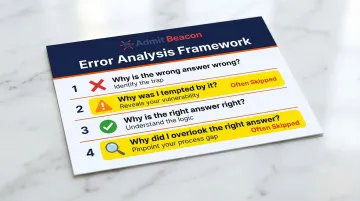
Questions 2 and 4 are the ones most people skip, yet they're often the most revealing.
Build a "Know the Code" Framework
Distill practice takeaways into reusable mental rules: "When I see X, I do Y." For example:
- "When I see 'differs by more than X%,' I check for absolute difference, not directional."
- "When a CR argument uses a survey, I look for sampling bias first."
This conditions you to recognize GMAT patterns on sight — rather than solving each question from scratch.
Separate Careless Errors from Knowledge Gaps
True careless mistakes are random — rushing, misreading once. But consistently missing the same question type signals a knowledge gap, not sloppiness. If the same mistake appears three times, it's a conceptual blind spot that needs targeted work, not more practice volume.
Keep an error log:
Track these three things for every error:
- Mistake type
- Underlying cause
- The rule or habit to prevent recurrence
As test day approaches, this log becomes your personalized study guide — focused entirely on your specific weak spots.
Section-Specific Strategies for Quant, Verbal, and Data Insights
Quant: Logic First, Calculation Second
GMAT Quant uses basic mathematical concepts to test logic and reasoning, not computational complexity. No calculator is allowed in this section, and the "clean" solutions the test rewards come from finding the elegant approach, not brute-force calculation.
Key tactics:
- Always work on scratch paper using the same tools available on test day
- Look for shortcuts and logical reasoning paths before calculating
- Recognize that if a calculation seems overly complex, you've likely missed a simpler approach
- Practice mental math and estimation to build speed on straightforward problems
Verbal: Treat Every Word as Intentional
Verbal precision carries across the entire GMAT, not just the RC section. Test-takers commonly misread qualifiers ("some" vs. "most"), morph meanings subtly, or overlook scope shifts.
Key tactics:
- Slow down and treat every word as intentional
- Pay special attention to qualifiers in Critical Reasoning arguments
- Watch for extreme language in answer choices (always, never, must, only)
- Re-read the question stem before selecting your answer to ensure you're answering what's actually asked
Data Insights: Read the Story, Then the Numbers
Quant builds your reasoning foundation; Data Insights asks you to apply it across multiple sources at once. This section tests how well you read and interpret tables, graphs, and text together—and an on-screen calculator is available here, unlike in Quant.
Key tactics:
- Read the question first to understand what the data is asking
- Prioritize understanding relationships and trends over crunching every number
- Use the calculator strategically, but don't let it slow you down
- Practice integrating information from tables, graphs, and text simultaneously
Timing Strategy and Test-Day Execution
Not every question deserves equal investment. The "executive ROI" approach means having a pre-defined "bail list" — specific question types or topic combinations where an immediate educated guess and moving on is the right call. Knowing when to cut your losses is a skill, not a shortcoming.
Timing Benchmarks
Practice untimed at first while building knowledge and skill, then gradually impose time constraints:
- Start at 3 minutes per question
- Progress to 2.5 minutes as competence increases
- Target 2 minutes per question for test-day readiness
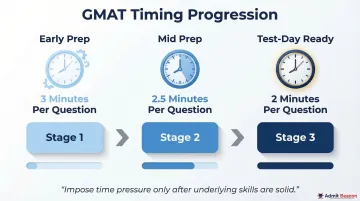
Timed pressure works best once the underlying skills are solid — imposing it too early just reinforces guessing habits.
The Question Review & Edit Feature
The GMAT Focus Edition allows you to bookmark questions and, if time remains after completing all questions in a section, review and edit up to three answers per section. This feature rewards disciplined pacing. Avoid over-investing time on single hard questions — you need time remaining to access the review screen. Use your three edits strategically to fix calculation or reading errors, not to second-guess correct responses.
Readiness-Based vs. Date-Based Scheduling
Take official full-length practice tests toward the end of preparation. Once you're consistently hitting your target score across multiple simulations, schedule the real test. Booking a date before that readiness is demonstrated adds unnecessary pressure and often leads to retakes.
Know Your Target Score—And What It Means for Your MBA Application
What does "good" look like on the GMAT Focus Edition? The global mean Total Score is 554.67, but that's far below what top-tier programs expect.
The Scoring Scale Has Shifted
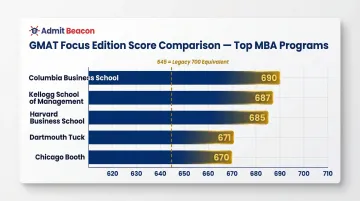
The GMAT Focus Edition uses a 205–805 scale. GMAC explicitly states that a 645 on the Focus Edition is equivalent to a 700 on the legacy scale, and the July 2025 concordance table places a 645 at the 86.7th percentile. In practical terms: 645 is the new 700, and your target should reflect that.
Where Top Programs Actually Land
Recent MBA classes report GMAT Focus scores clustering in the high-600s:
- Harvard Business School (Class of 2027): Median 685
- Columbia Business School (Entering 2025): Average 690, Range 615–805
- Kellogg (Class of 2027): Average 687
- Chicago Booth (Class of 2027): Average 670, Range 615–725
- Dartmouth Tuck (Class of 2027): Average 671, Range 595–775
Set a School-Specific Target, Not a Round Number
Aiming for the 80th percentile range of your target programs is a stronger goal than chasing a generic "700+." Score weighting varies by program and applicant pool, so look up the median for each school on your list and benchmark against that.
The Score Is the Starting Line
Once you've hit your target, the application itself—essays, recommendations, career narrative, school fit—becomes the deciding factor. That's where consultants like Admit Beacon come in, helping candidates turn a strong GMAT into a school-specific application that actually reflects who they are.
Frequently Asked Questions
How do I increase my GMAT score?
Focus on three pillars: build foundational knowledge topic-by-topic until you reach consistent accuracy and speed, analyze errors deeply rather than grinding through more questions, and apply section-specific strategies tailored to Quant, Verbal, and Data Insights.
Can I score 700 on the GMAT in 3 months?
Established prep firms indicate that a 50–100 point increase typically requires 100–170 hours of study over 2–3 months. A readiness-based approach—studying until you consistently hit your target on practice tests—is more reliable than committing to a fixed timeline.
How long does it take to prepare for the GMAT?
Most candidates need 2–6 months of structured study. A 30–50 point increase typically requires 80+ hours, while a 70–150+ point gain demands 100+ hours of focused preparation.
What GMAT score is considered good?
It depends on your target programs. Harvard's median is 685, Columbia's average is 690, and Kellogg's average is 687. Look up the median scores for your specific school list to set an appropriate target.
Is 645 the new 700 on the GMAT?
Yes. The GMAT Focus Edition uses a new 205–805 scoring scale, and scores are not directly comparable to the legacy 200–800 scale. GMAC's official concordance confirms that a 645 on the Focus Edition maps to a 700+ on the old scale, so context matters when benchmarking your performance.