Introduction
According to GMAC survey data, interviews account for 21% of the admissions decision for two-year MBA programs — edging out standardized test scores (20%) and undergraduate transcripts (18%). That makes the interview one of the highest-leverage moments in the entire application process.
Yet most candidates treat it like a casual conversation rather than a structured performance.
That performance gap is driven by preparation, not intelligence or credentials. Admissions officers explicitly cite "implausible pivots" and generic "Why this school?" answers as top reasons strong candidates are rejected post-interview. This guide walks through 11 actionable steps — before, during, and after the interview — that give candidates the best possible shot at top programs like HBS, Wharton, Stanford GSB, and others.
Key Takeaways
- MBA interviews test fit, self-awareness, and clarity of purpose, not just your resume
- Preparation covers three phases: before (research, narrative, practice), during (first impression, structured answers), and after (thank-you note, reflection)
- The "Why MBA?" and "Why this school?" questions are the highest-stakes elements: answer with specificity, not generalities
- Mock interviews are the single most effective preparation tool. Practicing out loud is non-negotiable.
- Logistics details like attire, timing, and materials carry more weight than most candidates expect
Before the Interview: Steps 1–7
Step 1: Research the School's Interview Format and Culture
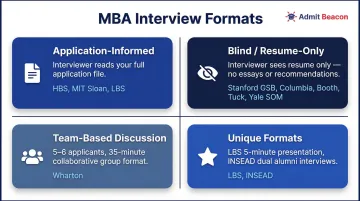
Not all MBA interviews are the same. HBS conducts application-informed interviews where interviewers scrutinize your entire file, while Stanford GSB uses blind (resume-only) formats. Wharton employs Team-Based Discussions (TBDs) with 5-6 applicants, Kellogg emphasizes culture fit, and others vary widely.
Key format differences across top programs:
- Application-informed interviews (HBS, MIT Sloan, LBS): Interviewers have read your essays and can reference specific claims—you must defend every detail without contradicting your written application
- Blind interviews (Stanford GSB, Columbia, Booth, Tuck, Yale SOM): Interviewers see only your resume—you'll need to introduce your core narrative from scratch
- Team-based formats (Wharton): You'll participate in a 35-minute group discussion with other applicants, testing collaboration and leadership in real-time
- Unique requirements: LBS includes an impromptu 5-minute presentation; INSEAD requires two separate 45-60 minute alumni interviews
Confirm which format applies to your target school and shape your preparation accordingly. For blind interviews, prepare a concise career narrative you can deliver in under two minutes. For application-informed interviews, review every essay claim and be ready to expand on specific examples.
Step 2: Know Your Application Essays Cold
Interviewers—especially adcom-conducted ones—may reference specific claims from your essays or resume. You must speak fluently and consistently about every example or story you submitted. Contradicting your written application signals dishonesty or lack of self-awareness.
Preparation checklist:
- Reread every essay you submitted 2-3 days before the interview
- Note specific examples, company names, metrics, and outcomes you cited
- Prepare to expand on each story with additional context not included in the essay
- Ensure your verbal answers reinforce and deepen what's on paper, never diverge from it
Think of the interview as a deeper conversation about what you already wrote — not a separate audition.
Step 3: Build Your Career Narrative—"Why MBA," "Why Now," and "Why This School"
These three questions form the backbone of nearly every MBA interview. Build a compelling, cohesive narrative that connects past experience → future goal → MBA as the logical bridge → specific reasons this school is the right fit.
The "implausible pivot" red flag:
Admissions officers explicitly cite implausible pivots as a top rejection reason. Transitioning from private equity to EdTech with zero demonstrated prior interest signals weak self-awareness. Apply this test: Would someone in your target industry actually hire you post-MBA based on your experience?
Nailing "Why this school":
Generic answers are rejection red flags. Admissions readers instantly spot surface-level research like "I want to attend because of your strong finance program and excellent reputation." Strong answers demonstrate deep engagement:
- Name specific courses and explain exactly why they matter to your growth
- Reference professors whose research aligns with your interests
- Identify clubs and explain how you'll contribute, not just participate
- Connect school culture to your values with concrete examples
This is where genuine school research pays off. Admit Beacon's network of alumni and current students can surface program-specific insights — the kind that don't appear on any admissions webpage — helping candidates build answers that feel informed rather than rehearsed.
Step 4: Prepare for Behavioral and School-Specific Questions
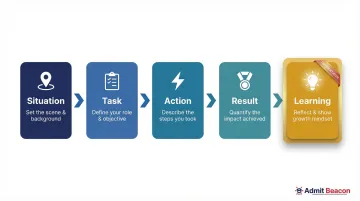
Top MBA programs rely heavily on behavioral questions, operating on the conviction that past performance is the best predictor of future behavior. The STAR method (Situation, Task, Action, Result) is explicitly endorsed by MIT CAPD and GMAC as the optimal framework.
Build your story bank:
Prepare 5-7 versatile STAR stories that can be adapted to questions about:
- Leadership: "Tell me about a time you influenced others without formal authority"
- Failure: "Describe a time when you had to overcome a failure"
- Teamwork: "Tell me about a time you worked on a team where there was conflict"
- Impact: "Tell me about a time you went above and beyond"
- Values: "Tell me about a time when your ethics were compromised. What did you do?"
Add the fifth component: Learning
After detailing Situation, Task, Action, and Result, reflect on what you learned and how it shaped your leadership style. This fifth element demonstrates self-awareness and coachability—qualities admissions committees explicitly value.
Step 5: Prepare Thoughtful Questions to Ask the Interviewer
Your story bank handles what they ask you. What you ask them matters just as much. Arriving without thoughtful questions — or defaulting to ones easily answered on the school's website — signals low engagement. Strong candidates prepare 3-5 specific questions reflecting genuine curiosity.
Strong question types:
- Questions about specific courses or clubs: "I'm interested in Professor X's course on behavioral economics. How have students applied those frameworks in internships?"
- Career outcomes in a particular industry: "What resources does the school offer for students pivoting from consulting to healthcare?"
- The interviewer's own MBA experience: "What surprised you most about the culture when you were a student?"
- Recent initiatives at the school: "I read about the new sustainability center. How are students getting involved?"
Avoid anything answerable with a five-minute website search — those questions signal you haven't done your homework.
Step 6: Practice Out Loud with Mock Interviews
Writing answers is not enough. Fluency, pacing, tone, and composure required for a real interview can only be built through repeated verbal practice. Candidates who only prep mentally consistently underperform.
Why mock interviews matter:
Mock interviews help you identify blind spots—talking too much, lacking structure, overusing jargon—that you're often unaware of. They provide a low-risk environment to practice articulating ideas under pressure and building executive presence.
Working with an experienced consultant provides structured, school-specific feedback that self-practice can't replicate. At Admit Beacon, Niketa personally conducts one mock interview with each candidate, offering candid feedback on delivery, authenticity, and how well the narrative lands under real questioning conditions.
Step 7: Prepare Your Logistics the Night Before
Small logistics details matter more than candidates expect. Confirm interview time and format (in-person vs. virtual), lay out professional attire appropriate for business school culture, test video/audio if virtual, prepare copies of your resume, and plan to arrive or log on 10-15 minutes early.
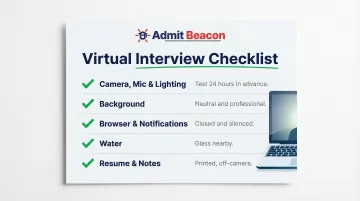
Virtual interview checklist:
- Test camera, microphone, and lighting 24 hours in advance
- Choose a neutral, professional background
- Close all browser tabs and silence notifications
- Have a glass of water nearby
- Keep a printed copy of your resume and notes out of camera view
During the Interview: Steps 8–10
Step 8: Make a Strong First Impression from the First Minute
Interviewers form early impressions quickly. Posture, eye contact, a confident introduction, and genuine warmth signal self-assurance and social intelligence—both of which MBA programs explicitly value.
Culture fit assessments begin before the first official question. Every interaction counts:
- Greet the receptionist with the same warmth you'd bring to the interviewer
- Stay composed and present during waiting room time
- Keep informal pre-interview chat professional and engaged
Step 9: Answer Every Question with Structure, Specificity, and a Clear Point
Avoid two common traps: rambling (giving a long story without a clear conclusion) and being too brief (answering without enough substance). The goal is answers that are focused, vivid, and memorable.
Specificity is what separates strong answers from forgettable ones. Interviewers hear hundreds of candidates — naming a real company, a real challenge, a real outcome, and a concrete lesson learned creates a lasting impression. Instead of saying "I led a team through a difficult project," say "I led a five-person team at Acme Corp to redesign our client onboarding process, reducing time-to-value from 45 days to 12 days and increasing customer satisfaction scores by 28%."
Step 10: Ask Your Questions and Listen Actively
Approach the question portion as a genuine two-way conversation. Listening carefully to what the interviewer shares and following up thoughtfully shows intellectual engagement and strong interpersonal skills.
If the interviewer mentions a particular club or initiative during the conversation, reference it when asking your questions. This demonstrates active listening and genuine interest.
After the Interview: Step 11
Step 11: Send a Thank You Note and Conduct an Honest Self-Review
Send a personalized thank you email within 24 hours. It should reference something specific from the conversation—not a generic template—and briefly reaffirm your enthusiasm for the program.
Debrief While It's Fresh
A quick self-review after the interview sharpens your performance in future rounds:
- Note which questions felt strong and which felt weak
- Identify what you would answer differently
- Refine any STAR story you stumbled on before your next interview
Beyond the thank you note, some schools have post-interview requirements that catch applicants off guard. Some schools require additional submissions. HBS requires a 300-450 word Post-Interview Reflection within 24 hours, acting as a final case to the admissions committee. MIT Sloan requires a data visualization slide submitted 24 hours before the interview. Check your target school's specific requirements.
What Makes or Breaks an MBA Interview
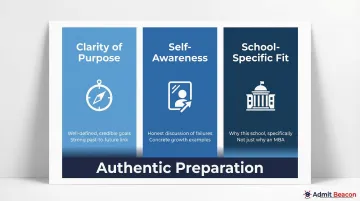
Beyond preparation mechanics, three factors disproportionately determine outcomes:
- Clarity of purpose — Are your goals well-defined and credible? The informal test admissions officers apply: would someone in your target industry actually hire you post-MBA based on your experience? Vague goals or a weak link between past and future suggest a lack of self-reflection.
- Self-awareness — Can you discuss failures and weaknesses honestly, without deflecting? Strong candidates recognize their mistakes and demonstrate how they've grown. Rather than claiming "perfectionism" as a weakness, acknowledge a real challenge — say, struggling to delegate — and explain the concrete steps you took to improve.
- School-specific fit — Can you articulate why this school, not just why an MBA? Admissions committees want candidates who genuinely align with the school's values and culture, not those delivering rehearsed answers robotically.
MBA interviews test authenticity more aggressively than most job interviews do. Admissions officers use curveball questions and deep follow-up probes specifically to break scripted responses. Interviewers can tell the difference between a well-prepared candidate and a rehearsed one — the former thinks on their feet; the latter stalls when the script runs out.
Common MBA Interview Mistakes to Avoid
Even well-prepared candidates can derail strong applications with avoidable errors. Watch out for these five:
- Generic "Why this school?" answers that could apply to any top program — adcom interviewers flag this as a clear signal of weak research
- Over-scripted responses that sound rehearsed; interviewers are trained to probe beyond memorized answers, so story-based preparation beats rote recitation
- Weak connection between past experience and future goals — vague career direction signals a lack of self-reflection, not ambition
- Generic post-interview thank-you notes that add nothing to the conversation and miss a chance to reinforce your candidacy
- Talking too fast or too long without checking whether the interviewer is following your narrative
Frequently Asked Questions
What are the best ways to prepare for an MBA interview?
Research the school's specific interview format, build a clear career narrative connecting past experience to future goals, prepare STAR-method stories for behavioral questions, and practice out loud with mock interviews. Verbal practice is non-negotiable—writing answers isn't enough.
What are the most common MBA interview questions?
Core categories include "Why MBA / Why now / Why this school," behavioral questions about leadership and failure, and "Walk me through your resume" or "Tell me about yourself." Prepare flexible stories that can be adapted to multiple prompts within each category.
How should I answer questions about my strengths and weaknesses?
Choose genuine examples and use a specific story to illustrate strengths. Frame weaknesses with honest self-awareness and a clear description of how you're actively working to improve. Avoid clichés like "I'm a perfectionist"—admissions officers see through these immediately.
What is the best way to answer "Tell me about yourself"?
Deliver a concise career narrative—briefly covering professional background, a key achievement, what's driving the MBA decision, and why this school—in under two minutes. Practice until the delivery feels conversational, not rehearsed.
What are common interview mistakes to avoid?
Generic school-specific answers, memorized-sounding responses, vague career goals, and failure to send a personalized thank you note. Also avoid contradicting your written application or failing to demonstrate self-awareness when discussing failures or weaknesses.
What questions should I ask the interviewer?
Prepare 3-5 specific, research-backed questions about the school's programs, culture, or career outcomes. Avoid questions easily answered on the school's website.
Ready to prepare for your MBA interview with personalized guidance? Admit Beacon offers mock interview preparation with Niketa, who works directly with each candidate on narrative, delivery, and school-specific strategy. Contact us at hello@admitbeacon.com to learn more.