Introduction
Most candidates spend hours researching interview questions but very little time actually practicing answering them out loud. That gap is the single biggest reason people underperform — especially in high-stakes MBA admissions interviews at schools like Harvard Business School, Stanford GSB, and Wharton.
Practicing for interviews is not the same as preparing for them. Results vary widely based on method, feedback quality, and how closely practice simulates the real thing.
Research shows that active verbal retrieval yields a high effect size (0.70) compared to silent reading (0.51) — meaning speaking answers aloud creates different cognitive demands than mental rehearsal alone.
This guide covers:
- What to prepare before your first practice session
- A repeatable step-by-step practice process
- The variables that determine whether practice actually improves performance
- The most common mistakes candidates make
Key Takeaways
- Interview practice only works if it involves speaking answers aloud—not just thinking through them silently
- Build a story bank of 8–10 concrete examples before practicing so you're not improvising structure under pressure
- Real conditions—time limits, unfamiliar questions, a live listener—produce better results than solo silent rehearsal
- The quality of feedback matters more than the quantity of repetitions—generic encouragement from friends is far less useful than specific, critical input
- MBA interviews require school-specific prep—knowing each program's culture and what it's really assessing—yet most candidates skip this entirely
What to Prepare Before You Start Practicing
Candidates who skip preparation and jump straight into practice end up drilling weak or unfocused answers. Preparation defines the ceiling of what practice can achieve.
Know Your Interview Format and Evaluation Criteria
Research whether the interview is behavioral, conversational, case-based, or a combination, and identify the core competencies being assessed—leadership, self-awareness, career clarity, or problem-solving.
MBA admissions interviews vary dramatically by school:
- Harvard Business School: 30-minute non-blind interview with full application access, followed by a mandatory 24-hour written reflection
- Wharton: 35-minute Team-Based Discussion with 5-6 applicants, plus a 10-minute one-on-one reflection session
- Stanford GSB: 45-60 minute blind interview (resume only) focusing on how you think, lead, and see the world
- MIT Sloan: 30-60 minute non-blind interview requiring pre-interview data visualization or short answer
- London Business School: 60-90 minute blind interview including a 5-minute impromptu presentation on a randomized topic
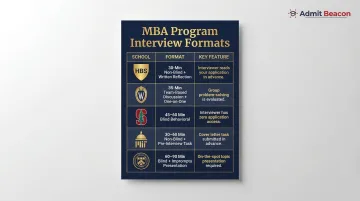
These format differences matter. A candidate ready for Stanford's 60-minute blind behavioral interview will still struggle in HBS's rapid-fire, non-blind format without adjusting their strategy.
Build a Story Bank Using the SAR Framework
Before practicing, compile 8–10 real examples from your professional, academic, or leadership experience. Structure each story around:
- Situation (20%): Set the scene briefly — one or two sentences of context
- Action (60%): Describe what you specifically did, not what "we" accomplished
- Result (20%): Quantify the outcome and reflect on what you learned
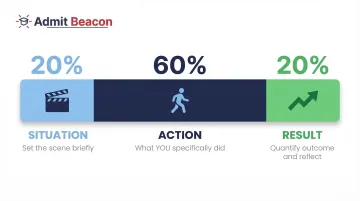
Having these stories ready prevents generic, abstract answers during practice sessions. SAR (also called STAR) is universally endorsed by top MBA career centers, with experts recommending 4–8 adaptable narratives covering leadership, teamwork/conflict, failure, and impact.
Develop Your Core Career Narrative
For MBA applicants specifically, clarify your "Why MBA, Why Now, Why This School" story before drilling individual answers. Practicing without this narrative anchor leads to inconsistent, disconnected responses.
Generic praise fails in these answers. Strong responses cite specific resources—a particular professor, a specialized lab, a niche club—and connect them directly to your career goals. Understanding what each program genuinely values before you rehearse is the difference between a polished answer and a persuasive one. Admit Beacon's school-specific Knowledge Base and connections to current students can help you get that clarity early.
Prepare Your Questions for the Interviewer
Draft 3–5 thoughtful questions to ask at the close of the interview. These reveal genuine curiosity and school fit. Practicing these questions aloud is often overlooked but matters—your delivery, tone, and follow-up responses are part of the evaluative impression.
Strong closing questions typically fall into one of these categories:
- Program-specific (a course, club, or initiative you've researched)
- Career path–focused (how alumni in your target industry used the degree)
- Culture-driven (what surprised current students most about the community)
- Forward-looking (how the program is evolving in your field of interest)
Rehearse these out loud. Your delivery and follow-up responses leave a lasting impression.
How to Practice for Interviews: A Step-by-Step Approach
The order of these steps matters. Skipping or reordering them reduces the effectiveness of each subsequent step.
Step 1: Answer Out Loud, Not in Your Head
The cognitive load of real-time verbal delivery is what practice is designed to build. Mental rehearsal alone does not replicate it. Speaking aloud boosts memory retention by 10% to 25% compared to reading silently, creating a highly distinctive memory trace.
How to do it:
- Set a 2–3 minute timer per question
- Speak your full answer aloud without pausing or restarting
- Record every practice session (audio or video) rather than relying on memory
Most candidates are surprised by how different their delivery sounds compared to how it felt internally. Recording captures filler words, pacing issues, and structural gaps you can't perceive in real time.
Step 2: Repeat Each Answer Multiple Times Before Moving On
Answer the same question five times in succession, refining structure and language with each attempt. The "5-rep method" lets answers evolve naturally rather than becoming over-scripted. Fluency is the goal, not memorization.
Most candidates practice a question once and move on, leaving answers in rough, unpolished form. Research on spaced repetition shows that distributed practice significantly improves long-term retention compared to cramming — so repetition across sessions compounds the benefit.
Step 3: Introduce Unfamiliar Questions to Test Adaptability
After drilling core questions, shift to practicing with unexpected or reworded ones. True preparedness means pivoting a practiced story to fit a question you've never seen before — interviewers frequently use novel phrasing to test adaptability and surface unscripted honesty.
Building this flexibility starts with exposure to a wide range of questions. Good sources include:
Curated question banks:
- MBA program websites (many publish sample questions)
- Poets&Quants' school-by-school interview question database
- Admissions consulting firms' question banks
- Alumni interview debrief forums
Step 4: Conduct Full Mock Interviews Under Realistic Conditions
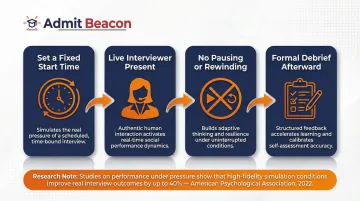
A realistic mock interview includes:
- A set start time (not "whenever you're ready")
- A live interviewer (not a friend reading from a screen passively)
- No pausing or rewinding
- A formal debrief afterward
These conditions activate performance pressure, which is exactly what needs to be rehearsed. Research shows that practicing under conditions that raise self-consciousness — such as video recording — eliminates performance decrements under pressure. Standard single-task practice, by contrast, leaves candidates vulnerable to choking.
Timing recommendations:
- Conduct at least one mock interview early to identify structural gaps
- Conduct a second mock interview close to the interview date to simulate final readiness
- For high-stakes MBA admissions, Admit Beacon's consulting packages include a structured mock interview session designed specifically for admissions contexts, personally conducted by founder Niketa Desai
Key Factors That Determine Whether Practice Actually Works
Two candidates can practice the same number of hours and get dramatically different results. The difference comes down to these variables.
Feedback Quality
The most critical variable is the quality of feedback received after each practice attempt. Feedback that only says "that was great" or "maybe slow down a bit" does not improve performance.
Useful feedback:
- Names specific structural weaknesses (e.g., "Your 'Action' phase was too brief—you spent 80% on context")
- Identifies which part of the SAR answer was missing or underdeveloped
- Suggests concrete language adjustments (e.g., "Replace 'we decided' with 'I proposed'")
- Points out delivery habits you can't perceive (filler words, pacing, eye contact)
The Dunning-Kruger effect reveals that bottom-quartile performers drastically overestimate their performance due to a lack of metacognitive monitoring skills, making self-assessment of interview delivery highly unreliable. External feedback gives you an accurate picture of what the interviewer actually sees—not what you think you're projecting.
Simulation Realism
Good feedback only helps if you're practicing under the right conditions. A casual, low-stakes setup—lying on a couch, pausing mid-answer, restarting freely—trains the wrong habits. The closer your simulation matches the actual interview (formal posture, uninterrupted delivery, a real listener), the more directly practice transfers to performance.
Elements of realistic simulation:
- Sit at a desk in interview-appropriate posture
- Use video recording to capture delivery
- Answer questions with no pausing or restarting
- Follow each session with a structured debrief using the recording
Spaced Practice vs. Cramming
Realistic simulation conditions also depend on when you practice, not just how. Spacing sessions across 2–3 weeks builds durable recall and smoother delivery. Cramming all preparation into the 48 hours before an interview produces rehearsed rigidity that can collapse under unexpected questions.
Distributed practice significantly outperforms massed practice. For a high-stakes interview 2–3 weeks away, candidates should use a spaced repetition schedule—practicing answers at expanding intervals rather than massing them into a single weekend.
Self-Awareness of Delivery Habits
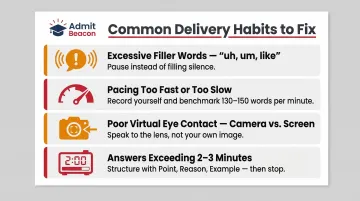
Verbal habits—filler words, pacing that is too fast, answers that run over time—are invisible to the speaker but obvious to the listener. Reviewing recordings specifically to identify these habits (rather than to evaluate content) is a separate and necessary practice task.
Common delivery issues:
- Excessive filler words ("uh," "um," "like")
- Pacing too fast or too slow
- Poor virtual eye contact (looking at your own image instead of the camera)
- Answers that exceed the recommended 2–3 minute length
Common Mistakes to Avoid When Practicing for Interviews
Most practice failures are not about effort—they come from practicing in ways that reinforce bad habits rather than correcting them.
Over-Scripting Answers Word for Word
Memorizing a fixed script creates two problems: the answer sounds rehearsed and inauthentic to the interviewer, and any unexpected follow-up question can derail the entire response. The goal is to internalize the structure and the key points, not the exact phrasing.
The difference:
- Scripted: Memorized word-for-word; collapses under follow-up questions
- Structured: Key points and story arc internalized; flexible under pressure
Practicing Only With People Who Won't Give Critical Feedback
Friends and family tend to give encouraging, non-specific feedback that feels supportive but won't surface the gaps an admissions interviewer or hiring manager would notice. Structured feedback from someone familiar with what strong answers actually look like—an admissions consultant, career coach, or alumni interviewer—is far more useful.
If that level of feedback isn't available, at minimum record yourself and self-evaluate against a clear rubric.
Ignoring Non-Verbal and Vocal Delivery
Candidates often focus entirely on what they say and ignore how they say it. Tone, pacing, eye contact (in video interviews), and confident pausing all shape how interviewers perceive you—and most candidates never practice these separately from content.
Delivery elements to practice:
- Vocal variety (avoiding monotone delivery)
- Appropriate pausing for emphasis
- Confident body language and posture
- Eye contact with the camera (not the screen)
Practice Methods: Choosing the Right Format for Your Stage
The right practice method depends on where you are in your preparation. Early-stage candidates need content development, while late-stage candidates need simulation and feedback.
Solo Practice With AI Tools or Recordings
Solo practice is the entry point. Record yourself on your phone or use AI interview tools to get baseline feedback on delivery, filler words, and pacing. This is most useful for early-stage content refinement, not final simulation.
AI-powered tools for solo practice:
| Tool | Cost | What It Does |
|---|---|---|
| Google Interview Warmup | Free | Transcribes answers and detects job-related terms; does not grade responses |
| Big Interview | Paid | VideoAI feedback on pacing, filler words, vocabulary, and tone |
| Yoodli | Paid | Real-time feedback on pacing and conciseness; AI asks dynamic follow-up questions |
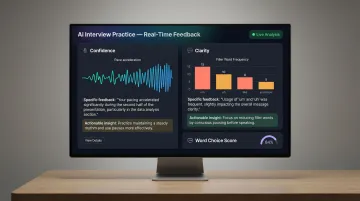
AI tools are highly effective for diagnosing mechanical delivery flaws during solo practice, but they cannot replace human mock interviews for evaluating the strategic nuance and cultural fit required by top MBA programs.
Peer Mock Interviews
Once you've refined your delivery mechanics, peer practice moves you closer to real conditions. Mutual peer practice — where both participants take turns interviewing each other — introduces the live-listener dynamic and builds comfort with real-time delivery. The limitation is that peers rarely know what strong answers look like from an evaluator's perspective, so feedback may be encouraging but not calibrated to actual standards.
Professional Mock Interviews
Working with a professional who has direct experience in the admissions or hiring process produces the most targeted feedback. For MBA applicants, this means someone who understands how top programs evaluate candidates. This is the highest-ROI investment for high-stakes interviews where the outcome carries significant career and financial weight.
Admit Beacon's consulting packages include mock interview preparation conducted personally by founder Niketa Desai, who brings direct admissions expertise to every session.
Frequently Asked Questions
What are the 10 best interview questions?
The most important questions to practice include "Tell me about yourself," behavioral prompts like "Describe a time you led through adversity" or "Tell me about a conflict with a team member," goal-oriented questions like "Why MBA, Why Now, Why This School," and reflection questions like "Tell me about a time you failed."
What are good 3 weaknesses to say in an interview?
Pick a genuine developmental area — not a thinly veiled strength like "I work too hard" — show self-awareness about its impact, and describe specific steps you are taking to improve. Concrete, recent progress matters more than a polished-sounding answer.
How many times should you practice before an interview?
Most candidates benefit from answering each core question at least five times across multiple sessions spaced over 2–3 weeks, with at least one full mock interview close to the actual date. Spreading practice over time builds genuine recall and natural delivery — rather than answers that sound memorized.
How do I practice for a behavioral interview?
Start by building a story bank of 8–10 STAR examples, then drill them aloud with a timer. Finally, test those same stories against differently worded questions — this builds flexible recall so you can adapt on the fly rather than reciting a script.
What is the best way to simulate an interview at home?
Set a fixed start time, sit at a desk in interview-appropriate posture, use video recording to capture delivery, answer questions with no pausing or restarting, and follow each session with a structured debrief using the recording. This simulates the performance pressure of the real interview.
How do I prepare specifically for an MBA admissions interview?
Beyond general prep, MBA interviews demand a clear career narrative (why MBA, why now, why this school), deep knowledge of each program's culture and values, and at least one practice session with someone familiar with how admissions committees assess fit. Generic interview coaching rarely covers all three.
Conclusion
Practicing for interviews works only when it is active, spoken, and simulated under realistic conditions. Preparation quality—story bank, narrative clarity, school research—sets the ceiling for how effective any amount of practice can be.
The most common failure is not lack of effort but lack of feedback quality and simulation realism. Both are within a candidate's control before interview day.
For high-stakes interviews like MBA admissions, the investment in structured, guided practice—rather than unguided repetition without honest feedback—is what matters most. At Admit Beacon, mock interviews are built into the consulting process precisely because preparation without accountability rarely closes the gap. Candidates who treat practice as a structured process—with feedback, iteration, and real simulation—are the ones who show up ready.