This guide cuts through the uncertainty by examining what the available data suggests, how UChicago's waitlist process actually works, what the admissions committee looks for in waitlisted candidates, and exactly what steps you can take to maximize your chances of admission. UChicago's overall acceptance rate has hovered in the low single digits for recent classes—4.48% for the Class of 2028—which makes every path to admission, including the waitlist, intensely competitive. But competitive does not mean impossible.
TLDR:
- UChicago does not publish its waitlist acceptance rate; peer institutions admit 1-3% of waitlisted students
- The waitlist is unranked and decisions depend on enrollment yield, not a predetermined order
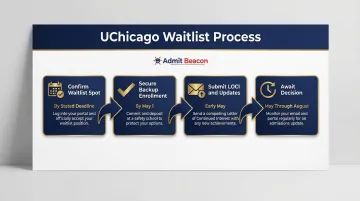
- Confirm your spot promptly and secure a backup enrollment by May 1
- Submit a concise, specific Letter of Continued Interest showing genuine intellectual fit
- Meaningful updates—new awards, research, leadership—carry real weight if communicated strategically
UChicago Waitlist Acceptance Rate: What the Data Actually Shows
UChicago does not publish its waitlist acceptance rate in its Common Data Set (CDS). The relevant fields in both the 2023-2024 and 2024-2025 CDS documents are left blank. That means there's no public record of how many students were offered a spot, how many accepted, or how many were ultimately admitted — unlike most peer institutions that routinely publish these figures.
What We Know from Peer Institutions
To understand the competitive landscape, we can examine published data from peer institutions for the Class of 2028:
| Institution | Offered Waitlist Spot | Accepted Waitlist Spot | Admitted from Waitlist | Waitlist Acceptance Rate |
|---|---|---|---|---|
| Princeton | 1,734 | 1,396 | 40 | 2.87% |
| Johns Hopkins | 2,374 | 1,614 | 30 | 1.86% |
| Dartmouth | 2,589 | 2,189 | 29 | 1.32% |
These official Common Data Set figures reveal that even when highly selective institutions use their waitlists, they typically admit fewer than 3% of students who opt to remain on the list.
National Benchmarks vs. Selective Institution Reality
The National Association for College Admission Counseling (NACAC) reports that colleges nationally admit about 20% of waitlisted students on average. However, this figure is misleading for applicants to highly selective institutions. NACAC's research shows that the most selective colleges admit only approximately 7% of waitlisted students, and the most competitive schools often fall well below even that.
Given UChicago's 4.48% overall acceptance rate for the Class of 2028 (1,955 admitted from 43,612 applicants), the waitlist acceptance rate likely falls in the 1–3% range consistent with peer institutions. That estimate assumes the waitlist is used at all in a given year — which is far from guaranteed.
The Yield Dependency Factor
Waitlist outcomes at schools like UChicago depend heavily on enrollment yield from the admitted class, which fluctuates year to year. The "acceptance rate" from the waitlist is driven more by institutional need than by applicant quality alone. If UChicago's admitted class enrolls at higher-than-expected rates, the waitlist may not be used at all. Conversely, if yield is lower than projected, the admissions committee will turn to the waitlist to fill specific gaps in the incoming class.
How the UChicago Waitlist Process Works
Unranked Waitlist and Active Confirmation
UChicago's waitlist is officially unranked, meaning there is no fixed order of consideration. The university states:
"Our waitlist is not ranked, meaning that students have a place in a pool of students who have been waitlisted rather than a ranked position in a line."
To be considered for admission from the waitlist, you must actively confirm your spot by the stated deadline through your UChicago Account. Simply being placed on the waitlist is not enough—you must opt in.
Timeline: May 1 Through Summer
Waitlist movement typically begins after May 1, the national enrollment deposit deadline. UChicago explicitly notes that at the time waitlist decisions are released, they "do not yet know if or when we will be able to extend offers of admission to students off the waitlist."
Decisions can come as late as July or August, depending on how enrollment yield plays out—so plan for a wait that stretches well into summer.
Portal Monitoring and Additional Materials
UChicago may ask waitlisted students to submit additional materials through the admissions portal. The university permits students to submit optional supplemental materials and updates to their application file via the UChicago Account.
Critical action items:
- Check your email and UChicago Account daily
- Respond promptly to any requests from the admissions office
- Submit updates only if they add meaningful new information
What UChicago Looks for in Waitlisted Applicants
A Different Question, Not a Second Review
Waitlist consideration is not a second review of your original application. Admissions officers are asking a narrower question: does this student fill a specific gap in the admitted class? Gaps can be defined by intended major, geographic diversity, extracurricular talents, or other institutional priorities.
Your job is to help the admissions committee answer "yes" to this question by demonstrating both your continued commitment and your specific value to the incoming class.
Intellectual Curiosity and Unconventional Thinking
UChicago's institutional culture prizes students who engage deeply with ideas. The university's Core Curriculum features small, Socratic-style classes capped at 19 students. Learning is driven by discussion of primary texts and interdisciplinary inquiry — designed to teach students "how to think critically and how to approach problems from multiple perspectives."
Waitlisted applicants should demonstrate this capacity for rigorous, interdisciplinary intellectual engagement in any follow-up communication. Generic enthusiasm won't strengthen your case — specific, grounded references to UChicago's academic culture will.
Demonstrated Interest: The Commitment Signal
UChicago wants to see that a waitlisted student genuinely intends to enroll if admitted. A lukewarm or hedged response — one that implies UChicago is one of several options — will not help your candidacy. Admissions officers are looking for students who would accept an offer without hesitation. If your letter of continued interest reads like a backup plan, it will be treated like one.
The most effective way to signal commitment is to make your LOCI (Letter of Continued Interest) specific: name a professor whose research you've followed, a Core course sequence you've thought through, or a student organization directly relevant to your goals.
Meaningful Updates Carry Real Weight
Strong commitment signals pair well with concrete updates that show your profile has grown since you applied. Significant developments since your original submission can meaningfully strengthen your candidacy:
- New awards or academic recognitions
- Published work or research outcomes
- Expanded leadership roles or new responsibilities
- Notable GPA improvements or course completions
Keep these concise and specific. Don't rehash what was already in your application — focus on what's genuinely new and adds dimension to your profile.
The "Fit" Signal Is Critical
UChicago's Core Curriculum and academic culture are distinctive. Any waitlist communication should show that you understand what makes UChicago different from peer institutions — and that the difference matters to you specifically. Admissions officers can distinguish between a student who has read the website and one who has genuinely engaged with the university's intellectual ethos. Make sure your communication reflects the latter.
How to Write a Winning Letter of Continued Interest for UChicago
What a LOCI Is and Why It Matters
A Letter of Continued Interest (LOCI) is a brief, targeted communication sent to the admissions office expressing genuine and specific continued interest in UChicago. While UChicago does not explicitly request a LOCI, the university permits students to submit optional updates if there is an "academic achievement of note" or something that highlights skills and potential contributions not already included in the application.
At a school that values demonstrated fit and intellectual authenticity, a well-crafted LOCI can be the difference between remaining in the pool and receiving an offer. The structure and tone of that letter matter as much as what you say.
Structure of an Effective LOCI
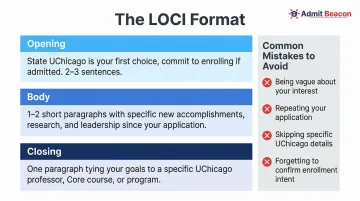
- Opening (2-3 sentences): State directly that UChicago is your first choice and that you will enroll immediately if admitted.
- Middle (1-2 short paragraphs): Include one or two meaningful updates since your application — new accomplishments, research progress, leadership roles, or academic achievements. Be specific and concise.
- Closing (1 paragraph): Articulate why UChicago — not just any top school — is the right fit. Reference a specific professor's research, a Core Curriculum course, or an intellectual community that genuinely connects to your interests.
Common LOCI Mistakes to Avoid
- Add new information only — the committee already has your file; restating it wastes your limited space.
- Avoid vague enthusiasm. Phrases like "UChicago has always been my dream" read as generic; specificity is what gets attention.
- Commit fully. Listing multiple schools or hedging implies UChicago isn't your top choice, which defeats the letter's purpose.
- Keep it to one page. Admissions officers read hundreds of these; brevity signals self-awareness.
Tone and Voice: Intellectual Authenticity
UChicago rewards intellectual authenticity — and admissions officers can tell the difference between researched interest and admissions-speak. Write in your own voice, not the polished register you think sounds impressive.
Concretely, this means:
- Avoid phrases like "rigorous academic environment" or "collaborative community" — these appear in virtually every LOCI
- Mirror the intellectual register UChicago uses in its own materials: curious, precise, unafraid of complexity
- Ground every claim in a specific detail — a course name, a faculty member's published work, a student organization's actual focus area
If your LOCI could apply to any selective university with minor edits, it isn't working. The goal is a letter that reads like it could only have been written about UChicago — by you.
What to Do While You Wait
Secure a Backup Plan by May 1
Submit an enrollment deposit at another school by May 1. A waitlist offer is not a guaranteed seat, and you need a confirmed backup — even if UChicago is still your first choice. May 1 is the National Candidates Reply Date, meaning you must commit to an accepted school by this deadline or risk losing your fallback option entirely.
Avoid Over-Communicating
Sending multiple emails, repeated check-ins, or unsolicited additional materials can appear pushy and may hurt your candidacy. One well-crafted LOCI is typically the right move, unless the school specifically invites further contact.
Evaluate Whether UChicago Is Still the Right Fit
Use this time to honestly assess whether UChicago is still the right fit for you:
- Visit campus if possible
- Connect with current students through official channels
- Attend any waitlist or admitted student info sessions
Going through this process sharpens your own thinking — and if UChicago does come through with an offer, you'll be deciding from a position of clarity rather than anxiety.
Frequently Asked Questions
What is UChicago's waitlist acceptance rate?
UChicago does not publish its waitlist acceptance rate in its Common Data Set. While exact figures are unavailable, context from peer school data (Princeton at 2.87%, Johns Hopkins at 1.86%, Dartmouth at 1.32%) and NACAC benchmarks suggests the rate at highly selective institutions like UChicago is likely in the low single digits.
How many students does UChicago typically put on the waitlist?
UChicago does not consistently publish the number of students placed on its waitlist. The relevant fields in the university's Common Data Set are marked as "not published," making it impossible to know the exact size of the waitlist pool in any given year.
Does UChicago rank its waitlist?
No. UChicago does not rank its waitlist, meaning all waitlisted students are considered equally. Final decisions hinge on the incoming class's composition needs—balancing intended majors, geographic diversity, and similar priorities—not a fixed order.
When will I hear back if I'm on UChicago's waitlist?
Waitlist notifications typically begin after May 1 and can extend through summer, sometimes as late as July or August. The exact timeline depends on how enrollment yield plays out — no fixed deadline applies.
Should I write a Letter of Continued Interest to UChicago?
Yes — a LOCI is strongly recommended. It signals genuine commitment and gives admissions officers updated information. Keep it concise and specific to UChicago; a generic expression of enthusiasm will not move the needle.
Can I improve my chances of getting off UChicago's waitlist?
While there are no guarantees, you can strengthen your candidacy by confirming your spot promptly, sending a targeted LOCI with meaningful updates, and making clear that UChicago is your first choice. Every communication should add something new — not restate what's already in your file.