Introduction
Being waitlisted at a top MBA program is a high-stakes moment. You've cleared a major hurdle—your application was strong enough to keep you in consideration—but the door isn't fully open yet.
Unlike the initial application process, where you had months to craft your story, the waitlist phase offers a narrow window and few tools to influence the outcome. One of the most critical is the Letter of Continued Interest (LOCI), a formal waitlist email that reaffirms your commitment and strengthens your candidacy with new achievements, updates, or program-specific insights.
Those odds make a well-crafted LOCI essential. According to 2019 GMAC data, waitlist acceptance rates at M7 schools range from just 2% at Harvard Business School to 15% at Chicago Booth. This post covers what to include in your LOCI, how to write it, school-specific best practices, ready-to-use templates, and the mistakes that quietly sink good candidates.
Key Takeaways
- A waitlist email reaffirms your interest and adds new, meaningful information since you submitted
- Keep it to 300–500 words, professionally written, and specific to that school
- Send within two to four weeks of the waitlist decision — earlier if the school's timeline is tight
- Check the school's portal or admissions FAQs first — some programs prohibit unsolicited contact
What Is an MBA Waitlist Email (and Why It Matters)
Defining the LOCI
An MBA waitlist email—formally called a Letter of Continued Interest (LOCI)—is a short, purposeful communication sent to the admissions office after being placed on the waitlist. It signals continued interest while strengthening your file with new evidence that makes you a more compelling candidate than when you first applied.
This is not a passive "thank you for considering me." Admissions committees use LOCIs to gauge genuine fit and enthusiasm — and schools filling waitlist spots prioritize applicants who have reaffirmed their intent and shown meaningful progress since the original application deadline.
Why Waitlist Communication Policies Vary Widely
Each school has its own waitlist communication policy. Some explicitly invite updates, others prefer silence, and a few mandate portal submissions only. For example:
- Harvard Business School allows exactly one 300-word update via their Application Status Page
- Wharton explicitly forbids supplemental documents for inclusion in the file
- Stanford GSB welcomes brief updates via their Waitlist Response Form
- Chicago Booth, Kellogg, and MIT Sloan require updates through designated portals
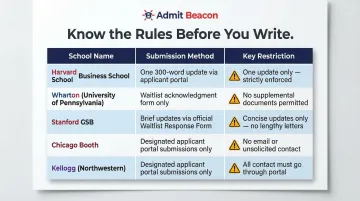
Before writing anything, check the school's portal or admissions FAQs. Ignoring a "do not contact" instruction will hurt, not help.
What to Include in Your MBA Waitlist Email
Subject Line and Opening
Use a clear, professional subject line:
"Letter of Continued Interest — [Full Name], [Program] Applicant"
Open with a brief, warm acknowledgment of the waitlist decision. Don't dwell on disappointment—get straight to the point.
Reaffirm Your First-Choice Status with Specificity
State that this program remains your first choice, and be hyper-specific about why. Generic praise like "I've always admired [School]" actively harms credibility. Instead, name:
- A faculty member whose research aligns with your goals
- A particular course cluster or curriculum element
- A student club or initiative
- A recent program announcement or development
Example: "Professor [Name]'s research on sustainable supply chains directly aligns with my goal to lead operations transformation in emerging markets. I'm particularly drawn to the [Course Name] elective and the [Club Name], which would allow me to deepen my expertise while contributing my experience in [specific area]."
Present New Information That Materially Strengthens Your Application
This is the core of your LOCI. Present updates that weren't in your original application:
- A promotion or expanded leadership role
- A significant project outcome with quantifiable results
- An improved GMAT/GRE score
- Completion of a quantitative course (especially if your profile had a quant weakness)
- A major award or recognition
Explain why this development makes you a stronger candidate. Don't just list the update: connect it directly to your post-MBA goals and the program's strengths.
What doesn't count as new information:
- Restating your original application content
- Generic enthusiasm without evidence
- Minor updates that don't meaningfully change your profile
The Recommendation Trap: Don't Submit Extra Letters
A common mistake is assuming more endorsements will help. Most top programs explicitly prohibit or discourage additional letters of recommendation.
According to school policies:
- HBS will not consider additional support letters from external parties
- Stanford GSB does not need supplementary materials or additional recommendations
- Chicago Booth and Kellogg explicitly discourage third-party letters
Only mention a new recommendation if the school explicitly invites it and you have a genuinely new recommender with material insights.
Close with Confidence and Gratitude
End by reiterating your enthusiasm, thanking the admissions team for their time, and making it easy to reach you. Keep the entire email under 500 words. Before sending, proofread carefully — a grammar error in a post-application communication signals carelessness at exactly the wrong moment.
MBA Waitlist Email Examples & Templates
Three templates follow, each suited to a different situation:
- Template 1 — You have a new promotion, award, or measurable win to share
- Template 2 — Your conviction about the school has deepened through research and outreach
- Template 3 — Tone examples showing how the same update reads across HBS, Wharton, and Stanford GSB
Template 1: The "New Achievement" Update
Subject: Letter of Continued Interest — [Your Full Name], [Program] Applicant
Dear [Admissions Committee/Specific Contact Name],
Thank you for your continued consideration of my application to [School Name]'s MBA program. I am writing to reaffirm that [School] remains my first choice, and I am fully committed to enrolling if offered admission.
Since submitting my application, I have [specific achievement: been promoted to Senior Manager, led a project that generated $2M in cost savings, earned the [Award Name]]. Through this role, I've built [specific skill or insight] and now lead a team of [number] across [geographies/functions]. This experience has strengthened my conviction that [School]'s [specific program element: emphasis on collaborative leadership, focus on impact investing, etc.] is exactly what I need to achieve my goal of [specific post-MBA objective].
I am particularly excited about [specific faculty member, course, or initiative] and the opportunity to contribute my experience in [your domain] to the classroom and the [specific club or community].
Thank you again for this opportunity. I look forward to the possibility of joining the [School] community and am happy to provide any additional information.
Warm regards,
[Your Full Name]
[Email] | [Phone]
Template 2: The "Deepened School Fit" Update
Subject: Letter of Continued Interest — [Your Full Name], [Program] Applicant
Dear [Admissions Committee/Specific Contact Name],
Thank you for keeping my application under consideration for [School Name]'s MBA program. I am writing to reaffirm my strong interest and share how my conviction about [School] has deepened since applying.
Over the past month, I [attended the virtual info session on [topic], spoke with [Alum Name], a [Year] graduate working in [industry], and connected with [Current Student Name] from the [Club Name]]. These conversations reinforced why [School]'s [specific cultural element or pedagogical approach] is the right fit for my goals. [Alum/Student Name] shared insights about [specific example], which directly aligns with my interest in [your focus area].
On the professional side, I have [brief update: taken on a new project, completed a course, etc.], which has further prepared me for [School]'s curriculum and strengthened my readiness to contribute from day one.
[School] remains my top choice, and I am eager to join the community. Thank you for your time and consideration.
Best regards,
[Your Full Name]
[Email] | [Phone]
Template 3: School-Specific Tone Variation
These aren't full templates — they show how the same promotion update reads differently depending on each school's culture. Use them to calibrate your voice before drafting.
Harvard Business School — Lead with authority:
"Since applying, I was promoted to lead a cross-functional team of 12 driving digital transformation across three markets. This role has sharpened my ability to lead through ambiguity and align diverse stakeholders—capabilities I'm eager to develop further through HBS's case method and leadership curriculum."
Wharton — Lead with data and teamwork:
"My recent promotion to Senior Analyst involved leading a $5M cost-reduction initiative, where I collaborated with finance, operations, and procurement teams to deliver a 22% efficiency gain. This experience reinforced my interest in Wharton's team-based discussion format and the Operations & Information Management major."
Stanford GSB — Lead with meaning and mission:
"Being promoted to lead our sustainability initiative has been deeply meaningful—it's allowed me to align my work with my core belief that business can be a force for positive change. Stanford GSB's emphasis on developing leaders who amplify their impact resonates with how I see my career evolving."
Best Practices: Timing, Tone, and School-Specific Strategy
On Timing
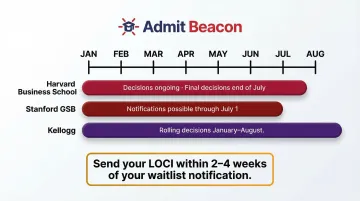
Send within two to four weeks of the waitlist notification unless the school specifies a different window. Avoid emailing during peak holiday or application review periods, and do not send multiple emails in quick succession. One well-crafted email outperforms a flurry of check-ins.
Waitlist decisions often roll out between May and August. According to school policies:
- HBS reviews candidates on an ongoing basis, with all final decisions made by the end of July
- Stanford GSB may notify candidates up until July 1
- Kellogg makes updated decisions on a rolling basis between January and August
On Tone
Strike the balance between confident and gracious. The email should read as someone who has done the work and believes in the fit, not someone begging for mercy. Avoid hollow pledges like "I will definitely attend if admitted"—show commitment through specificity instead.
On Personalization
A waitlist email that could have been sent to five schools signals exactly that. At Admit Beacon, each engagement starts with mapping a school's specific ethos — so the narrative that emerges could only belong to that one program.
Tailor tone to school culture:
- HBS calls for a direct, leadership-focused narrative — lead with impact, not reflection
- Wharton rewards analytical precision — link any new achievements directly to your goals, reflecting their data-driven, collaborative culture
- Stanford GSB invites slightly more reflective, authentic language aligned with their evaluation criteria
On Length and Format
300–500 words, no attachments unless explicitly invited. Send as a plain professional email (not a designed document), addressed to the specific admissions contact named in your decision letter or portal.
Common Mistakes That Hurt Waitlisted MBA Applicants
Repeating Application Content
The single most common error is summarizing what the adcom already read. Every sentence should introduce something new or add a dimension that wasn't in the original file. If you're restating your career goals or rehashing your essays, you're wasting the opportunity.
Over-Emailing or Going Silent
There are two failure modes:
- Over-emailing: Multiple check-ins and follow-ups create noise — adcoms notice, and it reads as desperation
- Going silent: Sending nothing at all means forfeiting the one chance to shift the decision
Neither works. One thoughtful, timely email is the standard.
Generic Enthusiasm Without Evidence
Phrases like "I've always dreamed of attending [School]" with nothing specific behind them harm your credibility. Every claim of fit should be backed by a concrete detail—a course, a faculty member, a club, a recent initiative. Vague praise reads as copy-pasted.
Ignoring School-Specific Instructions
Fit and enthusiasm matter — but so does following the rules. If a school like Wharton explicitly states they do not accept supplemental documents, submitting an update will "most definitely identify yourself in a negative way." Ignoring a zero-update policy tells the adcom you can't follow basic instructions before you've even enrolled.
Frequently Asked Questions
What is a waitlist email?
A waitlist email — also called a Letter of Continued Interest (LOCI) — is a formal message sent to a school's admissions office after being waitlisted. It reaffirms your interest and shares meaningful updates that strengthen your candidacy, such as promotions, improved test scores, or new achievements.
What to say in a waitlist email?
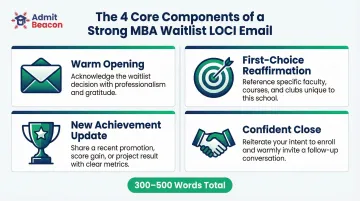
Include four core elements: gratitude for the waitlist decision, a specific restatement of why this program is your top choice, a genuine new update to your application (achievement, role, result), and a confident close reiterating your intent to enroll.
How long should an MBA waitlist email be?
The ideal range is 300–500 words—long enough to communicate meaningful updates, short enough to respect the admissions team's time and demonstrate the ability to write with economy and precision.
When should I send my waitlist email to an MBA program?
Send within two to four weeks of the waitlist notification, unless the school's portal specifies a different timeline. Always check whether the school accepts waitlist communications before sending—some programs have strict no-contact policies.
Can I send more than one waitlist email?
One strong, well-timed email is the right approach. A second update is acceptable only if a genuinely significant development occurs — such as a major promotion or award — not simply to check in.
Do all MBA programs accept waitlist emails?
No—policies vary by school. Some programs actively encourage LOCIs, others prefer applicants use a designated portal, and a few advise against unsolicited emails. Always read the waitlist communication instructions before writing anything.
Need help crafting a waitlist email that stands out? At Admit Beacon, we help applicants navigate waitlist strategies with targeted communication plans and school-specific guidance. Our consultants have deep knowledge of top programs and can help you craft a LOCI that reflects who you are — not a template. Get in touch to learn more.