Introduction
Picture this: You've spent weeks rehearsing answers to "Walk me through your resume" and "Why an MBA?" You've practiced your STAR stories until they flow naturally. Then, after 30 minutes of thoughtful conversation, your interviewer leans back and asks, "So, do you have any questions for me?"
And you freeze.
This moment is not a formality. It's an evaluated part of your MBA interview. Admissions committees at top programs like Harvard Business School, Stanford GSB, and Kellogg assess not just your answers, but the quality of your questions — questions that signal how deeply you've researched the program and how clearly you understand your own fit.
At programs like HBS and Chicago Booth, interviewers submit written reports that directly influence final decisions — and your questions are captured in those reports. At Tuck, the stakes are spelled out plainly:
"The interviewer summarizes and records notes in a report, and makes a recommendation on your candidacy to the admissions committee."
This guide provides 28 ready-to-use questions organized by interviewer type (alumni, AdCom, and current students), plus strategic advice on how to choose and deliver them effectively.
Key Takeaways
- The questions you ask signal preparation, self-awareness, and genuine fit—not just curiosity
- Tailor questions to your interviewer: alumni offer lived experience, AdCom provides institutional insight, students share day-to-day reality
- Avoid yes/no questions or anything easily found on the school's website
- Prepare 5–6 questions with 2–3 backups ready in case the conversation covers your planned topics early
Why Asking Smart Questions Is Part of the Evaluation
MBA interviews are two-way conversations. Schools like Stanford GSB explicitly state that "the interview is a two-way conversation" designed for mutual assessment. Chicago Booth echoes this: "As we find out more about you, you are interviewing us as well."
But make no mistake—this is an evaluated component. Your questions reveal:
- Research depth: Have you gone beyond the website?
- Goal clarity: Do you know what you need from an MBA?
- Cultural fit: Do you understand what makes this program unique?
Understanding Interviewer Types
You'll encounter three main interviewer types, each offering a different lens:
- Alumni interviewers (Stanford, Columbia, INSEAD) speak candidly about lived experience — the stuff the brochure leaves out
- AdCom officers (HBS, MIT Sloan, Wharton) evaluate how you'll contribute to the program, not just what you hope to gain from it
- Current students (Tuck, Booth, Kellogg) give you unfiltered, real-time insight into recruiting timelines, club dynamics, and daily life
Blind vs. Application-Based Interviews
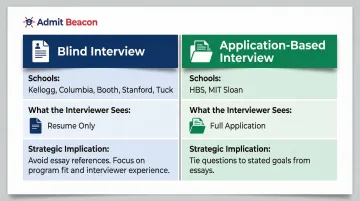
Interview format varies significantly by school. Knowing which type you're walking into changes how you frame your questions.
| Format | Schools | What the Interviewer Sees | How It Shapes Your Questions |
|---|---|---|---|
| Blind (resume-only) | Kellogg, Columbia, Booth, Stanford, Tuck | Resume only | Avoid referencing essays or application details |
| Application-based | HBS, MIT Sloan | Full application | Tie questions to goals you described in your essays |
Common Mistakes That Undermine Credibility
The most damaging questions are:
- Too generic: "What makes your program special?"
- Too easily Googled: "Do you have a consulting club?"
- Seeking real-time evaluation: "How do you think I did?"
- Yes/no format: "Is the alumni network strong?"
These questions signal that you haven't done your homework—or worse, that you're not genuinely interested in the program.
10 Questions to Ask an Alumni Interviewer
Alumni interviewers offer firsthand, unfiltered perspective on the MBA experience. These questions should draw on their personal journey rather than official program information.
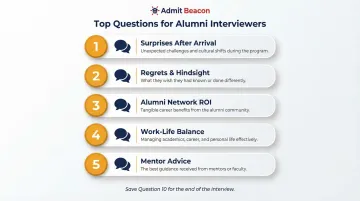
Question 1: What surprised you most about [School] once you actually arrived?
Few questions uncover the gap between expectation and reality as effectively. Alumni tend to give candid answers that reveal the program's true culture—whether it's the intensity of recruiting, the collaborative spirit, or unexpected academic rigor.
Question 2: What do you wish you had done differently during your MBA?
Expect tactical, school-specific advice you won't find anywhere else. Answers range from "I wish I'd taken Professor X's negotiation class" to "I should have done the international trek to Asia." That kind of insider guidance is exactly what you're there for.
Question 3: How has the alumni network actively supported your career since graduating?
Asking for evidence—not just reassurance—signals that you care about long-term ROI on the degree. Strong answers include concrete examples: mentorship relationships, job referrals, or business partnerships that emerged years after graduation.
Question 4: Which classes or professors had the most lasting impact on how you think or work?
Alumni often name professors who never appear in brochures but who fundamentally shaped how they work. You get insider academic recommendations while signaling that intellectual depth matters more to you than credentials alone.
Question 5: How did you balance coursework, recruiting, and personal life—and what would you tell someone just starting?
Asking this shows you understand the MBA is intense and you're already thinking about how to navigate it well—not just get in. Alumni appreciate the candor, and their answers are often the most practically useful of the conversation.
Question 6: How did the program support your specific career goals—especially if they were unconventional or involved a pivot?
Understanding fit at a human level—not just academically—is what separates serious candidates from checklist applicants. Answers here reveal whether the culture is competitive or collaborative, whether students socialize outside class, and what the unwritten norms actually are.
Question 8: Was there a resource, club, or opportunity at the school that you almost missed but were glad you pursued?
Hidden gems—career treks, research centers, niche communities—rarely appear in official materials. Alumni love sharing these discoveries, and you walk away with information that most applicants never find.
Question 9: What advice would you give an incoming student hoping to break into [specific industry or function]?
Personalizing this question to your specific career target makes the conversation far more relevant—and memorable. If you're targeting private equity, ask about the PE club, relevant coursework, and recruiting timelines. The specificity shows focus and earns a more useful answer.
Question 10: Based on what I've shared today about my background and goals, is there anything specific you'd focus on if you were in my position?
Save this for the end. It invites the interviewer to step into a mentor role briefly—and they often rise to it. Alumni frequently give their most candid, valuable advice in response to this single question.
10 Questions to Ask an AdCom Interviewer
AdCom officers understand the program's strategy, admission criteria, and institutional values at a structural level. Questions here should demonstrate that you've thought critically about fit, goals, and how you will contribute—not just what you hope to receive.
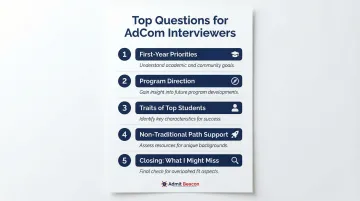
Question 11: Based on my background and career goals, what courses or program resources would you suggest I prioritize in the first year?
Few questions land better in an AdCom interview. Asking this shows you've already defined your goals clearly and are thinking about how to maximize your time at the school—not just how to get in. AdCom members respond well to candidates who treat the MBA as a strategic investment.
Question 12: What strategic changes or new directions has the program taken in the last two to three years, and where is it heading?
The question demonstrates long-term thinking and genuine curiosity about where the program is headed. It also gives you useful intelligence: whether the school is expanding AI coursework, building sustainability initiatives, or deepening global partnerships directly affects whether it fits your goals.
Question 13: What traits or qualities do you consistently see in MBA students who truly thrive here?
A subtle but effective way to understand selection criteria and culture. You're showing that you care about fit, not just admission. The answer will typically reveal whether the school gravitates toward collaborators, intellectual risk-takers, entrepreneurs, or a specific leadership archetype.
Question 14: How does the program support students pursuing high-risk or non-traditional career paths—such as entrepreneurship, career changes, or niche sectors?
Especially valuable if you don't fit a conventional mold. An engineer pivoting to product management or a consultant moving into impact investing needs concrete support—not just a general career center. This question shows you've done the thinking about whether the school can back your specific transition.
Question 15: How does the school define and measure student success—both short-term and long-term?
Asking this moves the conversation beyond rankings and salary outcomes to what the school actually values. Some programs prioritize entrepreneurship; others measure success through social impact or leadership trajectories. The answer tells you a lot about whether your definition of success aligns with theirs.
Question 16: What's one thing you wish more applicants asked you about this program?
Disarming and effective, this question tends to produce the most candid responses of the interview. AdCom members field the same dozen questions repeatedly—this one breaks the pattern and leaves a lasting impression. The answers are often the most honest and specific you'll hear.
Question 17: How does the career services team support students who are pursuing roles in industries where the school doesn't have a dominant recruiting presence?
For candidates targeting climate tech, social enterprise, or global markets, this question is essential. It shows you've researched the school's recruiting strengths—and thought realistically about navigating gaps in their network for your specific career path.
Question 18: How does the MBA curriculum continue to evolve in response to changes in the business world—for example, in areas like AI, sustainability, or geopolitics?
Naming specific themes—AI integration, sustainability mandates, geopolitical risk—demonstrates you're tracking real developments in business, not just classroom theory. It also helps you evaluate whether the school responds to emerging trends or lags behind them.
Question 19: How would you describe the relationship between MBA students and faculty outside the classroom?
A sharper version of "Are professors accessible?" Rather than office-hours availability, you're asking about mentorship culture, research collaboration, and the intellectual community outside formal instruction. Some schools have faculty deeply embedded in student life; others keep a clear classroom boundary.
Question 20: Given my profile, are there aspects of the program or opportunities I might overlook that I should be researching more deeply?
A strong closing question for any AdCom interview. It shows humility and strategic self-awareness—and practically speaking, AdCom members frequently point candidates toward lesser-known resources, centers, or tracks that align closely with their specific goals. The answers are often more useful than anything in the brochure.
8 Questions to Ask a Current MBA Student
Current students offer the most honest and unfiltered view of daily life, student culture, and what actually matters once you're enrolled. These questions should be conversational, peer-to-peer in tone, and focused on the lived experience.
Question 21: What does a typical week actually look like in terms of balancing classes, recruiting, and everything else?
Few people can answer this more honestly than someone living it right now. Expect a candid breakdown of juggling case prep, networking events, club leadership, and social commitments — the kind of week-to-week reality no admissions brochure captures.
Question 22: How competitive versus collaborative is the classroom environment—really?
Official materials almost always say "collaborative." The real answer varies widely. Some programs have forced curves and cutthroat dynamics; others foster genuine teamwork. Knowing which camp your target school falls into shapes how you'd experience the program day to day.
Question 23: What clubs, treks, or extracurricular activities have delivered the most professional value for you?
Understanding where to invest time outside academics — and signaling that you've thought holistically about the MBA — makes this question worth asking. Students often highlight specific treks, pro-bono consulting projects, or leadership roles that opened unexpected doors.
Question 24: If you were starting year one over again, what would you do differently?
Candid reflection questions like this tend to produce the most actionable advice. You'll hear things like: take that obscure elective in Q1, join the right club early, or don't wait until spring to start recruiting conversations.
Question 25: What's been the most valuable thing you've done outside the formal curriculum?
Hidden parts of the MBA experience — independent consulting projects, informal mentorship programs, alumni treks — rarely appear in admissions materials. Students often only discover these after arriving, which makes this question a reliable source of on-the-ground intel.
Question 26: How accessible are second-year students and alumni when it comes to informal mentoring or career advice?
Peer support beyond formal career services is a real differentiator across programs. Some schools have strong cultures of second-years mentoring first-years; others are more fragmented. The answer tells you a lot about the kind of community you'd be joining.
Question 27: What's one thing about this school's culture that you didn't fully understand until you were here?
Authentic cultural nuances that admissions materials rarely capture tend to surface here. Answers range from the intensity of recruiting season to the strength of section bonds to unwritten social norms you'd only learn by being there.
Question 28: How well does the recruiting and career support infrastructure serve students targeting your specific industry?
Personalizing this to your target field shows serious career planning and gets you information you can actually use. If you're targeting tech product management, ask specifically about tech recruiting strength, relevant clubs, and the depth of alumni connections in that space.
How to Choose and Deliver Your Questions Strategically
From the full list of 28 questions, you should prepare 5–6 questions tailored to the school and interviewer type, plus 2–3 backups in case key questions are answered naturally during the conversation.
Selection Framework
Choose one question per "layer":
- One about program structure or direction: Questions 11, 12, 15, or 18 for AdCom; Questions 21 or 23 for students
- One about personal experience: Questions 2, 4, or 7 for alumni; Questions 24 or 27 for students
- One tied directly to your specific goals or industry: Questions 6 or 9 for alumni; Question 28 for students; Questions 14 or 17 for AdCom
This ensures you're covering different angles and demonstrating both research depth and personal fit.
Blind vs. Non-Blind Interview Considerations
Your approach shifts depending on whether the interview is blind or non-blind:
| Format | Schools | What to Do |
|---|---|---|
| Blind | Kellogg, Columbia, Booth, Stanford, Tuck | Interviewer has only seen your resume — focus questions on program offerings and the interviewer's own experience; skip essay references |
| Non-blind | HBS, MIT Sloan | Interviewer has read your full application — you can reference stated goals directly: "I mentioned my interest in healthcare entrepreneurship — which professors or resources would you suggest I connect with?" |
Delivery Matters More Than Script
Questions should feel like genuine curiosity, not a performance. Listen actively during the interview and follow up on answers mid-conversation rather than mechanically working through a prepared list.
When an interviewer shares something unexpected, a spontaneous follow-up lands better than pivoting back to your list. If an alumni mentions a trek to South America, ask what made it valuable — that moment of genuine engagement is what interviewers remember.
Practice Makes Natural
Admit Beacon's mock interview sessions, led by Niketa, include dedicated rounds where candidates test the questions they plan to ask — with real-time feedback on whether they read as genuinely curious and school-specific. Walking in having practiced means the conversation feels natural, not scripted.

Frequently Asked Questions
How many questions should I ask in an MBA interview?
Prepare 5–6 questions with 2–3 backups, but plan to ask 2–3 during the interview itself. In a 30-minute interview (HBS, MIT Sloan), you may only have time for one or two. In a 60-minute conversational interview (Booth, Stanford), you might ask three.
What questions should I avoid asking in an MBA interview?
Avoid questions answerable through a quick Google search ("Do you have a consulting club?"), yes/no questions, and any question that implies you haven't researched the program. Never ask how you performed or whether the interviewer thinks you'll be admitted.
Should I ask different questions in blind versus non-blind interviews?
Yes. In blind interviews, avoid referencing essays or application details the interviewer hasn't seen. In non-blind interviews, tie questions to specific goals or experiences from your application to make the conversation more targeted.
Can I ask the same questions at every school I interview with?
Generic questions can work across schools, but the strongest ones are tailored to each program. Research school-specific initiatives, faculty, or recent strategic changes and reference them directly.
What if the interviewer already answers my prepared questions during the interview?
Acknowledge it ("You actually touched on exactly what I was going to ask—so let me go deeper:") and pivot to a backup question or dig further into what the interviewer just shared. It means the conversation was substantive.
Is it appropriate to ask critical or probing questions about the program's weaknesses?
A thoughtful question about areas for improvement ("Where do you see the program continuing to develop?") can be impressive—but frame it constructively, not skeptically. It works better with alumni or student interviewers than AdCom members.