Introduction
Hiring managers spend an average of just 7.4 seconds reviewing your resume during the initial screen. That's the window you have to make an impression. For MBA applicants targeting competitive programs like Harvard Business School or Wharton, that scrutiny is even more intense—admissions committees review hundreds of resumes and can instantly spot generic, unfocused applications.
A standout resume doesn't require years of additional experience or flashy graphics. It requires strategy: thoughtful design that guides the reader's eye, a clear career narrative that shows progression, quantified accomplishments that prove impact, and careful customization for each application.
This guide walks through 8 actionable tips spanning formatting, structure, language, and tailoring—covering both professional job-search resumes and the unique conventions MBA programs demand.
Key Takeaways
- Use clean, single-column formatting and ATS-friendly file types so your resume parses correctly every time
- A sharp professional summary and reverse-chronological order let admissions readers and recruiters grasp your career arc at a glance
- Quantified accomplishments using the XYZ formula make your impact concrete and memorable
- Tailoring keywords to each application boosts interview rates by 115%
- For MBA applications, one page is the rule — and objective statements should be cut entirely
Tips 1 & 2: Design Your Resume for the First Few Seconds
Why Visual Clarity Matters
Recruiters follow predictable reading patterns (specifically F-pattern and E-pattern eye movements) that concentrate heavily on the top-left quadrant of your resume. Within those critical 7.4 seconds, they fixate on your name, current title and company, previous title and company, and employment dates.
A clean layout with consistent fonts, generous white space, clear section headings, and aligned margins makes this information instantly accessible. Cluttered designs with graphics, photos, or multi-column layouts frustrate reviewers and obscure your qualifications.
The ATS Compatibility Imperative
92% of recruiters confirm their ATS does not auto-reject based on formatting — so the "75% auto-rejection" statistic you've likely seen is a myth. Parsing errors, however, are real. A 2025 analysis found that resumes using tables, text boxes, multi-column layouts, or contact information in headers face an 88% higher likelihood of parsing failure. File format matters: plain DOCX files have only a 4% parsing failure rate, while PDFs carry an 18% failure rate — especially when exported from design software like Canva.
ATS-safe formatting rules:
- Use single-column layouts only
- Stick to standard fonts: Calibri, Arial, Helvetica (sans-serif) or Garamond, Cambria, Times New Roman (serif)
- Keep font size between 10-12 points
- Submit as DOCX unless PDF is specifically required
- Avoid headers, footers, tables, and text boxes
Resume Length by Career Stage
For job seekers:
- Entry-level professionals (0-5 years): Strictly 1 page
- Mid-to-senior professionals (5-15+ years): 2 pages are widely accepted
For MBA applicants: Top programs like HBS, Wharton, and Stanford GSB require or strongly prefer a one-page resume, regardless of experience level. This strict constraint forces ruthless prioritization of your most impactful content.
Formatting Checklist
- ✅ Consistent verb tense (past for prior roles, present for current)
- ✅ Spell-check completed before submission
- ✅ No photos or logos unless specifically required
- ✅ PDF export only if explicitly requested (otherwise DOCX)
- ✅ Proofread by reading aloud and having a peer review
Typos and grammatical errors signal carelessness. At schools like HBS and Wharton, adcoms read hundreds of applications — a single error is often enough to shift a borderline candidate from "invite" to "ding."
Tips 3 & 4: Build a Compelling Career Narrative
The Professional Summary: Your 30-Second Pitch
The top two to three lines of your resume are the most valuable real estate on the page. A strong professional summary answers three questions: who you are, what you have achieved, and what you are seeking. This functions as a written elevator pitch that frames your value immediately.
Example: Marketing strategist with 6 years driving digital growth for SaaS startups. Increased customer acquisition by 140% and reduced CAC by 35% through data-driven campaign optimization. Seeking to apply analytical skills and leadership experience in a product management role.
Important exception for MBA applicants: Wharton explicitly advises eliminating objective or summary statements to reclaim space for leadership and impact metrics. Career goals belong in your essays, not your resume.
Career Narrative Coherence
A reviewer should read your experience section and immediately understand a logical arc of growth, increasing responsibility, and intent. Before writing each bullet point, ask yourself: what thread connects my roles? How does each position build on the last?
At Admit Beacon, lead consultant Niketa works with each candidate on resume development and career narrative. She dedicates roughly 40% of total application effort to this work — connecting past experiences, current role, and future goals into a story that reads as deliberate to any admissions committee or recruiter.
To stress-test your own narrative coherence, ask:
- Does each role visibly build on the one before it?
- Can a stranger identify your specialty within 10 seconds?
- Does your most recent title feel like a natural next step, not a detour?
Strong formatting is what makes that narrative visible at a glance.
Structure the Experience Section for Scannability
Format each role clearly:
- Company name, title, and date range as visual anchors
- Reverse chronological order (most recent first)
- Show visible progression if promoted within a company
- Limit each role to 3-5 bullet points focused on outcomes, not just duties
Keep each bullet to a maximum of two lines to facilitate rapid scanning during that 7.4-second window.
Skills and Education Sections
When to lead with education:
- Recent graduates or early-career professionals (0-3 years)
- MBA applicants (education always appears prominently)
When to lead with experience:
- Mid-career and beyond (5+ years)
Skills section best practices:
- List technical skills specifically: "Advanced Excel (pivot tables, VLOOKUP, macros)" rather than "Microsoft Office"
- Separate hard skills (technical, certifications) from soft skills (leadership, communication)
- Include relevant certifications with dates
Tips 5 & 6: Quantify Your Impact and Use Precise Language
The XYZ Accomplishment Formula
Google's former Senior Vice President of People Operations, Laszlo Bock, popularized the XYZ Formula for resume bullet points: "Accomplished [X] as measured by [Y] by doing [Z]."
Unlike a job description, this structure forces proof — what you achieved, how much it mattered, and exactly how you pulled it off.
Weak bullet (passive, no metrics): Studied financial performance of companies and made investment recommendations.
Strong bullet (XYZ formula applied): Improved portfolio performance by 12% ($1.2M) over one year by refining cost of capital calculations for information-poor markets and re-weighting portfolio based on resulting valuations.
Why Numbers Matter
58.18% of recruiters are explicitly impressed by measurable achievements on resumes. Dollar figures, percentages, team sizes, timelines, and rankings make accomplishments concrete and comparable.
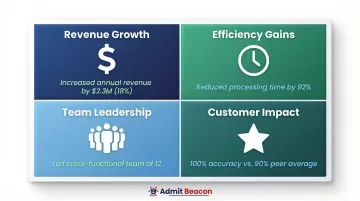
Examples of quantifiable metrics:
- Revenue growth: "Increased annual revenue by $2.3M (18%)"
- Efficiency gains: "Reduced processing time from 4 hours to 15 minutes (92% improvement)"
- Team leadership: "Led cross-functional team of 12 across engineering, design, and marketing"
- Customer impact: "Served 85 customers per day with 100% accuracy vs. peer average of 70 at 90%"
Use Strong Action Verbs
Start each bullet with a specific, powerful verb that signals ownership and agency. Avoid passive or weak openers like "responsible for," "helped with," or "duties included."
High-impact action verbs by category:
| Leadership | Technical | Business Impact |
|---|---|---|
| Orchestrated | Engineered | Negotiated |
| Spearheaded | Architected | Accelerated |
| Directed | Optimized | Secured |
| Championed | Automated | Generated |
Balance Detail with Interview Potential
Include enough specificity to generate genuine interest — then stop. A useful test: if a bullet already answers the "so what," cut it there. Save the "how exactly" for the conversation across the interview table.
Tips 7 & 8: Tailor, Polish, and Present Consistently
Why Tailoring Your Resume Doubles Interview Rates
A generic resume sent to multiple employers or MBA programs rarely performs well. Tailored resumes achieve a 5.75% interview conversion rate compared to just 2.68% for generic submissions—a 115% improvement. Candidates who match the exact target job title on their resume have an interview rate 10.6 times higher than those who don't.
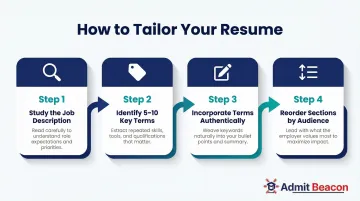
How to tailor effectively:
- Study each job description or program's values and language
- Identify 5-10 key terms that appear repeatedly (technical skills, leadership indicators, industry-specific language)
- Incorporate relevant terms authentically into your bullets
- Reorder or reweight sections to align with what each audience values most
For MBA applicants, this means emphasizing leadership impact and cross-functional influence for programs like Wharton, while highlighting entrepreneurial initiative and innovation for Stanford GSB.
Keyword Strategy Without Keyword Stuffing
99.7% of recruiters use keyword filters in their ATS, with 76.4% filtering specifically by skills. The key is to mirror job posting language naturally rather than cramming keywords awkwardly into sentences.
Compare these two approaches:
Led Agile development team of 8 engineers, implementing Scrum methodology to reduce sprint cycle time by 30%. — keywords woven naturally into an achievement.
Experienced in Agile, Scrum, Kanban, sprint planning, retrospectives, daily standups, and Agile project management methodologies. — a keyword dump that reads like a glossary, not a résumé.
Keep Your LinkedIn Profile in Sync With Your Resume
75% of recruiters actively cross-reference candidates on LinkedIn, and 46.75% specifically check for alignment between the resume and the profile. Inconsistencies in role titles, dates, or key accomplishments signal discrepancies that can cost you the interview.
LinkedIn profile checklist:
- Professional headshot photo
- Personalized headline (not just job title)
- Role titles and dates match resume exactly
- Key accomplishments appear in both places
- Skills section reflects resume expertise
The MBA Resume: What Makes It Different
Strict Format Requirements
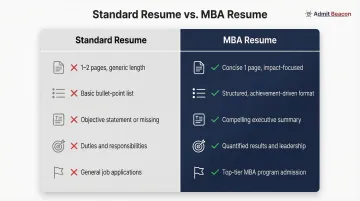
MBA programs at schools like HBS, Stanford GSB, and Wharton have specific resume requirements that differ significantly from standard job-search resumes:
Key differences:
- Length: Strictly one page, regardless of experience level
- Format: Reverse chronological only
- Summary/Objective: Explicitly discouraged or prohibited
- Emphasis: Leadership impact, cross-functional influence, and community involvement take priority over technical skills
- Purpose: Complements essays and recommendations rather than standing alone
Holistic Application Integration
MBA admissions committees read your resume as part of a complete application package. It must reinforce the story told in your essays and recommendations — not simply list credentials.
Every line should contribute to answering "why MBA, why now": where you've been, where you're going, and why this specific program is the right next step.
This is where working with an MBA admissions consultant can shift how committees read your application. Admit Beacon's lead consultant Niketa works with each candidate on resume development, career narrative, and essay storyboarding — identifying the thread connecting your roles before a single bullet gets written. That sequencing keeps the resume, essays, and recommendations telling one coherent story.
What Top Committees Actually Look For
- Wharton: Looks for growth, progression of responsibilities, and demonstrated analytical skills, communication, and leadership. Evaluates depth and breadth of role — not just years served.
- Stanford GSB: Industry-agnostic; focuses on workplace impact, how you've cultivated leadership and team skills, and whether you've maximized your professional opportunities.
- HBS: Prefers a clean, easy-to-read format with clearly labeled dates and locations. Looks for extracurriculars pursued with "uncommon purpose or persistence."
Frequently Asked Questions
Frequently Asked Questions
How to make a resume that will stand out?
Three principles drive a standout resume: ATS-friendly formatting that clears the initial scan, quantified accomplishments using the XYZ formula, and content tailored to mirror the language of each specific role or MBA program.
What are the 3 C's of a resume?
The 3 C's—Content, Clarity, and Conciseness—work as a self-audit checklist. Content covers relevant experience and quantified achievements; Clarity means clean formatting and logical structure; Conciseness means cutting padding and staying within page limits.
What is the 30-second rule for a resume?
The 30-second rule holds that a resume should convey your core value and fit within roughly 30 seconds of scanning. A strong professional summary, clear section headers, and bullet points that lead with impact make this achievable.
Should I tailor my resume for each MBA program application?
Yes. Each program has a distinct culture, and a tailored resume signals genuine research and fit. A school focused on entrepreneurship (like Stanford GSB) should see that thread in your bullets; a finance-focused program (like Wharton) should see quantitative impact front and center.
How long should an MBA application resume be?
Most top MBA programs — HBS, Wharton, Stanford GSB — require or strongly prefer a one-page resume. That constraint demands tight writing and hard prioritization: every line must earn its place by showcasing measurable impact.