This article unpacks what that 30% really means: the actual class profile, how academics and work experience shape your odds, the hidden role of nationality and industry background, and what separates accepted applications from rejected ones when credentials look identical.
Key Takeaways
- INSEAD admits roughly 30% of applicants, meaning most strong candidates still don't make the cut
- The average admitted student has a GMAT around 710, 6 years of work experience, and a GPA near 3.5
- Nationality and industry background create sub-pools with vastly different competition levels
- When credentials look alike on paper, essays and narrative clarity separate admits from rejections
- 81% of 2025 graduates secured job offers within three months of graduation
INSEAD Acceptance Rate: The Real Number and What It Hides
INSEAD does not officially publish its acceptance rate or total application volume. What the school does share is enrollment: approximately 930 students per year across two intakes—August and January—making it one of the largest elite MBA cohorts globally. Based on class size and peer benchmarks, the acceptance rate is estimated at roughly 30%.
That 30% is misleading. When the applicant pool consists almost entirely of globally competitive professionals—many from McKinsey, Goldman Sachs, or top-tier tech companies—seven in ten are still rejected despite meeting all technical thresholds. Being "qualified" does not mean being competitive.
How INSEAD Compares to Peer Programs:
| School | Applications | Enrolled Class | Implied Acceptance Rate |
|---|---|---|---|
| Harvard Business School | 9,409 | 943 | ~10% |
| Stanford GSB | 7,259 | 434 | ~6% |
| Wharton | 7,322 | 866 | ~12% |
| Chicago Booth | 5,876 | 635 | ~11% |
| INSEAD | Not published | ~930 | ~30% (estimated) |
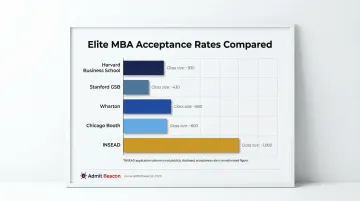
INSEAD occupies a distinct middle tier numerically, but its globally dispersed applicant pool and 90+ nationalities make it one of the hardest programs to stand out in. The competition isn't limited to consultants in New York or London. You're up against elite professionals from São Paulo, Singapore, Mumbai, and Dubai — all vying for seats within tightly managed regional quotas.
The Dual Intake Dynamic
INSEAD's August and January intakes are nearly identical in curriculum, class composition, and competitiveness. Timing is the meaningful difference — and for some applicants, it's a strategic one.
The January intake includes a two-month summer break mid-program. INSEAD recommends this path for career switchers targeting investment banking, since banks recruit full-time associates through summer programs. If IB is your target, the January intake isn't just a scheduling preference — it's the path that keeps that door open.
For most other career paths, the choice between intakes comes down to personal readiness and application timing rather than any structural advantage.
INSEAD Class Profile: Who Gets In?
The Class of 2025 (929 graduates) provides a clear picture of who INSEAD admits:
Key Quantitative Benchmarks:
- GMAT: Average ~710 (competitive range: 670–750)
- Work Experience: Average 6 years (range: 1–7+ years)
- Age: Average 29 years
- GPA: Average ~3.5 (INSEAD does not publish a minimum due to global grading variation)
- Class Size: ~930 students annually
Gender and Geographic Breakdown:
- Women: 38%
- Nationalities Represented: ~90
- No Single Nationality Cap Published: INSEAD states "everyone is a minority" and there is "no dominant nationality"
Geographic Distribution (Class of 2025):
- Asia Pacific: 35%
- Western Europe: 17%
- Southern Europe: 12%
- North America: 11%
- Africa / Middle East: 10%
- South America: 10%
- Eastern Europe: 4%
- Northern Europe: 2%
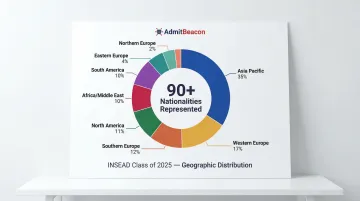
The numbers tell a clear story: INSEAD is not U.S.-centric. North Americans represent just 11% of each cohort, so applicants need to show genuine global exposure — not just awareness of it.
Industry Breakdown (Pre-MBA):
- Management Consulting: 33%
- Financial Services: 20%
- Technology, Media, Telecom: 18%
- Healthcare: 6%
- Retail, Consumer, Luxury Goods: 6%
- Public Sector / Social Impact: 4%
- Corporate Services / Energy: 3% each
- Manufacturing / Transportation: 2% each
Consulting historically represents the largest pre-MBA cohort. Applicants from this industry compete against the largest share of similar profiles. Professionals from healthcare, government, nonprofits, or emerging markets bring rarer backgrounds — and typically encounter a less crowded applicant pool.
How Your Academic Background and Test Scores Factor In
GPA Philosophy
INSEAD does not publish a minimum GPA because grading standards vary globally. What matters is relative performance within your institution and demonstrated quantitative competency. A GPA below approximately 3.2 on a 4.0 scale, or a declining academic trend, typically triggers closer scrutiny of GMAT quantitative scores.
GMAT/GRE Targets
INSEAD evaluates GMAT and GRE scores by section, not just total score. Test waivers are not permitted—every applicant must submit a valid GMAT or GRE score.
GMAT Focus Edition Benchmarks:
- Verbal: 60th percentile (score of 80)
- Quantitative: 66th percentile (score of 80)
- Data Insights: 66th percentile (score of 77)
Legacy GMAT (10th Edition) Benchmarks:
- Quantitative: 70th percentile or above
- Verbal: 70th percentile or above
- Integrated Reasoning: 6 or above
GRE Benchmarks:
- Verbal: 80th percentile or above
- Quantitative: 80th percentile or above
Strong performance in both sections is expected. A high composite with a weak quant score can still trigger scrutiny — INSEAD's curriculum is quantitatively demanding, and the admissions committee treats section scores as meaningful signals.
Language Requirements: A Unique Filter
INSEAD enforces a strict three-language policy that reflects its global ethos and differentiates it from most U.S.-based MBA programs:
- English: Required at application. Non-native speakers must submit TOEFL, IELTS, or PTE Academic scores, or proof of a degree taught exclusively in English.
- Second Language: Must be validated at B1 (CEFR) before the program starts. INSEAD strongly encourages completing this before arrival rather than during the intensive curriculum.
- Third Language (Required for Graduation): Students must validate a minimum "Basic" level of understanding in a third language, equivalent to A2 on the CEFR scale.
If you're still working on a second or third language, start validation early — language gaps that surface late in the process can complicate your timeline.
Work Experience and Nationality: Two Factors That Reshape Your Odds
Work Experience Quality Over Quantity
INSEAD evaluates work experience on quality and impact, not just years. The admissions team looks for:
- Career progression and autonomy
- Measurable business results
- Leadership scope and complexity
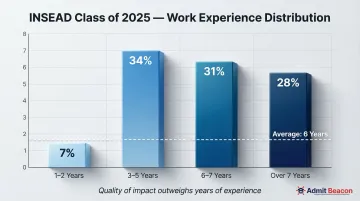
The average of 6 years is a benchmark, not a minimum. Someone with 4 years of exceptional progression can outperform a candidate with 7 years of lateral moves.
Work Experience Distribution (Class of 2025):
- 1 to 2 years: 7%
- 3 to 5 years: 34%
- 6 to 7 years: 31%
- Over 7 years: 28%
Industry Competition Dynamic
Applicants from consulting face the densest pool of directly comparable candidates because it is the most heavily represented industry in the class (33%). Professionals from other sectors often represent stronger class diversity and face less concentrated competition within their sub-pool. Industries that typically see lower representation include:
- Healthcare and life sciences
- Government and public policy
- Nonprofits and social enterprises
- Energy and natural resources
- Emerging market industries
The Nationality Factor
INSEAD's cap on any single nationality (approximately 10–12%, though not officially published) means Indian and Chinese applicants—who represent among the highest application volumes—face more intense competition within their national applicant pool than applicants from less well-represented countries. If you come from an underrepresented country, this cap works in your favor — make that geographic diversity a clear thread in your application narrative.
Nationality is one dimension of diversity INSEAD actively shapes. Beyond geography, the admissions committee values candidates who add different life and professional contexts to the classroom.
Diversity Profiles Beyond Geography
Candidates with non-geographic diversity profiles can strengthen their applications even when quantitative credentials sit at the lower edge of the competitive range. Profiles that tend to enrich classroom dynamics include:
- Women in male-dominated industries
- Military veterans transitioning to business leadership
- First-generation university graduates
- Professionals from social enterprises or development organizations
If you belong to any of these groups, your application narrative should make that context explicit — not as a soft qualifier, but as a concrete contribution to class dynamics.
How to Build a Winning INSEAD Application
Essays: Where Differentiation Actually Happens
INSEAD's essay prompts ask applicants to explain key career decisions, describe their current role's impact in concrete terms, and articulate specifically why INSEAD's one-year format, global campuses, and cross-cultural emphasis—rather than any other top MBA program—serves their distinct professional ambitions.
Generic "I want to grow as a leader" narratives fail here. Applicants must reference specific INSEAD curriculum elements, specializations, or campus experiences. When credentials are similar, essays and narrative clarity become the deciding factors.
What Makes a Recommendation Letter Stand Out
Strong recommenders provide specific anecdotes — not vague praise. Admissions readers look for evidence of:
- Collaborating across cultural and functional boundaries
- Solving complex problems under real constraints
- Exercising judgment under pressure with measurable outcomes
A detailed account from a direct manager who observed daily impact consistently outweighs a polished endorsement from a senior executive with limited firsthand exposure.
Structured, School-Specific Strategy
For applicants who want to connect their career story to INSEAD's specific ethos rather than rely on a generic template, Admit Beacon's personalized consulting process offers a structured advantage. The firm limits client intake to ensure each application receives the depth and strategic attention it needs.
Lead consultant Niketa works with each candidate on resume development, school selection, career narrative, and essay storyboarding — dedicating roughly 40% of total effort to offline comments and reviews. Candidates also gain access to current INSEAD students and alumni for school-specific insights, helping them build applications that reflect INSEAD's global, cross-cultural leadership philosophy rather than simply checking credential boxes.
Frequently Asked Questions
What is the acceptance rate for INSEAD?
INSEAD's acceptance rate is approximately 30%, though the school does not officially publish this figure. This rate applies across a globally competitive applicant pool where many technically strong candidates are still rejected. The rate has remained relatively stable in the 29–31% range in recent years.
How hard is it to get into INSEAD?
Despite the ~30% headline rate, admission is extremely competitive because the pool is made up of elite global professionals. Clearing the GMAT or work experience bar isn't enough — a strong personal narrative and genuine cultural fit matter just as much.
What is the average profile of INSEAD MBA?
The average admitted student has a GMAT around 710, 6 years of work experience, and is 29 years old. Classes average 930 students, with 38% women and 90+ nationalities represented.
Is INSEAD MBA expensive?
INSEAD's tuition for 2026/2027 is €109,860, with living expenses adding roughly €30,000–€32,000 depending on campus (Fontainebleau or Singapore). The one-year format lowers opportunity cost, and 41% of students receive scholarships averaging €22,000–€24,000.
What GMAT score do I need to get into INSEAD?
The average GMAT score is approximately 710, with a competitive range of 670–750. INSEAD evaluates quantitative and verbal sections independently, so a high composite with a weak quant score may still raise flags given the program's rigorous quantitative curriculum.
Does INSEAD require language proficiency beyond English?
Yes. INSEAD requires English fluency to apply, a second language at functional proficiency (B1 CEFR) by entry, and a third language at basic proficiency (A2 CEFR) before graduation. Few MBA programs anywhere match this requirement.