Introduction
Wharton sits in a rare position among elite MBA programs: more accessible than Stanford GSB or Harvard Business School on paper, yet still turning away roughly four out of five applicants. The acceptance rate is just a headline. What actually determines your outcome is what sits behind it.
Before diving in, clarify scope: Wharton has two distinct acceptance rates that often cause confusion. The undergraduate program admits around 4.5% of applicants, while the full-time MBA program admits 20–21%. This guide focuses exclusively on the full-time MBA program.
You'll learn current acceptance rate data, class profile benchmarks, what the admissions committee truly values, and concrete steps to strengthen your candidacy.
TLDR:
- Wharton's MBA acceptance rate is 20.5%—more accessible than HBS or Stanford GSB but still highly selective
- Class of 2027 posted a record 735 average GMAT and 3.7 GPA
- Admissions weighs three dimensions: classroom contribution, community engagement, and post-MBA impact
- The Team-Based Discussion interview is unlike any other format — preparation is non-negotiable
- Apply Round 1 or 2 for best odds; Round 3 is significantly more competitive
Wharton MBA Acceptance Rate: By the Numbers
Wharton's most recent MBA acceptance rate is 20.5% for the Class of 2026, with approximately 7,600 applicants competing for roughly 880 seats. This means one in five applicants receives an offer—a highly selective outcome, though statistically more attainable than its closest M7 peers.
How Wharton compares to other M7 programs:
| Business School | Acceptance Rate |
|---|---|
| Stanford GSB | 6.8% |
| Harvard Business School | 11.2% |
| Wharton | 20.5% |
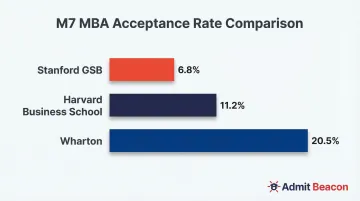
Wharton sits in the middle tier of M7 selectivity. Candidates who may be borderline for Stanford's 6.8% rate often find Wharton a more viable target, provided they demonstrate strong quantitative readiness and collaborative fit.
Wharton's acceptance rate has historically ranged from 18–25%, and year-to-year variation is real. Recent trends show application volume rebounding after a post-pandemic dip: applications surged to 7,613 for the Class of 2027, a 4% increase from the prior cycle.
The Class of 2025 saw applications drop to 6,194 during a strong job market, but demand has since recovered. This pattern tracks macroeconomic conditions: when employment is robust, fewer professionals apply; when uncertainty rises, MBA applications climb.
Undergraduate vs. MBA: A Quick Clarification
Wharton's undergraduate program has a much lower acceptance rate—approximately 4.5% for Fall 2023—a figure frequently confused with the MBA rate. The two are entirely separate: different admissions criteria, timelines, and processes. The MBA program evaluates professional maturity, career trajectory, and leadership impact—not the same criteria that filter 17-year-old applicants. A low undergrad rate is simply not relevant to your MBA candidacy.
Who Gets Into Wharton: Class Profile Breakdown
The Wharton Class of 2027 demonstrates the program's commitment to academic excellence and professional diversity.
Quantitative benchmarks:
| Metric | Class of 2027 | Class of 2026 |
|---|---|---|
| GMAT (Legacy) | 735 (record high) | 732 |
| GMAT (Focus Edition) | 676 | Not reported |
| GRE (Quant / Verbal) | 163 / 162 | 163 / 162 |
| Undergraduate GPA | 3.7 | 3.68 |
| Work Experience | 5 years | 5 years |
Pre-MBA professional backgrounds:
The industry breakdown for the Class of 2027:
- Consulting: 31%
- Private equity / venture capital: 15%
- Nonprofit / government: 10%
- Investment banking: 8%
- Technology: 8%
This distribution signals that Wharton actively seeks industry diversity, not just finance credentials. Tech entrepreneurs, nonprofit leaders, and government professionals are not disadvantaged — provided they demonstrate leadership impact and quantitative capability.
Demographic composition:
- Women: 44%
- International students: 26% from 68 countries
- First-generation college students: 11%
- LGBTQ+: 12%
Wharton builds its class across multiple dimensions — academic achievement is necessary, but it's rarely sufficient on its own.
Most commonly represented employers and institutions:
Pre-MBA employers include McKinsey, Bain, BCG, Goldman Sachs, JP Morgan, Google, and Amazon. Top undergraduate institutions include Penn, Harvard, Princeton, Yale, Stanford, and MIT. This is not a gatekeeping list — strong applicants from less-represented schools or employers are admitted every cycle. These names indicate where Wharton's network runs deep.
What about the "stats floor"?
Wharton does not publish minimum GMAT or GPA requirements. However, submitting scores below the class average requires proportionally stronger evidence of leadership, impact, and career trajectory elsewhere in the application. A 700 GMAT or 3.5 GPA won't disqualify you, but you'll need exceptional work experience and compelling essays to compensate.
What the Wharton Admissions Committee Really Looks For
Wharton's admissions philosophy centers on three explicit questions: What will you achieve and contribute in the Wharton classroom, within the Wharton community, and throughout your post-MBA career? Every application component is designed to surface answers across all three dimensions — so your narrative needs to speak to each one.
Career Trajectory Over Employer Prestige
The adcom looks for demonstrated career acceleration: fast promotions, expanded scope, and evidence of impact beyond your job title. A consultant who led a $50M cost-reduction initiative stands out more than one who simply worked at McKinsey. Quality and trajectory matter more than brand-name employers.
The "Multidimensional" Requirement
Wharton wants students who will be active and engaged on campus, not just academically capable. Essays and recommendations are assessed for evidence of:
- Leadership and involvement outside of work
- Extracurricular commitments with real depth
- Community engagement and intellectual curiosity
- Willingness to contribute to student clubs and learning teams
Generic claims of "leadership" don't cut it. The adcom wants specifics.
Quantitative Proficiency
Even for applicants from non-finance backgrounds, the adcom looks for comfort with numbers and data-driven decision-making. This shows up in GMAT/GRE quant scores, your academic record, and the nature of your professional responsibilities. Wharton explicitly states: "The stronger your quantitative background, the better prepared you will be" — and notes they admit students without this background only when there's clear evidence they can handle quantitative coursework.
School Fit Is Non-Negotiable
Wharton seeks candidates who understand what makes the program distinct — its collaborative culture, the Team-Based Discussion interview format, and its learning-team model. You need to articulate why Wharton specifically, not just any top MBA, fits your goals. Generic lines like "Wharton is ranked #1" actively hurt your application.
Show you've researched the program and can connect its unique features to your career trajectory.
The Wharton Application Process: What You Need to Know
Required components:
- Undergraduate transcript (unofficial accepted initially)
- GMAT or GRE score (self-reported initially)
- English language test (TOEFL, IELTS, PTE, or DET for non-English-language undergrads)
- One-page resume
- Two essays (career goals + community contribution)
- One letter of recommendation (GMAC Common Letter format)
- $275 application fee (waivers available for military and extreme financial hardship)
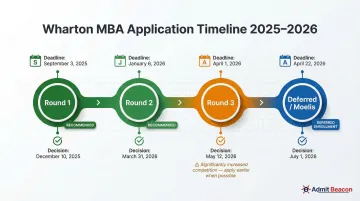
2025–2026 Application Deadlines (all 5:00 PM ET except Deferred):
| Round | Application Deadline | Interview Invitations | Decisions Released |
|---|---|---|---|
| Round 1 | September 3, 2025 | October 22, 2025 | December 10, 2025 |
| Round 2 | January 6, 2026 | February 20, 2026 | March 31, 2026 |
| Round 3 | April 1, 2026 | April 17, 2026 | May 12, 2026 |
| Deferred (Moelis) | April 22, 2026 (11:59 PM ET) | May 27, 2026 | July 1, 2026 |
The Team-Based Discussion (TBD) Interview
Wharton's interview is by invitation only and conducted in a unique group format. The TBD is a 35-minute virtual group exercise with 5-6 randomly assigned applicants, followed by a 10-minute one-on-one interview. It is designed to simulate Wharton's collaborative classroom environment and assess:
- Communication style and engagement level
- Leadership presence within a group
- Decision-making process under time pressure
- Collaborative problem-solving
Performance in the TBD is heavily weighted. Preparation means studying group dynamics and active listening — not just rehearsing individual answers.
Round Strategy
Round 1 and Round 2 are both competitive entry points, with the majority of seats filled across these two rounds. Round 3 is significantly more difficult—Wharton explicitly states that "space in the class becomes more limited for Round 3 applicants, resulting in a more competitive round". Apply in Round 3 only if your circumstances genuinely prevented an earlier submission. The Deferred Enrollment (Moelis Advance Access) track is exclusively for current college students and full-time graduate students.
How to Build a Winning Wharton MBA Application
Build a Coherent Career Narrative
The two essays and resume must work together to tell a single, consistent story about where you've been, what impact you've had, and where you're going post-MBA. Wharton can detect when an application is assembled from disconnected parts. A strong narrative thread across all components separates good applications from great ones.
Address Weak Spots Directly
A GMAT score below the class average, a GPA dip, a career gap, or a non-linear path won't disqualify you—but ignoring them will. Wharton expects applicants to address weaknesses directly rather than hope the adcom doesn't notice. A well-framed explanation of a setback, paired with evidence of subsequent growth, can actually strengthen an application by demonstrating self-awareness and resilience.
Choose Your Recommender Strategically
Wharton requires one recommendation. The recommender should be someone with direct, recent knowledge of your work—ideally a direct supervisor—and should speak to specific moments of performance, leadership, and growth rather than generic praise. A strong recommendation corroborates and deepens what you write about yourself. Avoid senior executives who barely know you; a manager who can cite specific examples of your impact is far more valuable.
Consider Working with a Specialized Advisor
Wharton weights the holistic narrative heavily—essays, career story, and interview preparation all need to work in concert. A specialized MBA admissions advisor who understands Wharton's culture can help you build an application that feels authentic rather than assembled.
Admit Beacon takes a deliberately limited-intake approach, working with a small number of clients to ensure each application gets genuine strategic depth. Lead consultant Niketa works directly with each candidate on career narrative, school selection, and essay development—connecting clients with current Wharton students for school-specific insight and drawing on memberships in AIGAC, AIIEC, and TOC for the latest admissions intelligence.
Is a Wharton MBA Worth the Investment?
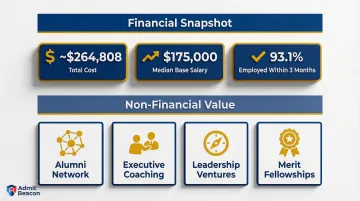
The two-year total cost runs approximately $264,808 (tuition, fees, and living expenses combined). The Class of 2024 reported a median base salary of $175,000, with 93.1% employed within three months of graduation. These are averages, and outcomes vary meaningfully by industry and role.
The financial return is only part of the picture. Wharton's non-financial value includes:
- Access to one of the most well-connected alumni networks in business
- Executive coaching and leadership development programs
- Leadership Ventures — experiential programs across industries and geographies
- A peer cohort that becomes a career-long professional network
Wharton also awards merit-based fellowships to roughly one-third of incoming students, which can reduce net cost substantially. All admitted applicants are automatically considered — no separate application required.
Frequently Asked Questions
What are the odds of getting into Wharton MBA?
The current acceptance rate is approximately 20–21%, making it highly selective but more accessible than HBS (11.2%) or Stanford GSB (6.8%). Individual odds depend heavily on profile strength—GMAT/GRE scores, GPA, work experience quality, and demonstrated fit with Wharton's collaborative culture—not just the aggregate rate.
What GPA is needed for a Wharton MBA?
The Class of 2027 average GPA is 3.7. Wharton does not publish a minimum GPA requirement. A lower GPA can be offset by strong GMAT/GRE scores, a rigorous undergraduate major (engineering, mathematics, or economics), or demonstrated quantitative ability through analytical roles or projects at work.
What billionaires went to Wharton?
Forbes reports that more than half of Penn's 28 billionaire alumni earned their degrees from Wharton—more than any other business school. Notable alumni include Elon Musk, Donald Trump, Steve Cohen, and Ronald Perelman.
Is Wharton harder to get into than Harvard Business School?
No. HBS is significantly more selective at approximately 11.2%, compared to Wharton's 20.5%. Both require outstanding profiles, but Wharton's larger class size (approximately 880 vs. HBS's 930) and higher acceptance rate create more seats for qualified applicants.
What is Wharton's Team-Based Discussion interview?
The TBD is Wharton's group interview format: invited applicants discuss a topic together for 35 minutes, followed by a 10-minute one-on-one conversation. It directly assesses collaboration, communication, and leadership in action—skills that most schools evaluate only through essays.
Is it better to apply to Wharton in Round 1 or Round 2?
Round 1 offers a slight edge since more seats are available, but a polished Round 2 application outperforms a rushed Round 1 submission. Both rounds are fully competitive and fill a substantial share of the class.