Introduction
You've told personal narratives your entire life, often without realizing it. When you explained why you switched careers in a job interview, wrote about a formative experience in your college application, or shared what shaped your values over dinner with a mentor, you were crafting one.
Personal narratives aren't just stories. They're structured, reflective accounts of real experiences that reveal something true about who you are — and for MBA applicants, they're the foundation every compelling essay is built on.
This article breaks down what a personal narrative is, what separates a strong one from a forgettable one, and how to write yours in a way that actually resonates with admissions committees.
Key Takeaways
- A personal narrative is a first-person, non-fiction account of a real experience, written to reveal meaning and connect with readers
- Effective personal narratives combine storytelling with reflection — sensory detail, emotional honesty, and a clear arc all work together
- The format spans published memoirs, student assignments, and high-stakes MBA or college application essays
- Strong narratives show growth through conflict and resolution — the arc of change is what earns the reader's trust
What Is a Personal Narrative? Definition and Purpose
A personal narrative is a prose piece written in the first person that recounts a real experience from the writer's life, with the aim of revealing a personal or universal truth. Purdue OWL characterizes narrative essays as "anecdotal, experiential, and personal—allowing students to express themselves in a creative and, quite often, moving ways."
It's classified as creative nonfiction, a genre that values factual accuracy and literary craft in equal measure.
How It Differs from Related Forms
Personal narratives occupy a specific niche:
- Not a diary entry: Diaries are private, unfiltered, and written for the self. Personal narratives are shaped for an audience, with intentional structure and reflection.
- Not a memoir: Memoirs are book-length works covering broader periods of life. Personal narratives zoom in on a single, specific experience.
- Not fiction: Every detail is true. Purdue OWL's creative nonfiction guide emphasizes that creative nonfiction requires "accurate retelling of life experiences."
The Dual Nature: Event + Reflection
A personal narrative does two things simultaneously: it recounts what happened and reflects on what it meant. Without reflection, a narrative is just a chronicle. The hallmark is combining what happened with what it meant. Purdue OWL notes that the essay "should have a purpose. Make a point! Think of this as the thesis of your story."
Where Personal Narratives Appear
You'll encounter personal narratives in:
- Classroom writing assignments (elementary through graduate school)
- Published literary essays in magazines and anthologies
- College application essays (Common App, Coalition App)
- MBA admissions essays (Harvard, Stanford, Wharton, and beyond)
Stanford GSB asks applicants to "reflect deeply and write from the heart," while Wharton urges applicants to "be introspective, candid, succinct, and most importantly… be yourself!"
Key Elements of a Personal Narrative
First-Person Point of View
The "I" perspective is non-negotiable. It gives the account authenticity and authority—this is your story to tell. Third-person narration creates distance; writing in first person pulls readers directly into the experience.
Vivid Sensory Detail and Imagery
Strong personal narratives show, not just tell. Purdue OWL advises that "a reader must be able to see, hear, taste, touch and smell things" to be fully immersed in the scene.
Flat telling: "I was nervous during my first presentation."
Sensory showing: "My hands trembled as I clicked to the first slide, and I could feel sweat pooling at the small of my back."
Even so, restraint matters. The Creative Nonfiction Foundation cautions against over-indexing on "show, don't tell," noting that effective writing requires "constant alternation between summary or exposition and 'in-scene' writing."
Emotional Honesty and Relatability
Admissions readers and literary audiences connect with how you genuinely felt, not just what occurred. Emotional authenticity transforms a sequence of events into something a reader can relate to on a human level. Whether you're writing about a setback or a breakthrough, let the real emotion — disappointment, relief, pride — come through on the page.
Narrative Structure—Arc and Conflict
A personal narrative needs shape. Drawing from linguist William Labov's narrative structure model, effective narratives include:
- Orientation: Setting the scene (time, place, context)
- Complicating action: The problem, tension, or challenge
- Resolution: What happened as a result
- Reflection: What it meant—the insight or growth
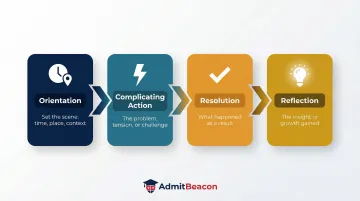
Each of these elements serves a purpose, but conflict is the engine. Without it, the narrative has no forward pull.
Reflection and Meaning-Making
Reflection is what separates a personal narrative from a simple retelling. Purdue OWL emphasizes that without it, "the reader is left with the feeling that the writer hasn't learned anything, that the writer hasn't grown." This is where insight, growth, and hard-won perspective emerge—and it's what admissions readers find most compelling.
Types of Personal Narratives — With Examples
Literary Personal Essays
These are short, polished essays by established writers published in magazines, anthologies, or collections. They set the standard for the form.
Notable examples:
- E.B. White's "Once More to the Lake" (1941, Harper's Magazine): A meditation on memory, time, and mortality as White revisits a childhood vacation spot with his son.
- George Orwell's "Shooting an Elephant" (1936, New Writing): A reflection on imperialism and moral conflict, recounting Orwell's experience as a colonial officer pressured to kill an elephant.
- Virginia Woolf's "The Death of the Moth" (1942): A brief, powerful reflection on the vitality of life versus the inevitability of death, observed through a dying moth.
Memoirs and Book-Length Narratives
When a personal narrative extends across a full book and covers a significant portion of a person's life, it becomes a memoir. The same elements apply—first person, specific scenes, reflection—but the scope is larger.
Widely recognized memoirs:
- Maya Angelou's I Know Why the Caged Bird Sings (1969): An autobiography covering Angelou's childhood and adolescence, nominated for a National Book Award.
- Joan Didion's The Year of Magical Thinking (2005): A memoir exploring grief and loss, winner of the 2005 National Book Award for Nonfiction.
Academic and School Personal Narratives
Students from elementary school through college are regularly assigned personal narratives. Topics typically span life experiences, travel, relationships, and formative moments.
A popular variant at the college level is the literacy narrative—a reflective account of the writer's own history with reading and writing. The Kennesaw State Writing Center defines literacy narratives as "personal essays in which writers share their personal experiences with learning to read and write" to "explain how those experiences shaped their current literacy practices."
Admissions Essays as Personal Narratives
Classroom assignments prepare writers for higher-stakes territory: the college application essay and the MBA admissions essay are both personal narratives, but with a specific purpose.
These essays ask applicants to recount a real experience and use it to reveal something true about who they are. What sets them apart from academic writing is the audience — an admissions committee at programs like HBS or Stanford GSB isn't just evaluating prose quality. They're assessing:
- Self-awareness: Does the applicant understand what the experience meant?
- Character: What values or decisions does the story surface?
- Fit: Does this person's narrative align with the program's culture and priorities?
That shift in audience changes everything about how the essay should be written.
How to Write a Personal Narrative
Choosing the Right Experience
The best topic isn't necessarily the most dramatic event. It's the one that allows you to demonstrate genuine reflection and growth. Choose an experience where something shifted—a belief challenged, a lesson learned, a relationship changed.
The Common App prompts explicitly ask applicants to "recount a time... what did you learn?" and discuss events that "sparked a period of personal growth." Don't choose a topic just because it sounds impressive. Admissions committees can spot manufactured drama.
Structuring Your Narrative
Open with a hook—drop the reader into a vivid moment. Build through the complication (the tension, struggle, or challenge). Close with a resolution that includes reflection.
Purdue OWL advises applicants to "concentrate on your opening paragraph," noting that "you grab the reader's attention or lose it. This paragraph becomes the framework for the rest of the statement."
You're also not bound by strict chronology — reordering events can sharpen tension and make the meaning land harder.
Making It Resonate
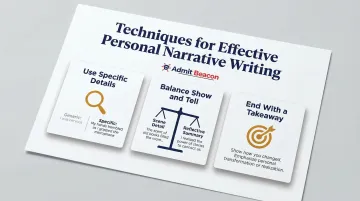
Structure gets you started, but execution is what makes a narrative stick. These three techniques make the difference:
- Use specific, concrete details rather than vague generalities. "I volunteered at a hospital" is generic. "I held Mrs. Chen's hand while she waited for her daughter to arrive" is specific.
- Balance showing with telling. Show key scenes with sensory detail and dialogue. Tell (summarize) transitional moments and provide reflection.
- End with a clear takeaway. What transformation, realization, or question does the reader carry with them? Purdue OWL notes that the conclusion should "emerge as the logical conclusion to your story."
Personal Narratives in MBA and College Admissions
The personal narrative is at the heart of the MBA application. Business schools aren't just selecting academic credentials—they're building a cohort of diverse leaders. The essays ask applicants to narrate real experiences that reveal leadership, resilience, values, and post-MBA goals. Essentially, the entire application is a personal narrative told across multiple essays.
What Makes an MBA Personal Narrative Different
The audience is highly analytical, and admissions readers evaluate hundreds of essays. The narrative must be both authentic and strategic—it should reveal character while aligning with what the school values. Harvard Business School emphasizes the importance of "self-reflection" and finding "the story I had to go with."
Vague storytelling or a list of achievements without reflection won't stand out. GMAC advises applicants to "be authentic, not what you think schools want to hear... All you're trying to do is tell your story."
Crafting a Cohesive Narrative Across Components
Balancing authenticity with strategy gets harder when your narrative spans multiple components—resume, essays, and recommendations—each read by the same skeptical admissions reader. Effective storyboarding means making deliberate choices:
- Which experiences to feature (and which to leave out)
- How to frame setbacks or pivots as growth, not failure
- How to align your arc with each school's values without losing your voice
- How to keep recommendations reinforcing, not contradicting, your essays
Working with a focused admissions consultant like Admit Beacon can help you move from a loose collection of experiences to a coherent story. Because Admit Beacon limits client intake, the work goes deep—identifying your strongest material and building a narrative that holds together across every component you submit.
Frequently Asked Questions
What is a personal narrative?
A personal narrative is a first-person, non-fiction prose account of a real personal experience, written to share meaning with an audience. It differs from fiction (which is invented) and diary writing (which is private and unstructured) by combining factual accuracy with intentional reflection and literary craft.
What are examples of personal narratives?
Common examples span several formats:
- Literary essays: George Orwell's "Shooting an Elephant," E.B. White's "Once More to the Lake"
- Published memoirs: Maya Angelou's I Know Why the Caged Bird Sings
- Student essays: literacy narratives and classroom assignments
- Admissions essays: college personal statements and MBA application essays
What are the elements of a personal narrative?
Core elements include first-person point of view, vivid sensory detail, emotional honesty, a clear narrative arc (orientation, conflict, resolution), and personal reflection on meaning. Without reflection, a narrative remains a sequence of events rather than a story.
What is the purpose of a personal narrative?
The purpose is to share a personal experience, reveal a truth (personal or universal), persuade or educate a reader, and—in admissions contexts—demonstrate self-awareness and character to an evaluating audience.
How is a personal narrative different from other types of essays?
Unlike argumentative or expository essays (which make claims or explain information), a personal narrative tells a story from the writer's own life, prioritizing emotional authenticity and reflection over logic or evidence. The emphasis is on lived experience rather than abstract analysis.
How do you write a strong personal narrative for a college or MBA application?
Choose an experience that shows genuine growth or a shift in perspective. Use specific scenes and sensory detail rather than broad summaries. Close with clear reflection that shows what the experience revealed about who you are and where you're headed.